



Ultimo numero uscito
VOLUMI
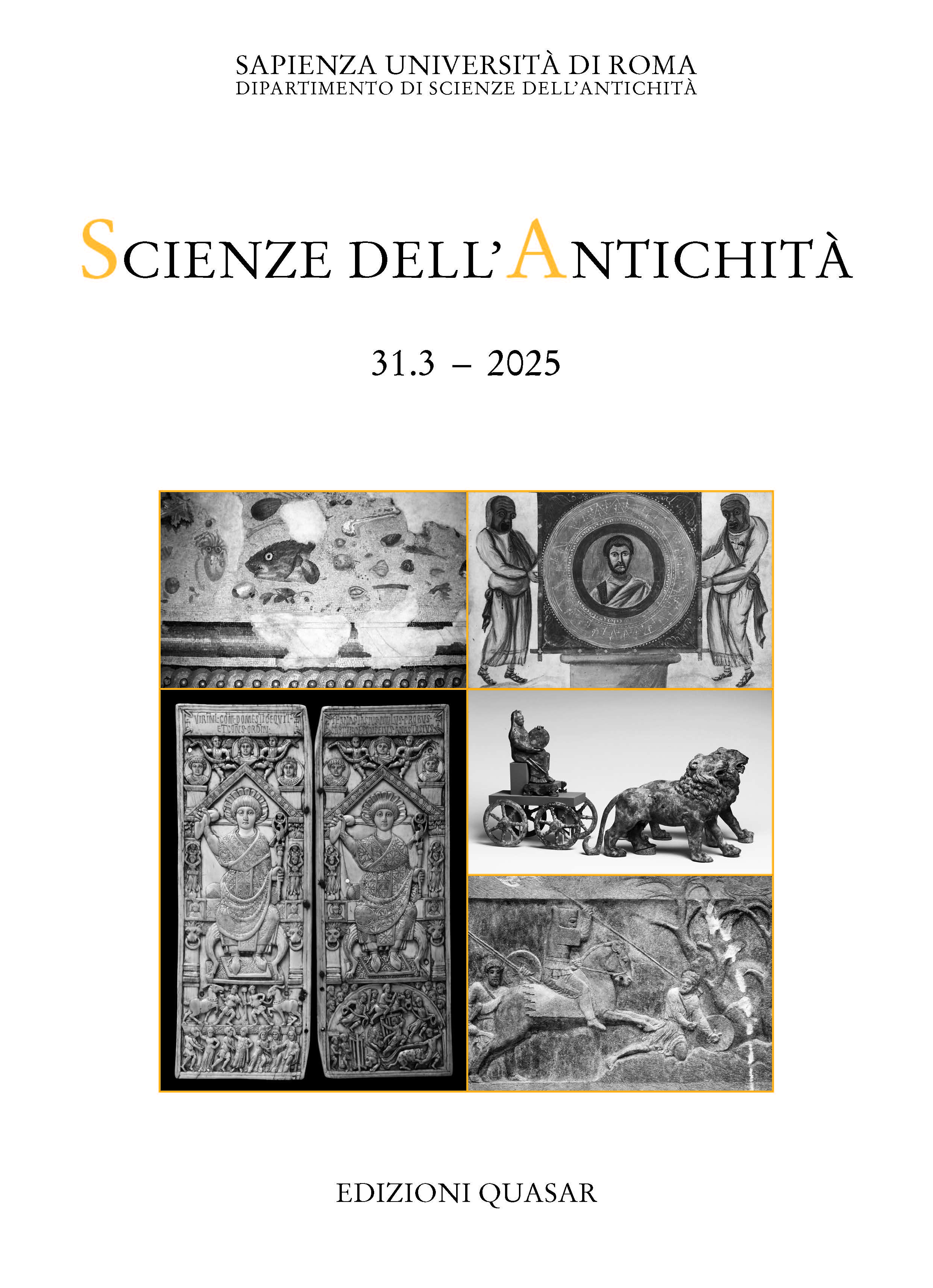
31.3 - 2025
Lo sguardo e la parola. Forme e strategie dell’ekphrasis nella Roma antica
a cura di A. Cucchiarelli, G.L. Gregori, F. Lubian

A. Cucchiarelli – G.L. Gregori – F. Lubian – D. Pellacani, Lo sguardo e la parola: immagini, testi e loro interazioni in Roma antica
The paper acts as an Introduction to the publication of the papers presented at the PRIN 2022 PNRR Workshop “Lo sguardo e la parola: testi, immagini e loro interazioni in Roma antica” (Sapienza University of Rome, February 18, 2025).
I Sezione. Visione e parola: retoriche della descrizione e immaginazione nella letteratura latina
L. Pirovano, Paene in obtutus dedit: le descrizioni di Sallustio nella tradizione scol(i)astica tardoantica
Which author was recommended to late-antique Latin students as a “model” for the preliminary exercise of “description” (ἔκφρασις / descriptio), particularly for descriptions of places? Three occasional references by Granius Licinianus (36. 30-32), Avienus (ora 32-41), and Tiberius Claudius Donatus (ad Aen. 1. 159-171) point to Sallust.
G. Moretti, Parola, visualità e pittura: intorno alla Pro Milone
The first section of the paper examines the figure of the idolopeia – namely, a fictional speech attributed to a deceased person. The most famous example of this is the speech of Appius Claudius Caecus in the Pro Caelio, where his words are set in sharp contrast to the ethopoeia of Clodius. In the Pro Milone, the evocation from the Underworld is this time that of Clodius himself: it constitutes an unusual case of a “silent” idolopeia, since no words are attributed to the revenant Clodius; it is solely the conjuring of his ghost that looms large in Cicero’s narrative. Nevertheless, it is clear that Cicero intends this unusual idolopeia to complete the rhetorical arc he had begun in the Pro Caelio. The second part of the paper explores the pervasive parallel Cicero establishes between speech and painting across various levels and domains. After showing how the rhetorical language of ekphrasis is often borrowed from the technical vocabulary of the visual arts, it focuses on Pro MiloneP 53-54, where Cicero imagines a painting of Milo’s procession – an image that seems closely akin to the tabulae or siparia described by Quintilian as having been specifically prepared for courtroom display.
F. Capizzi, Con gli occhi della mente: evocazione di immagini e descrizioni nei declamatori latini
This article explores the practice of image evocation and description in Latin declamation within the framework of the doctrine of evidentia as outlined in ancient rhetoric handbooks. It begins by addressing some terminological and taxonomical issues and then investigates the various functions that descriptive passages serve within the declamatory tradition according to the technique of diatyposis and ekphrasis. The study challenges the common misconception that descriptions in Latin declamation serve merely to arouse the audience’s emotions or to enhance the speech stylistically, demonstrating that in some cases they are intended to support an argument as well. In the last part of the paper the techniques of image evocation and description are connected to certain practices of real forensic oratory. This shows that they serve to create an illusion of reality within the fictional context of declamation.
E. Dal Chiele – T. Torcello, Mentis acies: vista e visualità in Apuleio filosofo
The paper examines the lexical field of sight and visuality in Apuleius’ philosophical works, demonstrating how terms and metaphors related to vision function not only as figurative elements but also as argumentative and structural devices. The first section focuses on the De Platone, where Apuleius systematically reworks a Platonic scheme – originally conceived to distinguish sensible from intelligible knowledge – applying it to a range of conceptual oppositions in the rhetorical, political, ethical, and amorous domains. The second section turns to the De mundo, highlighting how visuality operates on a rhetorical and stylistic level through the extensive use of ekphrasis, metaphor, and analogy. In both cases, visuality is not merely thematic but functions as an epistemological and literary framework that shapes both thought and textual form.
II Sezione. Testi, immagini e contesti nella documentazione archeologica ed epigrafica
M. Papini, “È una cosa terribile, il grande mosaico”: racconti e immagini delle battaglie di Alessandro
This contribution examines several controversial aspects of the famous mosaic in the House of the Faun, beginning with the presence of the dry tree, to which a symbolic meaning is often attributed. Another central issue concerns the identification of the battle depicted – whether it represents the Battle of Issus or that of Gaugamela. The analysis explores the complex relationship between two different genres: on the one hand, the historical reports of the event, which are often inconsistent even in sources close in time to the events and further complicated by later reinterpretations and distortions; and on the other hand, the specific requirements of visual representation. The study aims to shed light on how the image interacts with historical narratives and their transformations over time.
R. Rubio González, Analisi delle iscrizioni e della iconografia di alcuni mosaici da contesti privati dell’ Africa Proconsularis
This article analyses the relationship between text and iconography in mosaics from domestic spaces belonging to the Roman elite in Africa Proconsularis. The mosaics are classified into six categories based on their location: private baths, thresholds, vestibules, basins in peristyles, antechambers, and reception rooms. The study examines how inscriptions and images reflect the aesthetic preferences of the owners and reveal aspects of social identity, religious beliefs, and cultural values. It highlights the variety and originality of North African workshops, whose iconographic and stylistic solutions display a unique creativity within the Roman Empire and enrich the understanding of local art.
F. Ferrari, Dediche sacre a Silvano. Interazione fra testi e immagini nella documentazione epigrafica urbana
Silvanus ranks among the most frequently attested divinities of the Roman Imperial period. Drawing on the extensive epigraphic record from the city of Rome the article aims to investigate the interplay between textual and figurative elements by adopting a material approach across different types of sacred dedications. The selected sources are analyzed both in terms of the spatial arrangement of inscriptions and images and the nature of their semantic relationship in order to identify possible recurring features of Silvanus’s cult that may serve as a basis for further historical and religious investigation.
F. Tecca, L’ekphrasis nei carmina Latina epigraphica pagani e cristiani
What is the meaning of ekphraseis in carmina Latina epigraphica? Why describe in detail a building that was visible to all? What was the relationship between monument and inscription, between text and image? I will attempt to answer all these questions in this article, analysing a selected corpus of pagan and Christian inscriptions from various parts of the empire, mainly dating from late antiquity. References to deities, allusions to restoration work, literary topoi that seem to be taken from rhetoric manuals and the possibility, in rare cases, of being able to evaluate the dialogue between text and monument today will help to shed some light on the subject.
III Sezione. Tradizioni visuali e ricezione dell’ekphrasis dalla Tarda Antichità al Rinascimento
L. Leoni, Some Notes About Ms Vat. Lat. 3868 and Its Frontispiece. Replicas, Imitations and Models from the Third to the Eighteenth Century C.E.
Il contributo riflette sulla rappresentazione dei due personaggi ritratti nel frontespizio del manoscritto Vat. Lat. 3868 e suggerisce una nuova interpretazione del valore simbolico di un dettaglio presente sulle loro vesti. Concentrandosi su alcune edizioni illustrate di Terenzio, smentisce la parentela tra un sarcofago ritenuto di III secolo d.C. e il modello della miniatura, identificandone l’origine in un malinteso durato alcuni secoli.
F. Lubian, Il pecten di Claudiano. Materialità e metatestualità nel Panegirico per il quarto consolato di Onorio (Claud. 8. 584-601)
This study examines the ekphrasis of the emperor’s trabea in Claudian’s Panegyric for the Fourth Consulship of Honorius (Claud. 8. 584-601), delivered in 398 CE. The aim is twofold: first, to shed light on Claudian’s significant interest in the material characteristics of the textile, also examining its implicit political connotations; second, to explore the metatextual dimension of this description, with a specific focus on the semantics of the expression ars pectinis.
B. Scuteri, L’attualizzazione dell’ekphrasis antica nel De apparatu Patavini hastiludii di Lodovico Lazzarelli
This study examines the ekphrasis of the emperor’s trabea in Claudian’s Panegyric for the Fourth Consulship of Honorius (Claud. 8. 584-601), delivered in 398 CE. The aim is twofold: first, to shed light on Claudian’s significant interest in the material characteristics of the textile, also examining its implicit political connotations; second, to explore the metatextual dimension of this description, with a specific focus on the semantics of the expression ars pectinis.
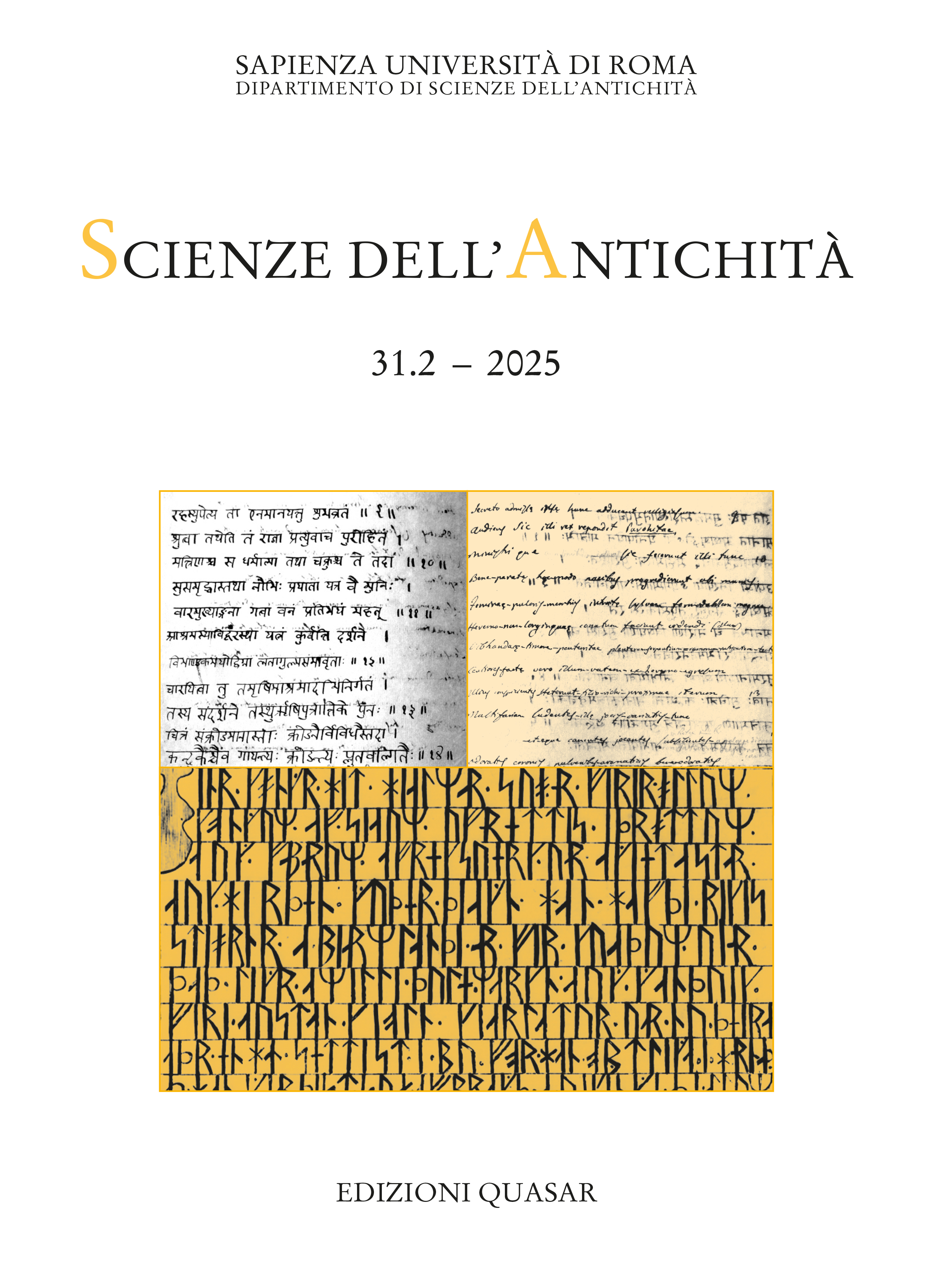
31.2 - 2025
Champollion beyond Hieroglyphs. The many Languages of the Rosetta Stone Code Breaker
a cura di Claudia A. Ciancaglini
F. Bianchi, Champollion dubiosa. La sezione ebraica del fondo Champollion nella Biblioteca Comunale di Faenza
This paper aims at shedding light on the Hebrew section part of J.-F. Champollion’s archive, which after his ultimately death, was found among the papers of a young Italian scholar, F. Salvolini. The archive today hosted in the Museo di Faenza, is composed of four subsections: a) some papers deal with elements of Hebrew grammar. A part seemingly belongs to Champollion’s work, whereas another to Salvolini’s notes; b) thirty papers deal both with the translation of the first verses of the Song of Songs or with a lot of Biblical and Talmudic texts about Jesus’s messianism. As far as we can see, Champollion seemingly favours the Hebrew interpretation accordingly to which Hezekiah would have been the Messiah. Other texts also deal with the early Christian fathers; c) a translation of the first chapters of a Megillat Ester found in the museum of Grenoble also hosts some remarks about the name Ahasweros and Darius; d) a last section includes some notes about Hebrew numismatics and the birth of the Hebrew alphabet. Among the coins discussed there are some shekel dated at the time of the first Jewish and some Jewish pseudo-coins with the images of David, Salomon and Jesus which were produced in the Ashkenazi Jewish world. As far as the section b), c) and d) are concerned, they were part of Champollion’s archive and for some unknown reason Champollion bestowed them to Salvolini. As far as we know, Champollion bestowed them to Salvolini, who has been able to follow his lessons as a kind of encouragement.
P.G. Borbone, “Fondo Champollion” – papers related to Aramaic dialects – Samaritan, Mandaic, Syriac – and Phoenician/Punic
L’articolo descrive brevemente alcune carte di Champollion, o a lui attribuite, relative a dialetti aramaici e alla lingua fenicia/punica. Si tratta di una breve grammatica di aramaico samaritano (NAF 20365, ff. 83r-110r), un alfabeto mandaico con due brevi testi in scrittura mandaica e note sparse in siriaco (NAF 20365, ff. 208r-215). Altre note sparse sono relative al fenicio o punico (NAF 20366, ff. 253-256). Per quanto riguarda un testo più ampio e coerente, ovvero una bozza di grammatica siriaca introduttiva conservata nel Fondo Champollion della Biblioteca Comunale di Faenza (Ms. 65A, III, n. 10), l’attribuzione a Champollion non è certa e risulta anzi improbabile.
C.A. Ciancaglini, Il Frahang ī ōīm e il Frahang ī pahlawīg nelle carte inedite di Champollion
Among Champollion’s unpublished papers concerning Persian, there are also two Middle Persian dictionaries, the Frahang ī ōīm and the Frahang ī pahlawīg. Champollion’s source is Anquetil Duperron’s edition (1771), but especially as regards the second, Champollion also seems to have had access at least to the manuscript prepared by the dastūr Dārāb for Anquetil. This article focuses on the philological history of the second dictionary, which appears partly in a manuscript preserved in France (NAF 20363), partly in another manuscript preserved in the municipal library of Faenza (ms. 344).
A. Keidan, Gli appunti di Champollion sulle rune nordiche
The paper examines a number of handwritten notes taken by Jean-François Champollion during his Orientalist training, now preserved at the Bibliothèque nationale de France (Paris) and the City library of Faenza (Italy). The notes under consideration are those devoted to the study of runes and the Old Norse language and literature. An attempt is made to determine the possible sources used by Champollion in compiling these notes, and to understand the motivation that might have prompted the decipherer of Egyptian hieroglyphs to become interested in runes. It is also shown that the papers preserved in Faenza are exact copies of Champollion’s notes held at the BnF, executed by a different hand, perhaps that of Champollion’s pupil Francesco Salvolini.
E.R. Luján, Champollion on Palaeohispanic Languages and Scripts
In questo contributo esaminiamo e analizziamo l’informazione relativa alle antiche scritture ispaniche (paleoispaniche) fornita dai manoscritti di Champollion. Tali scritture non erano ancora state decifrate all’epoca di Champollion, e la comprensione delle iscrizioni risultava quindi piuttosto limitata. Come era consuetudine all’epoca, Champollion si basò essenzialmente sulle leggende monetali, traendo le sue informazioni dalla Description de médailles antiques di T.E. Mionnet. In questo studio forniamo l’identificazione di tutte le zecche e delle leggende monetali citate da Champollion, alla luce delle attuali conoscenze sulle scritture e le lingue paleoispaniche.
E.R. Luján, Champollion on Gaulish
In questo contributo esaminiamo e analizziamo le informazioni relative alla lingua gallica fornite dai manoscritti di Champollion. Le informazioni culturali e storiche si basano sugli scrittori greci e latini dell’antichità, mentre quelle linguistiche sulla lingua gallica risultano scarse, secondo quanto era noto all’epoca. Ci concentriamo in particolare sull’identificazione di un’iscrizione presumibilmente bilingue, citata anche da Champollion-Figeac. In realtà, il disegno riportato da Champollion non corrisponde a nessuna delle iscrizioni galliche conosciute e si trattava probabilmente di un testo in latino, come nel caso di altre iscrizioni trattate nei manoscritti.
C. Mastrangelo – M. Prayer, In search of ancient India through Jean-François Champollion manuscripts
Questo studio si occupa dei manoscritti relativi all’India presenti nelle carte Champollion conservate a Parigi e Faenza. Si tratta di testi di vario genere: excursus storici, cenni a dottrine e pratiche religiose, esempi di alfabeti Devanaˉgarıˉ, Grantha e Bengali e brani estratti da una grande varietà di fonti antiche e moderne, che vengono qui analizzati in dettaglio e, ove possibile, ricondotti all’originale, tradotti e contestualizzati. In base ai risultati, la varietà degli interessi di Champollion per l’India può essere suddivisa in due principali aree disciplinari, vale a dire quella storico-religiosa e quella filologico-letteraria. Anche se l’India non era propriamente al centro dell’attività accademica di Champollion, i suoi manoscritti mostrano una marcata consapevolezza dell’importanza del sanscrito, e in generale dell’India, nel panorama delle antiche civiltà del mondo. Soprattutto lo studio dei sistemi di scrittura dell’India getta luce sul suo tentativo di comprendere la base fonetica delle lingue indiane in una prospettiva comparativa, mentre l’attenzione per testi epici e filosofici testimonia il suo vivo interesse per il contesto storico e culturale.
F. Merletti, Il 𝘍𝘰𝘯𝘥𝘰 𝘊𝘩𝘢𝘮𝘱𝘰𝘭𝘭𝘪𝘰𝘯 della Biblioteca Comunale 𝘔𝘢𝘯𝘧𝘳𝘦𝘥𝘪𝘢𝘯𝘢 di Faenza e Francesco Salvolini: un interesse filologico condiviso tra maestro ed allievo
The Champollion Fund is kept in the “Manfrediana” Municipal Library in Faenza and consists of about three hundred of his manuscripts archived among the Carte Salvolini kept in the same library. Remaining virtually unknown for around one hundred and eighty years, they were written in his youth in Grenoble and Paris, and concern studies on numerous Middle Eastern writings. This contribution aims to highlight how his linguistic interests, almost common to Champollion’s, could allowed Salvolini to examine them by personally requesting them from the master, for a publication on the Sanskrit studies that the Faentine was arranging and how their arrival in Faenza was a consequence of the theft accusations leveled against him by Champollion-Figeac, the French scholar’s older brother.
P. Orsatti, Gli studi di Jean-François Champollion sul persiano
The article offers a description of the material gathered in ms. “Francesco Salvolini, Opere, ms. 65A, Cartella Persiano” of the Biblioteca Comunale Manfrediana in Faenza, mainly in Jean-François Champollion’s own hand. The papers (scattered folios and bifolios) in the first fascicle contain a series of notes related to the study of the Persian language and literature by Champollion, during his first year as a student at the École spéciale des langues orientales vivantes in Paris (1807-1808). The papers in the second fascicle offer a series of tables, likewise attributable to Champollion, attesting his interests for the chronology of the Middle Eastern dynasties of the ancient and Islamic periods.
A. Papini, 𝘏𝘰𝘳𝘳𝘪𝘥𝘢 𝘙𝘰𝘮𝘰𝘭𝘦𝘶𝘮 𝘤𝘦𝘳𝘵𝘢𝘮𝘪𝘯𝘢 𝘱𝘢𝘯𝘨𝘰 𝘥𝘶𝘦𝘭𝘭𝘶𝘮. J. Fr. Champollion’s Latin studies in the 𝘉𝘕𝘍 manuscript 𝘕𝘈𝘍 20365
Il contributo offre un’analisi preliminare della breve parte dedicata allo studio della lingua latina nel manoscritto NAF 20365, conservato presso la Bibliothèque nationale de France e attribuibile (almeno in parte) a Jean-François Champollion. La sezione 1 del contributo illustra alcune caratteristiche generali del manoscritto, mentre la sezione 2 descrive in dettaglio la parte dedicata al latino. Infine, la sezione 3 analizza le fonti utilizzate da Champollion per lo studio di questa lingua. In particolare, tale sezione si propone di mostrare come lo studioso francese si sia servito dell’“ingannevole” edizione degli Annales realizzata nel 1595 dal classicista olandese Paul van Merle (Paulus Merula).
G. Shurgaia, Gli 𝘐𝘣é𝘳𝘪𝘦𝘯𝘴 di Jean-François Champollion
The Ibériens by Jean-François Champollion. In this essay, the notes that Jean-François Champollion (1790-1832) took during his study of Georgian are published and analysed for the first time. We establish that they were written before the 1830s and derived from the second edition of Liber complectens Georgianæ seu Ibericæ vulgaris linguæ institutiones grammaticas (1670) by Francesco Maria Maggio, C.R. (1612-1686), a missionary in Georgia between 1637 and 1638. We show that Champollion naturally inherited quite a few mistakes from the Theatine father, yet his notes, despite their schematic and functional nature, are imbued with the personal reflection of the scholar, who does not fail to live up to his reputation as a great linguist.
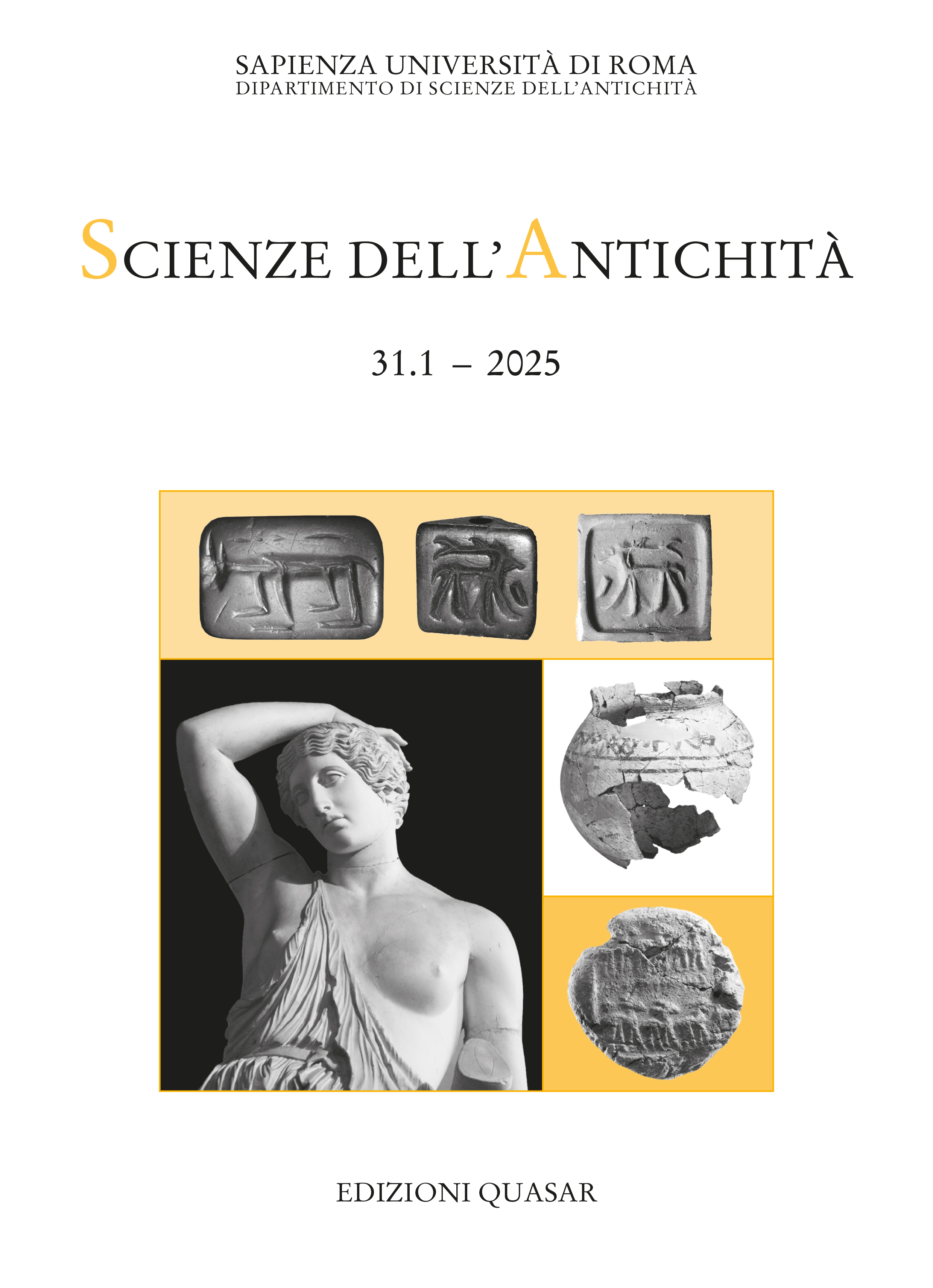
31.1 - 2025
Ricerche del Dipartimento
I Sezione. Mediterraneo e Oriente
F. Balossi Restelli – E. Biancifiori, Post-Ubaid regionalisation in Eastern Anatolia: the beginning of the Late Chalcolithic at Arslantepe (Türkiye)
Il contributo presenta i risultati preliminari delle indagini in corso ad Arslantepe, con particolare attenzione ai livelli del Periodo VIII, che, allo stato attuale delle ricerche, rappresentano la fase più antica di occupazione del sito, databile tra il V e l’inizio del IV millennio a.C. Le attività di scavo condotte sul versante occidentale della collina hanno consentito di individuare almeno sette livelli architettonici sovrapposti, tutti caratterizzati da una chiara destinazione d’uso domestica. Tra gli ambienti meglio conservati si segnalano spazi interpretabili come cucine, per la presenza di installazioni funzionali alla preparazione dei cibi e di elementi destinati allo stoccaggio delle derrate alimentari. Il complesso dei materiali rinvenuti si colloca in un orizzonte culturale post-Ubaid/Tardo Calcolitico, con significativi contatti con i siti più vicini a ovest e a sud, ma anche con relazioni più ampie che coinvolgono l’Anatolia orientale e la regione mesopotamica del Tigri. Sebbene l’occupazione del sito appaia continua dall’Ubaid al Tardo Calcolitico, i materiali provenienti dagli strati sinora indagati sembrano riferibili, in particolare, alla fase del Tardo Calcolitico 2.
L. Mori – N. Danelon – S. Festuccia – V. Indere – A.C. Fantasia – F. Balossi Restelli, Traditional mud-brick architecture at Orduzu (SE Türkiye) and the importance of preserving a historical memory surrounding the Unesco site of Arslantepe
L’inserimento di Arslantepe (Türkiye) nella lista Unesco dei siti patrimonio dell’umanità dal 2021 ha sti‑ molato un processo da sempre portato avanti dalla missione archeologica Italo-turca in Türkiye orientale (MAIAO) della Sapienza, volto a integrare il lavoro archeologico sul campo con ricerche etno-storiche sul territorio della piana di Malatya. L’intenso dialogo con la popolazione circostante, che vive a ridosso del sito archeologico nel villaggio rurale di Orduzu, da cui provengono tutti gli operai da sempre coinvolti nelle campagne di scavo e strumento principale nella tutela del sito, ha favorito e sostenuto le ricerche scientifi‑ che che proseguono da più di 60 anni. Grazie al finanziamento di un progetto Prin PNRR dal 2023 si sta portando avanti un lavoro di ricerca sull’architettura tradizionale in mattone crudo delle case del villaggio di Orduzu, con particolare attenzione alle strutture presenti nella buffer zone, ovvero la zona protetta che circonda il sito Unesco. Il progetto, presentato alla fine del 2022, si è rivelato particolarmente prezioso a seguito del catastrofico terremoto che ha colpito la regione nel febbraio 2023. Molte abitazioni tradizionali sono state o stanno per essere abbattute, col rischio di perdere una memoria storica che ha caratterizzato il sito nella sua interezza. L’articolo presenta i risultati preliminari della prima campagna di terreno volta a raccogliere il maggior numero possibile di informazioni sull’architettura tradizionale di Orduzu, prima che venga perduta.
L. De Vito – D. Nadali – L. Volpi, Scavi e ricerche a Tell Zurghul, l’antica Nigin, in Iraq: formazione e sviluppo di un centro urbano della Mesopotamia meridionale dal V al III millennio a.C.
Since 2014, the Italian Archaeological Mission in Nigin has been conducting excavation campaigns at Tell Zurghul/Nigin, 7 km south-east of Tell al-Hiba/Lagash, in the province of Dhi Qar, southern Iraq. The excavations clarified the period of occupation of the settlement between the mid-5th and the end of the 3rd millennium BCE, when the city was finally destroyed and never reoccupied extensively. The prehistoric phases of the site are significant for the presence of a sequence of public buildings (probably of a temple nature), which point to the existence of organised and complex forms of settlement already in the 5th millennium BCE and the significant phenomenon of the first urbanisation in the 4th millennium BCE. The analysis of the presence and extent of occupational levels dating back to the beginning of the 3rd millennium BCE and, above all, the identification of ancient levels from the 3rd millennium BCE (Jemdet Nasr Period) show how the city developed over time and played an important role well before the rulers of the First Dynasty of Lagash in the mid-3rd millennium BCE.
II Sezione. Italia Meridionale e Sicilia
A. Lo Monaco – C. Parisi Presicce – L. Kosmopoulos, Selinunte, Collina della Gaggera. Campagna 2024
In 2024, a new excavation was undertaken in Selinunte on the Gaggera Hill, led by Sapienza University and Sovrintendenza Capitolina ai Beni Culturali di Roma. The investigation in the Heraion was focused on the altar and the sacrificial area located between it and the oikos. As a result, we now have many details about the materials used, the construction process – including elements such as the crepidoma and the foundation itself – as well as insights into the activities that took place in the area both before and during its construction. The mission also concentrated in the Malophoros Sanctuary on the two rectangular rooms north of the Propylon and on the block with circular carvings situated to the north of the Zeus Meilichios temple.
III Sezione. Roma e il Lazio
D. Palombi – V. Astolfi – V. Bruni – C. Cicone – C. Devoto – A. Grazian – G. Restaino – V. Scala – A. Ten, “Progetto Velia”: lo scavo degli 𝘩𝘰𝘳𝘳𝘦𝘢 𝘗𝘪𝘱𝘦𝘳𝘢𝘵𝘢𝘳𝘪𝘢 nel Foro Romano (campagne 2019-2020)
The paper presents the first results of Progetto Velia, which aims at a general review of the geomorphological, topographical, architectural and historical problems of the urban sector extended between the Sacra Via and the Colle Oppio, known as the Velia neighborhood.
The project consisted of several phases, which included archive research and geomorphological analysis through core drilling – all preparatory to the study and excavation of the complex of the horrea Piperataria, the spice warehouses built during the reign of Domitian and partly discovered beneath the Basilica of Maxentius at the beginning of the last century by M. Barosso.
The excavation of one of the courtyards of the horrea has brought to light a complex stratigraphic sequence, with the succession of a series of buildings from the Augustan age up to the last interventions on the horrea, occurred in the Severan age. The complex, damaged by the construction of the basilica of Maxentius, had a long history in the post-antique period, partly testified by the spoliation activities recognized thanks to therecent excavations and partly reconstructed thanks to archive research.
The project consisted of several phases, which included archive research and geomorphological analysis through core drilling – all preparatory to the study and excavation of the complex of the horrea Piperataria, the spice warehouses built during the reign of Domitian and partly discovered beneath the Basilica of Maxentius at the beginning of the last century by M. Barosso.
The excavation of one of the courtyards of the horrea has brought to light a complex stratigraphic sequence, with the succession of a series of buildings from the Augustan age up to the last interventions on the horrea, occurred in the Severan age. The complex, damaged by the construction of the basilica of Maxentius, had a long history in the post-antique period, partly testified by the spoliation activities recognized thanks to therecent excavations and partly reconstructed thanks to archive research.
F. Di Salvo, Loom Weights from the Ager Faliscus: shape and function
Il contributo presenta un resoconto dell’analisi condotta sui pesi da telaio rinvenuti a partire dal XIX secolo nell’Ager Faliscus, in particolare negli insediamenti di Falerii, Narce, Vignanello e Corchiano. Viene analizzata in dettaglio la morfologia degli strumenti, con particolare attenzione per gli elementi “decorativi” e il loro possibile significato. Vengono inoltre discusse le possibili applicazioni d’uso dei pesi, fornendo un ulteriore elemento per la comprensione della produzione tessile locale. Attraverso il confronto con le culture tessili dell’Italia preromana, ed in particolare dell’area tirrenica, si evidenziano similitudini e differenze per un miglior inquadramento delle specificità di questo territorio.
L. Ebanista – C. Molle, Nota sul foro di Setia e su una nuova iscrizione
This paper presents a new inscription from Setia, found as reused material in the walls of the cathedral of Santa Maria. In light of the epigraphic and the archaeological data, the recent surveys in the cathedral’s hypogea and topographical considerations, a proposal is drawn up for the location of the city’s forum square, while considering the difficulties associated with the analysis of a city with continuity of life.
A.F. Ferrandes – A. Pegurri, La villa “di Giulia” a Ventotene (LT). Nuove riflessioni per la conoscenza e la conservazione del complesso imperiale
This paper presents the preliminary results of a project undertaken by the Dipartimento di Scienze dell’Antichità at Sapienza University of Rome, focusing on the imperial complex known as the Villa di Giulia, located on the island of Ventotene in the Pontine Archipelago. Conducted in collaboration with the Soprintendenza Archeologia, Belle Arti e Paesaggio for the Provinces of Frosinone and Latina, the project forms part of a broader initiative aimed at re-examining previously unpublished documentation from several archaeological sites excavated on the island between the 1990s and 2005/06. The research involves reconstructing and verifying stratigraphic sequences across various monuments and analyzing associated materials. Notably, the promontory of Punta Eolo, where the villa stands, has been selected as one of eight pilot sites in the TRIQUETRA Project, funded by the Horizon Europe 2020 program and dedicated to developing tools for assessing and mitigating climate change risks.
Constructed in the late Republican/early Augustan period, the villa is best known as a place of exile for several prominent women of the Julio-Claudian and Flavian dynasties, most notably Julia the Elder, who was confined there for five years beginning in 2 BCE. This complex, the only known example of a luxury residence on the island, extends over more than 4 hectares and is organized into three main areas: the access, the residential and the service areas. The residential area features refined architectural elements, including a xystus, a peristyle or viridarium, a bath complex, and a semicircular banquet hall with panoramic views of the sea. The service area, in the southern side of the promontory, was likely intended for staff accommodations and storage facilities.
Analysis of the stratigraphy, construction techniques, and decorative elements has revealed at least five major building phases, spanning from the late Republican period to the end of the 1st century CE. Given the hydrogeological threats currently affecting the site, the development of a conservation strategy aligned with the area’s evolving environmental conditions is imperative. As part of this effort, the TRIQUETRA Project integrates geological and technical modeling, multi-parameter environmental monitoring, and detailed archeological documentation to inform the development of risk mitigation strategies that may be applied to similarly vulnerable heritage contexts.
Constructed in the late Republican/early Augustan period, the villa is best known as a place of exile for several prominent women of the Julio-Claudian and Flavian dynasties, most notably Julia the Elder, who was confined there for five years beginning in 2 BCE. This complex, the only known example of a luxury residence on the island, extends over more than 4 hectares and is organized into three main areas: the access, the residential and the service areas. The residential area features refined architectural elements, including a xystus, a peristyle or viridarium, a bath complex, and a semicircular banquet hall with panoramic views of the sea. The service area, in the southern side of the promontory, was likely intended for staff accommodations and storage facilities.
Analysis of the stratigraphy, construction techniques, and decorative elements has revealed at least five major building phases, spanning from the late Republican period to the end of the 1st century CE. Given the hydrogeological threats currently affecting the site, the development of a conservation strategy aligned with the area’s evolving environmental conditions is imperative. As part of this effort, the TRIQUETRA Project integrates geological and technical modeling, multi-parameter environmental monitoring, and detailed archeological documentation to inform the development of risk mitigation strategies that may be applied to similarly vulnerable heritage contexts.
IV Sezione. Tra fonti letterarie ed epigrafia
A. Moscone, Una nota all’oracolo del muro di legno: la storia oracolare dalla battaglia di Salamina ai Cavalieri di Aristofane
At the conclusion of the so-called “battle of oracles” between Paphlagon and the Sausage-Seller in Knights (Aristoph. Eq. 1036-1050), Aristophanes makes an explicit reference to the oracle of the wooden wall, as presented in Herodotus’ Histories. Analysing the relationship between Aristophanes, Herodotus, and other sources linked to the memory of the Battle of Salamis allows us, due to the unique value of comedy as a historical source, to offer new insights into the tradition of oracles and the evolution of the “oracular tale” from the historical event to its recounting in Herodotus’ Histories.
A. La Rocca, ἸΣΟΤΙΜΟΣ. L’ideale di eguaglianza nell’epigrafia greca di età imperiale
This contribution focuses on five occurrences of the adjective ἰσότιμος in epigraphic texts from Asia Minor of the imperial age. As the adjective is attributed to high notables, their lives, or their political behaviour, scholars have largely ignored its ordinary meaning, ‘equal in honour’, and have attempted to interpret it in various ways, but without substantiating it with any arguments. Comparison with some neglected evidence from Greek literature of the imperial age allows us to restore to the adjective a meaning very close to its ordinary one and to open an interesting glimpse into the rhetoric of honorary epigraphy in the imperial age.
G. Baldassarrini – G.L. Gregori, Vilipendio del Cadavere e 𝘥𝘢𝘮𝘯𝘢𝘵𝘪𝘰 𝘮𝘦𝘮𝘰𝘳𝘪𝘢𝘦 del falso Antonino. Politica – religione – memoria di un principe “lvxvriosissimvs”
In recent studies on the controversial figure of Emperor Elagabalus, there has so far been a lack of adequate reflection on the circumstances of his brutal murder and particularly the desecration of his corpse; this is what will be attempted in this paper, contextualizing the macabre episode in light of literary sources. Epigraphic and numismatic documentation, in turn, provides the opportunity to specify the timing of the tricky religious reform promoted by the young emperor from Emesa, including the introduction of the cult of El-Gabal in Rome, of which he was a priest, and to evaluate the consequences of the senatorial measures of damnatio memoriae and abolitio nominis that befell the prince immediately after his assassination, which we can perceive through the erasure of elements of his name and/or titles.
D. Nonnis – G. Almagno – C. Colledanchise Masella – F. Di Santo – C. Gabrielli – M. Iampieri – C. Montin, EDR – Effetti collaterali 11
Closely linked to the ongoing update of the Epigraphic Database Rome project (www.edr-edr.it), the paper focuses on urban epigraphy, re-examining a mid-Republican inscribed jug, providing the first edition of two funerary epigraphs and the revision of already known documents, and finally reporting the rediscovery of a cinerary in a French private collection and the recognition of a fragment of a tabula lusoria.
S. Orlandi – E. Zuddas – V. Padiglioni, EDR – Effetti collaterali 12. Iscrizioni inedite e riletture dall’Umbria
The autopsy checks carried out for the purpose of filing the Latin inscriptions of Umbria in EDR, as well as a series of reports by some private users of the database, have allowed us to find inscriptions that were considered untraceable, to correct the information of other ones, and even to discover new unpublished texts.
V Sezione. Cronache dai Musei del Dipartimento
R. Bucolo, Cronache dal Museo dell’Arte classica: un “inedito” calco del Museo dell’Arte Classica della Sapienza, l’Amazzone della Ny Carlsberg Glyptotek di Copenaghen
The paper discusses a plaster cast of an Amazon held in the Museo dell’Arte Classica at Sapienza University. Although it was initially believed to be derived from a statue in the Vatican Museums, closer examination reveals some differences. This has led to an investigation into whether the cast may be derived from another statue currently housed in the Ny Carlsberg Glyptotek in Copenhagen. The statue in Copenhagen, originally from private collections in Rome, has undergone multiple modifications over the years, almost losing memory of its original restoration and appearance. The research analyses historical documentation, including descriptions, drawings, and pictures.
C. Devoto, Cronache dal Museo delle Antichità etrusche e italiche: monete della Collezione Zuccari
The paper presents a small collection of coins recently acquired by the Museo delle Antichità Etrusche e Italiche and now on display, providing a catalogue of the coins. Along with the collection of plaster casts of coins already housed in the Museo dell’Arte Classica, the new group of coins will be an useful teaching tool, increasing at the same time the collection of the Museo.
VI Sezione. Attività di Terza Missione
S. Grosso – S. Servoli – A. Sorrenti, Un progetto di Terza Missione per l’archeologia partecipata. “Porti aperti. Narrare l’attualità dell’accoglienza e dell’integrazione nel porto etrusco di Pyrgi”
The project “PORTI APERTI. Narrare l’attualità dell’accoglienza e dell’integrazione nel porto etrusco di Pyrgi” was made possible through funding from Sapienza University of Rome (Avvio alla Terza Missione – 2023 Call) for initiatives aimed at advancing the Third Mission. These initiatives seek to enhance the value of educational and research outputs while fostering the economic and social development of the region. While Sapienza’s research has had a profound and enduring impact over the years – leading to the creation of museums and the promotion of local enterprises – there remains significant potential to further strengthen the connection between the local community and the cultural heritage of the area. To address this, the project focused on active community involvement by creating an educational-scientific initiative centred on exploring the Pyrgi site. Highlights included the development of an exhibition presented during the European Heritage Days 2024, organised by students from Cerveteri’s “Enrico Mattei” High School and Rome’s “Augusto Righi” High School, as well as a series of educational workshops attended by over 50 primary school students from Cerveteri. These students became both active participants and narrators of Pyrgi’s history, which was further examined in a lecture series delivered by the research team that has been studying the site for years. The lectures attracted not only younger audiences but also engaged adult participants. Ultimately, the project underscored that the bond between local communities and their cultural heritage can never be taken for granted. Even in regions rich in archaeological, artistic, and natural assets, this connection must be actively nurtured. When cultivated, this relationship has the power to create a virtuous cycle where the local population takes ownership and preserves its rediscovered heritage.
30.3 - 2024
Il mondo è pieno di dei.
Il Politeismo in Grecia: archeologia e contesti
Il Politeismo in Grecia: archeologia e contesti
a cura di Annalisa Lo Monaco
A. Lo Monaco, Il politeismo in Grecia: lo sguardo dell’archeologia
H. Kyrieleis, Zum Einfluss der vorderasiatischen und ägyptischen Götter-Ikonographie auf das griechische Götterbild
Tema centrale di questo articolo è l’influenza dei miti e delle rappresentazioni degli dei del Vicino Oriente
sull’iconografia e sulle caratteristiche specifiche degli dei greci. Molto tempo prima della creazione delle
prime immagini greche, all’inizio del VII sec. a.C., le caratteristiche specifiche delle singole divinità sono
già espresse chiaramente nei poemi omerici e prima di essi nei testi cuneiformi delle saghe epiche del Vicino
Oriente. Analizzando caso per caso emergerà come anche le iconografie delle divinità greche abbiano dei
precedenti diretti nelle soluzioni figurative del Vicino Oriente già all’inizio del II millennio a.C.
A. Moustaka, Riflessioni sul culto delle divinità celesti e ctonie a Olimpia
Kronion, the conical hill, on the southern foothills of which the pan-Hellenic sanctuary of Zeus was gra‑
dually created, consists together with the river Alpheios, an important landmark for the plain of Olympia. Apart from its topographical significance and the reference to Pausanias, the research rarely dealt with the role of Kronos in the context of the mythological past of the area. This was certainly due to the fact that the few and rather insignificant relics that had previously been found at the top of it do not provide sufficient evidence for its importance in the context of worship. However, an inscription from the archaic era that was published in recent years and which for the first time refers to Kronika, the hitherto unknown festival, which was dedicated to the worship of Kronos, has been the starting point to the thoughts that will follow in the context of this presentation.
Kronos as the primordial deity, son of Ouranos and Gaia but also father of Zeus must have played an important role in the religious consciousness and collective memory of the people who visited the sanctuary. In this context, and based on older and newer archaeological data, reference will be made to some other deities, of a celestial or chthonic character, that characterize the complex cult scene of the Olympic landscape.
Kronos as the primordial deity, son of Ouranos and Gaia but also father of Zeus must have played an important role in the religious consciousness and collective memory of the people who visited the sanctuary. In this context, and based on older and newer archaeological data, reference will be made to some other deities, of a celestial or chthonic character, that characterize the complex cult scene of the Olympic landscape.
R. Di Cesare, Culti e struttura urbana: gli spazi della politica nell’Atene arcaica e classica
The paper aims at examining the relationship between the religious topography and the urban structure of the polis with reference to Archaic and Classical Athens and its political spaces. Analysis of the formation and definition of the Athenian urban form reveals a specific cultic characterization of certain central sites of political and civic life. The cults anchored in the area of the Prytaneum and the primitive seats of the archons, as well as the Theseion, are first examined. These spaces had great relevance for political life from the High Archaic period onward and should also be read in connection to the definition of the poliadic sanctuary on the Acropolis and the oldest cults in the Ilissus area. A different characterization is shown by the analysis of the Athenian Agora in the Ceramicus quarter. This space was connected to the Academy and the Acropolis, was crossed by the Panathenaic Way and already from Archaic times housed religious activities and festivals. The dedication of the Altar of the twelve gods greatly enhanced the religious significance of the place. After becoming, with the Pnyx, the center of political life of democratic Athens, the Agora the Agora would soon become the most crowded space of the asty, not only of men, but also of gods and heroes. The festivals and parades that took place in the Agora in honor of the gods find a visual connection with the Parthenon frieze. The analysis of religious stratigraphy in urban topography is a promising research path, which may result in a deeper understanding of the relationship between cults, city spaces and their functions.
R. Sassu, Dei ed eroi nei santuari dell’Acropoli e di Amyklai a Sparta. Coesistenze e interazioni
The complex and multifaceted sacred system of Sparta, deeply rooted in the social identity of the urban community, is marked by a strong local connotation – which is largely connected to the education of the youth and to the civic and military management of the polis – and by a recurring coexistence of different cults in the main sanctuaries located inside and outside the settlement. In order to contribute to the discussion on the nature of Greek polytheism, the paper considers two sacred areas that exemplify the plurality of divine beings worshipped in Sparta and the complex relations among them, namely the sanctuary of the Acropolis and that of Amyklai. The two temene act as emblematic case studies for the reflection on the relationship between the main owner of the sanctuary and the additional honored gods and heroes. Moreover, they illustrate the differences in the pertinent spheres of actions, groups of worshippers, types of consecrated structures, offerings and ritual practices.
M.E. Gorrini, Quel che resta dei riti: l’Apollonion e i pozzi di via dei Tolomei a Siracusa
The paper aims to reconsider the Isthmus area of Ortygia, Syracuse, in order to try to reconstruct divine rituals and social identities through the analysis of the assemblages of the votives found during the excavations of the Apollonion and the wells of via dei Tolomei, along the Noth-Eastern coast of the island. The materials recovered by Paolo Orsi in via dei Tolomei seem to address to a Nymphs’ cult, but some identical types recur in the deposits of the Apollonion as well as in the Credito Italiano.
I. Polinskaya, Polytheistic Complexity in the West Sacred Area of Olbia Pontica
Il capitolo offre una breve panoramica dell’area sacra occidentale di Olbia Pontica e delle divinità ivi venerate, prima di passare alle testimonianze di epiclesi cultuali di Apollo, presentando alcuni importanti graffiti scoperti di recente e mettendo in discussione la lettura e le interpretazioni di alcuni già noti. L’autore sottolinea come l’Area Sacra Ovest sia uno spazio di culto comunitario e di devozione personale, mettendo in guardia dal considerare singoli casi di titoli divini attestati nei graffiti come prove sicure di un culto comunitario.
A. Buyskikh – I. Polinskaya, Aphrodite and the Polytheistic Microcosm of the South Sacred Area of Olbia Pontica
Il testo offre una panoramica delle evidenze archeologiche relative allo sviluppo storico dell’area sacra meridionale di Olbia Pontica, dal 500 a.C. circa fino all’età ellenistica. Il lavoro offre una discussione di molteplici oggetti che possono essere interpretati come doni votivi agli dèi e di iscrizioni chiave che ci permettono di identificare l’area come incentrata sul culto di Afrodite, ma allo stesso tempo sede di dediche all’Eroe Messaggero, Achille, e forse al dio fluviale Borysthenes e (Apollo) Ietros.
D. Chiekova, Meter Pontia: the Maritime Prerogatives of the Mother Goddess on the Western Coast of the Ancient Black Sea
Nel presente lavoro si propone che la Madre degli Dei, venerata come Pontia nell’antica Dionysopolis (l’odierna Balchik) sulla costa occidentale del Mar Nero, avesse caratteristiche sia locali sia generali come protettrice della comunità politica. I confronti con i poteri marittimi delle Dee Madri del Vicino Oriente, con il culto di Afrodite Pontica, con la Madre degli Dei sull’isola di Samotracia, a Kyzikos e in altre aree del Mediterraneo antico forniscono preziose indicazioni sulle competenze marittime della dea Meter nella regione pontica occidentale.
I. Achim – V. Bottez, Recent Evidence for the Cult of Apollo Ietros in Istros, Romania
Il protettore di Istros/Histria è il milesio Apollo Ietros, il cui tempio non è sinora stato individuato, nonostante gli archeologi abbiano iniziato gli scavi del ormai 110 anni fa. Nel presente articolo discutiamo le teorie già avanzate sulla localizzazione del tempio e proponiamo un’alternativa, basata sui risultati di recenti scavi e di una ricerca interdisciplinare. L’area da noi individuata è sul margine occidentale dell’Acropoli, che dominava la zona bassa antistante e la cui posizione fu rafforzata dalla costruzione di un podio. Qui sono venuti alla luce tre pozzi scavati nella roccia (due di età greca e uno di età romana), interpretabili come fosse di scarico di rifiuti di materiale sacro e dai cui riempimenti provengono ceramica, materiali da costruzione, votivi in terracotta e ossa. Le analisi geofisiche (magnetometria e GPR) nell’area hanno portato all’individuazione di una nuova strada che conduce direttamente ai pozzi. Probabilmente a est dei bothroipotrebbe collocarsi il tempio del protettore di Istros.
E. Interdonato, Dei symbómoi, dei patroíoi e divinità minori nell’Asklepieìon di Kos nella prima età ellenistica
Starting with the analysis of the epigraphic and archaeological evidence from the sanctuary of Asklepios on Kos, the present contribution aims to reconstruct the complex cult system of the sacred site. If, in fact, it is possible to witness the definition and canonisation of a public and official cult from the mid-3rd century BC, with Asklepios, Igea and Epione as the main recipients of the cult (in association with Apollo), a series of testimonies allows us to identify the other symbomoí gods.
Epigraphic sources, associated with archaeological remains, also attest to the presence, at least from the 4th century B.C. onwards, of a cult of a gentilitial type or linked to institutionalised social groups (for the patroíoi gods), as well as specific practices aimed at the sanctuary’s “minor” deities.
Epigraphic sources, associated with archaeological remains, also attest to the presence, at least from the 4th century B.C. onwards, of a cult of a gentilitial type or linked to institutionalised social groups (for the patroíoi gods), as well as specific practices aimed at the sanctuary’s “minor” deities.
L.M. Caliò, Spazi sacri e architettura a Camiro in età ellenistica
The monumental centre of the city of Kamiros is organised on two large plateaus occupied by the sanctuary of Athana and Zeus Polieus, the upper one, and the structures dedicated to Hestia in the lower one. The two sanctuaries differ above all in their political purpose, the one on the acropolis being more open with banquet halls and extensive attendance, the lower one reserved for the nobility with initiatory barriers and exclusive spaces. The political management of the city is composed between these two administrative and religious poles; the city takes on an articulated city configuration, whose large monumental spaces have a complex social, political and religious function.
A. Lo Monaco, Il politeismo a Lykosoura: dei e fedeli tra i monti dell’Arcadia
The article examines polytheism in Lykosoura. First the protagonists. Gods: the meaning of the presence of four divine statues on the same plinth inside the cella is examined, their reciprocal relationships are studied and their iconographic and cultic characteristics are discussed. Men: a second stage is dedicated to the study of the faithful, who are involved in the ritual. The second tranche of the work is dedicated to the performance of the local annual festival, of which a reconstructive sequence is proposed over two days, concluded by the predawn illumination of the statues of Despoina and Demeter inside the cella. The study concludes by identifying different times and frequentations between the lower plateau of the sanctuary and the hillside cults.
S.L. Guglielmino, Luce e astri nei santuari del Peloponneso: il contributo dell’archeoastronomia
Although several records from Greco-Roman civilizations contain information about celestial phenomena, their relationship to cultural practices is under-researched, particularly in architecture, iconography, and literature that does not explicitly focus on sky observations. Here, we review passage from ancient literature like the Homeric epics with astronomical references, indicating the potential for archaeoastronomical studies in the Archaic and Classical periods of ancient Greece. This also suggests that even before the Homeric era, stellar navigation was used for Mediterranean voyages. Additionally, we explore the correlation between astronomical knowledge and rituals by comparing social behaviour and religious practices in the sanctuaries of Artemis Orthia in Sparta and of Despoina in Lykosoura, ancient Arcadia.
P. Fileri, Ospitati e ospitanti: interazione e convivenza tra culti isiaci e divinità “tradizionali” nei santuari greco-romani. I casi di Cirene e Creta
In the articulated analysis of the Greco-Roman polytheism, cohabitation and interchange between different deities within the same cult place are of particular interest. If this phenomenon is well-known among the “traditional” deities of the Greco-Roman pantheon, there is a field where these forms of coexistence and dialogue are precipue and systemic in many ways: that of the Isiac cults. Visibility plays a crucial role, and the location of an Isiac cult place, inside or near the ancient sanctuaries, turns out to be almost always as the result of a planned and successful choice. This cohabitation favored a resonance in the local and regional context, not necessarily to be understood in a competitive way compared with the previous deities, but rather complementary to the articulated religious system which characterized a sacred area. Starting from the archeological data, this study focalizes the phenomenon in the contexts of Cyrene and Crete.
F. Guizzi – M. Nocita, Apollo, Plutone e gli altri. Riti e culti nell’area sacra centrale di Hierapolis di Frigia
The study focuses on the multiplicity of cults and related rituals of two sanctuaries located in the central sacred area of Hierapolis of Phrygia (near present-day Pamukkale, district of Denizli/Turkey), the sanctuary of Apollo, the polyadic deity, and the famous Ploutonion, access to the underworld, sacred to Pluto and Kore. Among these cults, a special place is held by the Mother, the Phrygian Cybele, who is worshipped at the opening to the underground cavity on the seismic fault. Among the various divinities present in the two sanctuaries are also, in that of Apollo, an Anatolian god of the circle of the Mother, Karios, and in that of Pluto and Kore, Zeus Sabazius and Nemesis, aspects of whose cults and rituals will be illustrated.
30.2 - 2024
“L’otium è rivelatore”.
Imperatori e otium tra archeologia e letteratura
Imperatori e otium tra archeologia e letteratura
a cura di Massimiliano Papini
M. Papini, L’otium degli imperatori tra archeologia e letteratura
Abstract esempio per volume 2.
M. Papini, Tiberio: una vita attraverso l’otium
The article offers a critical review of the periods of Tiberius’ otium (Rhodes, horti di Mecenate, praetorium speluncae, Capri), with a consideration of the archaeological and literary evidence. The contribution thus reaches new conclusions regarding various themes, such as on the permanence in the horti of Maecenas and on different aspects of the decoration of the Sperlonga cave, among which the chronology of the statue of Ganymede stands out. The contribution closes by reconsidering the nature of the stay on Capri: Tiberius is a prototype of a tyrant in Tacitus, for which he was attracted by the solitudo of the isle. But even there he remained a tormented soul.
P. Carafa, “Ampla et operosa praetoria gravabatur” (Suet. Aug. 2. 72). Gli spazi privati del princeps
We know a lot about Octavian/Augustus’ activities and inclinations in his life beyond military commands, magistracies and governments. In this paper, private life and private “spaces” of the princeps are discussed in the light of the literary tradition and of the more recent assessments in the archaeological research and debate about the monuments identified as Octavian Augustus’ residences in Rome – with a focus on his last residence on the Palatine before and after 36 B.C.E. – and in Italy. It is also examined how the princeps’ otium has been described by the Ancients and in which architectural and topographical contexts we can set his private life.
A. Cucchiarelli, “Ludebat cum pueris”. Gli ozi innocenti di Augusto
The quotation from Suetonius in the title (Aug. 83) refers to the playful and infantile component that is an important part of Roman otium. This article aims to investigate the ways in which otium, as it was particularly practiced by Augustus, corresponds to a studied strategy in defining an image of princeps who was authoritative and, nevertheless, capable of dissolving conflicts through irony.
F. Ursini – F. Salvatori, Ovidio e l’otium dei potenti
This paper aims to analyse how the concept of otium of powerful people is exploited within Ovid’s work, with particular reference to the elegiac exilic collections. A close reading of the representation of the otium of Augustus in Tristia 2 (213-240; 509-520; 557-560), on the one hand, and a comparison, on the other, with that of the otium of Germanicus (Pont. 4. 8. 65-78; fast. 1. 19-26) and the Thracian king Cotys (Pont. 2. 9. 47-66) in the Epistulae ex Ponto and in the reworking of the Fasti during the exile show how, if the latter two are presented by the poet as positive models in their use of otium, the portrayal of Augustus instead reveals very problematic aspects from this point of view.
M. Cadario, Otium e politica: ritratti della domus Augusta nelle ville imperiali
This article aims to discuss the presence of portraits representing members of the Domus Augusta in the imperial villas from the Augustan age to the Tetrarchic one. A first case study is the cuirassed statue of Augustus found at Prima Porta, which is interpreted as an exceptional work designed specifically for Livia’s villa. Starting from the Julio-Claudian age, there was a progressive increase in the presence of portraits in the imperial villas, due to the need to progressively update the image of the imperial family. From the Flavian age, some historical reliefs are also attested, demonstrating the penetration of specific forms of public celebration even in imperial villas. From the 2nd century A.D. the presence of busts forming dynastic galleries quickly became the preferred formula for representing the domus Augusta inside a villa, thus creating a difference between the image of the imperial family in private and public places, where standing statues still prevailed. Villa Adriana and the villas of Antoninus Pious in Lanuvium and Lucius Verus in Acquatraversa provide the best preserved galleries. At the time of the Severi, the inclusion of portraits of the new dynasty continued while subsequently the evidence of new portraits decreased. Thus, since the Augustan age, an ambiguity between otium and negotium emerged in the spaces of the imperial villas. On one side they were usually dedicated to the otium of the princeps, but on the other side their praetoria often housed some of his public duties too. Therefore, the imperial portraits did not only represent the Emperors as owners of their villas, but always recalled their constant engagement to negotium even in a ‘private’ space.
D. Palombi, Sotto mentite spoglie: imperatori e abbigliamento tra ozio e politica
Clothing – which in ancient societies identifies the status and role of the individual within the group to which he belongs – assumes particular importance in the history of the Principate as an occasion and instrument of characterisation and distinction of the image and personality of the emperor, revealing his ethical and cultural values and, in a broader perspective, allegory of the principles of his ideological vision and political action.
The article explores – with reference to the precedents of the republican age – the forms, times, contexts and meanings of the betrayal of the ‘rule of the toga’ that places the emperor outside the social paradigm through the subversion of the signs and values that it represents: in fact, the sought-after and exhibited transgression of socially shared norms regards clothing, constitutes a conscious form of communication with a high ideological coefficient..
The article explores – with reference to the precedents of the republican age – the forms, times, contexts and meanings of the betrayal of the ‘rule of the toga’ that places the emperor outside the social paradigm through the subversion of the signs and values that it represents: in fact, the sought-after and exhibited transgression of socially shared norms regards clothing, constitutes a conscious form of communication with a high ideological coefficient..
S. Borghini – A. D’Alessio, “Versatilia cenationum laquearia”: otia e miracula al tempo di Nerone
A recent hypothesis that we have proposed, or rather relaunched on a radically new basis, regarding the identification of the praecipua cenatio rotunda mentioned by Suetonius in his albeit meagre description of the Domus Aurea with the octagonal hall of the so-called pavilion of the Opium Hill, allows us to reflect here on the semantic scope of a series of references and terms used by some ancient authors (contemporary or slightly posterior to the last exponent of the Julio-Claudian dynasty) and to exemplify their possible structural, material and functional declination within Nero’s construction. The interpretation of Nero’s otium, so to speak engineering and “technological”, as stupor mundi or at least coup de théâtre, also passes through the reinterpretation of terms cited by ancient sources, such as “laquear”, “coagmento/coagmentare” or “lacunar/lacunaria”, the eminently technical meanings of which seem to adhere to our recent interpretation of the Sala Ottagona as cenatio rotunda, reconstructed with a perforated lacunar counter-dome,like those of the ceilings of the neighbouring rooms, but in addition rotating and in perpetual motion with respect to a fixed background.
E. Ghisellini, Nerone e l’arte greca: un rapporto contradditorio
Nero was an avid collector of Greek works of art, which he devoted to the decoration of his villas and especially his immense and sumptuous residence, the Domus Aurea.
The paper systematically reviews literary and epigraphic sources containing information about Nero’s collecting in order to reconstruct where and how the works of art were appropriated, their distribution in imperial properties, and the emperor’s thematic and artistic preferences. The analysis of the written sources is supplemented with the scarce data provided by the archaeological record.
The paper systematically reviews literary and epigraphic sources containing information about Nero’s collecting in order to reconstruct where and how the works of art were appropriated, their distribution in imperial properties, and the emperor’s thematic and artistic preferences. The analysis of the written sources is supplemented with the scarce data provided by the archaeological record.
B. Del Giovane, Nerone poeta
This paper focuses on Nero’s literary and poetic otium, which becomes absolute and all-encompassing, and which constitutes a real break with the traditional conception of Roman political power. Suetonius, Martial, Pliny the Younger and Tacitus discuss Nero’s poetic attitude and his alleged doctrina, passages that are the subject of the analysis proposed here. I will then investigate the theme of spectacle, which, in Nero’s case, overlaps with the political exercise of power: measures and initiatives oriented in this perspective bear witness to this. Spectacle and poetry for Nero were understood in an “agonal dimension” that finds in the figure of Paris a significant antecedent on which to orientate its own self-fashioning.
F.R. Berno, La concessione dell’otium. Nerone e la lettera 73 di Seneca
In this paper, I offer a reading of Seneca’s letter 73, in light of Seneca’s biography, and of the semantic grid of the text. The letter expresses gratefulness towards the emperor for the gift of retirement, but this contrasts with Tacitus’ account of Seneca’s own request, which has been denied by Nero (ann. 14.52-54). The text is built on two key concepts: that of otium, which is gradually replaced by peace, and that of gratefulness. Differently from retirement, which is a personal choice, peace is a general condition of which everyone benefit, so, even if it is factually granted by the emperor, it does not imply gratefulness, as shown by a comparison with some passages from De beneficiis. In that same work, Seneca affirms that you are not due to be grateful to an emperor if he turns to be a tyrant: this is exactly the case of Nero. Seneca’s flattery towards the prince in letter 73 is a fake: his actual benefactor is not Nero, but the philosopher Sextius, quoted in the final section.
S. Fortini, Svaghi del princeps e pubblici divertimenti in Calpurnio Siculo
The present article analyzes the analogy drawn in Calpurnius’ eclogue 4 between the iuvenis Caesar and Jupiter as a child by considering its relation to the Curetic cult and focusing on the relationship between the emperor’s otium and the notion of repuerascere (the return to childhood). Regarding the wooden amphitheater in Calpurnius’ eclogue 7, where the collective otium of the Roman people finds its place, the article discusses new arguments in favor of the Neronian dating and hypothesizes its topographical coincidence with a later, Trajan-era amphitheater. The final line of the eclogue (7, 84) is interpreted in relation to the public image of the emperor in a moment of leisure and joy, potentially shared by all the Roman people, including a simple shepherd such as Corydon.
F. De Stefano, Spazi, modelli e architetture dell’otium in età flavia
The contribution aims to provide a schematic examination of the imperial villas of the Flavian era, particularly in relation to the places and activities connected to the otium of the princeps. Attention will be focused especially on the villas at Circeii and Aricia, which will also be analyzed in the light of other contexts for which we have information concerning the stays of the emperor and/or building interventions implemented during the last decades of the first century CE. Therefore, of each site the organization of the spaces, the architectural solutions adopted and the furnishings that decorated them will be taken into consideration, according to a diachronic perspective that allows us to focusing on the nature and values of the transformations introduced in the Flavian age.
G. Rosati, Vivere in villa (e replicare l’impero) sotto i Flavi
In social customs of the Flavian age otium legitimizes itself as a relaxed and cultured lifestyle appropriate to the elite, indeed it becomes its distinctive trait, defining its cultural identity. The new phenomenon of villa life finds its celebration in Statius’ Silvae, where that ‘villa ideology’, which will have such great importance in Renaissance and modern European culture, takes shape. The villa becomes the appropriate setting in which to practice a modern epicureanism, capable of staging a productive otium and of conferring a socially respected authority. In addition to taking on the features of myth, the dominus of the villa replicates the model of the imperial court in his personal ‘theater of power’, a closed universe of which he is invited to imagine himself as the sovereign.
F. Bessone, “Deus nobis haec otia fecit”. Modelli di otium per i Flavi: Stazio e Domiziano
In Flavian epic and occasional poetry, Domitian is represented as a (former) practitioner, promoter and guarantor of poetic otium. This article reflects on how Statius shapes his relationship with the emperor – as an author, advocate, object and addressee of poetry – in the Thebaid’s envoi, the Achilleid’s proem, and Silvae 4. 2 and 4. 4, in dialogue with the Augustan models (Virgil, Horace, and Ovid). Statius sponsors himself as a new Virgil for a new Augustus, who deigns to read his mythological poem (Theb. 12), and shows himself to be a heir to Virgil’s otium at Parthenope, a poet able to elevate his song, but reluctant to undertake an imperial epic (silv. 4. 4); in the ‘alternative’ encomiastic form of the Silvae, he offers himself as a eulogist of the prince’s convivial otium, which, however, amounts to celebrating in minor poetry, once again, the military glory of a never relaxing, inaccessibly distant general (silv. 4. 2); while, in the Achilleid, he instrumentally suggests his embarrassment at confronting the poet-prince on his own literary terrain. Flavian poets are pleased to share Domitian’s passion for poetry; however, celebrating the exploits of the Flavians in a sublime epic is a task they willingly leave to Domitian’s (long lost) poetic otium.
Z. Mari, L’otium di Traiano fra i monti. La villa agli Altipiani di Arcinazzo Romano
Pliny the Younger probably alludes to Trajan’s villa in Arcinazzo Romano, among the Affilani mountains, about 60 kilometers east of Rome (paneg. 81, 1 and 3), declaring the emperor’s passion for the woods, mountains and hunting. Fistulae aquariae with the name of Trajan and the procurator Hebrus were found in the villa in the 19th century, similar to those found in Civitavecchia (Centumcellae) and Talamone, where there are two other villas frequented by the emperor. The excavations (1999-2011) brought to light the lower terrace, which had a representative character, with monumental rooms, including a sumptuous triclinium, and a porticoed garden. The upper terrace, however, which was the subject of electromagnetic surveys, housed the residential palatium. The area was rich in wild animals, including large ungulates, so the villa had to be used for venationes (the only remissio that Trajan, according to Pliny, allowed himself), in order to procure game for banquets and shows. The oldest fistulae (97-102 AD) are likely to refer to a much smaller construction (a simple “hunting lodge”), never completed and incorporated under the villa that exists today (fistulae of 114-116 AD), also used for the summer stay and also remained unfinished.
F. Econimo, La caccia nell’otium degli imperatori: il gratissimus labor di Traiano
This paper focuses on Trajan’s hunting as part of his otium in Pliny’s Panegyricus. After highlighting the emperor’s unique ability to experience otium as labor and labor as otium, I will investigate the idealised portrait of Trajan as the sublime embodiment of the hunting hero. The emperor’s private hobbies, such as hunting in the wilderness while crossing mountains and visiting the gods, demonstrate once again his superhuman virtues. I will then consider Domitian’s hunting in the enclosed space of his Alban villa. The grotesque spectacle in which he hits weakened prey takes on a political meaning and symbolises his tyrant-like approach to his subjects. I will conclude by evaluating the influence of Trajan’s otium on his successor, Hadrian, a skilful and daring hunter who surpasses the benchmark of perfection achieved by Trajan in his leisure. Comparing Pliny’s Panegyricus with other literary and historical sources, I will argue that Trajan as a hunter epitomises the highest ideal of imperial otium.
G. Lentini, Regalità e otium in Dione di Prusa
The article examines the importance of the theme of otium (analyzed through the study of Greek words of comparable meaning like σχολή, ῥᾳθυμία, ἄνεσις etc.) in relation to the notion of kingship as developed by Dio Chrysostom, especially in his orations περὶ βασιλείας (1, 2, 3, 4). It can be shown that Dio makes use of “Socratic” sources (connections so far neglected with Plato’s Gorgias, for example, will be pointed out) in order to develop rather abstract norms on the king’s “love of labour” (φιλοπονία) and limited enjoyment of otium, but he can also give importance to amusement activities that may reflect real aspects of the emperor’s (that is, Trajan’s) life and personality.
F. de Angelis, Il Teatro Marittimo di Villa Adriana fra otium e negotium: modelli comportamentali e architettura
The Maritime Theater at Hadrian’s Villa, with its artificial island surrounded by a circular enclosure, is best understood as a space for otium characterized by seclusion and intimacy—its closest functional term of comparison being the diaeta of Pliny the Younger’s villa at Laurentum. It belonged to a tradition of palatial islands that went back to Late Classical times. In the Imperial period, however, this tradition had acquired an ambivalent flavor, not least due to the memory of Tiberius’ retreat in Capri. This paper argues that the Maritime Theater aimed to counter the negative connotations of monarchical insularity through its proximity to some of the most public spaces of the villa, in particular the monumental audience room of the Hall of the Philosophers and the Poikile, which likely functioned as one of the main access points to the site.
R. Hidalgo Prieto, Il Palazzo di Villa Adriana alla luce delle recenti indagini. Alcune note sugli spazi di otium
A renewed image of the important sector in Villa Adriana, the Palazzo, is provided by the archaeological excavations performed since 2013 by the University Pablo de Olavide from Seville. Among the novelties, the different peristyles which distributed the complex spaces have been defined. An euripus of the Republican period has been discovered at one of these peristyles, which was preserved and enlarged during the Hadrianic period.
The stibadium is highly remarkable between the spaces that open onto these peristyles. It is a precedent and a model for the stibadium of the Canopo. It is also noteworthy the identification of an original feasting hall which could have had the triclinium on a marble platform over a pond thanks to a series of pillars.
The stibadium is highly remarkable between the spaces that open onto these peristyles. It is a precedent and a model for the stibadium of the Canopo. It is also noteworthy the identification of an original feasting hall which could have had the triclinium on a marble platform over a pond thanks to a series of pillars.
S. Mattiacci, L’ otium letterario di un principe alle origini della poesia novella
The dimension of otium strongly marks Hadrian’s life. By examining the historical evidence and his few surviving poems, this paper intends to demonstrate how the poetic ludere constitutes the most original aspect of the literary otium of this cultured emperor and protector of the letters. Hadrian composed verses that both reveal his own complex personality and constitute the beginning of the so-called novella poetry, which had significant repercussions on the aesthetic canons of late antique poetry. His poetic nugae, which go back mainly to the neoteric models of the Republican period, show the archaizing taste of his time and the decline of the lofty literary genres, but also tend to marginalize the epigrammatic model imposed by Martial (‘committed’ to Romanizing and redeeming a “minor” genre). This was, therefore, uncommitted poetry, a refined literary game reflecting the amateur character of the literature of the Antonine age and destined to have a profound impact on the poetae novelli of subsequent generations and later on Ausonius. As the creator and witness of this important “renewal” of poetic taste, Hadrian’s significant role deserves our attention.
M.T. D’Alessio, L’otium degli Antonini in Villa
The spaces in which it was usually attempted to recognise the most suitable places to spend moments of leisure and time away from commitments, that is, moments of otium, are those linked to a specific type of ancient architecture: the villae. The idea of Roman otium villae includes architectures that were widespread in suburban landscapes, usually located in particularly impressive and environmentally suggestive places. These include imperial villas. In this contribution, the sites in ancient Latium where the emperors of the Antonine family spent their moments of otium, such as Lorium, Lanuvium or Villa Magna are analysed.
C. Ricci, Otium e non solo nel territorio di Veio? Severo, Caracalla e l’Etruria
My attention focuses on the epigraphic clues of the presence of the Severan Emperors in the southern Etruria area. Speaking of otium regarding the Severans may appear an historical oxymoron; it also can be a way of investigating their period of reign from a different perspective. It’s about understanding if and to what extent the periods of their stay in Rome left room for otium; and if these parentheses, intended as absence or moderate involvement in political and administrative commitments, also had suburban residences (and in particular one of them, the residence ‘ad Baccanas’) as a background.
U. Roberto, L’otium dei Tetrarchi. Considerazioni sul soggiorno di Diocleziano ad Alessandria (inverno 301/302)
The interpretation of their political power as militia and their legitimacy based on divine investiture force the tetrarchs to give up the usual forms of otium. However, the analysis of a private letter on papyrus (SB 3.6222) probably concerns an occasion for otium for the Augustus Diocletian in Alexandria (late December 301). The text is also relevant as far as the chronology of Diocletian’s stay in Alexandria in late 301 – early 302 is concerned.
C. Sfameni, Praeclarum otium. Ville e imperatori dai tetrarchi a Costantino: casi studio nei Balcani
The question of otium takes on more specific connotations, particularly with regard to the Roman emperors in the Tetrarchic age. According to the literary sources, the Tetrarchs did not appear to have had much time for the traditional otia, since they were perpetually on the move. However, after Diocletian’s extraordinary decision to retire from public life, a change occurs, the inauguration of a new type of residence. The villa-palace of Split was intended not only for the emperor’s praeclarum otium, but also as a structure that would act as a memorial after the emperor’s death. Galerius’ residence in Gamzigrad ought to be interpreted in this perspective. Recent research proposes to classify other residences attributed to Tetrarchs in this category, since they too were all linked to the Balkan homelands of their illustrious owners, which, incidentally was where many of the most important political decisions of empire were now being made.
A. Pittà, Otia come alii labores alla corte di Onorio: modelli letterari e modelli etici in Claudiano
Late-antique models of behavior prevent the emperor from enjoying his otium; on the contrary, an ideal princeps is required to be completely devoted to negotium, understood as full-time service to the community. This conception of the exercise of power is aptly emphasized by authors of the IV cent. AD: the paper focusses on Claudian’s verse panegyrics, with their constant description of imperial otium as a different (and even more tiring) form of negotium. Due attention is given to the peculiar case of the consul Mallius Theodorus, who renounced the otium of his private retirement to experience again the negotium of political life: Claudian’s praise of Theodorus re-adapts eulogistic commonplaces derived from Flavian poetry and, at the same time, hints at Theodorus’ potentially ‘Varronian’ intellectual activity..
30.1 - 2024
Ricerche di Dipartimento
I Sezione. Mediterraneo e Oriente
C. Devoto, La “Basilichetta” sul promontorio di Elaiussa Sebaste. Dati vecchi e nuovi alla luce delle indagini condotte nella campagna 2021
The contribution presents the data from the excavations carried out in 2021 at the northern cusp of the promontory of Elaiussa Sebaste (Cilicia Tracheia), south of the so-called Basilichetta – a small church that lies on the northern edge of the promontory.
The excavation involved a sector that had never been investigated stratigraphically until now, and brought tolight a series of five rooms aligned outside the southern wall of the Basilichetta. The discovery of numerous architectural fragments, together with the autoptic observation of the structures pertaining to the Basilichetta and with the analysis of archive photographs, offers some elements for a review of the plan of the small church. The new data also allow for a first tentative reading of the buildings that occupied this sector of the promontory between the 5th and 7th century AD.
The excavation involved a sector that had never been investigated stratigraphically until now, and brought tolight a series of five rooms aligned outside the southern wall of the Basilichetta. The discovery of numerous architectural fragments, together with the autoptic observation of the structures pertaining to the Basilichetta and with the analysis of archive photographs, offers some elements for a review of the plan of the small church. The new data also allow for a first tentative reading of the buildings that occupied this sector of the promontory between the 5th and 7th century AD.
A . Taddei, Edifici ecclesiastici protobizantini poco noti della “penisola” di Elaiussa Sebaste
The so-called “Peninsula”, the primitive core of the city of Elaiussa Sebaste, was fortified in Late Antiquity. It housed some unexcavated Christian buildings that are quite neglected. Well before the launching of systematic excavations by the Italian Archaeological Mission (1995), the remains of at least one church had been made known thanks to short notes published by Josef Keil, Adolf Wilhelm, Otto Feld and Ernst Kirsten. Later, in 1986, Hansgerd Hellenkemper and Friedrich Hild were able to survey three medium-sized basilicas on the spot. They appeared to be set in a dense urban canvas and their layout was somehow influenced by pre-existing buildings. These churches are only barely recognisable today, victims of marine erosion, collapse or wind siltation. This notwithstanding, they provide the evidence of the vitality of the centre of Elaiussa in the early Byzantine period. This article aims to document their present state and to put forward some thoughts on their relevance for the knowledge of the late antique city.
II Sezione. Italia Meridionale e Sicilia
G. Recchia - E. Lucci - I.M. Muntoni - F. Radina - M. Vilmercati, Modelli di occupazione del territorio durante l’età del bronzo nell’italia sud-orientale: nuovi dati dalle ricognizioni sistematiche nella lama del Garagnone (Parco Nazionale dell’Alta Murgia)
The interdisciplinary Alta Murgia Archaeological Project (AMAP), launched in 2023, aims at systematically investigating the changing settlement patterns in inland areas of south-eastern Italy and exploring both short- and long-range social interactions between communities during the Late Prehistory. The focus is the study of Late prehistoric communities settled in the inland-upland territories of the Alta Murgia system (Southeastern Italy).
This paper presents the preliminary results of the 2023 systematic filed survey, which have encompassed a transect located at the southern edge of the Murge upland: the Garagnone Castle valley. Probing trenches related to rescue excavations were carried out there in the ’90s of the last century by the local Superintendence, bringing to light traces related to an Early Bronze Age settlement (Palma Campania/Protoapennine facies). Data resulting from the 2023 surveys have significantly enlarged the knowledge on the patterns of human occupation in this area during the 2nd millennium BC, revealing the possible existence of more than one dwelling area belonging to the Early Bronze Age. A shift in the settlement strategy within this environmental niche between the early and mid-2nd millennium BC has also been detected.
This paper presents the preliminary results of the 2023 systematic filed survey, which have encompassed a transect located at the southern edge of the Murge upland: the Garagnone Castle valley. Probing trenches related to rescue excavations were carried out there in the ’90s of the last century by the local Superintendence, bringing to light traces related to an Early Bronze Age settlement (Palma Campania/Protoapennine facies). Data resulting from the 2023 surveys have significantly enlarged the knowledge on the patterns of human occupation in this area during the 2nd millennium BC, revealing the possible existence of more than one dwelling area belonging to the Early Bronze Age. A shift in the settlement strategy within this environmental niche between the early and mid-2nd millennium BC has also been detected.
A. Lo Monaco - C. Parisi Presicce, Selinunte, area della Gaggera: l’altare dell’Heraion. Dati preliminari e nuove prospettive di ricerca
After forty years since the last research mission, a new one has been undertaken in Selinunte, on the Collina della Gaggera in the Triolo contrada (Sapienza Università di Roma, Sovrintendenza Capitolina ai Beni Culturali). The investigation focused on the sanctuary of Hera, near the sanctuary of Malophoros. The excavation was focused on the altar: a monumental rectangular structure (m 8,91 x 2,70), covered by sand until the 1970s. The interior revealed various dumps of imported and locally manufactured materials contextual to the construction of the altar and predating its use. The structure can now be preliminarily dated for stratigraphic reasons to the first third of the 6th century BC.
III Sezione. Roma e Italia Centrale
A. F. Ferrandes – M. Fortunato – F. Parisi – A. Pegurri, Lo scavo urbano e i suoi archivi. Il caso del Palatino nord-orientale (ricerche 2001-17) tra classi “deboli” e contesti “forti”
The implementation of meticulous stratigraphic research methods has significantly improved our understanding and ability to organize data related to historical sequences and materials. Widely distributed artefacts such as fine wares, lamps, and amphorae have particularly benefited. However, coarse wares have not seen similar advancements in knowledge despite their widespread use. Understanding these artefacts through technological and formal analysis can reveal insights into ancient production districts and their responses to various influences. Research by Sapienza University of Rome at Meta Sudans and the north-eastern Palatine has allowed detailed monitoring of changes in urban material culture. Preliminary results from three case studies highlight the potential of applying these methodologies to coarse wares for expanding research on artisanal customs, marketing systems, and usage dynamics. These studies underscore the importance of long-term settlement sequences using unified statistical-quantitative approaches.
S. Palmieri, La necropoli etrusca di Fontevetriana sul Monte Cetona
The study conducted on some materials preserved at the Civic Museum for the prehistory of Monte Cetona, has allowed us do draw information about the possible presence of an Etruscan necropolis in the Fontevetriana area, located on the south-western slopes of the Cetona Mountain. The finds, very fragmentary and for which there is no information on the discovery, indicate an exploitation of the necropolis between the recent Orientalising period and the Archaic age. The location of the necropolis, on the route that flanks the Cetona massif to the west, connecting the territory of Sarteano to that of Cetona and San Casciano dei Bagni, is very significant in the context of the management of the territory by Chiusi. With this contribution we want to present the data resulting from the material analysis of the finds, with the aim of increasing knowledge of the territory of the southern closed countryside in Etruscan era.
A. Candeloro, Nuove identificazioni di reperti da Orte al Museo Gregoriano Etrusco
We hereby present the identification of eight objects kept at the Gregorian Etruscan Museum that were lacking information about their provenance. Consultation of documents from the archives of the former Camerlengato, now at the Archivio di Stato di Roma, has made it possible to trace their purchase by the papal administration from the seller Luigi Arduini, who had found them during his excavations at Orte (VT), between 1837 and 1838. In particular, certain details of the description presented in the list of objects offered for sale, together with the absence of other objects with the same characteristics and of unknown provenance, allow the attribution of three of them to the Hellenistic Etruscan necropolis of Cappuccini and of the remaining five to the coeval necropolis of San Bernardino.
M. Pacifici, Il paesaggio funerario a Narce: il caso del sepolcreto in località Monte Cerreto tra vecchie e nuove indagini
The understanding of the various aspects of the Faliscan settlement of Narce is to date mostly linked to our knowledge of its burial areas, which were intensively excavated between the late 19th and early 20th century. In 2020, thanks to a “Avvio alla Ricerca Grant”, awarded by the Sapienza University of Rome, it was possible to carry out a short geophysical survey in a portion, approximately 1 hectare, within one of the burial grounds investigated in the late 19th century east of the settlement of Narce, with the aim of assessing the reliability of the available documentation and collecting new data.
The results, in addition to validate the location and the cartography of the necropoleis, made it possible to put forward some proposals and reflections on the articulation of the Narce funerary landscape.
The results, in addition to validate the location and the cartography of the necropoleis, made it possible to put forward some proposals and reflections on the articulation of the Narce funerary landscape.
S. Marino – S. Carosi – B. Corradini – M. Eichberg – F. di Gennaro – A . Vanzetti, Impatto delle cave moderne sui beni e paesaggi archeologici: il complesso di Poggio Olivastro (Canino,VT). Secondo contributo del progetto QU&HERI
This paper presents a second report of the QU&Heri (Quarries & Heritage) project referring to Southern Etruria, more precisely to the territories of Montalto di Castro, Arlena di Castro, Tessennano, Tuscania, Tarquinia through a mapping of modern quarries affecting archaeological sites and landscapes. A specific focus is devoted to the case of the quarry that has heavily damaged the Poggio Olivastro archaeological context, in which an archaeological stratification referable to the Neolithic, Eneolithic and Roman Ages is documented. This paper summarizes data from bibliographic and archival analysis correlated with computer-based analytical applications.
M.C . Biella – S. De Angelis – M.A . De Lucia Brolli – O . Scarone, La ricerca archeologica tra centro e periferia. Il caso delle cosiddette Carte Bracci.
The interest in archival research applied to archaeology has never waned, and indeed in recent years we have witnessed a new interest, at least in the study of pre-Roman Italy.
Broader theoretical considerations have gone hand in hand with targeted research on specific contexts, and specific personalities have been reread.
In this context, the studies of the Tyrrhenian area have reached a particular level of detail for some case studies and have allowed, among other things, to highlight secondary actors on the stage of archaeological research, whose contribution was fundamental, especially with regard to the phases of discovery and study of those contexts that often still constitute the foundations on which the history of entire territories is based today.
So far, this type of focus has mainly been placed on the first fifty years after the unification of Italy, but it is clearly possible to extend it to more recent periods. This is exactly what is being attempted with the study of the so-called Carte Bracci, an archive fund at the Archaeological Museum of the Agro Falisco, which is being reported on here for the first time.
The Carte Bracci are an essential tool for researchers working on the area north of Rome, between Capena and Orte, which was under the supervision of the ‘Custode di zona’ Arcangelo Bracci during his years of service to the State (1950-1975).
A brief biographical sketch of Arcangelo Bracci, written by a person who knew him personally, is presented, followed by a description of the structure of the collection and the selection of a specific case study – that of the quarries and their impact on the territory – which is particularly relevant to shed light on his activity in the area.
Finally, considering the relevance of the documentation, the research and dissemination potential of the current study is outlined.
Broader theoretical considerations have gone hand in hand with targeted research on specific contexts, and specific personalities have been reread.
In this context, the studies of the Tyrrhenian area have reached a particular level of detail for some case studies and have allowed, among other things, to highlight secondary actors on the stage of archaeological research, whose contribution was fundamental, especially with regard to the phases of discovery and study of those contexts that often still constitute the foundations on which the history of entire territories is based today.
So far, this type of focus has mainly been placed on the first fifty years after the unification of Italy, but it is clearly possible to extend it to more recent periods. This is exactly what is being attempted with the study of the so-called Carte Bracci, an archive fund at the Archaeological Museum of the Agro Falisco, which is being reported on here for the first time.
The Carte Bracci are an essential tool for researchers working on the area north of Rome, between Capena and Orte, which was under the supervision of the ‘Custode di zona’ Arcangelo Bracci during his years of service to the State (1950-1975).
A brief biographical sketch of Arcangelo Bracci, written by a person who knew him personally, is presented, followed by a description of the structure of the collection and the selection of a specific case study – that of the quarries and their impact on the territory – which is particularly relevant to shed light on his activity in the area.
Finally, considering the relevance of the documentation, the research and dissemination potential of the current study is outlined.
L.M . Michetti – B. Belelli Marchesini – M. Bonadies – A . Conti – E . Abbondanzieri – S . Grosso – C . Kourta – C . Lo Verme – L . Nardò – S . Palmieri – E . Pillitteri – S . Servoli – A . Sorrenti – C . Tulini, Tra Caere e il mare: scavi e ricerche nel comprensorio di Pyrgi (campagne 2021-2023)
The 2021-2023 excavation campaigns have provided more information about Pyrgi’s overall urban asset, focussing the relation between the sacred district, the settlement area and the harbour.
In the settlement area, fieldwork has mainly addressed the Ceremonial Quarter at the intersection between the urban track of the Caere-Pyrgi road and a pebbled road leading to the oriental port-basin. This includes public buildings that have played representative, political and economic functions from the middle 6th century BC at least. Excavation has confirmed the performance of metallurgic activities and connected ritual acts in the plot N of the pebbled road, as already shown by the metal offerings focussing the gray tuff container included in room A; noteworthy is the recovery of two leaden counterpoise weights of lever scales. The building complex S of the pebbled road has certainly played a public function, as highlighted by the decorated roofs and the many ritual acts associated with any building intervention; its peculiar late-archaic plan matches the model of the transversal porticoed houses- well documented by Caeretan funerary architecture, and the atrium houses. Excavation is outlining the archaic asset of the building, also documented by the recovery of architectural terracottas; extremely interesting is a huge polycrome mud-brick basement-maybe connected with some ritual structure, that falls in the underground of the portico. In general, the ritual deposition of local and imported amphoras and of stone anchors, together with the offering of phoenician lamps, well highlights the attendance of the building by (foreign) merchants and the strict connection with the commercial sphere.
As far as the Monumental Sanctuary, the excavation area now includes not only the entrance area but also a wide strip along temple A and its frontal terrace. Fieldwork has definitively confirmed the presence of a road that stems from the Caere-Pyrgi track and runs parallel with Temple A, marking the limit of the Sanctuary to the N in spite of the lack of evidence of a proper témenos wall. Another important new acquisition is the evidence of a dry masonry rectangular archaic building-maybe a shrine, that was intercepted by Temple’s foundation cut, whereas the recovery of a ashlar masonry base included in the frontal terrace provides further information about the location of altars or donations in the sacred area.
As regards the overall asset of the maritime settlements, important new data have been gathered through the documentation and collection of pottery shards from the houses that are being dismantled by the sea erosion and through the underwater survey performed in 2023 in front of the excavation areas.
In the settlement area, fieldwork has mainly addressed the Ceremonial Quarter at the intersection between the urban track of the Caere-Pyrgi road and a pebbled road leading to the oriental port-basin. This includes public buildings that have played representative, political and economic functions from the middle 6th century BC at least. Excavation has confirmed the performance of metallurgic activities and connected ritual acts in the plot N of the pebbled road, as already shown by the metal offerings focussing the gray tuff container included in room A; noteworthy is the recovery of two leaden counterpoise weights of lever scales. The building complex S of the pebbled road has certainly played a public function, as highlighted by the decorated roofs and the many ritual acts associated with any building intervention; its peculiar late-archaic plan matches the model of the transversal porticoed houses- well documented by Caeretan funerary architecture, and the atrium houses. Excavation is outlining the archaic asset of the building, also documented by the recovery of architectural terracottas; extremely interesting is a huge polycrome mud-brick basement-maybe connected with some ritual structure, that falls in the underground of the portico. In general, the ritual deposition of local and imported amphoras and of stone anchors, together with the offering of phoenician lamps, well highlights the attendance of the building by (foreign) merchants and the strict connection with the commercial sphere.
As far as the Monumental Sanctuary, the excavation area now includes not only the entrance area but also a wide strip along temple A and its frontal terrace. Fieldwork has definitively confirmed the presence of a road that stems from the Caere-Pyrgi track and runs parallel with Temple A, marking the limit of the Sanctuary to the N in spite of the lack of evidence of a proper témenos wall. Another important new acquisition is the evidence of a dry masonry rectangular archaic building-maybe a shrine, that was intercepted by Temple’s foundation cut, whereas the recovery of a ashlar masonry base included in the frontal terrace provides further information about the location of altars or donations in the sacred area.
As regards the overall asset of the maritime settlements, important new data have been gathered through the documentation and collection of pottery shards from the houses that are being dismantled by the sea erosion and through the underwater survey performed in 2023 in front of the excavation areas.
G .M . Annoscia – S . Capriotti – M . Di Fazio – V . Mattia – L . Medeghini – F . Miele, Anuli narrantes: studio archeologico e archeometrico di alcuni anelli bassomedievali da Cencelle (Tarquinia, VT)
Leopoli-Cencelle town, founded by Pope Leo IV in 854 A.D., is located in the Tolfa Mountains in the territory of the municipality of Tarquinia (VT). The presented research focuses on the analysis of 15 rings from funerary contexts, which can be dated between the 13th and 15th centuries, analysed both from archaeological and archaeometrical perspective. The interpretations of these artefacts intrinsic and extrinsic characteristics, obtained by synthesising data from the excavation contexts, anthropological data and archaeometric analyses, revealed some interesting features related to the production process, gender and owners status. In this investigation was crucial to develop a mental attitude able to correlate the archaeological artefacts polysemanticity by carefully exploring the whole set of possible meanings between individual objects and the contexts in which they were found.
A.M. Jaia – L. Ebanista, Anzio – villa comunale: un nuovo complesso residenziale sostruito di età imperiale. Sondaggi di scavo 2023
This paper presents the preliminary results of the excavation campaign undertaken in September 2023 in the Anzio - Villa Adele area. The excavation, founded by the Municipality of Anzio, involved the highlighting of a complex of underground tunnels, accessible until now only trought a roman well. The research activities brought to light a thermal plant dating to the imperial age, built on a complex system of hypogeal galleries aimed at regularizing the natural steep slope of the city. An impressive earth filling of several thousand cubic meters of earth created in the last century has been highlighted.
IV Sezione. Tra fonti letterarie ed epigrafia
A. Cucchiarelli, Sguardi sul paesaggio: Italia e Lazio nella cultura romana tra fine repubblica e prima età imperiale
S. Harrison, Orazio e Tivoli
This piece looks at the role of Tivoli in Horace’s poetry, and in particular at how his relationship with the town changes and develops over his poetic career: Horace begins as a detached admirer of Tivoli, and ends up as an enthusiastic inhabitant. I will begin with the evidence that Horace had a home at Tivoli, and then examine the appearance of Tivoli in five different Horatian poetic books in chronological order: the first three books of Odes, the first book of Epistles, and the fourth and final book of Odes.
M. Papini, Alberi e boschi sacri del Lazio antico: letteratura e immagini
According to Pliny the Elder at the beginning of book 12 the trees were originally temples of the numina while, even now, according to an ancient rite, simple country people consecrate a more beautiful tree to the god; indeed, according to a moralistic perspective, gold and ivory simulacra do not arouse more veneration than luci; the reasoning follows on certain kinds of trees protected as they are dedicated to numina, such as the oak to Jupiter, the laurel to Apollo and so on. The intervention will analyze some passages of Latin literature dedicated to the sacred groves (Virgil, Ovid, Lucan) searching for parallels or identifying the differences with the most distinctive components of the category of so-called idyllic-sacral paintings. In similar images, sacred trees are often found at the center of the composition, in association with architectural structures of various types. The second part of the article will be dedicated precisely to the latter and to their actual correspondence or not to constructions known from archaeological evidence.
D. Spencer, “Piantare una scena” nelle Georgiche di Virgilio
Vergil’s Georgics was composed during a period when Rome was intensely preoccupied with food security, yet even for Vergil’s sophisticated audience, crops remain a complex entity rooted in tradition, labor, family, and cultivated land. Crops in this way play a multifaceted role, bridging gaps between the natural and the processed, the wild and the tamed, the sacred and the understood. They serve as the foundation for Rome’s grand monuments and civilization. This paper takes Elfriede Abbe’s illustrated commentary (1965) as a touchstone. Abbe’s project highlights the vivid and tangible framing contexts which support post-classical audiences. Reading the poem with Abbe emphasizes the intricate relationship between agriculture, nature, and the well-being of the Roman state while celebrating the complexity and significance of crops and their cultivation within a visual system.
V. Bartolomei, Note sull’epigrafia delle coppe falische a vernice rossa
This article deals with the red-varnished faliscan bowls characterized by inscriptions. The first part analyzes some aspects linked with the production and gives indications about their chronology and distribution, while the last part concerns sigla and inscriptions, providing an update to the published documentation. The aim of this work is to understand the meaning of these symbols and to investigate the choice of the red-varnished bowls as vectors of inscribed messages.
S. Orlandi – M. Coppari – C. Gabrielli – A. Mincuzzi, EDR – Effetti collaterali 10
Along with the ongoing process of digitalization of the Greek and Latin inscriptions of ancient Italy in the Epigraphic Database Roma (www.edr-edr.it), a number of re-discoveries about Latin inscriptions from Rome have been made: a fragment of a new late antique senatorial inscription; two epigraphic texts once known only through manuscrupts; a funerary slab edited twice as it it was unpublished; a new epitaph with a multa sepulcralis. These small but significant contributions show how important the EDR project is for the improving of our documentary base for the study of ancient history.
V Sezione. Attività di Terza Missione
F. Bisceglia, L’Archeologia incontra il carcere: “Comunicare e disseminare il contesto territoriale del Vastese (CH) e lo scavo di Cencelle (VT) presso la casa di lavoro di Vasto”
The work proposed is the outcome of a pilot project funded by Fondazione Sapienza under the establishment of the Marcello Barbanera Grant. The institution of a Public Archaeology workshop, the application of questionnaires before and after the activities, and the in itinere evaluation made it possible to objectively examine the potential benefits on the detention community of the Casa Lavoro di Vasto. The short-term impact assessment on the project and the structuring of questionnaires emphasise the multidisciplinary aspect of the initiative, supported by the partnership between La Sapienza University and the Lazio-Abruzzo-Molise Regional Proveditorate of the Ministry of Justice.
29.3 - 2023
Atti della III edizione del Convegno Egitto e Vicino Oriente Antico EVOA
a cura di Carlo G. Cereti
Premessa, Antonella Polimeni
Premessa, Roberto Antonelli
Introduzione, Carlo G. Cereti
S. Alaura – M. Bonechi – S. Di Paolo – F. Manuelli – T. Pedrazzi – I. Rossi, Il Vicino Oriente antico tra tradizione e innovazione: nuove prospettive di ricerca interdisciplinare al CNR-ISPC
In continuity with the activities of previous CNR institutes dedicated to Ancient Near Eastern studies, scholars at the Institute of Heritage Science (ISPC) conduct archaeological and philological researches on a wide range of historical issues, in the framework of the current international scenario characterized by the increasing use of innovative approaches. The “Vicino Oriente Antico” (VOA) Research Group, territorially organized between the ISPC branches in Rome and Milan, has recently launched a scientific program that brings together projects based on a well- established tradition, now tackled with an approach characterized by the integrated use of different technologies, with the aim of enhancing interdisciplinarity at the highest level. Our contribution intends to offer an overview of these researches, dedicated to territory and landscape, material culture, written texts and history of studies.
F. Balossi Restelli – M. Frangipane, La missione archeologica della Sapienza ad Arslantepe (Turchia): ricerca, cooperazione e valorizzazione di un sito Unesco
In July 2021, the site of Arslantepe was formally declared a World Heritage Site by the international UNESCO committee. This result has been achieved thanks to sixty years of excavation, research, conservation and valorisation of the site carried out by the expedition of the Sapienza University of Rome, initiated by Professors Salvatore Maria Puglisi and Alba Palmieri and then continued for 40 years by Prof. Marcella Frangipane, with a broad collaboration that now counts more than 20 national and international institutions. The article briefly presents the state of research, current collaborations and projects for the valorisation and dissemination of knowledge, which today make Arslantepe an example of a multidisciplinary scientific project with important spin-offs for both research and international cooperation.
C.G. Cereti – G. Maresca – G. Terribili, DiSA Sapienza per il patrimonio culturale e il paesaggio storico degli Zagros
Thanks to a project network that goes beyond contemporary political and territorial divisions, the Department of Science of Antiquities – Sapienza University of Rome – has since long focused its interest on the area of the central-northern Zagros mountains between Iraq and Iran. In this framework, the investigation of the macro-area was conceived as a consistent, albeit multifaceted, case study aiming to enhance a cultural heritage at risk. The present paper outlines the main activities carried out by the research group in the area and the results achieved in the last years.
E. Cianfanelli, ProsE: lavori in corso e prospettive future
The analysis of the exceptional anthroponomastic heritage recorded in the administrative and chancery texts from the cuneiform archives found in the Palace G of Ebla (Tell Mardikh, Syria, 24th century BC) allowed the scholars to achieve an abundance of data in both linguistic and prosopographical studies. Given the scientific advantages offered by the latter, in 2006 the project The Prosopography of Ebla was born by the joint effort of the Universities of Rome and Florence. Since then, this project, which is now known as ProsE under the responsibility of Amalia Catagnoti of the University of Florence, has been aiming to organize thousands of onomastic attestations from published and unpublished texts to create an open-access digital tool that promotes and facilitates research on the Ebla documentation. From the original organisation of the data up to the most recent structural modifications, the onomastic material accessible online in the project site makes it possible to identify the biographical traits of the considerable number of persons recorded in the Ebla texts.
L. Colliva, Il progetto Sarqala della Misak, Missione Storico Archeologica Italiana nel Kurdistan, tra salvaguardia, valorizzazione e ricerca
MiSAK, the Italian Historical and Archaeological Mission in Kurdistan, has signed in December 2021 a three-year renewable agreement with the KRG General Directorate of Antiquities and the Garmian Antiquities Directorate to carry out an archaeological project concerning the historical and archaeological study, protection, and enhancement of the Sarqala archaeological site (KRG, Iraq). This site includes a possible necropolis of the Parthian period and the Qalla Kon tell, a probable multi-phase site, possibly part of the settlement connected with the nearby necropolis.
The MiSAK project for Sarqala envisages flanking the historical and archaeological study activities, some of which are already in progress, with site preservation and enhancement actions and public archaeology initiatives aimed at raising the awareness of the local population and turning them into one of the main actors in safeguarding and enhancing actions.
The MiSAK project for Sarqala envisages flanking the historical and archaeological study activities, some of which are already in progress, with site preservation and enhancement actions and public archaeology initiatives aimed at raising the awareness of the local population and turning them into one of the main actors in safeguarding and enhancing actions.
C. Corti – R. Damiano – S. de Martino – G. Torri, Studi di prosopografia ittita e creazione di un data set prosopografico
In the framework of the programs PRIN 2017 “Writing Uses: Transmission of Knowledge, Administrative Practices and Political Control in Anatolia and Syro-Anatolian Polities in the 2nd and 1st Millennium BCE” and PRIN 2020 “Networks of Power: Institutional Hierarchies and State Management in Late Bronze Age Western Asia (NePo)”, one of the main goals is linked to the project “Research of Hittite prosopography of the Imperial Period and compilation of the prosopographic database”. All the personal names from Hittite epigraphic sources will be collected in a database, adapting an installation of the Omeka S platform. The aim of this project is to make available to the scientific community a tool for checking the Hittite personal names in their context, regularly updated, and consulted online. This data is the starting point for further biographical and prosopographical analysis of the Hittite officials, dignitaries, and people of the reign of Hatti and its Syrian vassals’ kingdoms.
L. Milano – C. Felli, Indagini territoriali nella regione di Wasit (Iraq)
The Wasit region is an area which has been somehow on the side of major enterprises of landscape archaeology in Iraq. Since 2018 the Ca’ Foscari University of Venice in collaboration with the University of Florence has started a project of extensive survey in the area with the aim to fill in that gap and cooperate with local representatives of the State Board for Antiquities and Heritage, Iraq in the monitoring and safeguarding activities of the archaeological heritage. The article intends to offer a presentation of the background, aim and objectives of the research along with a preliminary overview of the so far yielded results.
M. D’Andrea – S. Richard, Missione archeologica a Khirbat Iskandar, Giordania: risultati recenti e obiettivi futuri
Khirbat Iskandar is an archaeological site in central Jordan with significant human occupation during the urban Early Bronze II–III periods (ca. 3100/3000–2500 BC) and the non–urban Early Bronze IV period (ca. 2500–1950/1920 BC). The Archaeological Expedition to Khirbat Iskandar is a long-term project started in 1981 and continuing until today for the systematic investigation of this signature Early Bronze Age site. The 2022 excavation season exposed more of the Early Bronze III sequence to clarify the timing and proces- ses of the rural transition between Early Bronze III and IV, which are still opaque on a regional scale. In the meantime, the team is engaging with planning strategies for the site’s protection and promotion, as well as with the challenge of communicating the results of archaeological research efficiently. In fact, there are many important lessons for our contemporary society to learn from Khirbat Iskandar’s narrative of resilience in face of change and crisis that can be reconstructed through the stratigraphy and cultural heritage at the site.
E. Devecchi – E. Scarpa, Società, amministrazione ed economia nella Babilonia di età cassita: un progetto di digital prosopography
The surviving archival records from Kassite Babylonia (14th-13th centuries BC) offer a glimpse into the complex network of interactions resulting from the activities managed by the main economic and administrative institutions. Thousands of people appear in the documents, although in most cases we only know their names – rarely their patronymic and/or profession. The project presented in this paper aims at carrying out a prosopographical study in order to define the actors’ “functional” and “behavioral” profiles on the basis of the contexts in which they were active and the interactions they had with each other. To this aim, a prosopographical database has been designed to collect, organize, and query the prosopographical data and extract significant knowledge through data visualization and statistical analyses.
F. Di Filippo, Risolvere la complessità: gestione e fruizione di 60 anni di dati di scavo di Arslantepe
During the last 60 years, the data recovered from the excavations of Arslantepe (Malatya, Turkey) have accumulated into an invaluable collection of archaeological records characterized by complexity and an extraordinary variety of archival media. In order to rationalize this documentation, over the last five years, a joint project between the Sapienza University of Rome and the National Research Council (CNR - ISMed) has developed a prototype Document Management System (ArsDB, https://arsdb.cnr.it). It offers a versatile tool capable of keeping track of the wealth of relationships between collected objects, aiming to simplify processes such as entering new data, retrieving information, and evaluating research hypotheses. This brief presentation provides an overview of the operational choices made in the design of this original digital repository.
F. Di Filippo – M. Maiocchi – E. Scarpa, La geo-localizzazione del materiale epigrafico del Grande Archivio L.2769 (Ebla, Siria): obiettivi e prospettive nel quadro del progetto Ebla Digital Archives
The central archive of Ebla (Syria, ca. 2.400 BCE) provide us with unique details on archival practices in antiquity, as the primary archaeological context of the individual tablets within the archive is roughly known. Despite minor misplacements, a reliable reconstruction of the archive at the moment of the collapse of the room hosting it is largely possible, on the basis of excavation data carefully recorded by the members of the archaeological mission digging the site. However, until now the study of the Ebla material from the point of view of archivistics remained difficult, as the relevant data for the geo-localization of the epigraphic evidence unearthed there were unaccessible to scholars, as well as in a format unsuitable for digital analysis. The paper focuses on key aspects that impact on current research of the Ebla archive, with special reference to the nature of primary archaeological data, best digitization strategies for preserving such information, as well as the implementation of digital tools for the integration of spatial and philological data within a dedicated platform.
S. Di Paolo – G. Zisa, Biodiversità nel Vicino Oriente antico (BioANE). Per un approccio interdisciplinare all’interazione interspecifica
Concerned by the looming environmental and climate crisis, anxious about the state of the planet’s water resources, the extinction of plant and animal species, the quality of the atmosphere, the chemical pollution of the soil and the seas, almost all the world’s governments promise in their political agenda to try to remedy the environmental and climate damage caused by human beings, now considered as a geological force. Such issues may interest Ancient Near Eastern scholars, who, stimulated by the theoretical-methodological approaches of the so-called Environmental Humanities (EH), study the ways of the inter-specific collaboration not only between humans and the more studied non-human animals but also with plants and trees, which have not been the subject of such detailed studies. The aim of this short contribution is twofold: 1) to approach the study of the biodiversity of the ancient Near East and discuss how human communities have thought about their relationships with the environment they are part of, influencing it and being conditioned by it (connectivity ontology); 2) to encourage/stimulate the creation of a new research group overcoming the traditional dichotomy between the disciplines of “nature” and those of “culture”.
N. Ferrante – L. Medeghini – F. Mura, L’utilizzo dei tessuti nel rituale funerario: la tomba 172 di Mozia
The funerary textiles in the Phoenician and Punic world are small due to the perishable nature of the fibres in archaeological contexts and the lack of attention shown until a few years ago for this type of investigation. Currently there are many possibilities offered by new technologies applicable to the textile sector that allow investigating fabrics in a more specific way. The new methodological approaches, in addition to providing valuable information on the types of textiles used in funeral rites, allow us to understand the social and economic significance of these products.
The paper reports the results of the analyses conducted on the textile preserved on a knife found in Motya and the contributions that new technologies can make to the study of textile production and funeral rites in the ancient world.
The paper reports the results of the analyses conducted on the textile preserved on a knife found in Motya and the contributions that new technologies can make to the study of textile production and funeral rites in the ancient world.
G. Forgione, Il progetto iCHeriSH: esperimenti di accesso libero ad un sapere attendibile, per lo studio e la salvaguardia del patrimonio culturale dell’Asia Meridionale
iCHeriSH (the acronym for “inputting Cultural Heritage and Side Histories into the digital arena: Towards a collaborative network for South Asia”) is a project funded by the MUR – Ministero dell’Università e della Ricerca – in the frame of the special program FISR 2020, Special Integrative Funding for Research, FIRST PHASE.
The project involves two universities, l’Orientale of Naples and Ca’ Foscari of Venice and was conceived with the aim of creating an open access platform for the advertisement, study, and preservation of cultural heritage, both material and immaterial, of South Asia. This rich patrimony – often neglected, scarcely known, and misinterpreted – is at risk of destruction and dispersion, and only a better knowledge can contrast this risk. iCHeriSH aims at integrating the purposes of scientific research with new working strategies, even at distance, and at creating a digital space to support teaching and participative actions of crowdsourcing under the supervisions of universities and research institutes, the only ones that can guarantee the high scientific profile of contents.
The project involves two universities, l’Orientale of Naples and Ca’ Foscari of Venice and was conceived with the aim of creating an open access platform for the advertisement, study, and preservation of cultural heritage, both material and immaterial, of South Asia. This rich patrimony – often neglected, scarcely known, and misinterpreted – is at risk of destruction and dispersion, and only a better knowledge can contrast this risk. iCHeriSH aims at integrating the purposes of scientific research with new working strategies, even at distance, and at creating a digital space to support teaching and participative actions of crowdsourcing under the supervisions of universities and research institutes, the only ones that can guarantee the high scientific profile of contents.
R. Francia – M. Vigo, Eḫu iŝḫamai ‘canta!’ Proposta di un metodo alternativo per la comunicazione della storia delle antiche civiltà
The importance of re-discovering history is a challenging commitment of our time. The dissemination of scientific discoveries to a large public is an even more urgent task these days, but the way how to achieve it is still problematic. The project eḫu iŝḫamai aims, therefore, to propose an innovative approach to disclose to young students of primary and secondary schools the civilization of the Hittites, an Indo-European population who lived in Anatolia (present central Turkish plateau) in the second half of the 2nd millennium BCE. The project has set a manyfold agenda for dissemination which is articulated in outcomes accessible to a large audience: theatre performances of Hittite myths accompanied by music, comics, cartoons, and workshops in schools.
F. Genchi, Le tombe collettive a corridoio della necropoli di Daba¯: origine e diffusione di una struttura a carattere funerario sulla base delle evidenze del sud-est della penisola arabica
This paper takes as its starting point the exploration of two collective tombs of the corridorshaped type, also known as ‘long-chambered’, identified in the 2nd/1st millennium BC necropolis at Dibbā al-Bayah, on the east coast of the Musandam Peninsula in the Sultanate of Oman. The spread of this type of tomb is limited to the northern region of the Oman Peninsula, and to the period between the middle/late Bronze Age and the beginning of the Iron Age (first half of the 2nd millennium BC - first half of the 1st millennium BC). These tombs are of monumental character with a corridor chamber, usually semi-subterranean, that can reach a length of up to 30 m. The focus is therefore on the diffusion confined to the northern area of south-eastern Arabia, comparing the investigated specimens, and describing similarities and differences in order to hypothesise construction patterns. Furthermore, light is shed on the origins of this phenomenon, which are probably to be found in Iranian Luristan, on the basis of some similar architectural choices linked to funerary aspects and on the presence of objects of clear Iranian derivation among Dibbā findings.
B. Genito, L’archivio degli anni ’60 del secolo scorso delle missioni archeologiche italiane in Sistan
On the basis of the skills developed by Università di Napoli “L’Orientale” and the tradition of studies on the ancient Near East and Central Asia present also at ISMEO in Rome, work began on the data of the Umberto Scerrato archive relating to the historical Sistan of the 60s of last century. Methods of excavation, documentation and interpretative criteria in archaeology have changed a lot since that time. As is known, the Italian archaeological activities carried out in Iran in Sistan in the 60s and 70s of the last century were planned and organized in collaboration with the Service for the Restoration and Conservation of Historical Monuments of Iran (now the Iranian Organization for the Cultural Heritage, Tourism and Handicraft: ICHTHO) and the Istituto Italiano per il Medio ed Estremo Oriente (IsMEO) (later IsIAO, and now ISMEO). The activities brought to light an urban settlement in Daha¯ne-ye Ghola¯ma¯n, monumental complexes in Qalʻa-ye Sam, Qalʻye Tepe, and Kuh-i Khwaja.
B. Genito – M. Pardaev, Una tipologia di fortezza in Sogdiana: tra steppe e pianure (2009-2015 e 2018-2019)
The joint Italian-Uzbek archaeological activities began in 2008 and were concentrated in the Pastdargom district (lower course of the Dargom canal), just close to Samarkand. The main purpose of the project was to analyze the real archaeological consistency of a historiographically very significant macro-region of Sogdiana, between Bukhara and Samarkand, during the 6th-4th centuries BCE.
F. Giusfredi – A. Matessi – S. Merlin – V. Pisaniello, Il progetto PALaC: Pre-Classical Anatolian Languages in Contact
In this paper, we present the methodology and results of the ERC project PALaC, that has received funding from the European Research Council (ERC) under the European Union’s Horizon 2020 research and innovation programme (grant agreement n° 757299). The goal of PALaC is a study of the traces of language contact in the Ancient Anatolian area (and of some neighboring regions) in the II and I millennium BCE, as well as their cultural and historical contextualization.
F. Giusfredi – L. Warbinek, Il progetto TeAI: Teonimi e pantheon nell’Anatolia Ittita
The TeAI project deals with the analysis of textual data from different corpora of cuneiform documents written during the II millennium BCE in Hittite Anatolia, which is evaluated in linguistic and philological perspective.
Through a renewed formal analysis of those materials, the TeAI project aims to produce a rigorous and comprehensive description of the interactions between the so-called pantheons of ancient Anatolia, which was a historical and geographical point of contact between Indo-European, Semitic and isolated languages, as well as the ideal border between East and West.
The final results will be integrated into the general framework of cultural contacts in the Ancient Near East.
Through a renewed formal analysis of those materials, the TeAI project aims to produce a rigorous and comprehensive description of the interactions between the so-called pantheons of ancient Anatolia, which was a historical and geographical point of contact between Indo-European, Semitic and isolated languages, as well as the ideal border between East and West.
The final results will be integrated into the general framework of cultural contacts in the Ancient Near East.
R. Loreto, L’Università di Napoli L’Orientale nella Penisola arabica. Tredici anni della missione archeologica italiana nel regno dell’arabia saudita: ricerche, restauri e prospettive
Following a 40-year tradition of research conducted by the University of Naples L’Orientale in the Arabian Peninsula, since 2009 the Italian Archaeological Mission in the Kingdom of Saudi Arabia has been carrying out research activities at the site of Dûmat al-Jandal (ancient Adummatu) and in the North Arabian region of Jawf. The research, which initially focused on the ancient oasis and rediscovered major cultural phases from Assyrian times to the advent of Islam, now spans a broader spectrum of contexts and disciplines. Archaeological excavations in the oasis are complemented by restoration and consolidation work (which has already contributed to Dûmat al-Jandal’s entry on the UNESCO Tentative List); as well as remote geoarchaeological activities have been implemented, which have both exponentially enriched the mapping of the region’s cultural heritage, identifying over 18,000 prehistoric sites, and contributed to the training of Italian and Saudi collaborators on the production of remotely sensed archaeological maps based on the use of photointerpretation and remote paleoenvironment recognition. Therefore, this contribution would like to present the most recent scientific activities and major achievements of the Mission, as well as all those activities aimed at enhancing a cultural heritage straddling South-Arabia, the Levant, and Mesopotamia.
A. Rositani, Il nuovo centro di ricerca per lo studio dell’economia del vicino oriente antico
The paper presents the Interdisciplinary Research Centre on the Economics of the Ancient Near East (Centro di Ricerca Interdisciplinare sull’Economia del Vicino Oriente Antico) that has been created at the University of Messina, Department of Ancient and Modern Civilizations (DICAM). Thanks also to the presence on its Board of Directors of scholars of Philosophy, Greek Language and Literature, Numismatics, as well as Economists and Assyriologists, the Centre is meant to provide scholars of different ancient disciplines with a stimulating environment for sharing, supporting, and nourishing scientific research in the field of ancient economic history, with particular attention to the ancient Near Eastern context from the Mediterranean to the Iranian plateau. The paper introduces the main aims of the Research Centre, which intends to promote the study and interpretation of the economic phenomena of the populations of the ancient Near East and to address from fresh, original, and interdisciplinary perspectives both wide-ranging and more specific issues in the context of the ancient oriental economy.
S. Mancini, Il corpus ceramico della Cittadella di Erbil: risultati preliminari di un progetto di studio congiunto di Maiki e Hcecr
The paper presents the preliminary results of the joint HCECR-MAIKI study of the ceramic corpus found during the HCECR excavations at the Erbil Citadel. Islamic productions are the most representative and cover a broad chronological span from at least the 9th and 19th centuries. Although still ongoing, this study has identified several significant productions, both regional and imported.
D. Montanari, La missione archeologica della Sapienza a Betlemme: archeologia urbana e valorizzazione
The joint Italian-Palestinian expedition to Bethlehem by Sapienza University of Rome and the Ministry of Tourism and Antiquities of Palestine (MoTA-DACH), funded by Sapienza and the Italian Ministry of Foreign Affairs, has been active since 2015, and operates in the area of the municipality of Bethlehem, within a multi-year excavation and research project in the necropolis of Khalet al-Jam’a, with emergency excavations in threatened sites, with surveys and documentation seasons, in order to protect the archaeological heritage of the area, subjected to increasing building activity.
F. Nebiolo, Giuramento, promessa o invocazione. I Vincoli orali nella documentazione paleo-babilonese
The different expressions of oral bond, an essential element in social, political and religious relations, are often brought under the category of oath. However, Old Babylonian archival documentation makes it possible to analyze the multiple forms of bonding found in royal and private correspondence as well as in legal texts, highlighting not only the peculiarities peculiar to oaths but also the points of contact and substantial differences compared to informal forms of bonding (“informal oaths”), such as the promise or the declaration of intent.
The analysis of these forms proposes a new interpretive perspective on the immutable solemnity of the oath and the value attributed to different expressions for oral bonds depending on the type of document and the social dimension in which they act.
The analysis of these forms proposes a new interpretive perspective on the immutable solemnity of the oath and the value attributed to different expressions for oral bonds depending on the type of document and the social dimension in which they act.
L. Nigro, La missione archeologica a Tell Es-Sultan/ Gerico del Mota-Dach e dell’Università di Roma “La Sapienza”(1997-2022): tutela e valorizzazione del patrimonio archeologico nei territori palestinesi
Twenty–five years (1997–2022) of intense archaeological research and protection of the Cultural Heritage in Palestine by the Sapienza University of Rome, in fruitful collaboration with the Ministry of Tourism & Antiquities – Dept. of Archaeology and Cultural Heritage of Palestine (MoTA–DACH), and with the constant support from the Italian Ministry of Foreign Affairs and International Cooperation, have led to the creation of three joint archaeological missions, one in Tell es-Sultan, which has lasted since 1997, one in Bethlehem, active since 2015 and one in Tell Abu Zarad which worked in 2015 and 2016. These research initiatives, like other joint projects with the MoTA (JOAP, PADIS and PAIRR: www.lasapienzatojericho.it), are aimed at the protection and enhancement of the Archaeological Heritage at the monitoring of archaeological sites and finds and their recovery.
L. Peyronel – T. Pedrazzi – E. Devecchi, Valorizzare e comunicare le collezioni dell’Oriente Antico in Italia. Il progetto ArCOA
ArCOA – Archivi e Collezioni dell’Oriente Antico is a project launched by the University of Milan and by the Institute of Heritage Science of the CNR, having the University of Turin as a research partner. It aims at studying, communicating and promoting the collections of ancient Near Eastern artefacts hosted in the Italian institutions. In the paper an overview of the activities carried on by the ArCOA team is presented, illustrating the digital archive and the others dedicated digital tools, the survey of the collections, and the future developments. The ArCOA potential for supporting the study and enhancing the knowledge of the Near Eastern collections in Italy is illustrated through case study of archival records pertaining the acquisition history of objects in the Museo di Antichità di Torino.
P. Piacentini – M. Pozzi Battaglia – V. Bellandi, Un repository per l’Egyptian Italian Mission at West Aswan (Eimawa)
The EIMAWA Mission is made up of a multidisciplinary team that includes, in addition to egyptologists, the presence of experts from disciplines such as geomatics, forensic anthropology and radiology, but also archaeozoology, archaeobotany, chemistry and restoration, etc. Each excavation campaign ends with a huge mass of technical documentation that includes heterogeneous materials formulated by many different researchers. Precisely this heterogeneity of information has generated the need to adopt a centralized repository that would allow the management and extraction of knowledge from the data acquired during the excavations. For the organization, sharing and subsequent study a collaborative platform was modeled, thanks to the help of the IT experts of the mission created with open source software tools, which allows the storage and processing of the aforementioned data.
S. Ponchia – A.V. Rossi, Progetto “Dizionari del Vicino Oriente Antico”
The project “Dizionari del Vicino Oriente antico” has been undertaken as an enterprise of the Unione Accademica Nazionale with the aim to produce a series of dictionaries of various languages of the ancient Near East, to be used primarily in the university education. Dictionaries of the Sumerian, Neo-Assyrian, Phoenician and Punic, Hittite, Egyptian, Elamite and Old Persian languages, or of major textual corpora of these languages, are being presently prepared by an equipe of cooperating scholars. The project is fruit of the cooperation of the Academy, various Universities and ISMEO. Linguistic and philological accuracy combined with attention to the needs of university teaching of the ANE disciplines are the salient features of the works briefly presented in the article.
M. Ramazzotti, Le ricerche della missione archeologica della Sapienza nella Penisola Arabica e nel Golfo (Maspag) in Oman settentrionale
The Sapienza Archaeological Mission in the Arabian Peninsula and the Gulf (MASPAG) is an interdisciplinary research team founded in the Sapienza’s Department of Sciences of Antiquity in 2020 to support, undertake and promote excavations, surveys, anthropological researches and epigraphic-linguistic studies in the Arabian Peninsula and in the countries of Gulf. The mission currently operates in northern Oman in collaboration with the Ministry of Heritage and Tourism of the Sultanate of Oman, and since 2019 thanks to the funding of Sapienza Grandi Scavi to which was added in 2022 the recognition and a co-financing of the Ministry of Foreign Affairs and International Cooperation. The interdisciplinary research team is supporting the completion of the decennial excavation of the very rich collective grave LCG-2 at Dibba¯ al-Bayah in the Musandam Peninsula which dates back to the end of the Bronze Age, a possible excavation on the stratified settlement of Shokur, next to the Dhank Oasis in northwestern Oman and a new project of landscape archaeology in the southern Batinah in between the oasis of Nakhal, al-’Awabi and Wadi al-Ma’awil. The conclusion of the excavation of LCG-2 at Dibba¯ al-Bayah, the possible excavation at Shokur and the new surveys and excacations in southern Batinah project Maspag’s researches towards an integrated study of the funerary, settlement and landscape contexts of central-northern Oman, from the beginning of the Bronze Age to the end of the Iron Age. This extension of research to the integrated study of funerary contexts, human mobility and adaptation in central-northern Oman intends to refine our historical- geographical knowledge of nomadism in south-eastern Arabia, i.e. of those nomadic cultures with a strong territorial and political identity recorded in the Syrian and Mesopotamian texts since the second half of the 3rd Millennium BCE such as the Civilization of Magan.
S. Sabatini – M. De Giuseppe, Il Museo del Vicino Oriente, Egitto e Mediterraneo tra ricerca e valorizzazione online del patrimonio
The Museum of the Near East, Egypt and the Mediterranean of Polo Museale la Sapienza in Rome was reborn in the Rectorate headquarters in 2015 with the aim of collecting, studying, and displaying artifacts and copies from the Sapienza archaeological excavations in those areas. The Museum hosts events, conferences, exhibitions, organizes workshops for children and students, with the aim of disseminating and making the public aware of cultural heritage and its protection in areas that are often remote and at risk. However, the pandemic Covid-19 has made necessary to rethink communication strategies, through the involvement of students from remote to reach the widest possible audience. Based on this first experience required by the health emergency, the Museum has implemented digital activities, created ad hoc formats, and developed social content complementary to the visit in presence, capable of optimizing the museum experience.
F. Spagnoli, Nuova documentazione digitale del santuario di Ras il-Wardija, Gozo (Malta)
The promontory of Ras il-Wardija, on the northwestern cusp of the Island of Gozo, holds one of the most spectacular temples of the ancient Mediterranean dedicated to the Phoenician goddess Astarte. The Phoenician-Punic Sanctuary of Ras il-Wardija dates to the 4th century BC and lasts in use throughout the Roman period (3rd century BC–2nd century AD). It was one of the Mediterranean sanctuaries dedicated to the Great Goddess of sailors, along the ancient “Route of the Great Islands” connecting the eastern and western Mediterranean. The general plan of the sanctuary has been clarified by the excavations of the Italian Mission between 1963 and 1967. Almost 50 years after the Italian excavations at the Ras il-Wardija, the University of Rome Sapienza has resumed excavations on the site with the twofold aim of clarifying the nature of the cult performed in the sanctuary, and to undertake an enhancement project of this spectacular sacred place with Heritage Malta and the Superintendence of Cultural Heritage. Since the end of the Italian excavations, the Sanctuary has remained covered, because the Wardija promontory is subject to constant and inexorable erosion by atmospheric agents, especially the wind, and if left uncovered would be severely damaged. The Sapienza Archaeological Expedition at Gozo carried out the 3D scanning and photogrammetry, and a 3D virtual model of the sacred area. The 3D model allows a virtual visit to the site, which is currently partially covered, and represents a photogrammetric record of the degree of erosion of the uncovered parts of the Sanctuary, such as the Cave complex and the Temple on the lower terrace, potentially useful for future restorations.
M. Tamburrini, Potenzialità e nuove prospettive d’indagine nella Samaria meridionale: la missione archeologica congiunta Mota-Dach - Sapienza a Tell Abu Zarad
A new agreement on cooperation for the archaeological exploration, cultural and tourist enhancement of Tell Sheikh Abu Zarad, in central Palestine, was signed in April 2015 by Rome Sapienza University and the Ministry of Tourism and Antiquities of Palestine. Two seasons of archaeological investigation conducted in the spring and fall of 2015 shed new light on this ancient mound, one of the pre-classical cities in the heartland of the country. A GIS spatial survey of the tell and its immediate surroundings, as well as a systematic collection of surface-collected pottery, allowed to reconstruct the ancient landscape of the site and propose a topographical analysis of the site, as well as a provisional timeline of its occupation from the Early Bronze Age to the Ottoman period. By a preliminary examination, Tell Abu Zarad achieved the urban status in the Middle Bronze II-III and Iron I-II.
29.2 - 2023
Notizie delle epigrafi greche. Ricerche, progetti, prospettive di una disciplina.
Atti del VII Seminario Avanzato di Epigrafia Greca (SAEG)
Atti del VII Seminario Avanzato di Epigrafia Greca (SAEG)
a cura di Francesco Camia e Francesco Guizzi
Premessa, Francesco Camia - Francesco Guizzi
I. Occidente e Roma
G. Boffa, Ostraka e altri documenti epigrafici di età ellenistica da Torre San Giovanni di Ugento (le)
The present work aims to illustrate a little but intriguing Greek epigraphic corpus from Torre San Giovanni, Lecce, Italy. During the Hellenistic age, the place was a harbour dependent on Uzentum/Οὔξεντον, the important Messapic centre located in the area of the modern municipality of Ugento, Lecce. It hosted a Greek-Tarentine enclave with a sanctuary of Artemis-Bendis. Four ostraka and a little lead foil, which refer to the activities of the landfall and of the cult place, reveal some remarkable details.
M. Nocita, Sikeliotai, Italiotai e Italikoi. Le testimonianze greche nell’Adriatico
In the field of emigration and the mobility of individuals in the ancient world, few studies have addressed the presence of Greeks from Sicily and Magna Graecia and of Italics from the southern regions towards the Adriatic Sea, as evidenced by inscriptions. At present, we can verify their presence on the basis of onomastics, composed almost exclusively of the individual's proper name, sometimes followed by the patronymic and, in an isolated case, the ethnic. The evidence concerning Magna Graecia is very doubtful. Individuals from this area are apparently absent from the Greek epigraphy of the Adriatic Sea, whereas they are well present south of the Otranto Channel.
E. Arena, Le nuove epigrafi da Halaesa Archonidaea e le Tabulae Halaesinae: un primo bilancio
The greek epigraphic corpus of Halaesa Archonidea has been enriched with seven new inscriptions from the area of the ancient town, which have been published the present author between 2019 and 2020. They are dated on paleographic ground between the second half of the 2nd and the early 1st century B.C. and provide many new linguistic, topographic and antiquarian elements. In particular, two small fragments belonging to the lost Tabulae Halaesinae (IG XIV 352), a fragment of land lease (“Halaesa misthosis”), and IGDS I 197, which has been re-edited by the present author following personal autopsy, suggest a rather close chronology. In the author’s view these three documents would represent the different stages of a single process by which the polis of Halaesa, after the crisis of the first Slave Revolt, maybe around 100 B.C., decided to recover and lease some public lands. This process, which is comparable with that described in IG XIV 644 (Heraklea tables), was perhaps divided as follows: : 1) decree of land recover (IGDS I 197); 2) land registration and land lease contract (IG XIV 352); 3) new land lease contract (or lease renewal?) (“Halaesa misthosis”).
S. Kaczko, La celebrazione delle gesta atletiche nella poesia immateriale e nella poesia epigrafica: Ergotele di Imera tra Pind. Ol.12 e CEG 393
This paper deals with the memorialization of agonistic victories both in epinician poetry and in epigrams on monuments by victorious athletes and specifically by Ergoteles of Himera. Ergoteles, originally a citizen from Cnossos, settled in Himera after Theron resettled the polis (ca. 476/475 BCE) and achieved several victories in the Panhellenic games. He memorialized them as a citizen of Himera, through a victory ode (Pind. Ol. 12) and an agonistic epigram set up in Olympia (CEG 393), this latter in Doric dialect and Ionian “Milesian” alphabet. This paper analyzes the stylistic and visual features of the epigram commissioned by Ergoteles and argues that the Ionian “Milesian” alphabet was deliberately chosen because felt as supranational and therefore appropriate for display in a Panhellenic sanctuary.
D. Di Nanni, Lo sport in Magna Grecia e Sicilia. Testimonianze epigrafiche e letterarie
Written and archaeological sources testify to the participation of Western Greeks in both Panhellenic and local agones since the Archaic age. As regards the presence of sports festivals in Magna Graecia, however, testimonies are more uncertain and dubious. The contribution takes into consideration the evidence attesting to the presence of competitions and festivals in Magna Graecia and Sicily, in an attempt to give as complete a picture as possible. The city that had the largest number of contests in Magna Graecia, for example, was Taranto. Moving to Sicily, in Syracuse we find an annual competition in honor of Zeus Eleutherios. In Pozzuoli, starting from the first half of the 2nd century AD the Eusebean Games were held, while in Naples, in the Augustan age, the Italikà Rhomaia Sebastà Isolympia were established in honor of Augustus to thank him for having helped the city after a devastating earthquake.
S. Orlandi, “Che ci faccio qui?” Iscrizioni greche nel vi volume del Corpus Inscriptionum Latinarum
In the VI volume of the Corpus Inscriptionum Latinarum, a number of purely Greek inscriptions can be found, published among the Latin texts, apparently in contrast with the main mission of this reference book. Actually, the authors of the CIL chose not to separate Greek texts found, together with Latin inscriptions, in the same topographical context. This is particularly true for sacred inscriptions and monumenta columbariorum integra reperta, where, not by chance, most of the Greek inscriptions published in the Latin Corpus are concentrated, according to an editorial tradition that should be followed also in the future.
G. Tozzi, Frammenti epigrafici editi e inediti da Roma: alcune considerazioni e revisioni
G. Tozzi, Frammenti epigrafici editi e inediti da Roma: alcune considerazioni e revisioni The Greek epigraphy of Rome still holds pleasant surprises for us today, as regards both unpublished and already published texts. Moreover, the city offers us the often-unexpected opportunity to bump into fragments of inscriptions kept in alleys or inside courtyards or private buildings, which, though “on the public road”, can go unnoticed even to the most expert eye and thus remain forgotten for a long time. This paper focuses on this continuous and fortuitous possibility of small epigraphic discoveries or rediscoveries, taking into consideration five examples of inscriptions “hidden” here and there in some “corners” of Rome.
II. Atene
C. Lasagni, Incidere, esporre, comunicare: le clausole di “pubblicazione” e le indicazioni del luogo di esposizione nei decreti attici
This article deals with the publication clause found in Athenian decrees, and focuses specifically on the indication of the place of display. Although this aspect may appear well-known, there is still ample room for further analysis to clarify the meaning and function of these formulas on inscribed decrees displayed in public spaces. The article highlights the normative significance of the place name, which ensured that the erection of the epigraphic monument in a public space was officially approved and established by the polis. Through a classification of different types of place names found in decree formulas, the present article aims to elucidate previously unclear aspects regarding the final placement of the inscribed decree. Notably, it demonstrates how more generic and recurrent indications, such as “στῆσαι ἐν ἀκροπόλει,” may be associated with an established display practice, which limited the choice of the place where to set up the epigraphic monument to those areas that were already widely recognized by the polis community for their monumental and semantic significance.
C. Carusi, Il restauro delle fortificazioni ateniesi nel 307/6 tra imprenditori e benefattori (Maier, Mauerbauinschriften 11)
The epigraphic dossier concerning the Athenian wall-building program of 307-304 (Maier Mauerbauinschriften 12) shows several peculiarities, including the lack of an ad-hoc appointed board of overseers and the extraordinary role played by the official in charge of the dioikesis. Even more surprising are the size and heterogeneous nature of the portions of work allocated to the contractors, considering that craftsmen operating in Attica usually specialized in only one area of the construction industry and the productive capacity of their workshops was relatively modest. Given the structural reasons that determined such a situation, this dossier cannot point to the sudden appearance of veritable construction firms on the Athenian labor market. Rather, in light of the exceptional political and military circumstances under which this building program was carried out, it is likely that our contractors were performing a quasi-liturgical service on behalf of the city.
III. Grecità egea e Oriente mediterraneo
A. Gonfloni, CEG Supplementum online: una riflessione sui carmina epigraphica dubia e spuria. Il caso di seg 31.561, l’iscrizione dei Plateesi ad Apollo?
The Carmina Epigraphica Supplementum project consists of a textual and bibliographical update of Peter Allan Hansen’s Carmina Epigraphica Supplementum. The research is divided into three parts: a first section is dedicated to the bibliographical update of inscriptions already published by Hansen; the second is a catalogue of the new inscriptions not included in Hansen’s corpus (about 80 new epigrams). The catalogue includes archeological, literary, historical, epigraphical, metrical and cultural data, because to provide a right interpretation of an epigraphy it is really important not to leave out anything. The last part of the project consists of the database implementation: an online website where all data will be stored. The data storage has revealed some problems about metrical texts as well as some chronological issues. It has also revealed a non-existent inscription (SEG 31.561).
E. Santin – A. Tziaphalias, Due nuovi epigrammi funerari della Tripolis tessala
This paper is the editio princeps of two funerary epigrams which can be assigned to ancient Azoros, one of the three poleis of Tripolis, the northernmost region of Thessaly. The publication of these new documents is part of a collaborative project based in Lyon briefly described in the introduction, whose aim is to publish the entire epigraphic corpus of Tripolis. Based on the letter forms, both epigrams can be dated to the second half of the 5th century BC. The two stelai on which the inscriptions are engraved are both damaged; the epigrams are therefore incomplete (n. 1) or fragmentary (n. 2). For the first of them, we try to give a hypothesis of textual reconstitution and for the second we try to provide an iconographic context and some parallels with Thessalian monuments of the same period. Were the epigrams written by the same poet? This is what we will try to find out.
L.B. Borsano, C’era una volta la rivoluzione. Intorno a un celebre decreto da Zelea sul recupero dei terreni pubblici
The aim of this paper is to re-examine some aspects of a famous decree from Zeleia about the recovery of public lands (Syll.³ 279). Firstly, a re-edition of the text is given together with six other decrees which were engraved on the side B of the same stone (now lost). The unity of the dossier, long underestimated, is thus brought to attention. In the second part, all the elements (palaeography, dialect, structure etc.) are synthetically considered. This can help in understanding the civic dynamics within Zeleia and in reconsidering the historical context in which the dossier originated.
E. Rosamilia, Un dono degno di un re: coppe d’argento tolemaiche in un’iscrizione di Cirene
Most scholars agreed that IG Cyrenaica 016800 was either a decree or a law by the people of Cyrene that regulated the handling of Apollo’s sacred vessels, that is until Dobias-Lalou proved that this document is rather a Ptolemaic ordinance about the same topic. A list of silver vessels is inscribed on the same stone just after the ordinance, but so far it mostly eluded the scholars’ attention. After providing a new edition of the whole document, in the present paper I argue that the list is an attachment of the Ptolemaic ordinance and attests to a gift of silver vessels from the king in Alexandria to the Cyrenaeans. On the other hand, this gift was likely the king’s answer to a request by the people of Cyrene, which might explain the ordinance’s clauses against mishandling, theft, and misappropriation. Lastly, thanks to a new reading of line 6, I argue that the document was penned by none else than Ptolemy VIII Euergetes II in his capacity as king of Egypt.
C. Carabillò, Le procedure di voto nel mondo greco: la documentazione epigrafica
This contribution aims to focus on the importance of the epigraphic record for our knowledge of the voting procedures in use in the Greek world, cheirotonia (the vote by show of hands) and psephophoria, a term deriving from the use of psephoi – i.e., pebbles – as ballots. Many inscriptions mention the two procedures: these are decrees (primarily honorary), treaties and laws of various kinds, coming from different contexts of the Greek world and dating back to a period ranging from the fourth century BC to the Roman age. This record not only provides statistical elements on the spatial and chronological diffusion of the two voting systems, but it can contribute to a better understanding of the functioning of these procedures and of some less clear aspects such as the problem of counting votes, secrecy, and the presence of a quorum.
M. Tentori Montalto, Tre iscrizioni agonistiche esemplari come fonti epigrafiche sulle onorificenze della madrepatria per i vincitori agonistici
This paper aims at investigating through inscriptions the moral and economic rewards for winners in equestrian and gymnic games. A new general classification for rewards (i.e. the Greek word τιμή or τίμια) has been proposed. Moreover, since epigraphic sources are often the most relevant for this project, the analysis focuses on three exemplary inscriptions: IG I³ 131 (Athens, c. 440-430 BC); Hallof 2019 (Olympia, c. 290-280 BC); I.Ephesos 11 A = SEG 28, 834 (Aphrodisias, time of Hadrian). These inscriptions have been chosen on the basis of the following criteria: they are representative for three different rewards (sitesis, solemn entry into the city, erection of a statue) respectively in the Classical, Hellenistic and Roman Imperial periods and their study has revealed new exegetical suggestions.
C. Bongarzone, L’inventario delle fontane di Sardi (I.Sardis I, 17)
This paper analyzes one inscription, published in 1932 by W.H. Buckler and D.M. Robinson in I.Sardis I, 17, coming from the city of Sardis in Lydia. The inscription (AD 200) consists of 22 lines and concerns a list of fountains, which are identified with the word κρήνη and are designated mostly in relation to public or cultural buildings, with which they had a topographical or functional connection. Some fountains are followed by a measure of capacity, which could indicate the water delivered daily by the fountain or the volume of the fountain’s tank. The inscription constitutes a unique source for the distribution of water in a city in Roman Asia. Moreover, it provides valuable support for a topographical reconstruction of Sardis.
A. Bencivenni – M. Fogagnolo, Bridging the "<gap>": il progetto encode e l’epigrafia digitale
This paper provides an overview of the results produced by the ENCODE project. The project is a three-year Erasmus+ Strategic partnership for higher education, aimed at bridging the existing gap in the teaching/learning domains of ancient written cultures between the peculiar humanistic training and the now essential digital competences. The Bologna team focuses on Greek and Latin epigraphy and Artificial Intelligence applied to the study of inscriptions. In relation to this field, different products have been realized: two reports analyzing the results of previous training experiences, a database with teaching modules based on the description of the digital competences needed by graduates in Ancient History, Classics, Archaeology and Cultural Heritage and a MOOC unit on the required training for new epigraphists.
A. Cinalli, Lungo le tracce di sistemi aggregativi prima delle corporazioni artistiche
This contribution explores the phase before the first decrees attesting to the activity of the associations of the Dionysiac τεχνῖται of Athens and of the Isthmus and Nemea. Although inscriptions do not support at defining the very starting point of these guilds, we are allowed to acknowledge that artistic coordination was in place long before institutional epigraphy. There is evidence of artistic groups travelling along the threefold itinerary of the Athenian, Delian, and Delphian festivals in the time span of the eighties and fifties of the 3rd century BC. The in-depth observation of this convergence, whose start slightly precedes and overlaps the guilds’ first documents, leads to a granular analysis of contests involved in this route and to their socio-political implications. On the other hand, the investigation of the pre-attested-guilds phase allows to trace back to the mid-4th century BC artistic arrangements for professionals of drama and dithyramb in which a gestational phase of the Athenian and Peloponnesian guilds could be recognized.
C. Biagetti, Il progetto-dfg Schriftkultur und Wirtschaftsleben im spätantiken Ephesos. Neue Ostraka und Inschriften auf Gebrauchskeramik. Un bilancio delle ricerche
Goal of the DFG-Project Schriftkultur und Wirtschaftsleben im spätantiken Ephesos. Neue Ostraka und Inschriften auf Gebrauchskeramik is the study and publication of two groups of potsherds with scratched inscriptions, which have been unearthed in the urban area of Ephesos during the archaeological campaigns 2011-2016. In this paper, which follows a preliminary overview provided in the 6th edition of the SAEG, some of the outcomes of the Project are presented.
29.1 - 2023
Ricerche di Dipartimento
I Sezione. Roma, Lazio, Etruria
C. Minniti – C. Panella – M.C. Pizza – F. Quondam, Aggiornamenti dal Palatino nord-orientale: datazioni radiometriche e studio delle faune dalle stratigrafie del Primo Ferro
The archaeological research carried out between 2007 and 2018 by the Sapienza University in Rome, in the of the “Terme di Elagabalo” on the north-eastern slopes of the Palatine hill, brought to light the remains of some huts, dated from the Latial phase IIA-IIB1 to the Latial phase III. The study of animal remains contributes to expanding our knowledge on the environment, the economy and the exploitation strategies of animals by the first communities that occupied the area of Rome during the Early Iron Age. Primary economy was to be essentially based on the exploitation of the main domestic species (cattle, pigs, sheep and goats), although there is evidence of hunting, in particular towards red deer and wild boar. The mortality data seem to reflect a primary economy linked to a family-scale provisioning system, in line with the social structure that characterized these Early Iron Age communities. The study of the animal remains also provided an opportunity to carry out some radiometric dates of specimens found in closed stratigraphic complexes. The results are compared with those available for the advanced phases of Latial Protohistory.
M.T. D’Alessio – C. Fanelli – N. Squartini, Lo scavo alla pendice nord-orientale del Palatino: le ultime fasi di occupazione
The first results of the excavation activities on the north-eastern slope of the Palatine Hill are presented here. During the first six campaigns (2017-2022) of the research project, it was possible to collect data on the last phases of occupation of the area. After an historical and archaeological overview of the site, the paper focuses on whathappened following the abandonment of the structures in the Imperial Age and the end of the productive activities that had taken place there in Late Antiquity. The stratigraphic sequence and relative dating materials are then reviewed, proposing a reconstruction of the most recent periods (16th - 19th century) identified.
M. Turci, Un nuovo complesso monumentale per Ostia tardo antica. primi dati dalla campagna di scavi nel suburbio sud orientale
The paper presents the preliminary data of the first excavation campaign in the coastal district of Ostia, carried out by the University of Graz and the Sapienza University of Rome. Two sectors have been excavated. Sector 2 confirms the presence of a large architectural complex in opus reticulatum dating back from the 1st century AD, with restorations phases from the 2nd and 3rd century AD.
In sector 1, the development of a new building with a great architectural impact, dated from the late 3rd century AD, was documented. In particular, the investigations focused on the interior of a large main hall, from which numerous architectural elements and marble revetments were found. In addition, in the southern area, where a previous structure in phase with the hall’s masonry was removed, it has been possible to investigate a wall in opus vittatum articulated by a large curvilinear apse.
In sector 1, the development of a new building with a great architectural impact, dated from the late 3rd century AD, was documented. In particular, the investigations focused on the interior of a large main hall, from which numerous architectural elements and marble revetments were found. In addition, in the southern area, where a previous structure in phase with the hall’s masonry was removed, it has been possible to investigate a wall in opus vittatum articulated by a large curvilinear apse.
L. Ebanista, La colonia latina di Setia. Note di topografia urbana da Monte Trevi all’abitato storico
This paper analyses the Latin colony of Setia (382 a.C.). In the first part the inhabited area near Monte Trevi, surrounded by walls and located on a plateau southeast of the historic urban center of Setia, is investigated. It could constitute the oldest city, prior to the foundation of the colony mentioned by the sources. In the second part, the archaeological and epigraphic remains of the historical settlement of the colony are examined. Two building phases have been highlighted for the urban walls, connected to two phases of urban planning: the first in polygonal masonry of the second manner, expanded towards the north-west with one in the IV manner, probably in the early 2nd century BC.
C. Carlucci, Narrare per immagini: miti e riti della città. Una matrice da Falerii e il mito di Ifigenia
Among the matrices returned from the area of the sanctuary of the acropolis of Vignale (Civita Castellana, VT), a place of particular importance is undoubtedly occupied by the large antefix with a pair of full-length figures with an elderly character and a seated youth. The lack of a positive cast among the known terracottas from Falerii Veteres did not help the bibliographical fortune of this remarkable artefact, which, although legible in the overall scene depicted, has never really been framed both iconographically and in terms of its subject. The new 3D model of the positive cast, confirms the complexity of the scene represented and the subject that appears to be a true iconographic unicum for this category, with a young woman seated on a stool, over whom an elderly male figure, armed with a dagger, looms with a body position that already alludes to a sinister attitude. The young age of the woman, the attention placed on her hair, help to interpret the scene as the deception attempted on Iphigenia before her sacrifice, disguised as a promise of marriage. The style of the figures, finally appreciable, allows us to chronologically frame the matrix between the late 5th and early 4th century BCE., a time of great economic and cultural prosperity in the capital of the Faliscans.
M.C. Biella–J. Conti–S. De Angelis–R. Di Benedetto–A. Pola–O. Scarone, Dalla ricerca di base alla terza missione: un viaggio
non a senso unico. Il caso del Progetto Falerii
non a senso unico. Il caso del Progetto Falerii
The study of the Faliscan region in the pre-Roman period is one of the lines of research of the Dipartimento di Scienze dell’Antichità, Sapienza Università di Roma.
The main sites of the area were extensively investigated in the decades between the end of the 19th and beginning of the 20th century, and were widely reconsidered over the last thirty years.
Since 2011, a new project has been structured focusing on Falerii (Civita Castellana, VT), the main center of the region.
Finally, since 2019, a new season of field investigations has been underway on the Vignale hill, one of the two hills on which the ancient city stood.
This new series of activities has been also an opportunity to reflect on the role that a scientific mission and a research team can play in a territory, in which the value of the archaeological heritage is not always fully recognised, also questioning how to involve the local community in all its facets.
It was immediately clear that it was necessary to act on several levels, in an attempt to involve different parts of the population. A multilayered dissemination project was therefore structured.
The project was articulated in various actions, focused on different parts of the ongoing research and was carried out in strict collaboration with the local community.
The paper presents the first results of this dissemination path: a tactile experience, also intended for the differently-abled audience, and new visit itineraries for the Archaeological Museum of the Agro Falisco (Forte Sangallo, Civita Castellana, VT).
The main sites of the area were extensively investigated in the decades between the end of the 19th and beginning of the 20th century, and were widely reconsidered over the last thirty years.
Since 2011, a new project has been structured focusing on Falerii (Civita Castellana, VT), the main center of the region.
Finally, since 2019, a new season of field investigations has been underway on the Vignale hill, one of the two hills on which the ancient city stood.
This new series of activities has been also an opportunity to reflect on the role that a scientific mission and a research team can play in a territory, in which the value of the archaeological heritage is not always fully recognised, also questioning how to involve the local community in all its facets.
It was immediately clear that it was necessary to act on several levels, in an attempt to involve different parts of the population. A multilayered dissemination project was therefore structured.
The project was articulated in various actions, focused on different parts of the ongoing research and was carried out in strict collaboration with the local community.
The paper presents the first results of this dissemination path: a tactile experience, also intended for the differently-abled audience, and new visit itineraries for the Archaeological Museum of the Agro Falisco (Forte Sangallo, Civita Castellana, VT).
S. Servoli, Fornaci e strumenti per la produzione di ceramica a Veio-Piano di Comunità
This paper aims to present a typological study of tools, particularly neglected in the literature, and structural elements connected to pottery production (mainly bucchero). The ones here considered were found in the Etruscan city of Veii, loc. Piano di Comunità in the excavation carried out by the Sapienza Università di Roma (Dipartimento di Scienze dell’Antichità, Etruscologia e Antichità Italiche.
Those tools pertain both to the kilns discovered in the area and to the firing process of the vases that took place in them.
The so-called “firebars” have been recognized as structural parts of the kiln, being them probably part of the perforated floor of the firing chamber. The terracotta pipes instead can be interpreted like heating ducts. In addition, an unusual class of convex burnt objects, yet without comparanda, was possibly used to separate the vessels from the direct contact with the firebars.
Finally various kiln supports complete the set of tools taken into consideration in the paper.
Those tools pertain both to the kilns discovered in the area and to the firing process of the vases that took place in them.
The so-called “firebars” have been recognized as structural parts of the kiln, being them probably part of the perforated floor of the firing chamber. The terracotta pipes instead can be interpreted like heating ducts. In addition, an unusual class of convex burnt objects, yet without comparanda, was possibly used to separate the vessels from the direct contact with the firebars.
Finally various kiln supports complete the set of tools taken into consideration in the paper.
II Sezione. Italia meridionale
A. Cazzella – G. Recchia, I risultati delle recenti ricerche nei livelli subappenninici di Coppa Nevigata nel contesto del bronzo recente dell’Italia meridionale
This paper presents fresh results of the field research conducted at the Bronze Age settlement of Coppa Nevigata (Manfredonia – FG) in the last few years, which have particularly focused on the north-eastern portion. Here a sequence of Late Bronze Age deposits is well preserved; these, have yielded a number of elongated rectangular dwelling structures and cooking structures, belonging to diverse phases of the Recent Bronze Age (13th-12th centuries BC). In particular, a cluster of huts, neatly arranged close to one another with the same orientation, represents a very interesting example of a coherently planned settlement fabric. A further similar cluster of huts was brought to light by S.M. Puglisi’s excavations 1972-1975 in the north-western portion of the settlement. In southern Italy evidence of similarly planned settlement fabric is scarce, while comparisons can be drawn with the Terramare settlements in northern Italy. Moreover, the possible links between such a highly organized settlement plan and the rise of an elite in the Coppa Nevigata community during the Late bronze Age are discussed.
S. Marino – P. Aurino – F. Amodio – F. di Gennaro – F. Sudano – A. Vanzetti, L’impatto delle cave moderne sui beni e i paesaggi archeologici: primi lavori del progetto QU&Heri
In Italy, the historical and recent development of quarries had and still has a significant impact on landscapes, biodiversity, and non-renewable resources, including cultural and archaeological heritage. In many cases in central-southern Italy, but also in the rest of the country, illegal or even duly authorized quarrieshave damaged or fully destroyed archaeological contexts, without their adequate documentation. Further‑more, frequently the proximity of the quarry faces to archaeological contexts of acknowledged or registered scientific and cultural importance not only threatens their persistence over time, but clearly compromises the conservation, enhancement and enjoyment of the cultural landscape. The case of North-eastern Calabria is discussed in some detail. For these reasons, monitoring the past and present impact of modern quarries and assessing the risk incidence for Cultural Heritage are relevant issues in its comprehensive protection: this goal can be better pursued through synergistic planning actions and the use of advanced technologies.
P. Carafa – F. De Stefano – D. Ronchi, Paesaggi e merci di Magna Grecia. Un nuovo programma di ricerche a San Nicola di Amendolara (CS)
This paper presents the first outcomes of a new archaeological research programme carried out at the site of San Nicola di Amendolara (CS), as part of a Protocollo d’Intesa signed between the Soprintendenza Archeologia, Belle Arti e Paesaggio per la Provincia di Cosenza and the Dipartimento di Scienze dell’Antichità at Sapienza University. The activities undertaken so far at the site have included aerial mapping and geophysical surveys, which have provided new data for our knowledge of the archaeological context.
III Sezione. Tra epigrafia e fonti letterarie
A. Marcucci, Ermippo, Φορμοφοροι, fr. 63. 6 k.-a.: un gioco etimologico sul toponimo Ἰταλία?
Hermippus fr. 63 is a catalogue in 23 hexameters of goods imported to Athens since the city established its dominion over the seas in the 20s of the 5th century BC. Verse 6 focuses on the importation of πλευρὰ βόεια, “beef ribs”, into Athens from a region that the manuscripts identify as “Italy”, but many scholars correct to “Thessaly”. This article defends the manuscript reading, based on the hypothesis that Hermippus, by mentioning “beef ribs” as a typical Italian export product, is playing on th
A. Moscone, Il dialogo tra Sofocle ed Euripide nell’Elettra: il complesso “prologo-monodia-parodo” (vv. 1-250)
The analysis of Euripides’ influence on Sophocles’ Electra has often been limited to highlighting the links between the two homonymous tragedies, generally leading to a rather unfruitful discussion on the chronology of the two Electras. This work attempts to overcome this stalemate and aims to compare the initial section of the Sophoclean drama (vv. 1-250) with the entire Euripidean production, highlighting potential symptomatic elements of a dramaturgical dialogue between the two great tragedians.
S. España-Chamorro – G.L. Gregori, I Tetrarchi a Mustis (Africa Proconsolare). Nuove iscrizioni dal Fondo Poinssot (Paris)
Edition of two new Latin unpublished inscriptions discovered in the excavations of the 1960s in Mustis (Tunisia) and known from some photographs of the Claude Poinssot Archive, in Paris. They give new information about the importance of the Tetrarch period for the urban revival of this African community. Of particular interest is the first of these, concerning the dedication of a temple for Hercules, by the proconsul of Africa L. Helvius Aelius Dionysius, whose name, like that of the tetrarch Maximian, was later erased. In a third moment the dedication was updated, adding the name of the emperor Constans, son of Constantine, which in turn has been erased, probably during the usurpation of Magnentius.
M.L. Caldelli – C. Caruso – S. De Martini – A. Ferraro – C. Giobbe – A. Mincuzzi – A. Pergola – S. Torresan, EDR – Effetti collaterali 9. La collezione epigrafica di Evan Gorga
The epigraphic collection of Evan Gorga (1865-1957), acquired by the Italian State in 1950, has remained almost completely unpublished until now. A collaboration between the National Roman Museum and the Department of Classics at Sapienza – University of Rome has undertaken the study in order to publish all of the inscriptions.
Prior to the complete publication, we are pleased to offer a preview of its composition and potential points of interest for research.
Prior to the complete publication, we are pleased to offer a preview of its composition and potential points of interest for research.
IV Sezione. Cronache dai Musei del Dipartimento
L.M. Michetti – C. Carlucci – A. Conti, Cronache dal Museo delle Antichità Etrusche e Italiche
After the pandemic period, during which the MAEI remained active both in the field of communication and in that of documentation and digitisation, as well as other Sapienza museums, the last months of 2021 and the year 2022 saw a rich series of initiatives involving the museum’s heritage (new acquisitions and restoration, cataloguing of artefacts), the mounting of exhibitions, the holding of conferences, seminars and workshops, participation in the Pole’s initiatives, PCTO activities. This paper presents all these initiatives, some of which, such as the project on the Vulci Lost Heritage, have involved an international community of scholars and represent a first step in a process aimed at the valorisation and recomposition of the cultural heritage of other Etruscan cities that have been victims of clandestine excavations and illicit trade in archaeological finds.
28.3 - 2022
Scrittura epigrafica e sacro in Italia dall’antichità al medioevo.
Luoghi, oggetti e frequentazioni
Luoghi, oggetti e frequentazioni
a cura di G. M. Annoscia, F. Camia, D. Nonnis
S. Orlandi, “Interagire con dei e demoni”. Un’impostazione innovativa per il capitolo di un manuale mai scritto
Among the unaccomplished works by Silvio Panciera, one is particularly relevant: a new handbook of Latin Epigraphy, with a very innovative concept. This paper aims to present the idea that lies behind the chapter that was conceived to illustrate the sacred inscriptions: “Interacting with gods and demons”. Unfortunately, only a small part of this work has already been elaborated, and a lot remains to be done in the future, probably not by a single scholar, but by a whole research team.
R. Fabiani, Παρκαττίθεται αὐτὰ αὐτάν. Donne al santuario di Demetra a Eraclea di Lucania (seg 30.1162-1170)
This paper discusses nine bronze tablets (end of the 4th - beginning of the 3rd century BC) from the Demeter sanctuary in the Greek polis of Herakleia in Southern Italy. While some are in poor condition, the better-preserved ones allow us to conclude that they were written on behalf of women and meant for public display; the mention of the eponymous magistrate shows that they were dated ad annum. The main interpretations offered so far will be discussed, but against prevailing opinion it will be argued that these tablets are not acts of manumission in the form of self-consecration to the divinity. Indeed, the verb παρακατατίθημι and, above all, the similarities and differences to epigraphic texts of “liberation by consecration” from main land Greece suggest that these texts document public acts of entrustment to the goddess by former slaves already freed through a process of civic manumission. These freed women were looking for safe protection when leaving the security of their former oîkos.
S. Kaczko, Atleti, eroi ed epigrafia del sacro di Magna Grecia
This paper explores epigraphical evidence of the ancient, persistent, and multifaceted relationship between athletic prowess and the sacred in Magna Graecia. This phenomenon is observable, e.g., in the dedication of statues and inscribed monuments to gods (along with victory odes) by victorious athletes and in the heroization of several athletes. The focus is on the epigraphical material relating to the athlete and hero Euthymos of Locri, and in particular an epigram celebrating his victories at Olympia (CEG 399) and on the alterations that this text underwent. The analysis also considers the role played by the combination of iconography (i.e., depictions of young ephebes) and epigraphy (i.e., inscriptions referring to Greek heroes) in suggesting the heroic status of the young dead on South Italian red-figure vases.
L. Del Monaco, Tra epigrafia sacra e magia: Ephesia Grammata in Magna Grecia e Sicilia
The Ephesia grammata represent a magical formula that appears within the ἐπῳδαί, that is, “Incantations and Prayers for Salvation” (R. Kotansky) known from epigraphic and papyrus documents dating from the 5th century BC to III-IV AD; these are in total 10 and the oldest specimens come from Sicily and Magna Graecia. For the more recent texts, a purpose in the private sphere is evident, but at least some of the documents of V-IV BC seem to have a public purpose, since in these cases the polis invokes the protection of the gods, probably to fight not only generic evil spirits, but also in historical contexts of difficulty due to wars, famines or diseases. It is not excluded that these ἐπῳδαί were sung during a religious ritual within a sacred context.
P. Poccetti, Lingue e religioni nell’Italia antica attraverso l’epigrafia del “sacro”
Inscriptions relevant to religion represent the most important genre within the Italy pre-Roman languages epigraphic corpora, including Latin during the 4th-1st BCE centuries. This documentation kind provides with invaluable evidence for each language as well as for the respective religious systems in their reciprocal relations. They also evidence for both private and public attitudes towards worship practices and care of holy places. In those respects, the ‘sacred’ inscriptions are a remarkable societies, institutional organizations, political strategies and personal mobilities knowledge source. Moreover, inscriptions of this type, on one hand, witness for sociolinguistic variations in both diachronic and synchronic perspectives, raising the more complex relationship problem between language and religion from both theoretical and historical point of view. On the other hand, they often mirror contacts among different languages and cultures. Finally, this epigraphic genre significantly contributes to improve the Italy Romanization knowledge contrasting both active and passive resistance of local communities with individual tendencies to absorption into the Roman world. This paper follows the lines above sketched, interrelating multiple examples provided by the Italy pre-Roman languages main epigraphic corpora, including Latin and Greek.
M.J. Estarán Tolosa, L’espressione brateis datas nell’epigrafia sacra in lingua osca
It is commonly accepted that the Oscan expression brateis datas corresponds to a thanksgiving action and refers to a gift that has been given by a deity. This formula has been recorded in c. 10 cultic dedications coming from the central Oscan speaking territory only, which can be dated between the 4th and the 2nd cent. BCE. Judging by the epigraphic data, this formula has not been borrowed by any other similar culture. This paper analyses in depth this expression in order to highlight its main features and to track its creation and evolution as an epigraphic formula, paying special attention to the role played by the Greek culture.
L. Rigobianco, Faliscità e romanità nella epigrafia del sacro a Falerii Novi : le dediche dei ququei e dei Falesce quei in Sardinia sunt
This paper focuses on the dedicatory inscriptions coming from the Faliscan territory and dating back to the period following the Falerii Veteres destruction by the Romans in 241 BC. Specifically, it will examine the dedications of the ququei (‘cooks’) to the i]nperat{.}oribus summeis (‘high emperors’) and of the Falesce quei in Sardinia sunt (‘Faliscans who are in Sardinia’) to [di]ouei, iunonei, and mineruai (‘Jupiter, Juno, and Minerva’), respectively engraved on the two sides of a bronze plate found in Falerii Novi. After discussing the relationship problem between the two texts, contibution will analyse their main linguistic and cultural aspects, also in comparison with other same period dedicatory inscriptions from Latium. Furthermore, it will propose some considerations on the possibility of recognizing in the two dedications, despite their evident Roman character, traces of local models, which are likely to be interpreted as the desire to connect with a disappearing local tradition.
A. Gaucci, Epigrafia, sacro e società tra Etruria settentrionale e padana. Gruppi sociali e modelli egemonici nei luoghi di culto tra vi e v secolo a.C.
The contribution aims to systematise the society manifestations in sacred contexts within Northern and Po Valley Etruria through epigraphy. A contextual approach is chosen and the analysis is developed focusing on the 6th-5th century BCE, while it is not considered practicable for the Hellenistic period due to the reliable documents lack in Po Valley Etruria. Practices and agents are compared, particularly in order to formulate considerations on social classes and their relationship with the sacred. This allows us to propose the identification of at least two diversified models, one of a hegemonic nature within the Po Valley urban settlements and the other linked to the sacred places use by the aristocratic groups of the territories along the Arno valley from Volterrano to Casentino.
E. Benelli, Aequipondium etruscum . Elementi per una rilettura
The Etruscan inscription on the bronze weight from Cerveteri (ET Cr 4.22), first published by Mauro Cristofani in 1996, is not easy to read, because some areas of its surface are heavily corroded. Three main autoptic readings have been proposed since now, but all the published apographs are little more than sketches. The need for an adequate drawing of this inscription has brought to an entirely new reading of about one third of it.
D.F. Maras – D. Nonnis, Il paesaggio religioso di Veio tra Etruschi e Romani: il contributo dell’epigrafia
This paper surveys the Etruscan and Latin inscriptions found in sacred contexts of Veii from the Archaic to Republican periods in order to verify the existence of patterns of continuity and/or discontinuity throughout the centuries, with special regard to the Roman conquest time (traditionally 396 BC). New evidence is gathered from unpublished inscribed fragments from the Portonaccio sanctuary referring to Latin-speaking devotees and from a thorough examination of the tufa altars found at the Macchiagrande north-east sacred area. In particular, the “altar of Minerva” surprisingly has all its four sides inscribed: three in Latin and one in Etruscan, thus providing evidence for the period of change in languages during the third century BC.
M.L. Caldelli, Mater Magna a Roma: tre variazioni sul tema
The paper is part of the project which aims to update the section of CIL, VI concerning Rome sacred inscriptions. Three cases regarding the Mother of the Gods are debated. In the first case, we try to demonstrate how the original belonging place of CIL, VI 505 and 506 is not a private property of the clarissimus L. Cornelius Scipio Orfitus but a public space where the Mother of the Gods was worshiped. In the second case, we bring to attention the most ancient Mother of the Gods inscription in Rome, AE 1994, 215, hypothesizing that the woman mentioned there may belong to a relevant but unrecognized gens Varia of the end of the III -beginning of the II century BC. In the last case, a different reading of CIL, VI 32466 + 19875 is attempted, according to which the archigalli would have had a regime of community life during their mandate.
F. Gatto, Sequenze onomastiche associate al teonimo Bona Dea a Roma e nelle Regiones italiche
This article analyses sacred dedications to Bona Dea in which the theonym is involved in more or less complex onomastic sequences of different kinds. In order to propose a epithets systematization that characterize the deity, define her field of action or link her to one or another geographical context or urban topography, the inscriptions discovered in Rome and Latium and those of Italic origin will be considered.
L. Rainone, Un’inedita dedica a Giove dall’Isola Tiberina
This paper analyzes a dedication to Jupiter Optimus Maximus on a marble altar from the Tiber Island with a focus on the dedicator, a centurion from Ankara, who probably served in the troops stationed in Rome.
G. Crimi, Vortvmnvs temporibvs Diocletiani et Maximiani: in margine a CIL, VI 804
Some ancient authors mention the existence of the god Vertumnus/Vortumnus statue in the vicus Tuscus, behind the Castor and Pollux Temple. We also know from the Dutch epigrapher Martinus Smetius that a base inscribed VORTVMNVS TEMPORIBVS DIOCLETIANI ET MAXIMIANI was discovered on that site in the Roman Forum in 1549 (CIL VI 804). However, from the late Renaissance period until today, all traces of it had been lost. Only recently has it been possible to recognize the base of Vortumnus in a stele included, albeit with some doubt, in CIL VI 40841 among the funerary inscriptions of the Diocletian age and currently kept in the storerooms of the National Roman Museum (inv. 72678).
F. Camia, Dediche di militari traci in greco nella Roma di età imperiale
This paper analyses three Greek votive dedications by Thracian soldiers from imperial Rome. They belong to a very limited group of dedications in Greek by soldiers enrolled in the capital troops (just six to my knowledge), and are the only known Greek inscriptions set up in Rome by individuals from Thrace. As far as concerns the recipient gods (and divine epithets) as well as their iconographical features, these three dedications, which were set up by two praetorians and one frumentarius, do not differ from the other (Latin) dedications by soldiers from the Balkan-Danubian area found in the Urbs. What sets them apart is the use of Greek, which was the most widespread language in Roman Thrace. It is my contention that in this specific case language was consciously used as a medium for the expression of the dedicants ethnic and cultural identity.
P. Fratini, Scrittura e iconografia nelle Sethianorum Tabellae della via Appia
The so-called ‘Sethianorum Tabellae’ are an interesting group of forty-eight curse tablets from Rome of IV-V century C.E., chiefly in Greek. They present a high-quality cursive writing, traceable back to two or three different hands, and a rich iconographic apparatus, which represents many magic-related gods, demonic entities, magical symbols. These curse tablets are an excellent and unique production example of such documents in the late Roman Empire.
F. Van Haeperen, Sacra publica - sacra privata a Ostia, Porto di Roma: coabitazioni, permeabilità e interazioni
The extensive studies on the cults of Ostia, at various levels (supra-civic, civic, infra-civic), now allow us to consider the question of cohabitations, permeabilities and interactions between cults practised on a private basis and those performed on a public basis (private and public being understood here in their legal sense). These cohabitations and interactions, which are mainly revealed by epigraphic sources, can be observed at the level of the worship places, the gods honoured, the dates chosen for offerings, as well as the choice of dedications made in the private sphere which, in certain cases, could be inspired by civic or even supra-civic religious life.
C. Molle, Iscrizioni da un santuario romano nell’ ager di Formiae (Itri, Lt)
A small group of Republican inscriptions has been found in a Roman sanctuary recently discovered on the Itri hills, in the Formiae (Latium adiectum) territory. There are a dedication to Fortuna and other fragmentary epigraphs, sometimes engraved on stairway steps: these inscriptions concern curatores pecuniae (if not curatores pecuniae conlatae) and works relating to the area monumentalization.
S. Evangelisti – C. Ricci, Laribus (Augustis), Silvano Sacrum. Una ricognizione delle attestazioni epigrafiche del culto nell’Italia meridionale
In the paper overall considerations on the cult of Silvanus and the Lares in Augustan Italy regions II, III and IV are presented. The text is accompanied by a prospectus giving basic information (discovery place, monument type, dedicators, bibliography) for all the documents considered. After having illustrated the geographical, topographical and chronological distribution figures of the dedications collected (some also of a funerary nature), the authors proceed by suggesting some points of interest regarding the cult protagonists, the existence of local collegia and the epithets of the deities.
G. Almagno, Epigrafia del sacro e committenza libertina in età repubblicana. Un’indagine preliminare
Starting from the review of a not well-known inscription dedicated to Victoria from Palatine hill (RPPA 53/54, 1980-82, pp. 291-295), the aim of this paper is a comprehensive investigation concerning the role played by freedmen and freedwomen, as private dedicators and therefore not involved in corpora, in Rome and Italy sacred epigraphy during the period from the origins until the end of the Republican age.
A.E. Felle, Il medium epigrafico negli spazi devozionali e cultuali dei cristiani di Roma (III-VII secolo)
The focus of the paper is the sacrum growing role in the inscriptions by Christians in Rome, starting from their very first examples in the third century till to their relevant action into the transformation processes in using the epigraphic medium in Late Antiquity -until the seventh century. Some examples and cases of study show a phenomenon of an increasing ‘permeability’ between sacrum and the other spheres of using the epigraphic medium. The ‘pervasiveness’ of the sacred sphere, first related only to the funerary epigraphs, gradually spread to the cultic buildings equipment, where the inscriptions by Christians – essentially by their leaders, as the bishops of Rome are – transform these spaces in the new actual ‘public spaces’ of the late antique and medieval Roma christiana.
G. Agosti, Epigrafia sacra greca in versi di età imperiale in Italia: prime prospezioni
The paper deals with some Greek metrical imperial age inscriptions related to the sacred, with a specific focus on the communication modes, the literary aspects and the strategies aimed at conveying the content to potential readers. After discussing some pagan votive inscriptions that show a semantic function of their layout (EDR 100041, Capua, 2nd c.; EDR 173505, Catania 3rd-4th c.; IGUR 1638; IGUR 149, 2nd-3rd c.; IGUR 102a-b), paper briefly come back on the crucial stylistic choices problem in relation to the readability of metrical inscriptions. The last section discusses the relationship between paideia and religious faith, offering a new assessment of the inscription of the physician Dioskoros (EDR 073767, Milan 4th c.).
F. Pallocca, Graffiti devozionali ed epigrafi monumentali della catacomba di S. Ippolito sulla via Tiburtina a Roma: status quaestionis
In this paper will be analysed the main epigraphic manifestations in relation to the St. Hippolytus venerated tomb in the Via Tiburtina catacomb, in Rome. The early modern rediscoveries of cultic graffiti as well as “apparatus inscriptions”, presented as a status quaestionis, prove to be an excellent tool for reconstructing the monumental and devotional phases of St. Hippolytus’ shrine.
A. Nastasi, Minacciare per tutelare tramite il sacro. Formule di anatema in alcune carte lapidarie romane altomedievali
The paper focuses on some anathemas as they appear in a group of lapidary charters from Rome. The aim is to analyse the material both in its epigraphic nature, investigating the appearance of the anathemas in medieval inscriptions, and in its documentary value as precious evidence of a specific kind of powerful self-representation.
C. Treffort, Construction et representation du sacre dans les Carmina Epigraphica carolingie
Dopo aver ricordato la predilezione dei Carolingi per il medium epigrafico, che si evince, ad esempio, dalla redazione e dalla copia di sillogi, l’articolo si propone di presentare, a partire da qualche esempio emblematico, l’arricchimento della portata e del significato di un testo metrico con l’associazione a un soggetto, un’immagine o un luogo particolare. In quanto scrittura esposta, l’iscrizione, nella sua forma poetica, viene a rafforzare la sacralità della chiesa, che si esprime con tanta forza attraverso il rituale. Il discorso epigrafico, una volta messo nello spazio, si articola con quello della liturgia – consacratoria, eucaristica o stazionale – per esaltare un edificio religioso percepito in epoca carolingia come luogo di contatto privilegiato tra gli uomini e Dio o i santi, un luogo anche di trasformazione spirituale.
D. Ferraiuolo, La memoria dei “grandi” nei poli religiosi della città di Napoli (secoli VII-X)
The article analyses the Early Medieval city of Naples epigraphic production and, in particular, the funerary models emergence and development reserved for political-military and religious elites. This contribution highlights the relations between Naples and its neighbouring areas, reflecting on the circulation of epigraphic models during the struggles between Neapolitans and Lombards.
G.M. Annoscia, In hoc altare recondite sunt reliquie: alcune iscrizioni su lamine plumbee nella Roma di Xii secolo
The contribution focuses on 12th-century inscriptions found in the altars of some Roman churches (6 from S. Lorenzo in Lucina): these epigraphic texts, 8 engraved on leaden laminates and 6 on marble slabs, came from indirect tradition (handwritten or findings reports from the late 19th-mid-20th century or from other inscriptions) with the exception of an artifact inscribed inside a leaden lid that covered a glass cup found in 1928 by G. Marchetti Longhi in the 12th century altar’s sealing block which still stands today in the
presbytery of S. Nicola de’ Calcarario, built on temple A in Largo Argentina. The analysis of the intrinsic
characters of this small epigraphic corpus has opened further fronts of investigation that focus in particular
on the function of these ‘autentiche’ hidden from the eye like the relics they accompany, and whose texts in
9 cases have also been copied on marble and collected in larger inscriptions of dedicatio ecclesiae or altaris,
real ‘scriptures exhibited’ in the relevant churches.
B. Luci, Ss. Cosma e Damiano de Pinea a Roma: tracce di una chiesa scomparsa dalla lettura di due iscrizioni bassomedievali
In L. Bufalini’s map of Rome (1551), near piazza della Pigna (south of the Pantheon and north of Piazza Venezia), the existence of a church that has now disappeared is known from late medieval catalogues: Ss. Cosma and Damiano de Pinea. Archaeologically, nothing has been preserved of the building and it is difficult to define the origins of this church; however, through the reading of a late-medieval inscription, identified by E. Michon at the beginning of the XX century, and through two inscriptions transcribed by A. Ciacconio (a XVI century antiquarian), paper will try to show new origins traces of a now lost church.
S. Riccioni, Narrare le storie della Vergine con immagini e parole. La decorazione absidale di S. Maria in Trastevere aggiornata da Pietro Cavallini
The S. Maria in Trastevere apse decoration, 12th century (arch and conch) - end of the 13th century (drum) together analysed using the method of Epiconography, reveals the updating of the artistic program committed by Bertoldo and Iacopo Stefaneschi. The Mary stories, by Cavallini, are characterized by a series of reference to the mosaics of the conch. Inscriptions, images and colors are all connected, transforming the “political” marriage between the Virgin and Christ, suggested by the schism of 1130, into the celebration of Mary queen/ecclesia who, after her assumption into heaven, sits on the throne next to Christ. The face of the Madonna of Mercy icon, copied in the Virgin face in the apse, and in the stories of Mary in the drum, also visually unify the decoration and its message.
A. Saggioro,Vide etiam…
28.2 - 2022
Produrre per gli dei
L'economia per il sacro nell'Italia preromana (VII-II sec. a.C.)
L'economia per il sacro nell'Italia preromana (VII-II sec. a.C.)
a cura di M. C. Biella, C. Carlucci, L. M. Michetti
V. Nizzo, Riprodurre per gli uomini i templi degli dèi: l’esperienza del Tempio di Alatri nel Museo Nazionale Etrusco di Villa Giulia. Un’introduzione
G. Marginesu, Santuari e cantieri nella Grecia d’età classica. Alcune considerazioni “economiche”
This short essay investigates a number of economic features of the Greek world during the classical age, with reference to Athens, but also to centres such as Delphi and Epidaurus. Data concerning the construction of sacred buildings in sanctuaries will be considered. An attempt is made to illustrate the economic impact of practices relating to the recruitment and remuneration of workers, as well as the purchase and the sale of items within the building sites.
A. Lo Monaco, Arredi e corredi nei santuari in Grecia
This paper examines the goods held by sanctuaries in Greece, which can be divided between furnishings and utensils, from the perspective of their production and manufacture. The analysis will be conducted, on the one hand, based on a distinctive thread between furnishings and utensils, and on the other hand on the material in which the goods are made, to understand whether they are local products or imports. In the foreword, a number of considerations are made in relation to the state of studies on industrial districts, workshops, and kilns in Greece and in the orbit of sanctuaries.
I Sessione. Edificare
C.R. Potts, Religious social capital in archaic central Italy
Il presente contributo cerca di descrivere come i depositi votivi nell’ Italia centrale antica potessero essere fonte di capitale sociale. Le relazioni tra i devoti e gli dèi al momento del rito hanno promosso fiducia, sicurezza, e rafforzato i valori condivisi. Tali risultati sociali potrebbero, a loro volta, aver accresciuto il potenziale economico delle persone e delle comunità abbassando così i costi delle transazioni e accrescendo la sicurezza in sé stessi. L’aumento degli investimenti nelle infrastrutture sacre nel periodo arcaico, per di più, indicherebbe anche in che modo il culto e il capitale sociale avrebbero contribuito alla crescita delle città e alla promulgazione di nuove idee della comunità.
S. Bernard, Temples, institutions, and economic structure at Rome from the late archaic to mid-republican periods
Questo contributo ha due scopi. Il primo è dimostrare l’importanza primaria dei templi e santuari per la vita economica di Roma a partire dal periodo tardo arcaico. I templi romani erano spazi non solo di produzione economica, ma anche di consumo e scambio. Nell’Italia centrale, Roma non era l’unica a questa riguarda, ma comunque l’urbs fornisce molte prove del fenomeno. Ciò suggerisce un’importanza strutturale e istituzionale della religione nell’economia urbana di Roma in questo periodo. Quindi il secondo scopo è considerare come comprendere questa importanza in termini teorici tratti dalla storia economica più ampia. La molto influente New Institutional Economics di Douglass North non tiene conto della particolare qualità “lived” della religione romana, che garantiva l’agenzia economica ad attori sia d’élite che non d’élite nei luoghi sacri.
B. Belelli Marchesini – C. Carlucci, La “fabbrica” di Pyrgi
The two late archaic temples located in the Sanctuary of Leucothea at Pyrgi can be considered to be the expression of Caere’s political power and direct control of the Tyrrhenian trade routes; at the same time, they highlight Caere’s building policy and management of resources. Thanks to the high level of preservation at the foundation level of the sites and the presence of architectural terracotta, the monumental temples of Pyrgi have been a reference point for the study of pre-Roman sacred architecture. In spite of the prompt and full publication of these sites, they are still deserving of a more in-depth study: new information has become available from ongoing specialist research, field activity and the creation of 3D digital models. In line with the theme of the workshop, this paper focuses on the architectural project of Temple A and attempts to quantify the amount of construction material that was used to erect and decorate the building, as a means of evaluating the economic impact of the construction campaign.
M. Bonamici – L. Rosselli, Produzione per gli dei nel santuario dell’acropoli di Volterra
The findings from the Etruscan sanctuary of the acropolis of Volterra reveal different aspects of production. These activities can be divided into two categories: the sanctuary as a client and the sanctuary as producer in its own right.
The first category includes important phenomena, such as the arrival of foreign craftsmen to build the valuable coverings of the main temples of the sanctuary between the end of the 6th and the middle of the 2nd centuries BC. Other specialist commissions include services of fine tableware for ceremonial use, especially cups, which were produced by the flourishing local workshops.
The self-produced items include objects manufactured inside the sanctuary itself, which were used for both the construction and maintenance of the buildings and for religious practices and the daily activities of the sanctuary: i.e. handmade pottery, loom weights, small objects and tools manufactured with moulds.
New data relating to the production overseen directly by the sanctuary come from the manufacturing areas situated outside the religious space, where recent excavations have identified the partial remains of terracotta kilns as well as metal objects, tools and waste relating to production processes, such as slag and mould sherds.
The first category includes important phenomena, such as the arrival of foreign craftsmen to build the valuable coverings of the main temples of the sanctuary between the end of the 6th and the middle of the 2nd centuries BC. Other specialist commissions include services of fine tableware for ceremonial use, especially cups, which were produced by the flourishing local workshops.
The self-produced items include objects manufactured inside the sanctuary itself, which were used for both the construction and maintenance of the buildings and for religious practices and the daily activities of the sanctuary: i.e. handmade pottery, loom weights, small objects and tools manufactured with moulds.
New data relating to the production overseen directly by the sanctuary come from the manufacturing areas situated outside the religious space, where recent excavations have identified the partial remains of terracotta kilns as well as metal objects, tools and waste relating to production processes, such as slag and mould sherds.
M.C. Biella – M.A. De Lucia Brolli, Processi di strutturazione e gestione della categoria del sacro in una città preromana: Falerii
There are several sacred contexts at Falerii. However, they have been investigated in different ways and at different times, none of which were carried out in a systematic manner. On the one hand, this has given us the opportunity to have at our disposal a material record that is in some ways enviable from a quantitative point of view, however, on the other hand it precludes more detailed analyses in relation to many other aspects of the sites.
The approach of the present workshop has led us to review all of the available data, attempting to focus our attention on three aspects of the economic investment in particular: the design phase, the monumentalization of the structures in the sacred public areas, and finally their management over time.
For Falerii, these aspects can essentially be investigated through three sets of material data: the few structures found at the time of the discovery of the sacred areas; the tools relating to the craftsmen, especially those used the creation of the decorative apparatuses of the sacred buildings (but also those used by the city for their management); and the decorative elements themselves.
This essay presents an initial overview of these aspects, framing them within the broader interdisciplinary research currently underway on the productive aspects of the ancient city, which combine archaeology, modern history, archival research and archaeometry. The project is based on a systematic analysis of the natural resources available in the area and their relationship with the finished products. The two appendices deal with these issues in particular. The first considers the clay quarry sites in the first suburbium, which were also used for production purposes in the 18th and 19th centuries, while the second presents an initial set of archaeometric analyses (X-ray diffraction on dust) on samples of so-called second phase architect
The approach of the present workshop has led us to review all of the available data, attempting to focus our attention on three aspects of the economic investment in particular: the design phase, the monumentalization of the structures in the sacred public areas, and finally their management over time.
For Falerii, these aspects can essentially be investigated through three sets of material data: the few structures found at the time of the discovery of the sacred areas; the tools relating to the craftsmen, especially those used the creation of the decorative apparatuses of the sacred buildings (but also those used by the city for their management); and the decorative elements themselves.
This essay presents an initial overview of these aspects, framing them within the broader interdisciplinary research currently underway on the productive aspects of the ancient city, which combine archaeology, modern history, archival research and archaeometry. The project is based on a systematic analysis of the natural resources available in the area and their relationship with the finished products. The two appendices deal with these issues in particular. The first considers the clay quarry sites in the first suburbium, which were also used for production purposes in the 18th and 19th centuries, while the second presents an initial set of archaeometric analyses (X-ray diffraction on dust) on samples of so-called second phase architect
M.A. De Lucia Brolli, Il santuario di Monte Li Santi-Le Rote a Narce: riflessioni sui processi di monumentalizzazione, gestione e fruizione
This paper deals with the construction of sacred buildings in the Narce – Monte Li Santi sanctuary in the 5th c. BC.
The analysis of the structures and of the techniques adopted by the builders highlights a very well-organised building system, both in terms of constructive awareness as well as with regard to the supply of raw materials. It is clear that in both cases there was a focus on efficiency and sustainability in relation to the available resources.
In addition to this, there is an evaluation of the economic and production processes related to the management of liturgical practices, in particular through the analysis of food offerings and their relationship with the vessels used for these purposes unearthed in secondary and primary deposits from the Hellenistic period.
The analysis of the structures and of the techniques adopted by the builders highlights a very well-organised building system, both in terms of constructive awareness as well as with regard to the supply of raw materials. It is clear that in both cases there was a focus on efficiency and sustainability in relation to the available resources.
In addition to this, there is an evaluation of the economic and production processes related to the management of liturgical practices, in particular through the analysis of food offerings and their relationship with the vessels used for these purposes unearthed in secondary and primary deposits from the Hellenistic period.
G. Tagliamonte – L.M. Rendina, Nel segno di Roma: Il complesso santuariale del Monte San Nicola a Pietravairano (CE)
On the basis of the results of the archaeological excavations carried out by the Università del Salento at Monte San Nicola near Pietravairano (Caserta, Italy), this paper aims to highlight a number of aspects of the monumentalization process of the spectacular sanctuary complex dating to the Late-Republican era, consisting of a Tuscan temple with three cells and a theatre arranged in line on different levels. The paper will focus especially on the architectural planning, the economic and technological undertakings, and the ideological and political values related to construction of the sanctuary. This will be done particularly in relation to the cultural trends established between Latium and Campania during the period, the historical and territorial context and the local communities.
II Sessione. “Fare” nel sacro
C. Moser, Entangled places: a production sanctuary at Lavinium
Il presente lavoro si propone di indagare un santuario in cui è attestato l’aspetto produttivo nell’Italia centrale di età repubblicana e i tipi di relazioni e interazioni che coinvolgono l’oggetto artigianale, il rituale religioso, le strutture di produzione e i monumenti sacri in quel sito.
Lo studio si baserà principalmente su un’integrazione ad hoc della entanglement theory con l’idea di luogo, per cercare di ridare un senso all’esperienza materiale associata al “cosa” e al “dove” di questo tipo di complessi di pratiche, oggetti, architettura e paesaggio.
Basandosi sulle testimonianze archeologiche del Santuario delle Tredici Are di Lavinium – con le sue fornaci doppie, l’edificio di produzione e i tredici altari – questo studio esaminerà come certi modi di guardare alle relazioni tra gli oggetti e i loro luoghi possano essere utilizzati, in modo costruttivo, per aiutare a sfumare il nostro abituale considerare la divisione tra attività economiche e religiose.
Lo studio si baserà principalmente su un’integrazione ad hoc della entanglement theory con l’idea di luogo, per cercare di ridare un senso all’esperienza materiale associata al “cosa” e al “dove” di questo tipo di complessi di pratiche, oggetti, architettura e paesaggio.
Basandosi sulle testimonianze archeologiche del Santuario delle Tredici Are di Lavinium – con le sue fornaci doppie, l’edificio di produzione e i tredici altari – questo studio esaminerà come certi modi di guardare alle relazioni tra gli oggetti e i loro luoghi possano essere utilizzati, in modo costruttivo, per aiutare a sfumare il nostro abituale considerare la divisione tra attività economiche e religiose.
E. Govi, L’economia del sacro a Marzabotto
This paper analyses the various raw materials used to develop an economy of the sacred in Marzabotto. From stone to metal, clay, wood and food resources, this study describes the systems that the city put in place from the time of its foundation, not only in relation to sacred architecture, but also with the aim of creating and developing productive and commercial activities that revolved around the sacred. In outlining the different types of production related to religious activities, the analysis highlights the pre-eminent role held by the city in the surrounding territory, as a gathering place and point of attraction for seasonal activities, which were most likely related to the sacred. A new image of the city emerges from this analysis. The sacred in Marzabotto is not an aspect that resulted from the urban structure of the town, but rather it is the premise from which the social, cultural and economic development of the city was generated.
C. Pellegrino – M.L. Rizzo – A. Serritella, Culto, attività produttive ed economia nei santuari di Pontecagnano e Poseidonia-Paestum
This paper deals with the two main sites of southern Campania in the pre-Roman period (Pontecagnano and Poseidonia-Paestum), which allow for an analysis of various questions relating to the economy of the sanctuaries.
For the Etruscan-Samnite site of Pontecagnano, an overview of the archaeological evidence is outlined: the focus of this is dedicated to the northern sanctuary of Luas, which is particularly interesting due to the economic implications of the ritual practice carried out in this area. With regard to Poseidonia-Paestum, the analysis focuses on the production of ceramics and coroplastics relating to the sanctuaries in the city and the surrounding territory.
For the Etruscan-Samnite site of Pontecagnano, an overview of the archaeological evidence is outlined: the focus of this is dedicated to the northern sanctuary of Luas, which is particularly interesting due to the economic implications of the ritual practice carried out in this area. With regard to Poseidonia-Paestum, the analysis focuses on the production of ceramics and coroplastics relating to the sanctuaries in the city and the surrounding territory.
F. Chiesa – E. Giovanelli, Gli ex-voto fittili di Capua - Fondo Patturelli. Un bilancio quantitativo e aggiornamenti sugli studi in corso
The Capuan terracotta votives uncovered in the sanctuaries of Fondo Patturelli (mainly) and Diana Tifatina, and now preserved in the Museo Provinciale Campano, represent one of the most considerable collections of these objects from ancient Italy. As the items have been removed from their original contexts, any economic considerations relating to them can only be made based on the variety of the objects and number of types evident, in order to examine the relationship between the customers (demand) and the workshop (supply).
A.M. Jaia, Produzioni e santuari: il panorama laviniate
The relationship between production and sanctuaries is one of the central study themes of ancient societies due to the close connection between resources, markets, legal guarantees and culture. This paper presents a number of reflections on the religious contexts at Lavinium, with particular reference to the sanctuary of the Thirteen Altars, where furnaces and most likely looms are documented, as well as the votive deposits found in the north-eastern sector of the city.
L.M. Michetti - A. Conti - B. Belelli Marchesini, I metalli a Pyrgi tra circolazione, tesaurizzazione e offerta
Ancient authors record the extraordinary wealth of Pyrgi’s sanctuary through the account of the looting by Dionysius of Syracuse in 384 BC. The treasure stolen from the sanctuaries of Leucothea and Apollo were claimed to have yeilded 1000 talents (Diod. 15. 14. 3-4) or 500 talents (Polyaen. Stratagem. 5. 2. 21), and special mention is made of the silver trapeza ripped away from the statue of Apollo (Aelian. Var. Hist. 1. 20). The hoard of nine silver Greek coins from the rear of temple A can be considered an indication of the large amount of money that circulated at the site and that was kept in the monumental sanctuary, which functioned as the seat of Caere’s aerarium. On the other hand, the well-known votive deposits from the Southern Sanctuary highlight the hoarding of economic resources closely connected with ctonic/ demetriac cults. This paper provides an overview and analysis of the extraordinary amount of metal (gold, silver, bronze, iron, lead) finds recovered from both of the Pyrgi sanctuaries, as well as the public ceremonial quarter N of temple A. The treatment takes into consideration all categories of objects discovered (ingots, premonetary bronze, inscribed tablets, jewels, weapons, containers and tools, furniture) as well as evidence for the ritual use of melted metal.
This paper provides an overview and quantification of the extraordinary amount of metal (gold, silver, bronze, iron, lead) finds recovered from both Pyrgi’s Sanctuaries and the public ceremonial quarter N of temple A, considering all categories of objects (ingots, premonetary bronze, inscribed tablets, jewels, weapons, containers and tools, furniture) and evidence for the ritual use of melted metal.
This paper provides an overview and quantification of the extraordinary amount of metal (gold, silver, bronze, iron, lead) finds recovered from both Pyrgi’s Sanctuaries and the public ceremonial quarter N of temple A, considering all categories of objects (ingots, premonetary bronze, inscribed tablets, jewels, weapons, containers and tools, furniture) and evidence for the ritual use of melted metal.
M.G. Benedettini – A.M. Moretti Sgubini, L’economia per il sacro: il caso di Lucus Feroniae
This contribution emphasises the economic context and dynamics that characterised the Lucus Feroniae sanctuary, as revealed through the analysis of the results of the, albeit limited excavations, conducted on the temple area between 2000 and 2010, which have recently been published.
The important commercial role of the sanctuary had previously been known from the documentary sources, which noted that it was a flourishing trade centre of and the location of famous markets where people of a wide range of ethnicities flocked.
This picture has been fully confirmed by the the excavation: the richness of the material goods, themselves of diverse origins, reflects the wealth and breadth of the exchanges taking place at the sanctuary. An analysis of the types of offerings deposited at the sanctuary also reveals how, from the earliest phases of the site, while there was a preponderance of ceramic goods, these were found alongside metal gifts, both worked and worked, with a subsequent significant rise in monetary offerings. As with the ceramics and the votive offerings of varying value that were found in the fill that marked the rebirth of the temple following its sacking by Hannibal, these monetary offerings were more often than not destroyed before deposition. Aside from underlining the votive character of the deposits, the presence of these types of items, such as the substantial numbers of metal ingot, constitutes tangible proof of the significant economic resources and hoarding capacity achieved by this place of worship between the Archaic and Middle Hellenistic periods. The recurring presence among the artefact records of metal sheets, rods, thread-like elements, beads, slag and shapeless residues in iron, bronze and lead, which were probably intended for re-smelting, linking them to a metallurgical activity that was elusive at the time, finally indicates their precise role in the complex system on which the flourishing economy of the sanctuary must have hinged.
The important commercial role of the sanctuary had previously been known from the documentary sources, which noted that it was a flourishing trade centre of and the location of famous markets where people of a wide range of ethnicities flocked.
This picture has been fully confirmed by the the excavation: the richness of the material goods, themselves of diverse origins, reflects the wealth and breadth of the exchanges taking place at the sanctuary. An analysis of the types of offerings deposited at the sanctuary also reveals how, from the earliest phases of the site, while there was a preponderance of ceramic goods, these were found alongside metal gifts, both worked and worked, with a subsequent significant rise in monetary offerings. As with the ceramics and the votive offerings of varying value that were found in the fill that marked the rebirth of the temple following its sacking by Hannibal, these monetary offerings were more often than not destroyed before deposition. Aside from underlining the votive character of the deposits, the presence of these types of items, such as the substantial numbers of metal ingot, constitutes tangible proof of the significant economic resources and hoarding capacity achieved by this place of worship between the Archaic and Middle Hellenistic periods. The recurring presence among the artefact records of metal sheets, rods, thread-like elements, beads, slag and shapeless residues in iron, bronze and lead, which were probably intended for re-smelting, linking them to a metallurgical activity that was elusive at the time, finally indicates their precise role in the complex system on which the flourishing economy of the sanctuary must have hinged.
G. Gambacurta – A. Ruta Serafini, Il riciclo nella produzione votiva del Veneto preromano
The shrines of pre-Roman Veneto provide a significant panorama of finds, thanks to the many detailed publications that have followed one another over the past twenty years of research. The assumptions built up through this work make it possible to go beyond the simple categorisation and stylistic chronology of these votive offerings to develop theories on seemingly marginal aspects of the phenomonology of cult practices. Within this panorama of sanctuaries, which predominantly contain metal votive offers, elements relating to small metallurgy should not be considered secondary, as they underpinned the production of both decorated and undecorated foils and statuettes. In this production, it is possible to identify both “primary” and “secondary” offerings, when signs of restoration, recycling, reuse of votives, perhaps on more than one occasion, reveal iterated actions of dedication, with an evident optimisation of the metal. A number of existing studies which have focussed particularly on decorated foils have dealt with the subject of recycling, suggesting that votives show a more developed and complex life than previously assumed. Intensive reuse activities can be identified at the shrines, with careful attention to the accumulation and recycling of metal involving a constant cycle.
Beginning with the body of materials from Atestine sanctuaries, in particular from the sanctuary of Reitia, we propose an overview of certain situations that may illustrate these activities, focusing not only on foils, but also on small bronze-work pieces; the numerous actions that can be identified on the finds, together with the remains of slag and semi-finished materials, may lead us to question the presence of genuine small workshops with specialised craftsmen within the sanctuaries themselves or in their vicinity.
Beginning with the body of materials from Atestine sanctuaries, in particular from the sanctuary of Reitia, we propose an overview of certain situations that may illustrate these activities, focusing not only on foils, but also on small bronze-work pieces; the numerous actions that can be identified on the finds, together with the remains of slag and semi-finished materials, may lead us to question the presence of genuine small workshops with specialised craftsmen within the sanctuaries themselves or in their vicinity.
G. Bagnasco Gianni, “Fare” nel sacro degli Etruschi: indagando fra attori, committenti e destinatari
Decoding the material evidence of Etruscan sacred areas requires a broad investigative perspective, taking into consideration the various different factors at play and recurring phenomena. This is essential in order to clarify the relational dynamics that could arise between production, clients, and the sacred destination of the objects. Starting from the experience of the “monumental complex” of Tarquinia, this contribution aims to reflect upon these matters from the perspective of a number of fields of research and will focus on a number of specific case studies.
M.C. Biella – M. Bischeri – L.M. Michetti – C. Tulini, Ri-produrre gli dei a Veio: il caso dell’Apollo lirìcine. Verso uno studio della produzione e del regime delle offerte nelle aree sacre di Veio
The city of Veii presents a particularly developed and complex sacred topography, which remains only partly understood. In 2014, Giovanni Colonna published a first comprehensive picture of the site: eleven sacred areas dot the plateau and the suburban area.
This contribution aims to investigate the dynamics by which the production activities related to the sphere of the sacred were organised.
The decision has been made to focus on the later, moulded productions, for which Veii is undoubtedly an important case study due to the quantity of objects that have been retrieved. In particular, specific products occur in high quantities and were distributed contemporaneously in various sacred areas in the city. It istherefore necessary to reflect on the organisation of the various ateliers and on the mechanisms by which their products were distributed to the different sacred areas.
In order to clarify some of these production dynamics, Mattia Bischeri and Carla Tulini have considered the case of the lyricine Apollo, adopting a morphometric approach.
This analysis would seem to open up a new perspective. Several “sizes” of the same objects were identified, with a calibrated percentage reduction of clay from one size to another. While this aspect may be a valid criterion for the distinction of the “generation” transition in the artisanal practice, it could also validate the idea of the existence of a standardised “sampler”, intentionally articulated by sizes within the same type. In other words, larger and more carefully retouched votive offerings may have had a higher intrinsic value, determined by the amount of raw material used and above all by the added value of the labour, thus responding not only to different religious practices, but perhaps also to variable “market” demands.
This contribution aims to investigate the dynamics by which the production activities related to the sphere of the sacred were organised.
The decision has been made to focus on the later, moulded productions, for which Veii is undoubtedly an important case study due to the quantity of objects that have been retrieved. In particular, specific products occur in high quantities and were distributed contemporaneously in various sacred areas in the city. It istherefore necessary to reflect on the organisation of the various ateliers and on the mechanisms by which their products were distributed to the different sacred areas.
In order to clarify some of these production dynamics, Mattia Bischeri and Carla Tulini have considered the case of the lyricine Apollo, adopting a morphometric approach.
This analysis would seem to open up a new perspective. Several “sizes” of the same objects were identified, with a calibrated percentage reduction of clay from one size to another. While this aspect may be a valid criterion for the distinction of the “generation” transition in the artisanal practice, it could also validate the idea of the existence of a standardised “sampler”, intentionally articulated by sizes within the same type. In other words, larger and more carefully retouched votive offerings may have had a higher intrinsic value, determined by the amount of raw material used and above all by the added value of the labour, thus responding not only to different religious practices, but perhaps also to variable “market” demands.
M. Di Fazio, Call me Sostratos. “Empori” e “santuari emporici” tra economia e religione nell’Italia antica
The contribution focuses on the question of the emporium, which is considered here not only as a place of trade, but rather as the hub of a network of political, cultural and religious relationships established between different cultures. In the light of this more specific definition, the author attempts to show that the places that can be defined as emporia in ancient Italy are not, in fact, so numerous. They then proceed to consideone specific example, namely that of the sanctuary of the goddess Marica at the mouth of the river Garigliano, which in the past has often been defined as an emporium in spite of the fact that it did not have the characteristics of such a site. The case of Marica serves not only to better clarify some aspects of the concept of emporia, but also provides an opportunity to develop some more general considerations on the link between the economy and religion in pre-Roman Italy.
F. Demma – E. Sartini, Produzione per il sacro e ritualità nel Piceno preromano. Inversioni di prospettive e metodi d’indagine
To date, the data we currently have on the Picene cult areas, which were usually located near rivers, do not make it possible to distinguish with certainty the areas that were used for production. Thus far, the only production area clearly identified in the proximity of a sacred context is a small, second century-B.C. kiln found in Ascoli Piceno, close to the hill of the Annunziata, which was most likely used for the production of miniatures.
The lack of knowledge relating to the sacred and rituality in the Picenum region has created a large number of problems in identifying and distinguishing individual ritual activities and genuine sacred areas. In some instance, this has led researchers to underestimate or misinterpret certain archaeological evidence. This is the case of a number (most likely ritual) activities that can be identified thanks to the presence of specific deposited objects, which are not purely connected to sacred contexts, but also to living and productive areas. The aim of this presentation is to identify and outline a number of ritual actions, both inside and outside sanctuary contexts in Picenum, which are still to be fully identified and understood.
The lack of knowledge relating to the sacred and rituality in the Picenum region has created a large number of problems in identifying and distinguishing individual ritual activities and genuine sacred areas. In some instance, this has led researchers to underestimate or misinterpret certain archaeological evidence. This is the case of a number (most likely ritual) activities that can be identified thanks to the presence of specific deposited objects, which are not purely connected to sacred contexts, but also to living and productive areas. The aim of this presentation is to identify and outline a number of ritual actions, both inside and outside sanctuary contexts in Picenum, which are still to be fully identified and understood.
L. Ebanista, Thymiateria da Lavinium: produzioni e distribuzione
This paper deals with the thymiateria from Lavinium. The exceptional numerical consistency of the group from the eastern sanctuary (dedicated to the goddess Minerva) has made it possible to develop detailed typological categorisation, as well as the analysis of the doughs which highlighted two productions. Furthermore, the already debated practical function of the thymiateria, considered tout court to be censers by the scientific literature, was examined in the light of the cults linked to Minerva, as part of the functional re-evaluation of these artefacts.
M. Fortunato, I thymiateria in impasto augitico a Roma e nel suo territorio tra V e iii secolo a.C. Diffusione, forma, funzioni
Among the votive offerings and the furnishing elements that played an important role in sanctuaries, a prominent position was occupied by thymiateria, objects commonly interpreted as perfume burners. The production of these objects was widespread throughout the Mediterranean basin in the period between the Archaic and the Middle Republican periods.
The present study will provide a detailed analysis of the clay thymiateria in impasto augitico (coarse-cream ware) from the most significant sites in Rome alongside an unpublished sample, which is numerically very consistent, from the excavation on the north-eastern slopes of the Palatine Hill.
This review of the documentation has made it possible to propose a new chronotypological classification of roman material and to outline the diffusion of these objects within the urban environment; the new data has also made it possible to develop some new, albiet still quite general, reflections on the various functions that the thymiateria fulfilled.
The present study will provide a detailed analysis of the clay thymiateria in impasto augitico (coarse-cream ware) from the most significant sites in Rome alongside an unpublished sample, which is numerically very consistent, from the excavation on the north-eastern slopes of the Palatine Hill.
This review of the documentation has made it possible to propose a new chronotypological classification of roman material and to outline the diffusion of these objects within the urban environment; the new data has also made it possible to develop some new, albiet still quite general, reflections on the various functions that the thymiateria fulfilled.
III Sessione. Poster session
E. Abbondanzieri, Strumenti della produzione ceramica a Pyrgi tra IV e III sec. a.C.
The excavation of Pyrgi (Santa Severa, RM) has brought to light a significant quantity of black-gloss ware, which provides a means of gaining information about cults and sacrificial practices related to the final phase of occupation of the southern Sanctuary of Pyrgi, following its invasion by Dionysius of Syracus in 384 BC. The black-gloss ware has been found in connection with firing supports, misfired vases, and waste pieces: artefacts that are useful for identifying this as a hypothetical Pyrgi workshop.
Developing out from a Ph.D. project (E. Abbondanzieri) based on the analysis of black-gloss ware in the sanctuary of Pyrgi, this paper represents a review of both edited and unedited evidence relating to craft activity found at Pyrgi and a preliminary report of the archaeometric analysis (M. Daszkiewicz and G. Schneider) carried out on the black-gloss ware, firing supports, and “olpette acrome” (a local production) aimed at identifying characteristics of black-gloss ware specific to Pyrgi and to try to reconstruct the chaîne opératoire of the Sanctuary of Pyrgi between 4th and 3rd century BC
Developing out from a Ph.D. project (E. Abbondanzieri) based on the analysis of black-gloss ware in the sanctuary of Pyrgi, this paper represents a review of both edited and unedited evidence relating to craft activity found at Pyrgi and a preliminary report of the archaeometric analysis (M. Daszkiewicz and G. Schneider) carried out on the black-gloss ware, firing supports, and “olpette acrome” (a local production) aimed at identifying characteristics of black-gloss ware specific to Pyrgi and to try to reconstruct the chaîne opératoire of the Sanctuary of Pyrgi between 4th and 3rd century BC
B. Arbeid – C. Ascari Raccagni – S. Bruni, Tra culto e produzione: il caso di Parlascio (Casciana Terme-Lari, PI)
The site of Parlascio (Casciana Terme-Lari, PI) is located on a small hill and underlying plateau in the southern sector of the territory of the ancient city of Pisa, on the border with Volterra. Research conducted since 2004 by the University of Ferrara has brought to light evidence of a large building built from organic materials and a well, which most likely served a function for the building. The finds, dating to between the 7th and the early 5th century B.C., document the coexistence of buildings with different functions: together with ceramic fragments pertaining to forms of common use (documented in quantities that are too big to refer just to a single residential building) there are clear traces of cult practices and materials related to production activities.
A. Conti – M. Zinni – M. Bonadies, Pyrgi: indizi di attività produttive nel quartiere “pubblico-cerimoniale”
The “Public-ceremonial district” of Pyrgi constitutes a hinge sector between the great sanctuary of Uni and Leucothea and the port settlement. The different phases of the complex are characterized by the presence of numerous clues, both structural and material, that can be attributed to production activities taking place in the site. In advance of the fully published excavation report and the results of the specialist analyses – which are currently in progress – this contribution aims to offer a summary of these clues, based both on previously revealed data, and on some new evidence that emerged during the excavation campaign conducted in September 2021.
M. D’Acri, Using object biography to highlight aspects of archaic trades: the case of the terracotta imitations of the Geneleos Group
Il contributo analizza una particolare serie di materiali che potrebbe aiutare a chiarire alcuni aspetti del commercio e degli scambi in età arcaica: si tratta di riproduzioni di un personaggio scultoreo del Geneleos group di Samo, sito che fu, non a caso, uno dei centri economicamente più attivi della Grecia orientale. Questi oggetti sono presenti anche nei siti etruschi e italici, come due balsamari realizzati a matrice e attestati a Sant’Omobono e Gravisca. La produzione di questi oggetti e il ritrovamento in contesti specifici legati al sacro e al commercio, suggeriscono una loro possibile funzione simbolica. Una possibile interpretazione suggerisce infatti come questa categoria di beni non era una semplice merce ma, poteva essere utilizzata come strumento attivo durante gli scambi.
C. di Fazio – D. Sarracino, Il culto di Ercole e l’economia dei santuari del Lazio
The cult of Hercules, a multifunctional divinity, is well documented in Latium Vetus and Latium Adiectum. The analysis of various sanctuaries and votive deposits has highlighted the location of these sites along the main road and commercial transport routes.
This brief paper aims to analyse the relationship between the presence and activities of Hercules, as evidenced by literary and epigraphic sources as well as by votive materials (small bronzes in particular), and the topographical distribution of these sanctuaries. By comparing data and contexts that have been revealed in ancient Latium it is possible to put forward an economic interpretation for some of the functions performed by certain places of worship, which are characterized by specific expressions of the cult of Hercules.
This brief paper aims to analyse the relationship between the presence and activities of Hercules, as evidenced by literary and epigraphic sources as well as by votive materials (small bronzes in particular), and the topographical distribution of these sanctuaries. By comparing data and contexts that have been revealed in ancient Latium it is possible to put forward an economic interpretation for some of the functions performed by certain places of worship, which are characterized by specific expressions of the cult of Hercules.
E. Foddai, “Alari votivi” da Veio e da Narce: manufatti miniaturizzati di bucchero e di impasto di incerta funzione
This article examines the relationship between a group of small, bucchero ram figures dating to 6th – 5th century B.C, which are specific to Veii, and another form of miniature impasto firedogs founded in Narce, Monte Li Santi. It is not easy to determine the function of these small bucchero and impasto figures, which were presumably manufactured locally. An analysis of the provenance of single pieces suggests that the majority of them are particularly found in votive contexts and sanctuaries. Could they be interpreted as ritual tools, decorations, or ex-voto offerings? A comparison of these artefact types will make it possible to identify analogies and differences related to both pottery classes, with a focus also on the close cultural link between Veii and Narce in the Archaic and Republican periods.
F. Galetta, La ceramica a vernice nera di Cerveteri: spunti e riflessioni dal santuario del Manganello
This paper focuses on an unpublished study of black-gloss ware from the Manganello Sanctuary of Cerveteri (RM). The main aim of this ongoing research is to create increased knowledge of this class of ceramics, in order to generate new data concerning the study of its production in the context of sacred areas, as well as to investigate the production of cerite black-gloss ware, its circulation and the economic processes associated with it. This contribution will outline the preliminary results related to the morphological and decorative analysis of the pottery, and will be accompanied by comparisons with pieces from the surrounding sacred areas and locally produced ceramics from South Etruria.
E. Marazzi, Acque curative e percorsi di transumanza nel Lazio preromano. Le dediche dal santuario di Casale Pescarola a Casalvieri (FR)
This paper focuses on a number of aspects of the economic practices underlying the genesis and development of pre-roman places of worship in the inland area of southern Lazio, through the case study of the Casale Pescarola sanctuary in Casalvieri (FR). These open-air areas of worship were located close to ponds or springs, along the routes connecting Lazio to the Sannio region and Campania. During the archaic period, these sites displayed similar patterns of votive offerings, characterized by the depositing of both clay and bronze miniature objects in a humid environment. The deposits began between the fourth and second centuries BC and included votive offerings displaying features typical of the Etrusco-Latial-Campanian coroplastic tradition. In this case, an analysis of the species of animal depicted in the figurines and the frequency with which they occurred has the possibility to shed light on the economic context of which the sanctuaries formed an important part prior to romanization.
L. Sagripanti, Fingere ex argilla. Gli indicatori di produzione di miniaturistici nel contesto votivo di Tivoli, Loc. Acquoria
The only votive context in Rome and Latium Vetus to have revealed a considerable level of evidence for corse ware production is the deposits at Tivoli (Acquoria). These are often small in size, and are closely related to the more common miniaturistic pottery. In addition to the possibility that these may be objects exclusively intended for votive practices, this talk aims to investigate the direct relationship between the documentary value of a deposit and the craft activities connected to it.
P. Stucchi, Iconografie di Bes nei santuari di Capua: nuovi dati per una riflessione sul cosmopolitismo capuano
This paper deals with approximately forty-two figured terracotta figures representing the god Bes and similar characters, made between the end of the 4th and the beginning of the 3rd century BC and the middle of the 2nd century BC, most likely originating from the Sanctuary of Fondo Patturelli and now preserved at the Museo Campano in Capua. The eight iconographic types highlight both Hellenistic and Oriental cultural influences. This emphasizes the cosmopolitan character and social structure of Capua, a broader network of Mediterranean contacts and the complex dynamics between clients and local craftsmanship. While the specific contexts that led to the choice and selection of this iconography in its various guises among the local community remain to be explored in detail, the spheres of competence of this divinity, such as kourotrophia, are not actually isolated to sanctuaries such as Fondo Patturelli, but are instead broadly connected with the introduction of oriental cults in Campania in the Hellenistic period.
A. Salvi – J. Tabolli, L’economia del sacro e le sorgenti termali di Campo Muri (Rapolano Terme, SI): nuove indagini sul deposito votivo di Buca delle Fate
This short paper presents the preliminary results of an on-going study of the archaeological finds uncovered during the 2001-2006 excavations carried out at the votive site of the Buca delle Fate (the Fairy Hollow), within the Etruscan and Roman sanctuary of Campo Muri (Rapolano Terme, province of Siena, Italy). It provides a general overview of the site and focuses on the stratigraphical contexts of the deposit, which was located in close proximity to the ancient hot springs of the sanctuary. During the Hellenistic period, a large number of small bronze figurines were deposited in the Buca delle Fate, most likely thrown into the hot mud. Although the symbolic value of the figurines is testified by the different types recorded – from infants in swaddles to adult figures – the preliminary analysis on the weights of the small bronze offerings revealed a consistent reference to metric scale, similar what has been observed in a number of different pre-Roman votive deposits. This scaling of the small finds according to weight points to the economic value of the figurines that were offered, which was tied to (or rather prevailed over) their symbolic value. During the Roman period, the economic aspect of the metal offerings made to the sanctuary was substituted by an increased use of coins.
F. Tanganelli, Prodotti per una dea: aspetti economici e culturali dei marmi di Garaguso
The small statuette of a goddess from Garaguso (MT), along with her model temple, which are now held in the collection of the Museo Archeologico Provinciale of Potenza – represents a very interesting example of Greek marble sculpture from Southern Italy. Both these sculptures were discovered Vittorio Di Cicco in 1916, in the area of contrada Filera, inside the remains of an Oenotrian sanctuary. Scholars have generally assigned their production to an artist from Metapontum and dated them to 480-470 BC. Made of white precious marble from the isle of Paros, the goddess was originally decorated with vivid polychromy, which has now been lost, while drill holes indicate the presence of metal features in her hands and lap. Wrongly considered to have been a unique artefact, this type of votive offering can find comparisons with other marble temple models from the Aegean area, although it would seem to be extremely rare in non-Greek sanctuaries.
A. Vivona, I grandi contenitori per lo stoccaggio di derrate dal santuario delle Curiae Veteres a Roma
Large containers for the storage of food appear in the archaeological contexts of central Tyrrhenian Italy from as early as the Protohistoric period. Over time, the use of these objects becomes increasingly important in various contexts, including sacred activities. Indeed, the presence of such artifacts in sanctuary areas is not unusual. In these sites they were used in ordinary activities (conservation and storage of solid and liquid foodstuffs) and, given their size and pivotal permanent use, they became an integral part of the functional furniture of the sanctuaries.
The Archaic and Republican layers of the civic sanctuary of the Curiae Veteres, where – according to tradition – the citizens that Romulus had divided into curiae celebrated the sacra (common meals), have returned a significant quantity of fragments that can be linked to this category of material. Although these are objects have not been found in their original position, their study has made it possible to obtain valuable information on the role played by these artefacts in the context of daily life of the sacred area thanks to the overall numbers of finds and the use of techno-typological and metrological approaches. An accurate analysis of the stratigraphy has also made it possible to carry out “long-term” analyses on some of these objects, which after an initial phase of life, sometimes appear to be reused to perform functions that differ from their original intended use, partly as a result of their construction costs.
The Archaic and Republican layers of the civic sanctuary of the Curiae Veteres, where – according to tradition – the citizens that Romulus had divided into curiae celebrated the sacra (common meals), have returned a significant quantity of fragments that can be linked to this category of material. Although these are objects have not been found in their original position, their study has made it possible to obtain valuable information on the role played by these artefacts in the context of daily life of the sacred area thanks to the overall numbers of finds and the use of techno-typological and metrological approaches. An accurate analysis of the stratigraphy has also made it possible to carry out “long-term” analyses on some of these objects, which after an initial phase of life, sometimes appear to be reused to perform functions that differ from their original intended use, partly as a result of their construction costs.
G. Sassatelli, Conclusioni
28.1 - 2022
Ricerche del Dipartimento
I Sezione. Mediterraneo e Oriente
M. Barbanera – M. Braini – M. Calosi – R. Civetta – J. Clementi – C. Devoto – A. Falcone – M. Lombardi – A. Taddei, Elaiussa Sebaste, Relazione sulla campagna di scavo 2021
This paper provides an overview of the data recorded on the recent excavation campaign at Elaiussa Sebaste (2021), including the topographical survey carried out in advance of excavation, the reorganisation of the archive and the traditional archaeological survey. A GIS has been developed to bring together the data that has been generated over the course of the now twenty-year excavation mission, with the aim of making it available to various types of users who can avail of increasing levels of detail depending on their needs. The system also includes data from other surveys in the area, which over the course of the last year have made it possible to identify traces of an occupation of the chora of Elaiussa, which is more complex than what had previously been understood. In addition to this, restoration and conservation was carried out on a number of artefacts and a risk map plan for Elaiussa was developed.
In order to ensure the long-term functionality of the Elaiussa archive, an attempt has been made to transfer the data from a media format that had become obsolete to a more up-to-date, easily readable medium. This means that for the first time it has been possible to establish a coherent classification system and adopt a single terminology for each aspect of the excavation. The excavation of the area on the promontory (Torre-Faro), close to the Piccola Basilica, is located on the northernmost edge of the promontory. In this area, the whole sector behind the Torre-Faro has been thoroughly cleaned up, in order to prevent interruption to access by visitors to the site. The excavation itself has uncovered part of the collapse of the Piccola Basilica as well as a number of rooms connected to it by steps.
The participation of the Istituto Centrale per l’Archeologia (MiC) in the 2021 survey campaign at Elaiussa Sebaste forms part of a broader collaboration between the ICA (Istituto Centrale per l’Archeologia) and La Sapienza University of Rome. This paper will also outline how the site of Elaiussa Sebaste, which has investigated by a scientific team from La Sapienza over the course of more than twenty years, represents a particularly interesting pilot case to test this collaboration. Over the years, the area of the Basilica of the Great Baths at Elaiussa Sebaste has been the focus of numerous excavation campaigns that have gradually brought to light its complex architectural stratification, which is the result of a continuity of use that had its two high points during the Roman phase of the Great Baths and the Byzantine phase when it was transformed into the large complex of the Basilica.
The Basilica delle Grandi Terme has been fully brought to light over a decade of systematic excavation. The preliminary investigations carried out by Chiara Morselli were followed by regular excavation campaigns between 2011 and 2019 coordinated by Ambra Naspi and Marco Conti. A final campaign season, in August and September of 2021, saw the complete uncovering of the south-eastern corner of the ecclesiastical building, and was curated by Matteo Lombardi. This contribution provides an overview of the initial interpretations in light of the conclusion of the excavation of the building.
In order to ensure the long-term functionality of the Elaiussa archive, an attempt has been made to transfer the data from a media format that had become obsolete to a more up-to-date, easily readable medium. This means that for the first time it has been possible to establish a coherent classification system and adopt a single terminology for each aspect of the excavation. The excavation of the area on the promontory (Torre-Faro), close to the Piccola Basilica, is located on the northernmost edge of the promontory. In this area, the whole sector behind the Torre-Faro has been thoroughly cleaned up, in order to prevent interruption to access by visitors to the site. The excavation itself has uncovered part of the collapse of the Piccola Basilica as well as a number of rooms connected to it by steps.
The participation of the Istituto Centrale per l’Archeologia (MiC) in the 2021 survey campaign at Elaiussa Sebaste forms part of a broader collaboration between the ICA (Istituto Centrale per l’Archeologia) and La Sapienza University of Rome. This paper will also outline how the site of Elaiussa Sebaste, which has investigated by a scientific team from La Sapienza over the course of more than twenty years, represents a particularly interesting pilot case to test this collaboration. Over the years, the area of the Basilica of the Great Baths at Elaiussa Sebaste has been the focus of numerous excavation campaigns that have gradually brought to light its complex architectural stratification, which is the result of a continuity of use that had its two high points during the Roman phase of the Great Baths and the Byzantine phase when it was transformed into the large complex of the Basilica.
The Basilica delle Grandi Terme has been fully brought to light over a decade of systematic excavation. The preliminary investigations carried out by Chiara Morselli were followed by regular excavation campaigns between 2011 and 2019 coordinated by Ambra Naspi and Marco Conti. A final campaign season, in August and September of 2021, saw the complete uncovering of the south-eastern corner of the ecclesiastical building, and was curated by Matteo Lombardi. This contribution provides an overview of the initial interpretations in light of the conclusion of the excavation of the building.
II Sezione. Roma e il Lazio
Lo Monaco – M. Ceci – L. Kosmopoulos – F. Perotta, L’Insula Volusiana al Foro Boario: strutture e cronologie
This article presents the results of the research carried out in the area of the so-called Insula Volusiana in Rome, from 2016 to 2021. The work involved the study of mobile artefacts, the realization of new reliefs and research in the archives. All of this has allowed for the creation of a proposal for the diachrony of the structures, divided into four successive phases (from the Hadrianic age to the 5th century AD) and a reading of the complex in its various phases of life in relation to the adjacent portus Tiberinus.
C.M. Amici – A. Benedetto – L. Bianchini Ciampoli – D. Nepi – S. Quilici – R. Santarelli – A. Ten, Ricerche nel suburbio sud-orientale di Roma: conferme e scoperte in merito a un tratto della Via Latina presso la Villa di Sette Bassi
Recent archaeological investigations and restoration work coordinated by officials from the Parco Archeologico dell’Appia Antica offer new insights into the wider south-eastern sector of the Roman suburbs and, in particular, the route of the ancient Via Latina. As a part of a detailed study of a peripheral area of the Villa dei Sette Bassi, a sector known as the Dependance, a non-invasive survey has made it possible to identify and precisely map a residual segment of the Roman road from both a planimetric and altimetric point of view. The outcome of this work has allowed researchers to confirm the existence of the route and to more accurately frame its layout within the context of the surrounding monumental structures.
The survey was organised as part of the collaboration agreement between the Archaeological Park of Via Appia Antica, the Department of Antiquity at the University of Rome La Sapienza, the University of Salento and the Department of Engineering at University Roma Tre.
The survey was organised as part of the collaboration agreement between the Archaeological Park of Via Appia Antica, the Department of Antiquity at the University of Rome La Sapienza, the University of Salento and the Department of Engineering at University Roma Tre.
M.C. Biella – M.A. De Lucia Brolli – M. Pacifici – C. Carlucci – B. Giuliani – L. Lambiase – F. Materazzi – G. Ligabue, con contributo di L. Balzerani – L. Gerini – S. Grosso – N. Sabina – O. Scarone – A. Sorrenti, Falerii, località Vignale. La ripresa delle indagini in un settore strategico della città antica.
The importance of ancient Falerii in the panorama of pre-Roman Italy is well known and is to a large extent due to the intensity of the field research carried out on the site over the last 150 years. Following in-depth research on the sacred areas and the necropoleis, in recent years the focus has shifted to the inhabited area, which was laid out on the two hills of Civita Castellana, characterised by a substantial continuity of habitation from the Middle Ages to the present day, and of Vignale, used almost exclusively for agricultural purposes during the same time period.
Today Vignale, which stretches over 14 hectares, is almost entirely free of buildings and therefore presents an enviable case study. For this reason, a new research project was launched in 2019 as part of the broader project Giving Voice to a pre-Roman City: Falerii. This new research package aims to resume archaeological investigation on the hill in order to understand the layout of this large sector of the pre-Roman city. This paper presents the research path that has been carried out to date: this includes the re-examination and systematisation of both the published and unpublished existing documents/materials, as well as the results of the most recent fieldwork (multispectral and thermal drone flights, a GPR campaign and a fieldwalking survey).
Interestingly, the analysis has highlighted the fact that the use of the plateau was quite diversified. The area appears to have been divided into an eastern portion which, as was previously known, housed one of the main sacred areas of the city and a western portion in which, at least according to the data available, an area used for residential purposes was most likely located. It can be hypothesised that habitation of this sector of the site extended from the Middle Bronze Age to the Hellenistic period, with later phases of used (early Imperial and post-antique), albeit with a particular concentration in the Archaic period. The possibility that the site was abandoned temporarily in the Early Iron Age must be corroborated through fieldwork and an initial excavation campaign to test this hypothesis has now been confirmed for June 2022.
Today Vignale, which stretches over 14 hectares, is almost entirely free of buildings and therefore presents an enviable case study. For this reason, a new research project was launched in 2019 as part of the broader project Giving Voice to a pre-Roman City: Falerii. This new research package aims to resume archaeological investigation on the hill in order to understand the layout of this large sector of the pre-Roman city. This paper presents the research path that has been carried out to date: this includes the re-examination and systematisation of both the published and unpublished existing documents/materials, as well as the results of the most recent fieldwork (multispectral and thermal drone flights, a GPR campaign and a fieldwalking survey).
Interestingly, the analysis has highlighted the fact that the use of the plateau was quite diversified. The area appears to have been divided into an eastern portion which, as was previously known, housed one of the main sacred areas of the city and a western portion in which, at least according to the data available, an area used for residential purposes was most likely located. It can be hypothesised that habitation of this sector of the site extended from the Middle Bronze Age to the Hellenistic period, with later phases of used (early Imperial and post-antique), albeit with a particular concentration in the Archaic period. The possibility that the site was abandoned temporarily in the Early Iron Age must be corroborated through fieldwork and an initial excavation campaign to test this hypothesis has now been confirmed for June 2022.
S. Grosso, Selva la Rocca. La (ri)scoperta di una necropoli etrusca nel territorio ceretano meridionale.
The Necropolis of Selva la Rocca could be considered one of the most important funerary sites in the southern territory of Caere, comparable with sites such as Monteroni, Le Fornaci, Procojo di Ceri and Vaccina. However, following its discovery and excavation by Donna Teresa Caetani, duchess of Sermoneta, between 1838 and 1841, its existence was almost forgotten, and the objects discovered on the site were largely lost to the antiquities trade. However, the discovery of new archival documents and the subsequent comparative study carried out with previously published materials has made it possible to provide a new analysis of almost thirty graves, which date from the 7th to the 3rd century BC. In conjunction with this, on-site reconnaissance has led to the discovery of well-preserved stretches of a road system, which it may be possible to identify as part of an ancient route linking Caere with Rome. By reflecting on this newly revealed data, it has therefore been possible to place the emerging findings within the wider context of the Caeretan territorial system and to formulate a hypothesis to identify the inhabited centre on which the Necropolis of Selva la Rocca must have depended.
S. Palmieri, La necropoli di Turona (Bolsena VT). Analisi dei corredi inediti di tre tombe e proposta di contestualizzazione alla luce di vecchi e nuovi dati.
This paper aims to present the data resulting from an analysis of the grave goods from three pit tombs discovered in the Turona necropolis by Raymond Bloch in 1952. The necropolis is located in a highly significant topographical context within the panorama of internal southern Etruria of the Recent Orientalizing and Archaic periods.
Located North/North-East along the eastern coast of Lake Bolsena, the Turona necropolis is part of a system of four burial grounds that belonged to the Civita d’Arlena (Bucine, S. Antonio, Scopetone and Turona), which reached its high point at from the end of the end of the 8th century B.C onwards. The analysis of the grave goods provided in this paper make it possible to clarify a number of chronological and topographical aspects relating to them as well as to shed light – albeit only partially – on some peculiar aspects of the burial customs of this frontier community.
Located North/North-East along the eastern coast of Lake Bolsena, the Turona necropolis is part of a system of four burial grounds that belonged to the Civita d’Arlena (Bucine, S. Antonio, Scopetone and Turona), which reached its high point at from the end of the end of the 8th century B.C onwards. The analysis of the grave goods provided in this paper make it possible to clarify a number of chronological and topographical aspects relating to them as well as to shed light – albeit only partially – on some peculiar aspects of the burial customs of this frontier community.
G. Previti, Le forme della cucina a Cencelle: fattori dimensionali e capienze per una ricostruzione dei set da cucina medievali.
The town of Leopoli-Cencelle, founded in northern Lazio in the middle of the 9th century by Pope Leo IV, has evidence for continuous habitation up until at least the 17th century, first as an urban centre and subsequently as a farmstead. Within the context of the archaeological excavation project which La Sapienza University of Rome has been carrying out on the site for almost thirty years, there is an increasing need to focus research on aspects related to the social dimension of the vessels that were used in everyday life. The classes of pottery that were used for cooking are particularly well suited to this type of research, in which the dimensional value of the vessels plays an important role. This has made it possible establish the size ranges of the pots that formed part of the cooking assemblage, which is linked to the number of people it was possible to cook for, food requirements, individual or collective modes of cooking, and the real needs of everyday life. The results obtained from this analysis, which are characteristic of the town of Cencelle, will subsequently be compared with those from neighbouring towns and areas or with nearby regions, in order to provide a standardised basis of comparison between different Late Medieval sites and to create wider social models, based on parameters that are difficult to consider in the field of pottery studies.
III Sezione. Tra epigrafia e fonti letterarie
G. Lentini, Appunti su metis e tragedia: l’Elettra di Sofocle
This paper is part of a larger research project on the notion of μῆτις in Greek tragedy and seeks to stress the significance of this idea in its analysis of Sophocles’ Electra, with specific attention to the play’s intertextual relationship with Homeric poetry. It will focus, in particular, on the prologue (where Orestes’ Odyssean character is introduced), on the controversial rhesis on Orestes’ false death (modelled on Antilochus’ race in Iliad 23), as well as on the recognition scene of Orestes and Electra, where the contrast between the different heroic identities of the two characters becomes evident.
S. Orlandi – V. Vari, EDR - Effetti collaterali 8.
The ongoing process of digitalization of the Greek and Latin inscriptions of ancient Italy in the EDR database (www.edr-edr.it) is constantly revealing new discoveries relating to epigraphic texts that have long been published. This paper presents an overview of a senatorial dedication from Privernum as well as a number of funerary inscriptions from Rome alongside an updated and improved reading and interpretation of the texts in question.
M. Giovagnoli, A proposito delle sigle q(- - -) a(- - -) nell’epigrafe di Turris Libisonis menzionante gli atti di evergetismo di T.Flavius Iustinus (CIL, X 7954)
This paper examines the appearance of the abbreviation q.a in the inscription., which recalls acts of evergetism carried out in the Imperial Era in Turris Libisonis by T. lavius IustinusF (CIL, X 7954). The interpretation proposed here argues that the abbreviation was not related to an ampliatio nor to the word quinquennalis, but to the honorary induction of T. Flavius Iustinus into the ranks of those who had held the duumvirate with censorial powers.
IV Sezione. Cronache dai Musei del Dipartimento
R. Bucolo – M. Curcio, Cronache del Museo dell’Arte Classica. I volti del Museo: progetti e immagini
The paper aims to outline some of the research conducted over the last year for the Museum of Classical Art. Through the analysis of a small group of photographic glass plates held in the archives it has been possible to focus on a phase in the history of the Museum dating to between the late 1940s and 1960s. The photographs allow us to “enter” the Museum and to see it appeared during those years. As confirmed by the archived documentation, the appearance of the Museum in the University City has changed several times, both in terms of the plaster casts exhibited as well as the layout of the space, often in response new needs relating to its significant role.
V Sezione. Conferenze del Dipartimento
M. Forte, Archeologia 3.0-3D: note in margine ad una trasformazione metodologica
The invitation to present at the opening conference of the School of Specialization in Archaeology at the University La Sapienza gave me the opportunity to discuss methodological transformations and research perspectives in digital and cyber-archaeology and, more in general, new scenarios in the archaeology of the third millennium. This contribution will be focused on the digital phenomenology of this process in relation to archaeological interpretation, communication and cognitive impact. The transformational and multivocal nature of the digital process requires new kinds of studies and a theoretical analysis in addition to the technological impact of data interpretation. The contribution of neuroarchaeology will be key to understanding this process, to evaluate what happens to the brain during a virtual simulation and an empirical experience and how these activities can influence each other. Initial EEG and eye-tracking experiments would seem to indicate that archaeologists and non-archaeologists have completely different reactions when observing an archaeological excavations and one would imagine that this extends to their interpretation processes.
27.3 - 2021
Pratiche e teorie della comunicazione nella Cultura Classica
a cura di Giuseppe Lentini
G. Lentini, Introduzione
M. Lloyd, Positive Politeness and Mock Politeness in Homer
Questo articolo discute l’espressione ἀγαθός περ ἐών che ricorre cinque volte nell’Iliade (1. 131, 1. 275, 15. 185, 19. 155, e, al dativo, 24. 53) e sostiene che essa esprime positive politeness (nella terminologia di Brown - Levinson 1987) in tutti e cinque i casi. Il contributo distingue tra positive politeness e internal verbal mismatch, e cerca di mostrare come una politeness relativamente “superficiale” può essere accettabile in contesti formali agonistici nei quali sono ammesse espressioni di disaccordo e di critica. In Omero la mock politeness è più spesso un caso di external mismatch, in cui “il contesto evocato da un comportamento produce una discrepanza rispetto al contesto d’uso” (Culpeper 2011, p. 155). Vengono discussi due esempi tratti dall’Odissea, che supportano la spiegazione proposta da Culpeper sul modo in cui la mock politeness ottiene il suo effetto.
G. Lentini, Aspects of Communication in Homer: the Reconciliation Scene of Iliad 19 as a Case Study
L’articolo propone un’analisi metodologicamente eclettica (pragmatica linguistica, (im)politeness theory, analisi del discorso, pragmatica della comunicazione umana) dello scambio verbale tra Agamennone, Achille e Odisseo nel libro XIX dell’Iliade. La teoria della “sintassi dialogica” (dialogic syntax) di J. Du Bois consente di meglio apprezzare gli echi verbali tra un discorso e l’altro e di definire con maggior precisione gli effetti pragmatici di questi. L’analisi permette, inoltre, di affrontare, in una prospettiva squisitamente pragmatica, la questione, molto dibattuta, del linguaggio usato da Achille.
L. Battezzato, Ambiguity and Politeness in Pindar: the Case of Pythian 3
Questo articolo discute il ruolo dell’ambiguità nella Pitica 3 di Pindaro. Sostiene che l’ambiguità è una strategia usata da Pindaro per bilanciare differenti pressioni linguistiche, sociali e religiose. L’ambiguità permette a Pindaro di compiere il suo dovere encomiastico (e forse andare anche al di là del suo dovere) di fronte a pressioni contrastanti provenienti dal suo patrono, dalla comunità e dalle norme religiose. L’articolo utilizza concetti tratti dalla politeness theory e da altri approcci linguistici per interpretare le narrazioni mitiche e le sezioni gnomiche di Pindaro.
E. van Emde Boas, “Filler Lines” in Greek Tragedy as Stylized Backchannelling
Questo contributo indaga una particolare categoria di “versi riempitivi” tipici di alcuni dialoghi delle tragedie greche: in essi il parlante B pone una domanda che incoraggia il completamento di un turno conversazionale in corso da parte del parlante A. Facendo uso di alcune nozioni proprie dell’“analisi conversazionale” (Conversation Analysis), il contributo reinterpreta questi casi come una forma stilizzata di un particolare comportamento dell’ascolto, ovvero come “backchanneling”: anziché essere inutili e artificiosi, questi versi imitano, in una forma particolare, il discorso naturale e inoltre ricoprono un ampio spettro di importanti funzioni pragmatiche.
A. Cucchiarelli, Cortesie da pastori. Pragmatica della comunicazione nelle Ecloghe 3, 5 e 7 di Virgilio
This paper focuses on three significant passages of Virgil’s Eclogues (esp. 3. 43; 5. 3; 7. 7-8) and analyzes them from the point of view of mimesis and narrative technique. Particular attention is given to pragmatics and linguistic interaction, including politeness theory and its linguistic manifestations. This approach is combined with literary comparisons between Virgil and Theocritus (i.e., Virgil’s main pastoral model) as well as between Virgil and other Roman authors (e.g., Plautus and Horace) in order to solve textual-critical and interpretive issues and highlight previously understudied aspects of Virgil’s text.
L. Ricottilli, Pragmatica della comunicazione e dissimulazione/simulazione gestuale nell’Eneide: analisi di alcuni casi
After a brief excursus into some of the most relevant results of almost forty years of applying communication pragmatics to the classical texts (a method that had been devised by G. Bateson and was more extensively resumed by Watzlawick et al. 1967), the present contribution, which inserts itself within this line of studies, examines three cases of gestural simulation and dissimulation in the Aeneid (1. 209; 4. 331-332; 4. 477).
A. Balbo, Cortesia e scortesia nell’oratoria romana dell’età repubblicana e imperiale: problemi teorici e casi di studio
My paper aims to investigate some features of politeness and impoliteness in Roman oratory also examining the main terminological issues about the topic. In the second part of the paper I deal with some Ciceronian examples taken from the orationes post reditumand with Tacitean case studies deriving from Ann. 1, where emperor Tiberius, Asinius Gallus and Haterius collide with each other.
F. Ursini, Aspetti di pragmatica della comunicazione applicata a testi letterari latini: il caso di Ovidio
This paper aims to explore the interpretive possibilities offered by the application of the concepts of pragmatics of communication and linguistic pragmatics to Ovid’s poetry. Specifically, the interactions between characters in episodes from the Metamorphoses, the double Heroides and the Fasti are analysed through the concepts of pragmatic paradox, conversational implicature and implicit narration.
F. Salvatori, Aspetti di pragmatica della comunicazione in Ovidio: il caso dei Tristia
This paper intends to analyse selected passages from Ovid’s Tristia (trist. 1, 1; trist. 2 and trist. 5. 2) by applying the theories of linguistic pragmatics and pragmatics of communication; especially the politeness theories and Grice’s four maxims of conversation. A focus on the pragmatics of the text provides a valuable insight on the relationship between the author’s communicative intentions and the text’s messages and addressees. Moreover, this methodology seems particularly promising when considering the political interpretation of Ovid’s exile poetry.
R. Ferri, Language Use in the Roman Army
Lo studio intende portare l’attenzione sul tema del sermo castrensis analizzando non tanto, come tradizionalmente fatto dalla letteratura secondaria su questo tema, il lessico speciale usato nell’esercito romano in vari periodi, ma soprattutto le forme di interazione ricostruibili da vari contesti, particolarmente le espressioni performative (ad es. obbedisco, comandi), le forme di interlocuzione e la formulazione dei comandi, orali e scritti, anche alla luce delle acquisizioni della pragmatica storica, estese all’ambito antico negli ultimi anni. Il lavoro si avvantaggia anche dell’enorme aumento di materiale di confronto dovuto alla frequenza di documenti militari tra i ritrovamenti archeologici e papirologici dell’ultimo secolo. Lo studio di questo materiale porta ad alcuni progressi anche nel repertorio lessicale del sermo castrensis.
M. Papini, Gli sguardi della pittura: i volti e gli occhi nelle Eikones di Filostrato maggiore
In the Eikones Philostratus the Elder praises painting against the many forms of plastic art: modelling in clay, imitation in bronze, and the work of those who carve Lygdian or Parian marble. Painting makes its contribution by the use of colours and with this one means ingeniously accomplishes much more, showing light and shadow and knowing the gaze, now of the man who is mad, now of the man who is sorrowing or rejoicing. The article focuses on the attention that Philostratus reserves for the faces, the eyes and other features of the painted figures as an expression of their character and feelings.
27.2 - 2021
Roma e la formazione di un'Italia "romana”
a cura di M. C. Biella e G. L. Gregori
Guardando il fenomeno dalla prospettiva etrusco-italica
M.C. Biella, Riflessioni introduttive alla sezione
E. Benelli, Da Etruschi a Romani. Qualche osservazione sul ricambio dei gruppi sociali di vertice nelle città dell’Etruria
Élite families have been widely recognized as the most volatile component in all pre-industrial societies. Biological and social constraints, exacerbated by a strategy preferring relatively low birth rates, combined in leading élite families to premature extinction or loss of status. Both archaeological and epigraphic evidence strongly suggest that the Etruscan élites were no exception. While a long-standing Etruscological tradition has often taken the claims of uninterrupted continuity boasted in aristocratic propaganda at face value, the paper suggests that discontinuities in the history of ruling-class families can best explain many prominent features in the history of the Etruscan world. This continuing turnover seems to have affected the changes in the composition of the ruling classes of the Etruscan cities after 90 BC more than any supposed interference of the Roman state.
L.M. Michetti, L’impatto della “romanizzazione” su Veio e il suo territorio: tracce di continuità e discontinuità in ambito sacro, abitativo e funerario
The traditional view of a clear break after the Roman conquest of Veii in 396 BC. has been around for some time questioned by re-evaluating the passage of Livy (6. 4. 4) and on the basis of a careful reading of the archaeological data.
The research conducted by Sapienza University of Rome in the urban area within the framework of the Veii Project and the data emerging from the recent excavations conducted by the Superintendency in the southern sector of the territory allow to reflect again and with more up-to-date tools on the problem of continuity / discontinuity of the life of the great Etruscan city in the phase of “Romanization”.
The research conducted by Sapienza University of Rome in the urban area within the framework of the Veii Project and the data emerging from the recent excavations conducted by the Superintendency in the southern sector of the territory allow to reflect again and with more up-to-date tools on the problem of continuity / discontinuity of the life of the great Etruscan city in the phase of “Romanization”.
M.R. Ciuccarelli – A. Raggi, Le élites ceretane e Roma in età ellenistica tra archeologia ed epigrafia funeraria
A closer examination of the necropolises of Caere, especially those in the Vecchio Recinto, between the late 4th century BC and the late 1st century BC/beginning of the 1st century AD, reveals significant changes in the burial assemblages and customs that match with the construction of new tombs and the reoccupation of old ones. This phenomenon is strictly related to the setting up of new relationships with Rome, that in the end brought to the acceptance of Roman funerary customs, even if the use of cippi in front or inside the tombs even now reveals a persistence of the Etruscan ones. Moreover, this phenomenon testifies that the gentes of the Caeretan elite for centuries chose to bury their deceased in the central and main areas of the necropolis, and this tradition was not modified by the new arrivals of families from Rome or Latium.
M. Di Fazio, Sacred Palimpsests. Religious “Romanisation” in Ancient Italy between Ritual and “Theology”
Il contributo è una riflessione sui meccanismi ed i processi della cosiddetta “romanizzazione religiosa”, intesa letteralmente come fenomeno di diffusione di aspetti religiosi da Roma al resto dell’Italia antica. La riflessione parte dai concetti di base, incluse le stesse idee di “religione”, “Roma” e “Italia antica”, per poi passare a riflettere sulle differenze tra rituali e la sfera che per convenienza si definisce ‘teologica’ (ovvero ciò che è direttamente collegato agli dei). Una breve disamina di casi dall’Italia antica sembra mostrare che i rituali sono ben codificati, con caratteristiche di forte rigidità e ancorati a specifiche realtà locali, mentre la ‘teologia’ appare più sfumata e fluida, con figure divine non precisamente delineate ma anzi spesso sovrapponibili. Da ciò deriva che gli dei possono aver giocato un ruolo importante come strumento di comunicazione nei più ampi processi di reciproci scambi ed influenze culturali, nell’ambito dei quali la cosiddetta “romanizzazione religiosa” è solo uno dei tanti possibili percorsi.
G. Caracciolo, L’Etruria prima e dopo la guerra sociale: continuità e discontinuità nelle cariche religiose
The issue of integration of the Etruscans into the res publica and the survival of local institutions and offices has been addressed on several occasions over the last few decades. This contribution aims to investigate the continuity and discontinuity of Etruscan religious offices in the Roman world, with particular attention to epigraphical records. The only Etruscan priesthood which finds a reliable counterpart in the Roman world is that of haruspex, in Etruscan netsvis, as testified by the famous bilingual inscription of Pesaro (CIL, XI 6363). Moreover, a series of inscriptions testifies to the revival, during the Roman Imperial Age, of presumed Etruscan institutions, such as the aedilitas Etruriae and praetura XV populorum.
E. Tassi Scandone, La concessione della cittadinanza romana ai Sabini: problemi e prospettive di ricerca
Scholars have underlined the exceptionality of the conquest of Sabina, that occurred in only one year (290 BC) thanks to M. Curius Dentatus, and the extraordinarily short amount of time that existed between the concession of the civitas sine suffragio and the civitas optimo iure to the inhabitants of ‘Sabina Tiberina’. This essay would like to analyse the institutional relationships that occurred between Romani and Prisci Sabini, based on the foedus between Romulus and Titus Tatius, and the ancient institution of the ager quaestorius that Gromatici Veteres identify with the ager of Cures Sabini. The most accurate knowledge of the political and institutional history of this territory, located near Rome and linked to the urbs since its beginning, could actually contribute to set in a broader context times and ways of the concession of the civitas Romana to Prisci Sabini.
M. Melone, La romanizzazione della Sabina e la divisio agrorum
The path towards the Romanization of the Sabine territory was distinct from those followed in other regions occupied by Rome. This differentiation is particularly evident when considering typical land division and the related juridical consequences. Romans did not carry out a classical colonization with establishment of new cities and massive centuriatio of the lands but chose another method to subdue their neighbors; this means consisted of an overlap of two institutional systems (Roman and Sabine) that had ample effects on the organization and territorial planning of the area.
V. Acconcia, Rite and Function: Continuity and Transformation in Hellenistic Abruzzo
Il territorio medio-adriatico, a partire dal IV secolo a.C. entra a far parte dell’orbita politica di Roma, che procede progressivamente alla sua riorganizzazione tramite la fondazione di nuovi centri o il potenziamento di quelli preesistenti. Nell’Abruzzo antico, questi cambiamenti sono il vettore per trasformazioni profonde, leggibili anche nei meccanismi di autorappresentazione delle comunità locali che, dal IX fino almeno al pieno V secolo a.C., adottavano specifiche forme del rituale funerario, caratterizzate da una evidente continuità. Nell’assetto delle necropoli già utilizzate tra l’età del Ferro e il periodo arcaico, ad esempio, si registra una tendenza a preservare la distribuzione dei nuclei di sepoltura già formatisi nei secoli precedenti, così come il rituale inumatorio, ma allo stesso tempo si esaurisce la spinta a rappresentare il caratteristico rigore funerario e si adottano nuove composizioni dei corredi vascolari e dell’ornamento. Anche le attestazioni di genere mutano sostanzialmente in termini quantitativi, con un incremento degli individui femminili in alcuni contesti. Soprattutto, sono adottate nuove tipologie sepolcrali, progressivamente influenzate dai comparti territoriali confinanti e, naturalmente, da Roma: le tombe a grotticella, ad esempio, e, verso la fine dell’età repubblicana, le tombe a camera, insieme alle più essenziali sepolture a incinerazione in pozzetto, che attestano la definitiva assimilazione delle comunità locali al sistema ideologico romano.
I. Di Sabatino, La necropoli di Campovalano, segni di continuità e discontinuità
The necropolis of Campovalano features an important monumentalization of the Orientalizing and Archaic period, which seems to persist till the fifth century BC. Starting from the following century and throughout the third century BC, the burials although with a reduced and standardized equipment, are mainly allocated around the large mounds, revealing a desire to belong to the noble class of the previous centuries. The continuity with tradition is also highlighted, even in the Hellenistic period, by the recurrence which granted an adult ritual to children older than one year. Instead one year old younger children were equipped by just a small bowl. From the 2nd century BC the funerary equipment changes, including elements for personal care. At this time the community seems to deviate from tradition and the graves concentrate along the sepulchral street.
F. Properzio, Riflessi della romanizzazione nelle necropoli della Piana di Capestrano
The research carried out since the nineteen thirties in the plain of Capestrano have evidenced a narrow framework of funerary groups (Fossascopana/Capo d’Acqua, Fontanelle and Presciano). The archaeological excavation brought to light about 520 graves dated between the VII century BC and the II century AC. With regards to the local burial customs, in the period between the second half of the I century BC and the I century DC, after the Middle-Adriatic territories were fully included in the Roman political system, a clear discontinuity with the past can be recorded. The fossa graves, mainly ascribed to children or youth individuals, were flanked by the built chamber tombs and cremations, that became the prevalent funerary practice and determined a strong standardization both in the ritual and in the artifacts composition.
J. Pelgrom – A. Casarotto – T.D. Stek, Contextualizing Papius: Samnite Traces in the Roman Colonial Context of Venusia
Come tributo a Mario Torelli, in questa sede presentiamo la recente scoperta di un bollo impresso su un frammento di opus doliare ritrovato nel territorio della colonia latina di Venusia (Basilicata). Il bollo reca il nome di un membro della gens Papia, nota più a nord nel Sannio, e trova un preciso confronto nel peso da telaio identificato in località Gravetta a Lavello, brillantemente descritto da Torelli (1990). Torelli interpreta l’iscrizione come la testimonianza della presenza e dell’assimilazione di elementi sannitici nella città di Forentum-Lavello, e contemporaneamente sottolinea come tale presenza sia stata fortemente influenzata dalla colonizzazione romana, in particolare dalla vicina colonia di Venusia. Adottando l’approccio interdisciplinare tipico dell’archeologia del paesaggio, abbiamo incrociato diverse fonti di dati (i dati della ricognizione di superficie, la fotografia aerea e la geofisica) che ci hanno permesso di osservare come il bollo si inserisca in un contesto rurale-produttivo attestante fasi di occupazione dal periodo coloniale all’età tardo repubblicana ed imperiale. La fotografia aerea e la geofisica documentano con chiarezza una struttura di forma quadrangolare in questo sito. Inoltre, nello stesso contesto sono presenti indicatori di produzione ceramica.
Uno sguardo al Nord-Est
G. Cresci Marrone – A. Marinetti, Introduzione alla seduta nord-italica
I. Rigobianco, La designazione dei liberti nella documentazione venetica: strategie linguistiche e riflessi istituzionali
This paper deals with the freedmen in the Venetic world, focusing on the ways of expressing such a status in the inscriptions. Taking also into account some Venetic inscriptions recently found in Montebelluna, it seems possible to distinguish two systems for naming freedmen. Specifically, freedmen appear to be named either by using a second name derived from the patron’s second name with the suffixes -iaio-/-iako-‹*-ia-io-/*-ia-ko- or by adding the Latin loanword libertos “freedman” – sometimes variously abbreviated – to the onomastic formula. Despite the fragmentary nature of the evidence, the use of a second name in -iaio/-iako can be considered as the original Venetic system for naming individuals previously not included in society, such as freedmen. Following cultural and linguistic contact with Rome, such a system of naming freedmen seems to have been replaced or accompanied by the Roman system, that is to say by the use of the patron’s second name (gentilicium) and possibly individual name (praenomen), which makes it necessary to add the term libertos for disambiguation.
F. Luciani, Indigeni e integrazione in Cisalpina: il caso dei Dripsinates
Some inscriptional evidence mentions the ethnonym Dripsinates and the toponym Dripsinum. The two terms refer to a population of pre-Roman origin and its administrative centre respectively. The ancient toponym Dripsinum has been linked to the modern toponym Trissino, which designates a town located in the valley of the river Agno, to the west of Vicenza (ancient Vicetia). The Dripsinates may have been one of the Euganeae gentes mentioned by Cato and Pliny the Elder, who had been assigned to the jurisdiction of neighbouring major towns in 89 BCE: Dripsinates should have been adtributi to Vicetia. Later on, perhaps in Augustan age, Dripsinates acquired self-governing status: the civitas Dripsinatium was thus ruled by duumvirs and aediles, and its citizens were enrolled in the Collina tribe. Echoes of a possible controversy over the self-governance of the Dripsinates involving the inhabitants of Vicetia in the Late Roman Republic may be found in a passage from Decimus Junius Brutus Albinus’ letter to Cicero, dated to May 21st, 43 BCE. By investigating the case-study as a whole, this paper aims to shed light on the process of integration of indigenous peoples into the Roman administrative system in North-East Italy.
F. Cassini, Gens, gentilitas, gentilis. Appunti su lessico e archeologia funeraria nella Venetia romana
The work addresses three Republican and early Imperial funerary inscriptions from Patavium where the term gens appears to be used as the Latin equivalent for large familial groups typical of Celtic and Venetic burial organization. After a careful review of all occurrences of gens, gentilitas, gentilis in Latin inscriptions and a close comparison with other instances from Cisalpine Gaul, I will present my hypothesis for the original location and use of the inscriptions, based on archeological comparanda drawn from other Venetic necropoleis. Against the standard interpretation of gens as a synonym of collegium/sodalitas, I believe the inscriptions can find a better explanation as burial markers intended to serve a hybrid society, still attached, in the physical and ritual organization of their spaces, to old pre-Roman habits.
H. de Mégille – G.L. Gregori – E. Melmeluzzi, Il lungo viaggio di Epona: dalle Gallie a Roma
This paper offers a general overview on the cult of Epona, the Celtic goddess of horses, and on its spreading from the Gallic lands to Italy and to Rome. The analysis starts from the epigraphic and iconographic evidences found in the Western provinces of the Empire, where the cult originated, and then it focuses on the military inscriptions found along the Empire’s borders, where Epona was particularly venerated by the auxiliary cavalry units. The second part of the article examines the few evidences of Epona in Italy, in particular the calendar of Guidizzolo (Mantua), which records a feast of Epona on 18th of December. The third and last part focuses on the military cult of Epona in Rome, where it is attested in the collective dedications of the equites singulares Augusti for a short period of time (132-141 AD).
Verso Lugo 2021
Ma. Dolores Dopico Caínzos, Volente ipsa civitate… iubeo. L’azione romana nelle comunità indigene: il Nord-Ovest ispanico come modello
The Northwest was the last territory of the Iberian peninsula conquered during the time of Emperor Augustus. From this moment on, an intense transformation of the indigenous communities began and it was carried out, in some cases, voluntarily but, in others, it was imposed by the Roman State. It is this last form that interests us and is the objective of our research project called “Aut oppressi serviunt aut recepti beneficio se obligatos putant: the intervention of Rome in the indigenous communities (2nd BC - 1st AD)” and it is also the reason why we have organised this workshop. We start from our research experience in the Hispanic Northwest, where both the literary information and, above all, the epigraphic information, allow us to see a systematic change, carried out by governors close to Augustus and in a short period of time. These government actions are intended to give greater cohesion to the indigenous communities and facilitate their integration into the Roman Empire.
27.1 - 2021
Ricerche del Dipartimento
I Sezione. Mediterraneo e Oriente
M. Barbanera, Revixit Urbs. A 3D Reconstruction of Elaiussa Sebaste (Rough Cilicia) as an Interpretative Model of Urban Settlement from Middle Hellenism to Late Antiquity: Project for the Next Five Years
Esattamente 25 anni dopo l’inizio delle ricerche a Elaiussa, condotte prima da Eugenia Equini Schneider e, negli ultimi cinque anni, da Annalisa Polosa nell’ambito dei “Grandi scavi Sapienza”, la direzione dello scavo dell’antico porto della Cilicia è stata assunta dall’autore di questo contributo. Il progetto di ricerca “Revixit Urbs” propone uno studio multidisciplinare delle fasi ellenistica, romana e bizantina di Elaiussa. Le ricerche saranno organizzate secondo tre linee di indagine strettamente interconnesse:
- la ricerca archeologica e gli studi paesaggistici, volti a comprendere lo sviluppo storico e topografico di Elaiussa all’interno del suo territorio;
- la ricerca subacquea e lo studio della cultura materiale con l’obiettivo di definire le produzioni locali e le rotte marittime e terrestri che collegavano Elaiussa ad altri insediamenti della Cilicia e, su più ampia scala, alle altre regioni del Mediterraneo;
- analisi di Elaiussa durante i primi secoli della cristianizzazione, quando la città svolgeva un ruolo importante lungo una delle più importanti vie di pellegrinaggio, che collegava la Cilicia e la Siria, definendone le peculiarità, non presenti in altre città anatoliche.
Un ulteriore aspetto della ricerca riguarda la trasmissione e la diffusione delle informazioni raccolte: il modello dell’intera area archeologica, i modelli virtuali degli edifici, i modelli 3D dei resti archeologici diventeranno strumenti di comprensione delle varie fasi di vita dell’insediamento e uno strumento didattico per il Museo archeologico di Mersin.
- la ricerca archeologica e gli studi paesaggistici, volti a comprendere lo sviluppo storico e topografico di Elaiussa all’interno del suo territorio;
- la ricerca subacquea e lo studio della cultura materiale con l’obiettivo di definire le produzioni locali e le rotte marittime e terrestri che collegavano Elaiussa ad altri insediamenti della Cilicia e, su più ampia scala, alle altre regioni del Mediterraneo;
- analisi di Elaiussa durante i primi secoli della cristianizzazione, quando la città svolgeva un ruolo importante lungo una delle più importanti vie di pellegrinaggio, che collegava la Cilicia e la Siria, definendone le peculiarità, non presenti in altre città anatoliche.
Un ulteriore aspetto della ricerca riguarda la trasmissione e la diffusione delle informazioni raccolte: il modello dell’intera area archeologica, i modelli virtuali degli edifici, i modelli 3D dei resti archeologici diventeranno strumenti di comprensione delle varie fasi di vita dell’insediamento e uno strumento didattico per il Museo archeologico di Mersin.
C.G. Cereti – P. Callieri – V. Messina – A. Reza Askari Chaverdi – A. Eghr – A. Engeskaug – M. Geravand – F. Giusto – C. Marchetti – G. Maresca – D.M. Mezzapelle – K. Mohammadkhani – M. Reza Nemati – M. Mousavi Nia – A. Sembroni – G. Terribili, Ērānšahr: Uomo, ambiente e società nell’Iran arsacide e sasanide. Testimonianze scritte, cultura materiale e società da Arsace a Yazdegard III
The article presents the results of the first year of work of the national research project on Ērānšahr in Parthian and Sasanian times, carried out by three research teams of Sapienza – University of Rome, University of Bologna and University of Turin (PRIN 2017PR34CS “Eranshahr: uomo, ambiente e società nell’Iran arsacide e sasanide. Testimonianze scritte, cultura materiale e società da Arsace a Yazdegard III. Tre casi studio: Pars, Pahlaw e Khuzestan”). The project was born to investigate the relations between man, political power and territory in Iran during the Arsacid and Sasanian periods (III BC - VII AD), a millennium of history set between two political transitions of considerable importance: the first between the dynasty of Seleucids and that of the Arsacids; the second between the Sasanian Empire and the Islamic Caliphate. In this framework, we intend to analyse the elements of continuity and discontinuity that have contributed to shaping the Iranian identity. The research considers two categories of documents, namely written sources and those more closely related to material culture, to study three nodal areas of ancient Iran, each one linked to the specific research interests of one of the three teams: the central-northern plateau between the historical regions of Mād and Pahlaw (Sapienza), Pārs (Bologna) and Khuzestan (Turin). The project embraces deep interdisciplinarity and provides for the involvement of three complementary units operating with different methodological approaches. We, indeed, believe sharing different disciplinary skills in a transversal perspective to be essential to adequately address one of the most significant cultural contexts of the ancient world.
II Sezione. Roma e il Lazio
M.T. D’Alessio, Nuove indagini sulla pendice nord-orientale del Palatino (2017-2020)
Research on the north-eastern slope of the Palatine Hill, directly overlooking the Colosseum Square, has represented an important project of the Department of Antiquity at La Sapienza University, which funds the fieldwork.
The research project started in 2001 under the direction of C. Panella and is still ongoing, under the direction of M.T. D’Alessio. Opened in 2017, the latest excavation is only on his fourth field campaign and has already made it possible to acquire relevant information relating to the last occupation of the site in late imperial times and its obliteration. In order to increase the understanding of this urban context in its development, further analyses will try to answer a number of unresolved questions, such as the southern extension of the curiae Veteres sanctuary and the relation between the sanctuary itself and other complexes in its vicinity.
The research project started in 2001 under the direction of C. Panella and is still ongoing, under the direction of M.T. D’Alessio. Opened in 2017, the latest excavation is only on his fourth field campaign and has already made it possible to acquire relevant information relating to the last occupation of the site in late imperial times and its obliteration. In order to increase the understanding of this urban context in its development, further analyses will try to answer a number of unresolved questions, such as the southern extension of the curiae Veteres sanctuary and the relation between the sanctuary itself and other complexes in its vicinity.
A.F. Ferrandes – D. Nonnis – A. Pola, Da Falerii a Roma. A proposito di un frammento iscritto di kylix a figure rosse dalle pendici nord-orientali del Palatino
This paper examines a small fragment of a red-figure Faliscan kylix discovered during the 2006 excavation on the north-eastern slopes of the Palatine Hill. The sherd, found in building waste associated with the construction of the impluvium of an aristocratic residence, bears a Latin inscription, painted before firing inside the frame surrounding the tondo. Starting from the analysis of the context of discovery, the paper broadens its perspective to the typological, productive, cultural and economic aspects connected to the presence in Rome of a Faliscan kylix inscribed in Latin.
D. Palombi – V. Astolfi – A. Grazian, La forma della Velia. Geologia, morfologia e immagine di un colle di Roma antica
The paper presents the results of a core drilling campaign carried out in the eastern part of the Temple of Venus and Rome. The investigations, promoted as part of the Velia Project of the Department of Science of Antiquities, are framed within a complex topographic and orographic system of the ancient city, largely cancelled by an uninterrupted succession of urban interventions (from ancient times to contemporary era), whose preliminary reading was fundamental for the analysis of the results of the drilling. These highlighted a succession of interventions, which began with a levelling activity along the north-south (larger) and westeast (less important) directions that erased the archaeological stratification prior to the imperial age, period to which almost all the materials found in the perforations seem to date. The sequence, in the lower part of the deposit (S01, S02, S03, S05, S07), of elements attributable to foundations and structures agrees with the heights of the nearby Nero arcaded street, also leads to assigning intervention to the urban redevelopment following the fire of 64 AD. The results of the core samples would therefore seem to allow us to hypothesize the shape and extent of this intervention, on which the Hadrianic temple was later built transforming this part of the city.
L. Sagripanti, Il fenomeno della miniaturizzazione nei contesti votivi di Roma e del Lazio tra VI e V sec. a.C.: spunti di riflessione alla luce di ricerche recenti
As part of a PhD entitled La miniaturizzazione nei contesti votivi di Roma e del Lazio tra VI e V secolo a.C., at the Sapienza University of Rome, a study has been undertaken of the the miniaturistic ceramics found in the votive areas of the Lazio region. The deposits analysed are specifically related to the public cult of Rome and of the Latium vetus between the Late Bronze/Early Iron Age and the 5th century B.C. While interest in this category of objects has been gradually increasing, it is only in recent years that proposals have been put forward for a correct classification of the items. The purpose of this contribution is to provide some reflections discovered during this research, concerning both the phenomenon of miniaturisation – terminological and chronological issues and the possible use value of these objects – and the votive contexts, through the application of the methodologies of archaeology of the sacred.
L.M. Michetti – B. Belelli Marchesini – M. Bonadies – A. Conti – R. Zaccagnini – M. Zinni, Pyrgi, porto e grande santuario marittimo di Caere. Scavi nell’area dell’abitato e nel santuario (campagne 2017-2020), con un’appendice di C. Alvaro, Attività di rilievo laser scanner a Pyrgi
Over the last decade, field research has mainly focussed on the Ceremonial Quarter at the intersection between the urban track of the Caere-Pyrgi road and a pebbled road leading to the oriental port-basin. This area includes public buildings adorned with decorated roofs, that possibly played an important political and economic function in relation to the harbour, even before the foundation of the Monumental Sanctuary. Between 2016-2020 the excavation area was enlarged to a total extension of 1600 square meters, following the GPR survey conducted in 2017 by the Dipartimento di Ingegneria Civile, Edile e Ambientale (Sapienza University of Rome) in collaboration with the company IDS GeoRadar s.r.l. Geophysics indicated the presence of a dense urban grid to the North of the excavation area, which has been ground-truthed to bring to light the corner of a new building complex opposite the so called Edificio in opera quadrata. Excavation in the area of the latter building has revealed the presence of a porch and a courtyard. The courtyard is characterised by the presence of a large open-air circular cistern, that was filled in during the imperial period, as also happened in the case of the water-pit on the opposite side of the pebbled road.
In the nearby urban lot, the peculiar furniture and the performance of ritual acts in room A suggest its function as a domestic shrine from the second half of the 5th century onwards. Noteworthy finds form this area include the metal offerings found both inside and outside a gray tuff container, which was located inside a previous precinct and associated with evidence for metallurgic activities. Moreover, the substantial raising of the floor level was marked by the ritual deposition of a red figure Attic cup at the eastern corner of the room, which was sealed by a pile of tuff blocks.
As regards the building complex to the South of the pebbled road, fieldwork has increased our understanding of its layout and hydraulic features (drainage channels, pits) throughout its various phases and even further highlighted its ceremonial function. It is noteworthy that ritual acts seem to have been performed to sacralise specific building interventions, such as the exceptional offering of a stone anchor (comparable with cases from the Near-East and Phoenician Sicily) in relation with the central courtyard and the burial of an Etruscan amphora containing animal bones in the porch. A further significant feature in the area occupied by the porch, is the surfacing of mud bricks structures that presently outline a small precinct including a basement, which once again is comparable with examples from the Levant.
The chance discovery a new ashlar masonry wall in 2018 led to the resumption of field activity in the Monumental Sanctuary, which focussed on the entrance area and the surroundings of Temple A. The new wall, which runs parallel at a distance of 20 meters from Temple A, is the kerb of a road that departs from the Caere-Pyrgi track, while at the same time providing a delimitation to the Sanctuary on its northern side, where the apparent lack of a témenos wall is thus far problematic.
It must be added that the whole of the Monumental Sanctuary, as well as the Ceremonial Quarter, has undergone restoration activities (in collaboration with the Faculty of Architecture of Sapienza University of Rome) and has undergone 3D (both laser scanning and drone flight) documentation.
In the nearby urban lot, the peculiar furniture and the performance of ritual acts in room A suggest its function as a domestic shrine from the second half of the 5th century onwards. Noteworthy finds form this area include the metal offerings found both inside and outside a gray tuff container, which was located inside a previous precinct and associated with evidence for metallurgic activities. Moreover, the substantial raising of the floor level was marked by the ritual deposition of a red figure Attic cup at the eastern corner of the room, which was sealed by a pile of tuff blocks.
As regards the building complex to the South of the pebbled road, fieldwork has increased our understanding of its layout and hydraulic features (drainage channels, pits) throughout its various phases and even further highlighted its ceremonial function. It is noteworthy that ritual acts seem to have been performed to sacralise specific building interventions, such as the exceptional offering of a stone anchor (comparable with cases from the Near-East and Phoenician Sicily) in relation with the central courtyard and the burial of an Etruscan amphora containing animal bones in the porch. A further significant feature in the area occupied by the porch, is the surfacing of mud bricks structures that presently outline a small precinct including a basement, which once again is comparable with examples from the Levant.
The chance discovery a new ashlar masonry wall in 2018 led to the resumption of field activity in the Monumental Sanctuary, which focussed on the entrance area and the surroundings of Temple A. The new wall, which runs parallel at a distance of 20 meters from Temple A, is the kerb of a road that departs from the Caere-Pyrgi track, while at the same time providing a delimitation to the Sanctuary on its northern side, where the apparent lack of a témenos wall is thus far problematic.
It must be added that the whole of the Monumental Sanctuary, as well as the Ceremonial Quarter, has undergone restoration activities (in collaboration with the Faculty of Architecture of Sapienza University of Rome) and has undergone 3D (both laser scanning and drone flight) documentation.
S. Grosso, Ipotesi sul porto etrusco di Alsium tra recenti acquisizioni e prospettive future
The landing place of the Etruscan site of Alsium is not as well-known as the most important of Caere’s harbors, Pyrgi, and its supposed location has fluctuated between the promontory of Palo, where the Roman colonia maritima is located, and the site of the famous so-called “Villa of Pompey”, about 2 km further south. Nowadays the second hypothesis seems to be the most likely. Its geographical position, dominating the alluvial plain of the Tiber, its proximity to the mouth of the Cupino stream, the placement of important necropolises such as S. Paolo and Monteroni along the route from Caere to Alsium, as well as the discovery and rediscovery of a number of interesting contexts are just some of the main indications in favour of this “petite acropole”. However, there is still no archaeological proof of this theory and currently it is only possible to outline a few preliminary considerations about the role played by Alsium, from the Orientalizing period onwards, in contacts with Mediterranean trade routes and, through to the Cupino valley, with the territorial sections overlooking Bracciano Lake and the Tiber valley.
F. Vallelonga – S. Del Ferro – L. de Lellis – L. Cocciantelli, La villa costiera in località Cappelletto (Civitavecchia-RM)
The site of Cappelletto, north of Civitavecchia (Rome) was excavated between 2013 and 2014. The excavation revealed the remains of a large coastal villa, characterised by various phases dating to between the 1st century BC and the 1st century AD. The remains of a large stone staircase, found under the current beach, which faced towards the sea, belong to the first phase. Subsequently, the entire complex underwent a radical restructuring that led to the obliteration of the staircase in favour of the construction of a porch. Around this structure lay a series of rooms with residential functions, characterised by floors with mosaic decorations and plastered walls, while the service section of the villa is located in the eastern area, towards the hinterland. In the northern area of the complex there is an apsidal room, part of the balneum, which has a different orientation from the rest of the rooms and which may relate to first phase of the site.
III Sezione. Tra epigrafia e fonti letterarie
S. Kaczko, Tra epigrafia e letteratura: circolazione, variazioni e doppie redazioni di epigrammi. Il caso di SEG 41. 855 vs. Aristot. fr. 644 Rose
This paper deals with a not-frequently attested phenomenon in the Archaic and (Late-)Classical world, namely the replica of an epigram, moreover handed down to us both in the literary transmission and on durable material. It is known from Eustathius and Ausonius, but likely goes back to the pseudo-Aristotelian Peplos, and it is also found on two Lucanian red-figured vases crafted by the same artist only few years apart from each other (early 4th cent. BCE). The case-study is worth discussing for a variety of reasons: the literary text is remarkable as regards its typology and stylistic features; the epigram circulated independently from the artifacts and reads two different versions; the variation of the iconographical-epigraphical theme on the vases is relevant from an artistic perspective; the presence of an inscription, its extension and replica are exceptional phenomena in Southern-Italian pottery on the one hand and generally speaking in the epigraphic field on the other; the analysis of the philological data cannot be separated from that of the archaeological data (and vice-versa); the relevant features pertain to two different, though strictly intertwined, aspects, the visual (archaeological-epigraphical) and textual (linguistic-literary) one.
G. Ecca, L’ambulatorio del medico antico: una ricognizione delle fonti letterarie
Ancient physicians usually visited patients at home, bringing with them the necessary instruments and medicaments for the therapy. Nonetheless, some ancient medical sources attest an increasing interest in the preparation of the surgery (ἰατρεῖον) in the private house of physicians. In this paper, I will critically analyze the text of those literary sources describing different features of the ancient medical clinic: light and air streams, noises and smells, beds and chairs, furniture, decorations, and hygiene. Along with literary sources, we find evidence of a particular care in organizing doctors’ surgeries in some archeological discoveries as well.
M.L. Caldelli – G. Almagno – C. Cenati – A. Mincuzzi, EDR – Effetti collaterali 7
The ongoing process of digitalisation of Latin and Greek inscriptions from ancient Italy in the Epigraphic Database Roma (EDR: www.edr-edr.it) is constantly leading to new readings and new interpretations of epigraphic texts that have previously been published as well as the publishing of new texts. The present paper includes contributions related to an apparitor from Rome (CIL, VI 3319 = 32308), an eques singularis Augusti (CIL, VI 36662,7), and three unpublished epitaphs inscribed on plaques opisthographs of CIL, VI.
S. Orlandi – C.E. Biuzzi – S. Bucci – C. Renzi - A. Romano – A. Rosa – S. Squintani, La collezione epigrafica di S. Agnese fuori le mura: inediti, revisioni, contributi al riordino
A study of the epigraphic collection displayed on the walls of the steps leading to the church of S. Agnese fuori le Mura revealed the presence of a number of fragments that were unpublished (an epitaph with pedatura and the inscription of a slave serving as an actor of Livia), as well as the need to carry out a revised reading of some other texts: a funerary inscription of a Christian senator, the fragments of a long text related to a cepotaphium, an inscription of an augur of a municipium and two fragments of a carmen, which until now had been edited separately.
I. Trivelloni, Loco suo, solo suo. Considerazioni in merito ad alcuni edifici pubblici costruiti su terreni privati
The following study aims to analyse a series of inscriptions, related to the construction of public buildings by private benefactors, that indicate the ownership of the land within the text. The topic, which is part of a wider research study based on the superposition of buildings for spectacula on structures with private functions and use, allows us to develop a series of considerations both from an urban and juridical point of view. Particularly significant is a small group of buildings for spectacula whose epigraphs mention the ownership of the place where the public monument is erected by its benefactor.
titolo
testo
IV Sezione. Cronache dai musei del Dipartimento
C. Conati Barbaro, Il museo è aperto: cronaca di un’emergenza culturale
Museums are among the cultural institutions most heavily affected by the pandemic crisis. This paper briefly outlines the solutions put in place by the Museo delle Origini to reach its audience and continue engaging with collections’ care.
L.M. Michetti – C. Carlucci, Cronache dal Museo delle Antichità Etrusche e Italiche
This paper presents an update on the main activities carried out by the Museo delle Antichità Etrusche e Italiche in recent years, concerning new acquisitions, restoration interventions, research activities and dissemination.
R. Bucolo – M. Curcio, Cronache del Museo dell’Arte Classica: il calco dell’“Eros palatino” tra scavo archeologico e documentazione d’archivio
This paper outlines the latest research conducted over the last year for the Museum of Classical Art. The plaster cast of Eros on loan from the collection was displayed on the occasion of the exhibition D’Alésia à Rome: L’aventure archéologique de Napoléon III (1861-1870). The original artwork was found during the campaign of excavations on the Palatine hill, commissioned by Napoleon III and supervised by Pietro Rosa. The occasion of the exhibition lead to a more extensive study of the plaster cast, its restoration and to a thorough analysis of written sources relevant to the Museum collection.
26.3 - 2020
La Macedonia antica e la nascita dell'Ellenismo alle origini dell'Europa
a cura di F. M. Ferrara, P. Vannicelli
F.M. Ferrara, Premessa
J.K. Davies, The Impact of Macedonia
I SEZIONE. ATENE E LA MACEDONIA
P. Vannicelli, Tucidide e il modello erodoteo: la spedizione di Sitalce in Macedonia del 429/8 a.C
This article deals with the interaction between Thucydides’ and Herodotus’ accounts of the history of ancient Macedonia. The starting point is Thucydides’ narrative of the expedition of Sitalkes, king of the Odrysians, against Perdicca II in 429/8 BC (Thuc. 2. 95-101). Thucydides adopts a narrative scheme frequently used by Herodotus for the military campaign of a king, and responds to some characteristic features of Herodotus’ historiography (ethnography, geography, captivating tales about the past). The paper focuses on Thuc. 2. 98 - 100. 2. Herodotus’ account of Xerxes’ march is clearly a subtext to Thucydides’ narrative of Sitalkes’ march towards Macedonia (2. 98). Moreover, Thucydides integrates and partially distances himself from Herodotus’ tale about the origins of the Macedonian kings (Hdt. 8. 137-139), and writes an account of Macedonian expansion (2. 99 - 100. 2) according to the criteria established in the Archaeology of Book I. This interaction between the two great historians is also a hint of the relevance of Macedonia in fifth century Greece, and offers a glimpse of a wider Athenian debate – a historiographical, but above all political debate – about the Macedonian kingdom.
M. Mari, Anfipoli diventa macedone: Filippo II e le lezioni della storia
The annexation of Amphipolis by Philip II, in summer 357 BC, represented a fundamental step in the building of a new powerful Macedonia. The event, which certainly looked surprising and unexpected to most contemporary observers, altered in an unprecedented way the balance of power in the Northern Aegean area and the nature of the Athenian presence in the region. Therefore, a correct reconstruction of the Macedonian conquest and successive treatment of Amphipolis may help us in understanding several fundamental aspects of the earlier history of the city itself and of the surrounding area: the long lasting balance of Athenian, Chalkidian and Macedonian ambitions; the inability of the Athenians in recovering the city’s control by themselves; the flexible relationships of the Chalkidians with cities, like Amphipolis, which were located far away from the core of their territory; the presence of different political groups within the city; the nature traditionally mixed of its population.
M. Faraguna, Una città in attesa: Atene, Alessandro e la Macedonia tra realtà presente e memoria del passato
The aim of this paper is to highlight some prima facie contradictory aspects characterizing Athenian policies in the age of Alexander. In the first part, the argument concentrates on prosopography: it is shown, also in the light of new insights provided by Hypereides’ speech Against Diondas, that Athens was at the time dominated by a conservative political group in principle unwilling to undertake the risk of a new confrontation with Macedonia. In the second part, it is argued that while this group was in the process of implementing a programme of vigorous civic revitalization and boosting internal cohesion, no constructive policy was to be detected in external relations. The focus on the model of Periklean Athens and its political and cultural achievements thus in large part turns out to be a void, though earnest, performance of a past, long-gone grandeur.
F. Landucci, Atene tra Cassandro, Demetrio e Lisimaco
The relationship between Athens, on the one hand, and the three Diadochoi, Cassander, Demetrios and Lysimachos, on the other, actually marks the history of the Attic city in particular and of Greece in general in the forty years following the death of Alexander the Great. Since the complete and thorough analysis of such a wide-ranging relationship is not possible, this paper is mainly focused on the fact that the control of Athens was for many years a strong clash between Cassander of Macedonia and Demetrios Poliorcetes. After Cassander’s death in 297 and Demetrios’ flight to Asia in 286, Lysimachos, who had always been a faithful ally of Cassander, remained substantially outside the issues concerning Athens, while after his death in 281, Antigonos Gonatas, Demetrios’ son, once he became king of the Macedonians in 277, managed to dominate Athens with an iron fist, thus inheriting not the policy of his father Demetrius, but the one of his maternal uncle Cassander.
II SEZIONE. SVILUPPO DELLA MACEDONIA: CITTÀ E TERRITORIO
A. Kyriakou, The Sanctuary of Eukleia at Vergina / Aegae: Aspects of the Development of a Cult Place in the Heart of the Macedonian Kingdom
L’indagine storico-archeologica sui luoghi di culto ha un ruolo chiave nella comprensione delle società antiche, comprendendo lo studio delle credenze religiose, dell’organizzazione dello spazio sacro, dell’amministrazione finanziaria e della costruzione di identità civica e sociale. Il “santuario di Eukleia” scoperto ad Aegae, l’antica capitale del regno macedone, esemplifica questa generalizzazione, dal momento che è fondamentale per comprendere l’ideologia dei committenti dinastici coinvolti nella sua realizzazione e gestione, così come nella sua integrazione nella vita della comunità. Questo intervento si basa sugli studi condotti dal team di scavo dell’Università Aristotele di Salonicco. Il suo scopo è quello di sottolineare alcuni degli aspetti nel quadro di un approccio olistico al santuario. Tuttavia, solo la terrazza principale del santuario, identificata in modo sicuro come luogo di culto, sarà oggetto della presente indagine, poiché conserva la maggior quantità di informazioni e costituisce lo scenario delle attività nell’arco di quattro secoli.
A. Koukouvou – I. Psarra, Ancient Mieza: a Macedonian City from the Perspective of its Public Space
Mieza era un’importante città dell’antica Bottiaia, situata nel cuore del regno di Macedonia tra Beroia e Pella. La città fiorì nel periodo ellenistico, famosa per aver ospitato la scuola dove Aristotele educò il giovane Alessandro ed i suoi eteri.
Negli ultimi anni la ricerca archeologica si è concentrata sul settore pubblico della città, rivelando un imponente complesso edilizio che copre un’area di 300 x 150 m. I resti architettonici si estendono su diverse terrazze, sfruttando le pendenze naturali del terreno: un’atipica tipologia di propylon con falsa facciata interna scandita da semicolonne, un piccolo edificio a forma di tempio e una stoa dorica con pavimenti a mosaico, sono alcuni degli edifici portati alla luce. La scoperta maggiore è un grande edificio a peristilio, composto da una serie di undici sale da banchetto. La presenza di questi vani, spesso legati al culto di Asclepio, insieme alle testimonianze epigrafiche della città riferite al culto del dio guaritore, avvalorano l’ipotesi che questa zona possa essere identificata come santuario dedicato ad Asclepio.
Tutti questi edifici costituiscono le unità architettoniche di uno spazio pubblico sofisticato e monumentale, molto probabilmente prossimo all’agorà della città. Secondo i materiali rinvenuti, il progetto edilizio è databile nella seconda metà del IV secolo a.C. I rinvenimenti forniscono nuove informazioni sul fenomeno dell’edilizia pubblica in Macedonia e sull’elaborazione locale delle tendenze dell’architettura del periodo ellenistico. Inoltre, la presenza in una città macedone di un’agorà di queste dimensioni offre una nuova prospettiva sull’organizzazione e la presenza di istituzioni civiche nel regno di Macedonia durante questo periodo.
Negli ultimi anni la ricerca archeologica si è concentrata sul settore pubblico della città, rivelando un imponente complesso edilizio che copre un’area di 300 x 150 m. I resti architettonici si estendono su diverse terrazze, sfruttando le pendenze naturali del terreno: un’atipica tipologia di propylon con falsa facciata interna scandita da semicolonne, un piccolo edificio a forma di tempio e una stoa dorica con pavimenti a mosaico, sono alcuni degli edifici portati alla luce. La scoperta maggiore è un grande edificio a peristilio, composto da una serie di undici sale da banchetto. La presenza di questi vani, spesso legati al culto di Asclepio, insieme alle testimonianze epigrafiche della città riferite al culto del dio guaritore, avvalorano l’ipotesi che questa zona possa essere identificata come santuario dedicato ad Asclepio.
Tutti questi edifici costituiscono le unità architettoniche di uno spazio pubblico sofisticato e monumentale, molto probabilmente prossimo all’agorà della città. Secondo i materiali rinvenuti, il progetto edilizio è databile nella seconda metà del IV secolo a.C. I rinvenimenti forniscono nuove informazioni sul fenomeno dell’edilizia pubblica in Macedonia e sull’elaborazione locale delle tendenze dell’architettura del periodo ellenistico. Inoltre, la presenza in una città macedone di un’agorà di queste dimensioni offre una nuova prospettiva sull’organizzazione e la presenza di istituzioni civiche nel regno di Macedonia durante questo periodo.
A. Koukouvou, Building Cities in Macedonia. The Stone Quarries and the Urban Development of the Kingdom
Nel 2001 sono state portate alla luce tre antiche cave di poros vicino all’insediamento di Asomata, nella prefettura dell’Emathia (Macedonia, Grecia). Le cave di Asomata sono le prime cave di pietra da costruzione ad essere state scavate e studiate sistematicamente, non solo in Macedonia ma anche in Grecia. Il loro studio ha prodotto informazioni inestimabili sui metodi di estrazione e sugli strumenti utilizzati, nonché sul funzionamento e l’organizzazione delle cave in età classica ed ellenistica. La loro ubicazione, che si colloca tra due importanti centri regionali: Aigeai, l’antica capitale macedone (l’attuale Vergina) e Beroia, ha sollevato un interrogativo sulla destinazione del materiale estratto. Per verificare la nostra ipotesi riguardo lo sfruttamento delle cave dell’Asomata per alimentare un importante programma edilizio che coinvolse la vicina Aigeai nel IV secolo a.C., generalmente priva di depositi di pietra da costruzione, è stato intrapreso un progetto di ricerca interdisciplinare. I risultati archeometrici confermano che i campioni delle cave di Asomata e quelli dei monumenti di Aigeai hanno evidenti somiglianze nella composizione mineralogico-petrografica, chimica ed isotopica. Questo contributo si propone di presentare l’intensa attività di estrazione e costruzione in questa regione del regno macedone in un momento di prosperità e supremazia politica. Le cave oggetto di questo studio costituiscono così il collegamento tra i potenti committenti, ovvero i basileis che costruirono le grandi città del regno plasmando il nuovo volto della Macedonia ellenistica, con gli anonimi artigiani che con la loro conoscenza tecnica e competenza ingegneristica realizzarono i progetti dei loro sovrani.
S. Drougou – C. Kallini, The Metroon at Aegae (Modern Vergina). Archaeological Evidence of the Cult of the Mother of the Gods
Durante il periodo ellenistico il culto della Madre degli Dei era particolarmente sviluppato nell’area della Macedonia antica. Due famosi Metroa si trovavano ad Aegae (moderna Vergina) e a Pella, quest’ultimo associato al culto di Afrodite. Successivamente è stato localizzato un Metroon di epoca romana in località Leukopetra, sul monte Bermion nella zona di Beroia vicino al sito di Aegae. Il Metroon di Aegae si trova nel centro della città antica ed era costituito da un grande e complesso edificio, in funzione dalla fine del periodo classico (circa 300 a.C.) fino alla metà del II sec. a.C. L’edificio ellenistico è in buono stato di conservazione e fu fondato sulla sommità del tempio di epoca classica. Il ritrovamento più importante della prima fase del tempio (fine del IV secolo a.C.) è un kantharos a vernice nera che conferma il culto della Grande Dea, durante questo periodo. L’iscrizione dedicatoria incisa sul vaso recita ΜΗΤΡΙ ΘΕΩΝ ΚΑΙ ΣΥΝΤΕΛΗΑ, indicando l’importanza del culto e la sua relazione con varie divinità, quali Afrodite, Persefone, Sarapide e Attis, divinità legate al mondo degli inferi, e naturalmente Dioniso. Ciò è ulteriormente rafforzato dal ritrovamento di statuette in terracotta raffiguranti queste divinità nel santuario di Vergina. Il numero e la varietà dei reperti di ceramica e dei reperti rinvenuti nel Metroon di Vergina bene si accostano alle caratteristiche ctonie del culto della Madre degli Dei.
B. Tripodi, La II tomba reale di Vergina quarant’anni dopo. Qualche riflessione ‘extravagante’
The history of the studies on the Macedonian Royal Tombs of the Great Tumulus at Vergina (on Tomb II in particular), forty years long by now, besides a fruitful discussion on a rich and important archaeological documentation, presents various problems in terms of research methodology, some of which are going to be addressed in this paper. These concern the way the bibliography on Royal Tombs over time has been developed and its controversial past and current uses, together with the self-contradictory contribution of osteoarchaeological studies regarding the open debate about the identity of the king and the queen buried in Tomb II.
III SEZIONE. LA MACEDONIA NELLA GRECIA SETTENTRIONALE: LA TESSAGLIA E L'EPIRO
G. La Torre, Skotoussa e il regno di Macedonia tra IV e II sec. a.C.
The results of the recent Italian-Greek researches on the site (2014-2019) show that the city had an important role during the kinship of Philip II and Alexander the Great. Around the middle of the 4th century BC the urban area was sensibly enlarged to an extension of almost 60 hectares and was surrounded by an impressive city wall.
In the Eastern part of the city a large public and religious complex was built in the last decades of the 4th century BC. In the same period the statue of Polydamas, a Skotoussean athlete who had won the Olympic games in 408 BC, was erected in the Olympia sanctuary; the statue was realized by the famous sculptor Lysippus, in the same years author of the group for the Pharsalian priest Daochos the 2nd. The surviving reliefs of the Polydamas statue base show the local hero fighting against Persians and killing a lion. We can relate this phase of richness and international visibility to the alliance with the Macedonian Kingdom and to the participation of Thessalian cavalry to the conquest of Persian Empire.
On the contrary, the Roman conquest after the battle of Kinos Kephales signed the beginning of a slow decadence trough the Late Republican and the early Imperial period, when the city was almost uninhabited.
In the Eastern part of the city a large public and religious complex was built in the last decades of the 4th century BC. In the same period the statue of Polydamas, a Skotoussean athlete who had won the Olympic games in 408 BC, was erected in the Olympia sanctuary; the statue was realized by the famous sculptor Lysippus, in the same years author of the group for the Pharsalian priest Daochos the 2nd. The surviving reliefs of the Polydamas statue base show the local hero fighting against Persians and killing a lion. We can relate this phase of richness and international visibility to the alliance with the Macedonian Kingdom and to the participation of Thessalian cavalry to the conquest of Persian Empire.
On the contrary, the Roman conquest after the battle of Kinos Kephales signed the beginning of a slow decadence trough the Late Republican and the early Imperial period, when the city was almost uninhabited.
L. Campagna, Il linguaggio architettonico della Tessaglia in età tardo-classica ed ellenistica: considerazioni preliminari a partire dal caso di Skotoussa.
Ongoing archaeological research in the Thessalian city of Skotoussa is bringing to light evidence of important public buildings, which help to outline a gradual process of monumentalisation of the urban landscape started in the second half of the 4th century BC. The architectural elements found during both excavations and systematic intra-site survey offered significant clues about the treatment of the Doric and Ionic orders in the late Classical and Hellenistic periods, which allow us to formulate the first considerations on the workers and their skills, as well as on the exploitation of local raw materials in the city building programs. The paper analyses these data in relation to the evidence of Doric and Ionic buildings of other Thessalian centres, attempting to define, at least in broad terms, the characteristics of the local architectural culture of the period. Comparisons with the contemporary testimonies of Macedonia show significant differences, ac‑ cording to which it seems legitimate to maintain that the workers active in Skotoussa in the early Hellenism developed an autonomous language, of Peloponnesian origin and with very limited Macedonian influences.
G.M. Gerogiannis, Larisa di Tessaglia e la Macedonia. Monumentalità e trasformazioni della città.
Larisa, is in Pelasgiotis, one of the four tetrads of Thessaly. Its location, close to the Macedonian kingdom, determined a close relationship between the two regions since earlier times. After the rise of Philip II, Thessaly fell under the control of Macedonia as testified by literary and epigraphical sources. From the archaeological point of view, evidence are less abundant, as the town is characterized by a continuity of life, ranging from prehistory to the contemporary age. The rescue excavations have brought to light few elements of archaic and classical periods, but most of the findings, except for those referring to the early Christian and Byzantine Age, relate to the Hellenistic and Roman time. Among these, the theatre A, built on the south slope of the ancient acropolis in the 3rd century BC, is the most important and best-preserved archaeological piece of evidence. It attests a change in the urban layout, which was planned according to an orthogonal grid between the 3rd and 2nd centuries BC. Following the chronology indicated by material evidence this transformation and monumentalisation of the urban planning is to be related to the Macedonian kingdom rule.
E. Santagati, Pirro: un velleitario epigono di Alessandro in Occidente.
Soon after becoming king, Pyrrhus stands out for the peculiar character of his sovereignty: despite being forced to conquer a throne that belonged to him by inheritance, he was able to convert such a disadvantageous condition in a chance for carving out a large network of alliances and contacts encompassing the most powerful areas of the Mediterranean and Aegean Sea. During his reign Pyrrhus maintained a good relationship with some of the most important people active at the outset of the third century BCE. He was able to manage these not always peaceful relationships with skill and sagacity, and his victories were magnified by court historians: many of them stressed Pyrrhus’ striking resemblance to Alexander. In essence, he looks like a man capable of shifting his condition: first a fugitive, then a hostage, a stranger and finally a Hellenistic ruler reaching the West as the ambitious successor of Alexander.
L.M. Caliò. – R. Brancato, Sviluppo urbanistico, fortificazioni e viabilità nell’Epiro ellenistico: il caso della Valle del Fiume Vjosa (Albania meridionale)
The paper seeks to present some highlights on the landscape of Hellenistic Epirus on the basis of the research carried out in Byllis and in its surrounding area, i.e. the valley of the river Vjosa (southern Albania). The local settlement system is still closely linked to the rough orography engraved by the course of the Vjosa river: the environmental characteristics of this sector of Albania and its position between the Adriatic Sea and the northern Greece have significantly affected the development of the local landscape throughout antiquity. Indeed, thoughout the fourth-third centuries BC, the region was embedded within the hellenistic kingdoms: the study of urban and rural fortifications and the contextual analysis of settlement system and roads allow to highlight the characteristics of the pervasive organization planned by the Hellenistic basileia, whose traces are still deeply impressed in the contemporary landscape.
IV SEZIONE. SPAZI, COMPORTAMENTI, CONTATTI, INFLUENZE
F.M. Ferrara, Società e architettura privata nella Macedonia ellenistica
During the end of the 4th century BC the reign of Macedonia faced an unprecedented urban development, promoted by the Antipatrid clan and the basileus Cassander. The king was engaged in a profound reorganization of the kingdom after the death of Alexander III in Babylon and the division of his vast empire. The foundation of several cities and the return of large capitals from the eastern military campaigns of the Macedonian army represent a strong moment of social development, in which both funerary and private architecture find specific and homogeneous forms of expression within the Macedonian territory. The floruit of the Early Hellenistic Age started with the political work of Philip II, but difficulties still exist in identifying its archaeological reality and urban development. Within the archaeological dossier of the 4th century houses in Greece, this paper will discuss some examples of the limited evidence available in the urban and suburban Macedonia, with particular attention to the emergence of prestigious domestic architecture in relation to the dynastic architectural models.
S. Guidone, Dalla Macedonia all’Italia meridionale: forme e modelli dell’architettura privata
In southern Italy the late-classical period is marked by the start of a process of assimilation and diffusion of formal programs and expressive canons inspired by models of behavior and representative choices elaborated in parallel in Macedonia and northern Greece. The expansion of the cognitive framework of archaeological evidence from the Magna Graecia side allows us to grasp the results of the phenomenon also in the planimetric and formal choices made in the housing dimension of the local aristocracies. The text tries to present and discuss contexts and central aspects of the changes that starting from the decades between the end of the IV and the beginning of the III century BC take over the prototypes of the local tradition and follow the progressive evolution of a specific expressive language, a harbinger of contents and meanings, which increasingly connotes the architecture and private culture of Italic and international Hellenism.
R. Graells i Fabregat, Hellenistic Cuirasses: Shapes, Decorations and Influences Between Macedonia and Southern Italy
Nella storia degli studi solo alcune delle componenti delle panoplie di epoca ellenistica hanno ricevuto un esame dettagliato. Parlando di corazze ellenistiche questa assenza è ancor più sorprendente, in quanto la corazza è un elemento fondamentale del corredo di un guerriero. Le fonti scritte la collegano a personaggi storici di spicco e l’archeologia afferma una diversità tipologica specifica per ogni area culturale. Il problema (o parte di esso) è molto probabilmente il modo in cui è stata sviluppata la ricerca delle armi: archeologicamente, da un approccio tipologico e, storicamente, con scarsa attenzione per l’oggetto in sé in quanto non descritto nelle fonti letterarie. Inoltre entrambi i filoni della ricerca partono da un punto di vista principalmente ellenocentrico. Questo è un approccio che è necessario abbandonare, suggerendo invece uno studio più ampio delle armi ellenistiche, che le consideri come la sintesi di un processo storico condizionato dalla dimensione tecnologica e dello scambio culturale. L’obbiettivo principale del contributo riguarda, da un lato, discutere la provenienza etnica specifica di queste armi e, contemporaneamente, mostrare il loro potenziale comunicativo e simbolico volto ad esprimere identità sociale e politica.
J. Thornton, Gli ultimi Antigonidi nella tradizione storiografica: cenni sull’ostilità di Polibio a Filippo V
The paper aims at investigating character, limits and reasons of Polybius’ hostility to the Macedonian king Philip V.
A. Sassù, Ex Macedonia et De Rege Perse: il bottino di Lucio Emilio Paolo in Grecia
The military campaign of Aemilius Paulus resulted in an influx of money, artistic masterpieces and precious objects into Rome. With the conquest of the Macedonian kingdom, the Roman general came into possession of goods belonging to Perseus, uppermost the royal treasure. This article aims to investigate how the spoils of war were used in a public and private context, since Aemilius Paulus shared the booty according to a diligent strategy. I will also briefly discuss some hypothesis concerning the provenance of the artistic pieces mentioned by ancient authors and presumably coming from royal properties. Finally, I will deal with the navis regia of Perseus, the flagship confiscated by Cn. Octavius. No doubts that it is a definitive sign of military supremacy but the exhibition of the ship in the triumphal procession and its preservation in the Campus Martius also represents an innovation in the panorama of the Roman triumph.
26.2 - 2020
Racconto nei testi, racconto nelle immagini.
La narratologia come approccio alla letteratura e all’arte antiche
La narratologia come approccio alla letteratura e all’arte antiche
a cura di A. Cucchiarelli
A. Cucchiarelli – R. Nicolai – M. Tulli, Considerazioni introduttive
A. Cucchiarelli, Racconto, immagine, immaginazione: una giornata di studi e un metodo di ricerca
R. Nicolai, Letteratura greca e narratologia: un rapporto dialettico
M. Tulli, La narratologia: un Wegweiser per la produzione letteraria greca
G. Lentini, Homeric Speakers between Narratology and Pragmatics
In questo articolo si suggerisce che una combinazione di narratologia e pragmatica si rivela utile nell’analisi dei discorsi diretti all’interno dei testi narrativi. Dato che, come recenti sviluppi nella teoria degli atti linguistici hanno mostrato, gli atti linguistici devono essere intepretati come ‘azioni congiunte’ (da parte del parlante e del destinatario), si può dire che l’esplicita identificazione (da parte del narratore primario ovvero di un personaggio) del tipo di atto linguistico realizzato non solo introduce una focalizzazione da parte di chi parla, ma indica anche una focalizzazione da parte del destinatario. Alcuni passi dell’Iliade e dell’Odissea vengono quindi analizzati sulla base di queste premesse.
I.J.F. de Jong, Facing Dionysus: the Metamorphosis of a Story from ‘Homer’ to Ovid
Il contributo consiste in un’analisi narratologica della storia di Dioniso e i pirati per come è raccontata nell’Inno Omerico a Dioniso e in Ovidio, Metamorfosi 3. 572-691. Nell’Inno Omerico si osservano, efficacemente alternate, giustapposte e, talvolta, mescolate, la focalizzazione del narratore esterno onnisciente, cui l’identità di Dioniso è ben nota fin dall’inizio, quella del timoniere, il primo a sospettare la natura divina del giovane, e quella, infine, di tutti gli altri pirati, che restano completamente ignari fino alla vera e propria conclusione. Nella versione di Ovidio la focalizzazione del narratore interno Acete, per il fatto di essere costantemente molto critica sul modo in cui i suoi compagni trattano Bacco, trasforma la narrazione secondaria (embedded narrative) in una ammonizione implicita a Penteo (che è infatti direttamente chiamato in causa in un punto cruciale della storia): come i marinai, per aver tentato di catturare Bacco, sono stati puniti con la trasformazione in delfini, così Penteo dovrebbe rendersi conto che imprigionare Bacco può riuscirgli fatale.
G. Paduano, Il racconto a teatro: I Persiani di Eschilo, Alcesti di Euripide
This paper analyses two outstanding examples of a well-known dramatic tool found in ancient Greek drama, the messenger’s speech. The first case examined is the long speech by the messenger in Aeschylus’ Persians, reporting the defeat of Xerxes’ army at Salamis. The analysis demonstrates that the speech interweaves narrative and dramatic aims, by interacting with the reactions of Atossa and the Chorus while it unfolds, and by combining different time perspectives, by means of a skillful managing of verb tenses. The second case analysed is the maiden’s speech in Euripides’ Alcestis, describing the protagonist’s last day. The paper zeroes in on the seeming contradiction between ll. 299-308 (Alcestis’ request to her husband not to marry another woman) and ll. 177-182 (Alcestis’ resignation to the husband’s new marriage), and aims to explain the relationship between the two passages by means of reference to the narrative status of the messenger’s speech.
L. Battezzato – L. Mariani, L’alibi di Oreste: l’Andromaca di Euripide, Didimo Calcentero e Ditti Cretese
The present paper aims to show that ancient writers and critics discussed the plausibility of the events that were not narrated or shown onstage. The Andromache of Euripides presents notorious problems in the reconstruction of off-stage events: does Orestes return to Delphi to kill Neoptolemus? Or was he in Thessaly with Hermione, Neoptolemus’ wife, when Neoptolemus was killed by his associates? Could Orestes cover the distance to Delphi in time? Modern interpreters offer different reconstructions of the off-stage events: some accept Orestes’ alibi, others do not. This paper argues that Euripides’ text purposely created two possible parallel narrative worlds and played on the ambiguity in order to downplay Orestes’ culpability. The paper also shows that ancient critics, especially Didymus, noticed some of the incongruities of the off-stage action presupposed by the play. Finally, the paper argues that an ancient writer, Dictys of Crete, in his Ephemeris belli Troiani, was aware of the narrative difficulties noted in the scholia as well as others that are not discussed in the extant scholia (and were possibly discussed in other sections of ancient commentaries that are now lost). Dictys chose to narrate the events of the play in a way that shows awareness of both versions and of the logistic difficulties of Orestes and stressed that Orestes’ alibi was false.
M. Papini, Storie scolpite a rilievo e narrazioni a confronto: gli stylopinakia di Ci-zico e il fregio di Telefo a Pergamo
The decoration of monuments in the Greek world allowed for a style known as paradigmatic, which was based on the combination of stand-alone images with their own space-time coordinates. Thanks to Pausanias, for example, numerous monuments are known to have been decorated with a multitude of mythical tales, such as the Chest of Cypselus exhibited at in the Temple of Hera at Olympia, the throne made by Bathycles of Magnesia at Amyclae or the erymata painted by Panaenus inside the temple of Zeus at Olympia. The selection of the themes is subject to one or more organizing concepts, although they do not always have explicit links, and the associations can arise due to both similarities and differences. On the other hand, another approach distributes a story in a unitary frame of multiple images, featuring one or more individuals (the labours of Heracles and the deeds of Theseus in the decoration of buildings such as the Athenian Treasury at Delphi and, especially for the second hero, in Attic vase-painting), that may or may not follow a spatial and temporal coherence. This article aims to highlight these two tendencies by presenting two roughly contemporary monuments in the context of the final phase of the reign of Eumenes II in Pergamon, namely the stylopinakia of the temple of Queen Apollonis at Cyzicus and the Telephos frieze from the Great Altar of Pergamon, with an analysis of the peculiar means of composition of their images and of their message.
F. Ghedini – G. Salvo, La costruzione del racconto nelle arti figurative: dai quadri di III stile al repertorio iconografico della media e tarda età imperiale (sarcofagi e mosaici)
This paper is part of a wider branch of research which focuses on the relationships between literature and the figurative repertoire. By using a new approach which involves applying the typical rules of the narratology to ancient images, we attempt to understand the ways in which Roman artisans solved the problem of depicting complex compositions. Through the examination of certain classes of material such as paintings, mythological sarcophagi and mosaics, we analyze the different solutions adopted by the artisans to represent a series of mythological events, with the aim of reconstructing the creation of complex iconographies in the Roman age.
A. Stramaglia, How to Paint a Fictional Prologue: a Test Case from the Villa della Farnesina
La scena di apertura di un celebre fregio figurato narrativo della Villa della Farnesina (prima età augustea) può essere interpretata come il proemio di un ciclo di storie di tipo novellistico. Ciò è suggerito da un confronto – essenzialmente narratologico – con i prologhi delle Metamorfosi di Apuleio e (per quanto lo consentono le fonti indirette) dei Racconti milesî di Aristide.
R. Kirstein, Narratologie und Biographie: Suetons Vita Augusti
Il contributo dimostra come nella Vita Augusti di Suetonio si possa osservare una narrazione “strategica” della vita dell’imperatore. Sulla scia della formulazione di de Jong circa una “narrativizzazione della descrizione” si potrebbe parlare, in questo caso, di una “narrativizzazione della vita”. In particolare, i due episodi sul luogo di nascita (§ 6) e su un antenato vittorioso di Augusto (§ 1) nella prima parte della Vita, permettono di comprendere che Suetonio era maggiormente interessato alla natura eccezionale di Augusto che a giustificarla con curiosi resoconti su antenati vittoriosi o sugli eventi prodigiosi verificatisi durante la sua infanzia. L’uso di questi due racconti brevi, impressionanti, ma ben collegati tra loro, può essere letto come una narrazione mirata e, appunto, “strategica” della vita dell’imperatore. L’elemento narrativo non si riduce, quindi, soltanto ad un mezzo di rappresentazione, ma è anche un mezzo per valorizzare la complessa eccezionalità del sovrano.
26.1 - 2020
Ricerche del Dipartimento
I Sezione. Oriente e Mediterraneo
C.G. Cereti - B. Faticoni - C. Marchetti - G. Terribili - M. Vassalli, Il monumento di Narseh da Paikuli a Sulaimaniyah. Nuove attività archeologiche e allestimento espositivo del materiale presso lo Slemani Museum
Since 2006, the Italian Archaeological Mission in Iraqi Kurdistan (MAIKI) has been active in various areas of the autonomous Kurdish Region of Iraq and at the archaeological site of Paikuli (ca. 100 km south-east of Sulaimaniyah and currently between the provincial districts of Darbandikhan and Kalar). Throughout 2019, MAIKI conducted a wide range of activities focusing on the study, conservation and enhancement of the monumental complex built by the Sasanian king Narseh (297-302 CE). In close collaboration with the Kurdish institutions, these interventions were carried out both on the site of Paikuli, where an intense archaeological campaign took place, and at the Slemani Museum. Within the framework of the latter activity, the comprehensive cataloguing of the blocks belonging to the Slemani Collection and the simultaneous updating of the associated documentation was carried out. As a result of these preliminary investigations, it has been possible to inaugurate a new museum gallery for the display of the Paikuli material.
II Sezione. Roma e il Lazio
Turci – M. Uehara – P.-E. Mathé, Per un’ipotesi di identificazione del Foro di Aureliano e del praetorium di Ostia. Prime osservazioni a partire dalle indagini geofisiche
This research, focused on the complex east of the Baths of the Porta Marina, is part of a research project on the coastal area of Ostia carried out by the Centre Camille Jullian, CEREGE and MAP-CNRS in collaboration with the Archaeological Park of Ostia Antica.
The integrated study of geophysical prospections, satellite images and topography allowed to define the characteristics of a large complex covering an area of approx. 15,000 m².
In particular, the presence of a large open area, flanked by a building with a basilical plan, makes it possible to recognize the structures of a forum. The location at short distance from the ancient coastline allows to identify the “Aurelian’s forum” and the praetorium known from the Historia Augusta.
The integrated study of geophysical prospections, satellite images and topography allowed to define the characteristics of a large complex covering an area of approx. 15,000 m².
In particular, the presence of a large open area, flanked by a building with a basilical plan, makes it possible to recognize the structures of a forum. The location at short distance from the ancient coastline allows to identify the “Aurelian’s forum” and the praetorium known from the Historia Augusta.
Attenni – L. Ebanista – D. Nonnis, La collezione Dionigi di Lanuvio: una nota su due iscrizioni vascolari d’età medio-repubblicana
The historical collection of the Frediani-Dionigi family is one of the most important in the Lanuvium area. Thanks to the collaboration of the family, in this paper two unpublished fragments of black-glazed pottery with painted inscriptions are examined. Considering the archaeological data of the presumed context, the vascular typology and the epigraphic data, the two inscriptions have been attributed to Libero and Libera and to the Tempestates and dated to the Middle Republican Age.
L.M. Michetti – M.C. Biella – B. Belelli Marchesini – F. Toppetti – D. Sarracino – M. Bischeri – M. Pacifici – L. Stomeo – L. Bianchi, Novità dall’area urbana di Veio. Recenti indagini nel distretto meridionale
The paper aims to present the various activities carried out at the Etruscan city of Veii by the équipe of Etruscology and Archaeology of pre-Roman Italy of the Dipartimento di Scienze dell’Antichità of the Sapienza University of Rome. In particular, it provides an updated picture of the 2018-2019 research campaigns. In total, four sectors were investigated during these campaigns (the so-called Edificio Lanciani, and sectors 19, 25, and 26).
In the Edificio Lanciani two rooms (E-Q) related to the large villa (4000 mq) built in the late Republican period were excavated. The most relevant outcome of this work can be considered the discovery of walls with a different orientation, suggesting the presence of pre-existing buildings which were part of a different settlement fabric.
In sector 19 part of the urban water supply system was brought to light. In particular, a large tank in which a tripartite structure in tufa blocks was built in the Middle Republican period, and a cuniculus equipped with an inspection pit were partially investigated.
In the closely interconnected sectors 25 and 26, the excavation focused, on the one hand on the large (about 4 m wide) EW road that connects the edge of the plateau with the main arterial road that crosses it, and on the other hand on the investigation of a massive group of thick layers, which indirectly testifies to the presence of an extremely consistent pottery production (especially bucchero and Etruscan Corinthian wares). In sector 26 the recovered sherds of architectural terracotta fortify the hypothesis of the presence in the area since at least the Archaic period of a sacred context, whose location must however still be identified, while in sector 25 the several thousand misfired bucchero sherds, an extremely interesting test for a decoration in the form of a gorgoneion, alongside an impressive quantity of kiln tools, fully confirm the presence of a production area at Piano di Comunità at least from the late 7th c. BC.
The final part of the paper describes the didactic activity and the past and future dissemination paths related to the archaeological mission, and in particular an exhibition at the Museum of Etruscan and Italic Antiquities of the Sapienza University of Rome and the project Veio: lost city. Conservazione, valorizzazione e fruizione del sito archeologico etrusco in collaboration with the Department of Architecture and Project.
In the Edificio Lanciani two rooms (E-Q) related to the large villa (4000 mq) built in the late Republican period were excavated. The most relevant outcome of this work can be considered the discovery of walls with a different orientation, suggesting the presence of pre-existing buildings which were part of a different settlement fabric.
In sector 19 part of the urban water supply system was brought to light. In particular, a large tank in which a tripartite structure in tufa blocks was built in the Middle Republican period, and a cuniculus equipped with an inspection pit were partially investigated.
In the closely interconnected sectors 25 and 26, the excavation focused, on the one hand on the large (about 4 m wide) EW road that connects the edge of the plateau with the main arterial road that crosses it, and on the other hand on the investigation of a massive group of thick layers, which indirectly testifies to the presence of an extremely consistent pottery production (especially bucchero and Etruscan Corinthian wares). In sector 26 the recovered sherds of architectural terracotta fortify the hypothesis of the presence in the area since at least the Archaic period of a sacred context, whose location must however still be identified, while in sector 25 the several thousand misfired bucchero sherds, an extremely interesting test for a decoration in the form of a gorgoneion, alongside an impressive quantity of kiln tools, fully confirm the presence of a production area at Piano di Comunità at least from the late 7th c. BC.
The final part of the paper describes the didactic activity and the past and future dissemination paths related to the archaeological mission, and in particular an exhibition at the Museum of Etruscan and Italic Antiquities of the Sapienza University of Rome and the project Veio: lost city. Conservazione, valorizzazione e fruizione del sito archeologico etrusco in collaboration with the Department of Architecture and Project.
Materazzi – M. Pacifici, Novità dall’area urbana di Veio. Telerilevamento multispettrale da drone e indici di vegetazione: nuovi strumenti per l’identificazione dei crop-mark dall’area di Campetti
This paper aims to present the application of a new tool for the identification and analysis of crop-marks in archaeological contexts. Multispectral drone remote sensing, which is currently mainly used in agronomic contexts, has been shown to guarantee great advantages and opportunities in the archaeological field, both from an economic and scientific point of view, in identifying the presence of archaeological evidence not visible to the human eye.
The use of multispectral cameras makes it possible to record the electromagnetic response of plants in the field of near infrared waves, allowing for the detection of particular anomalies in the subsoil that prevent the homogeneous growth of vegetation. By processing the data recorded through the use of different vegetation indices, it is possible to distinguish any anomalies related to anthropogenic buried remains. Drones offers enormous advantages to archaeological practitioners, significantly reducing flight costs, al‑ lowing repeated applications of techniques and also the possibility of flying at significantly lower altitudes than aircrafts in order to obtain higher detail images.
The experimental application of this technique on a portion of the Campetti area at the site of the ancient Etruscan center of Veii has shown how, even with a single flight performed slightly later than the ideal time frame for application, it was possible to detect a considerable amount of particularly significant traces from the point of view of the archaeological analysis of the site.
The possibility of integrating this new methodology with different techniques (survey with surface collection of materials, targeted excavation tests, analysis of the subsoil with geophysical investigation methods, use of thermal sensors), alongside precise planning, clearly represents a significant advance in the cognitive potential for archaeological research.
The use of multispectral cameras makes it possible to record the electromagnetic response of plants in the field of near infrared waves, allowing for the detection of particular anomalies in the subsoil that prevent the homogeneous growth of vegetation. By processing the data recorded through the use of different vegetation indices, it is possible to distinguish any anomalies related to anthropogenic buried remains. Drones offers enormous advantages to archaeological practitioners, significantly reducing flight costs, al‑ lowing repeated applications of techniques and also the possibility of flying at significantly lower altitudes than aircrafts in order to obtain higher detail images.
The experimental application of this technique on a portion of the Campetti area at the site of the ancient Etruscan center of Veii has shown how, even with a single flight performed slightly later than the ideal time frame for application, it was possible to detect a considerable amount of particularly significant traces from the point of view of the archaeological analysis of the site.
The possibility of integrating this new methodology with different techniques (survey with surface collection of materials, targeted excavation tests, analysis of the subsoil with geophysical investigation methods, use of thermal sensors), alongside precise planning, clearly represents a significant advance in the cognitive potential for archaeological research.
Bonadies – M. Zinni, La tomba “del tripode” di Falerii Veteres. Note su un contesto funerario di età arcaica
In 1894 a late archaic tomb was found at the Quattrini property in Civita Castellana (VT) and was named the “tripod tomb” due to the unusual discovery of a bronze tripod with rods. The analysis of the various documentary sources made it possible to recompose the arrangement of the objects on and around the tripod, recreating the entire bronze set. The bronze vessels (cauldron, basins olpai, simpula and colum) were accompanied by black-figure Attic pottery (Neck Amphora by the Villa Giulia Painter M 428, the Little Masters Band Cup and a stemless cup with gorgoneion), bucchero pottery and large containers connected to the practice of the symposium. The burial, dated to the last quarter of the 6th century BC, contributes to the reconstruction of the social floruit of the Faliscan community of the period, capable of exhibiting its wealth with the selection of a bronze symposium system of very high value as well as with Attic pottery of considerable commitment.
This paper, supported by the related documentary sources, aims to present the context as a whole and provide some insights to better understand the complex structure of the late archaic Falerii.
This paper, supported by the related documentary sources, aims to present the context as a whole and provide some insights to better understand the complex structure of the late archaic Falerii.
Corda, Diritto e società dei Sabini nelle fonti letterarie. Alcune osservazioni preliminari
The present paper aims to analyse some aspects of Sabine society and its institutions. The Greek and Latin sources describe the Sabines as a people marked by their parsimony, sobriety and in tune with the rhythm of their rural lifestyle. Indeed, it is notable that a number of leges in the sacred law, relating to these very values, were introduced by King Numa. Examples of these include the lex de piscibus and lex de rogum vino ne respargendo. With regard to moral conduct, men are described as strict and serious, women as pure and hard-working. However, being much more independent than Roman women, Sabine women are reported as descending directly from the Sabinae raptae, who played an important role in the foundation of the Roman-Sabine civilisation. Furthermore, it seems that some powerful exponents of the most influential gentes were Sabins and, with their reforms, they paved the way for the union between the Romans and the Sabines. Finally, this paper examines some of the leges attributed to Numa, which aimed at keeping social order by protecting familiae and gentes.
G.M. Annoscia, Desinat hinc bellator atrox, iam desinat hostis: la guerra a Leopoli-Cencelle in epoca medievale
Since its foundation in the middle of the ninth century the city of Leopoli-Cencelle has always been characterized by its military nature. Founded as a shelter for the population of the roman city of Centumcellae, it is an outstanding example of one of the few early-medieval foundations in the Latium area and has been endowed with walls since its beginnings. This contribution aims to provide an overview of the militaristic aspects of Cencelle (9th-15th century): the original settlement and architectural choice of “passive defense”; the archaeological evidence for war-arms and armor; the historical and archaeological reconstruction of wartime scenarios.
Orlandi – G. Almagno – A. Mincuzzi, EDR – effetti collaterali 6
The ongoing process of digitalization of Latin and Greek inscriptions from ancient Italy in the Epigraphic Database Roma (EDR: www.edr-edr.it) is constantly leading to new readings and new interpretations of epigraphic texts that have previously been published, in some cases even recently. The present paper includes contributions related to imperial and senatorial inscriptions from Rome (CIL, VI 40655; 40803; 41171), a lost funerary altar for an apparitor (CIL, VI 1842), and a couple of epitaphs (AE 2015, 159 and AshLI 142).
M.C. Capanna – C. di Fazio, Tecnologia per le scienze umane. Il progetto arca e l’esplorazione automatica della conoscenza
ARCA Project (Academic Research Creativity Archives) offers an innovative digital solution for advanced semantic and bibliographic research. Focused on interdisciplinarity, integration and sharing of technical-scientific knowledge and skills between technologies and humanities, it suggests the combination of research methods of humanities with the tools of the ICT world (Information and Communication Technologies). The aim of ARCA is to create an integrated platform of editorial products and digital services that can offer new semantic and bibliographic research methods and experiences, renewing the traditional method.
Oriented to current forms of development and multimedia production, cross-media distribution and digital post-production, ARCA platform makes possible a creatively use of academic contents, transformed into associable documents, overcoming the static nature of digital editions. Thanks to the semantic web ARCA creates a wider network of shared and interconnected information.
Oriented to current forms of development and multimedia production, cross-media distribution and digital post-production, ARCA platform makes possible a creatively use of academic contents, transformed into associable documents, overcoming the static nature of digital editions. Thanks to the semantic web ARCA creates a wider network of shared and interconnected information.
III Sezione. Italia meridionale
Galli – F. Coletti – A. Ciccola – I. Serafini, Archeologia e archeometria del tessuto antico: un gruppo di manufatti aurei dall’area vesuviana (Pompei, Ercolano, Oplontis)
Textile manufacturing is one of the most representative classes of material culture; furthermore, it significantly represents one dynamic factor of connectivity of ancient Mediterranean world. In this perspective, luxury products are particularly interesting among the textile manufacture processes, as fabrics realized with different techniques. They include threads, decorations or appliques, in golden material, often associated with purple.
The vesuvian area represents a unique case study to deepen inside ancient textile culture, thanks to its important collection of artefacts. These items attest highly diversified examples of textile products that were used or stored in the city while the environmental catastrophe of AD 79 occurred. The present contribution is dedicated to the results of the archaeological and archaeometrical analysis performed on 24 textiles found in Pompeii, Herculaneum and Oplontis. On the basis of raw materials, techniques and dyes, the analyzed fragments of fabrics are to be considered luxury goods. Specifically, the investigation focuses on two groups of textiles: 16 fabrics made of gold threads and 8 mineralized textile fragments of fine quality and dyed with purple. The microscopic, spectroscopic and chromatographic analysis offers insight about production techniques and precious materials used for the manufacture of gold threads and fabrics during the early imperial age
The vesuvian area represents a unique case study to deepen inside ancient textile culture, thanks to its important collection of artefacts. These items attest highly diversified examples of textile products that were used or stored in the city while the environmental catastrophe of AD 79 occurred. The present contribution is dedicated to the results of the archaeological and archaeometrical analysis performed on 24 textiles found in Pompeii, Herculaneum and Oplontis. On the basis of raw materials, techniques and dyes, the analyzed fragments of fabrics are to be considered luxury goods. Specifically, the investigation focuses on two groups of textiles: 16 fabrics made of gold threads and 8 mineralized textile fragments of fine quality and dyed with purple. The microscopic, spectroscopic and chromatographic analysis offers insight about production techniques and precious materials used for the manufacture of gold threads and fabrics during the early imperial age
25.3 - 2019
Opus imperfectum. Monumenti e testi incompiuti del mondo greco e romano
a cura di M. Papini
M. Papini, L’incompiuto nel mondo antico tra archeologia e letteratura: un’introduzione
This volume, entitled Opus imperfectum, is dedicated to the many variations on and reasons for incompleteness in the ancient world in their specific historical, socio-economic and cultural conditions – with some mention of their reception in the modern age –, according to paths that traverse the centuries up to Late Antiquity and concerning architecture, figurative productions, epigraphy and literature. The article, therefore, aims to give an overview of the many issues related to the unfinished, examining above all two famous pieces in the Naturalis historia of Pliny the Elder, the unfinished works of writers and ancient painters and sculptors together with a nod to buildings characterized by construction sites that lasted for several generations - and sometimes remained endless.
M. Papini, Non lavorato, non rifinito, non scanalato, non levigato: edifici incompiuti del mondo greco
A history of unfinished buildings in the ancient world is an impossible task: all types of monuments are involved, while the causes, not always decipherable, are linked to the articulated vicissitudes of construction sites, the nature of the commissions, the multiple and sometimes co-existing forms of financing and even to more exogenous factors. Today it is the same notion of incompleteness that is sometimes elusive due to misunderstandings caused by the distinction between accidental incompleteness and the multiple forms of intentional unfinishedness or “Bossenstil”. This article addresses the causes of incompleteness through the presentation of several examples, in particular from the 5th century B.C. to the Hellenistic era.
G. Marginesu, Il compiuto e l’incompiuto nelle iscrizioni edilizie greche d’età classica: questioni di metodo
Starting from a systematic examination of inscriptions on classical buildings, this study attempts to explain the importance of concluding projects by examining the building policy of the polis. In general terms, economic, managerial and technical difficulties made it difficult to complete the most ambitious programs. The completion of construction works within the terms of delivery was proof of excellent management. On the other hand, failure to deliver projects on time could create trouble for the various figures involved in the process, from epistatai and other magistrates to architects and workmen.
M. Grawehr, Opere incompiute e decorazioni lisce nell’architettura tolemaica
The art of Ptolemaic Egypt has often been considered as “impressionistic”, “sketchy” and not finished to the final detail. When encountering unfinished architectural elements, scholars have often been too quick to identify them as a stylistic and typical Alexandrian choice. To avoid misinterpretations, a sound methodology is needed. Only when there are clear indications that the “unfinished” elements were used in a finished building can we speak of an intentional style. To illustrate this, two accidentally unfinished buildings are discussed in more detail: The Qasr al-Abd in Jordan and the Roman colonnades of Philae. In order to contrast this with an intentional style, attention is drawn to the blocked-out Nabatean capitals. Their use is dictated by the properties of the local stone as well as by a deliberate choice. The style, employed for example in colonnades within the temple complexes at Philae, Douch, Akoris, and Maharraqa, can be regarded as a typical vernacular architecture of the late Ptolemaic and Roman East.
S. Borghini – A. D’Alessio, Il “non-finito” nell’architettura antica: la forma del cantiere che trasmuta in estetica?
The theme of the “unfinished” in ancient architecture, here assumes and hypothesizes how the shape of the yard (intended as a formal repetition and transmission of good building practices common to most ancient yards) can transmute into aesthetics, and transforms purely or essentially morphological elements into something else iconic /“stylistic” in nature. The analysis starts from the period of the so-called Claudian ashlar style, investigating the relationships that this phenomenon may have also developed in other areas of culture: in particular in the linguistic-literary field. Following this, the research extends to other historical and monumental contexts, from the 5th century BC in the Greek world to the Late Imperial Age. In this study it has been attempted to recognize a common thread unifying the testimonies examined; and this is identified in the construction of an aesthetic language, built on the imitation of the elements of a yard in the phases of its realization.
Y.A. Marano, Imperfectum adhuc: edifici incompiuti e attività edilizia in Asia minore tra Traiano e i Severi
Ancient laws have important implications for the study of Roman building activity and architecture. However, the number of legal (and literary) texts relating to unfinished buildings and aborted projects is very limited. Explanation for this is found in the fact that the very concept of completing a building on a specific date was unknown to Roman mentality and law: buildings are subject to constant additions, repairs, and renovations by successive patrons. An interesting partial exception is represented by a limited set of second- and third-century sources relating to Asia Minor. Notwithstanding their specific chronological and geographical framework, these texts can be considered as representative of wider phenomena affecting the Empire from the Trajanic-Hadrianic to the Severan periods.
M. Milella, Il non-finito nella decorazione architettonica romana a Roma
The term “unfinished” generally refers to an intermediate stage in the sculpture process, which involves a series of successive steps. Blocks abandoned in the quarry, or highly damaged during transport, or non-visible surfaces in finished architectural elements, make it possible to observe these traces. When the process has not been completed on surfaces that remained in view, we should wonder how the ancient observers perceived them and what were the reasons behind the phenomenon: conscious and deliberate aesthetic choice? Work-saving? Technical reasons? Difficulties on the building site an or urgency to complete the work? Special cases occur when the “finished” is again considered “unfinished” (re-use or ancient restoration) or when it seems to us “unfinished”, having lost its last finish in stucco or painting.
D. Esposito, Esempi di “non-finito” nella decorazione parietale delle città vesuviane
Looking at the evidence of Roman wall paintings from the Vesuvian area, it is not possible to apply the terms “intentionally unfinished” to the execution of these works. Within the Vesuvian towns, it is possible to recognise wall decorations that are unfinished because their execution was suddenly interrupted by the eruption of AD 79. Furthermore, it is possible to identify wall paintings with missing elements, which were “completed” with other decorative media, such as marble paintings and marble reliefs, marble incrustations, golden and cameo glasses, wooden panels, textiles, etc. These luxurious decorative materials were often integrated into the painted decorative schemes of the wealthy houses of Pompeii, Herculaneum and the villas around Vesuvius. Another category of decorations that can be taken into account for the topic of this volume comprises the numerous examples of ancient wall paintings that were “not restored”, or “not renewed” in the final years before the eruption of AD 79. Many of these were restored with raw plaster, to isolate the walls from humidity, continuing to use the old damaged painting rather than providing the walls with a new decoration. Such circumstance reveal an interesting phenomenon of urban resilience. The inhabitants of Pompeii and Herculaneum, being aware of the continuous damage caused by the earthquakes between AD 62 and 79, and waiting for a new phase of seismic quiescence, preferred in many cases to continue to repair the old and damaged paintings rather than renew them.
A. Anguissola, L’immagine della completezza nella scultura greca e romana: due note al gruppo di Ermes e Dioniso da Olimpia
The date and authorship of the group of Hermes holding the infant Dionysus from Olympia have been debated since their discovery in 1877. Two points, in particular, have been put forward yet never fully explored by scholars advocating against a fourth-century BCE date: first, the possibility that the passage by Pausanias referring to a marble statue of Hermes and Dionysus by Praxiteles may in fact refer to a later copy; second, the “unfinished” quality of the group’s support and its apparent inconsistency with the work of a fourth- century master. It is argued here that the choice to define the group as “art (τέχνη) of Praxiteles”, instead as “work (ἔργον) of Praxiteles”, is in line with Pausanias’ interest in technical and material features as chronological indicators. The shape and surface of the group’s supports seem to reflect intentional stylistic choices that are ultimately irrelevant to the purpose of dating and cannot be considered simple indicators of the work of a Roman copyist.
E. Ghisellini, Il non-finito nella scultura ellenistica tra motivazioni tecniche ed esiti formali
A large number of stone sculptures, in the round and in relief, dating to the Hellenistic period have come down to us in a more or less advanced stage of work, but still unfinished. The motivations and significance of the phenomenon have not yet been investigated. This paper seeks to outline a general overview of the issue, proposing a classification of the monuments and briefly discussing some problematic aspects. The analysis carried out has made it possible to identify the following categories: 1. Sculptures abandoned in the workshop in the early stage of work. 2. Sculptures in which the invisible parts have not been finished. 3. Accidentally unfinished sculptures. 4. Sculptures completed with the piecing technique or with materials other than marble. 5. Intentionally unfinished sculptures. In all cases it has become evident that painting played a decisive role in the completion of the sculptures.
M. Cadario, Osservazioni sul “non-finito” e/o “non-visibile” nell’arredo scultoreo nel mondo romano. L’influenza di collocazione e tipologia sulla prassi degli scultori
This paper aims to investigate the “unfinished” in Roman sculpture, and the link between the lack of refinement of a statue and its location. A careful review of the statues placed in a number of public buildings dating to the Imperial Age (Velleia, Olympia, Lupiae, Miletus) is a useful way to explore the “unfinished”, due to the fact that on one hand these statues clearly received the probatio of the redemptor, but on the other hand they were also usually left unfinished at the back, i.e. where nobody could see them, as can be argued from their location. In this sense these statues were really exactae. In fact, the sculptors had carefully planned the invisibility of the “unfinished” parts, interrupting their work on the back and on the sides of the statues along precise lines. The same conclusion can be deduced from the examination of togate and cuirassed statues. This phenomenon was mainly due to the evident savings in time (and money), and to the consciousness that the reverse section was normally excluded from any form of storytelling about a statue. Therefore, the act of not refining a statue must be interpreted as a sign of the desire to speed up and rationalize the production time rather than a mark of negligence or an “artistic” choice.
C. Mascolo, Non “guardarsi in faccia”: volti “non finiti” sui sarcofagi di età imperiale
The question of unfinished portrait heads on Roman sarcophagi is an inexhaustible one. Several solutions have been proposed – their completion in stucco or paint, serial production or even superstition – but none of these is without its problems. This paper aims to contribute to the understanding of this phenomenon, emphasising their numerical significance and the obvious and immediate effect of its normalization, without the need to resort to explanations that are hardly applicable to the ancient Roman world and to the practice otherwise attested in the ancient portraiture.
L. Faedo, L’incompiuto, l’incompleto e i liniamenta reliqua: sguardi sull’arte antica tra XV e XVIII secolo
After a short overview of 15th and 16th century practice of collecting and displaying fragmentary antique sculptures, this paper examines some examples of the display of torsos in 17th century Rome, highlighting the peculiar context of a work owned by Cardinal Antonio Barberini and connecting it with Bernini’s appreciation of the Pasquino group.
F. Camia, Incompiuto, imperfetto e provvisorio nell’epigrafia greca: considerazioni sulla realizzazione delle iscrizioni nel mondo greco
In the realm of Greek epigraphy there are inscriptions that are incomplete or imperfect or provisional. This is usually the result of various factors, which depend both on technical aspects and on the very modes of communication inherent to the epigraphic practice. Inscriptions cannot always be considered as finalized texts, as even after its publication, an epigraphic text can be subject to modifications, additions, corrections, and effacements. In the present paper, these and other related aspects will be considered through a few examples selected from the large corpus of Greek inscriptions.
S. Orlandi, Perficere, consummare, ampliare… diversi aspetti del non-finito nell’epigrafia latina
Latin inscriptions can testify to incompleteness essentially in two ways: as incomplete works themselves, when epigraphic texts are left incomplete for various reasons (mistakes, lack of information, the need for an empty space for future additions); or as official documents of buildings (both private and public) only partially completed by their founders, and brought to completion by other individuals, within the space of one or more generations.
L. Del Corso, Libri incompiuti e testi senza confini: contraddizioni e paradossi della produzione testuale antica alla luce delle testimonianze papiracee
Extant Greek papyri offer a wide range of unfinished and imperfect texts and books, dating from the early Ptolemaic Age to Late Antiquity, in many different formats (rolls, sheets, ostraka...). This paper surveys some remarkable examples, which include both formal and non-formal material, from the anthologies assembled by Apollonios son of Glaukias, in the Serapaeum of Memphis, to copies of the works of poets such as Pindar, arranged by professional scribes in the city of Oxyrhynchus. Special attention is paid to a particular category of “unfinished books”: author’s drafts or master copies made under the author’s supervision, as intermediate steps before the ultimate, “published” version of a single text. The analysis of such books and book practices may allow us to achieve a better understanding of the dynamics of production and circulation of texts in the Greek world.
G. Lentini, Appunti per una storia dell’“imperfezione” di Omero
This paper sketches out a history of ancient and modern discussions on the aesthetic “imperfection” of the Iliad and the Odyssey. The views of, among others, Horace, Pseudo-Longinus, F.A. Wolf, F.W. Nietzsche will be examined, as well as more recent evaluations of the Homeric poems. A passing comment by U. Eco will also inspire some reflections.
L. Sbardella, Non finito o non finibile? Riflessioni sul concetto dell’“opera letteraria” e dei suoi confini nella cultura greca
There was an evident trend in ancient Greek culture towards narrations that were not definitively ended which characterized many important genres, from epic poetry to historiography. It originated in the system of oral communication during the archaic and classical age. Only in Aristoteles’ theoretical speculation did the perfect telos begin to be considered an essential feature of a good literary product, and from the great philosopher onwards, especially during the Hellenistic age, the Greek literary tradition developed different strategies to conciliate Aristotelian theory with its inherent pleasure for never ending stories.
L. Lulli, L’immagine del non-finito: riflessioni sull’incompiutezza da Platone al trattato Sul sublime
This paper illustrates some aspects of the reflections relating to the ‘unfinished’ by ancient Greek literary critics, taking into account three major steps: the considerations made by Plato and Aristotle and the further elaborations of the concept in the treatise On the Sublime. There is a file rouge, which links the descriptions and reflections on the unfinished in the works of such different authors: the constant parallel between the realm of the figurative arts and the realm of literary texts and discourses, which are analysed for their ‘uncompletedness’. Apart from this aspect, the unfinished does not receive a coherent and stable elaboration, but it is a concept that is considered in multifarious ways: Plato takes it into account in relationship with the structure and style of his dialogues, as well as with the coherence of the philosophical system; Aristotleconsiders it mainly as an important component in the classification of the literary genres; and, in the treatise On the Sublime, it becomes a decisive element to observe the role it has in the literary works that reach the “sublime”, as well as to test the effectiveness of various types of discourses and texts in front of different audiences.
G. Agosti, Non-finito o estetica dell’incompiuto? Casi dalla letteratura greca della tarda antichità
This paper deals with the theme of the “unfinished” through the examination of some exemplary cases from Greek literature in Late Antiquity. Alongside authorial practices impatient with the labor limae – such as that of Damascius or Plotinus – or texts that now appear unfinished because of troubles in the manuscript transmission, there are cases of incomplete texts that have been brought to perfection by other authors, such as the Homeric Centos by Patricius completed by Eudocia, or the intercultural translation into epic language of the Psalms by Pseudo Apollinaris. The second part of the paper focuses on poems that show in- completeness or the lack of a final revision, arguing that they most likely convey a different aesthetic concept of structure, one that also involves the participation of the reader, who is required to supplement a superior, intellectual meaning.
A. Cucchiarelli, Monumenti più forti del fuoco. Incompiuto, immortalità e potere nella poesia augustea
This paper aims to define the dialectic between “finished” and “unfinished” in the works of Virgil and Horace. A final and shorter section will be devoted to Ovid. The dialectic finished/unfinished will be analysed within the framework of three variously interrelated topics: its relationship to literary forms and models (especially from Hellenistic poetry); the author’s self-representation and his projection of “immortality”; the context of receptions among readers and the relationship with political power (first and foremost, with Augustus).
F. Ursini, Il “finale” dei Fasti: un caso di semantizzazione dell’incompiuto
This paper deals with the hypothesis, suggested by several critics from the early Nineties onward, that Ovid’s Fasti is a complete poem in six books. This hypothesis is examined against the backdrop of contemporary critical interpretations and creative rewritings of Ovidian poetry, with a particular focus on critical works focused on the fragmentary and heterogeneous nature of the Fasti.
A. Barchiesi, Testo e frammento nell’Achilleide di Stazio
Only one (long) fragment of the Achilleid, an epic poem by Statius, is preserved, but it is so strikingly original that it has generated interest both in medieval culture and in recent times. The fortunes of this fragment have made it appear as a complete, autonomous work of some sort, a text in the fullest sense, and this approach has occluded other questions that we may want to ask. These include considerations of the relationship between the extant text and the project of the entire poem and the political implications of the story as it is narrated by Statius. The answers are extremely conjectural, but perhaps worth attempting.
25.2 - 2019
Pitture frammentarie di epoca romana da Roma e dal Lazio: nuove ricerche
a cura di S. Falzone e M. Galli
S. Falzone – M. Galli, Introduzione
S. Falzone – M. Galli – T. Ismaelli, Rinvenimento di frammenti di primo stile dagli scavi Carettoni-Fabbrini nella Basilica Iulia: note preliminari
During the archaeological campaigns carried out between 1960 and 1964, two large areas were excavated beneath the Augustan floor of the Basilica Iulia at the Roman Forum. This excavation made it possible to highlight the technical features of the Augustan building site, which entailed the construction of deep foundations and the raising of the area of the Basilica. The material collected from the layers of Augustan fill includes fragments of high-quality painted plaster attributable to the First Style. Due to its stylistic and technical characteristics, this decoration appears exceptionally similar to that of the Temple of Castor and Pollux, which is dated to the first half of the second century BC. This paper discusses the formation of the fill of the Basilica Iulia and suggests that the painted plaster, together with the well-known early fifth century BC terracotta found in the Augustan layers of the Basilica, could have belonged to the nearby temple, that was under reconstruction during the late Augustan period. Furthermore, the paper focuses on the use of the First Style decoration in Rome, which old and new excavations have documented both in public and private buildings.
S. Falzone – P. Ambrosi – C. Casale – V. Chiavelli – E. Quattrucci – S. Organtini – A.P. Margani – R. Stortoni, Qualità e varietà delle pitture della prima età giulio-claudia dal Pincio: nuove acquisizioni dall’area della falegnameria di Villa Medici
During the excavations of the so-called falegnameria of Villa Medici (2009-2013), a considerable amount of wall painting and stucco fragments were uncovered. This material is currently being analysed, and it may be possible to date it to between the Late Republican and Julio-Claudian periods. These wall decorations belonged to unknown residential complexes linked with the Horti of the Pincio. The fragmentary plaster is characterized by a high-level of craftsmanship, and significantly increase our knowledge of the late Second and Third Style wall paintings in Rome.
S. Falzone – S. Morretta – P. Palazzo, Testimonianze pittoriche frammentarie della prima età imperiale dallo scavo di Metro C presso piazza Celimontana
Recent investigations carried out in advance of the construction of the new Metro C line in Piazza Celimontana (Rome) have made it possible to shed light on archaeological remains dating from the Iron Age to the Modern Period, and in particular increase our knowledge of the Caelian Hill during the Imperial Period. A noteworthy feature, dating to the early Imperial Period, is a building characterized by an open courtyard with a garden and an ambulacrum. Fragmentary paintings, most likely related to the walls and to the ceiling of the ambulacrum and dating to the second half of the first century AD, are presented for the first time in this paper.
M. Bedello Tata, Passato e prospettive future per le decorazioni a stucco di Ostia antica
In Ostia Antica, like in Rome, the surface of some ceilings and the upper part of the walls of the tombs, houses, buildings and thermal baths were often covered by stucco decorations. Some of these works are still in situ: Tomb 18 of Laurentina necropolis, barrel vault of the Theater, Caseggiato del Serapide, Faro Baths. Alternatively, other stucco fragments from the Portico delle Corporazioni, from the House of Diana, from an unknown building and from the indeterminate site surface of the building named “Sotto il Tempio Collegiale” were housed for a long time in inadequate storerooms. Therefore, during the last years the majority of the stuccos were restored in situ and/or well-preserved in safer storerooms in Ostia Antica, studied and well-documented by illustrated features and graphic reconstructions. The description of the activities promoted and held by Ostia Antica Department on this artistic production along with bibliographic references are presented in this paper.
T. Girard – T. Morard, Le IIe style en reliefs: les ensembles de stucs de la Domus aux Bucranes a Ostia antica
The publication of the monograph Nani in Festa. Iconografia, religione e politica in Ostia durante il secondo triumvirato (C. Bocherens éd., Edipuglia, 2012) provided an opportunity to highlight the exceptional decorative system of the “Domus aux Bucranes”. In addition to the frieze depicting dwarfs, noteworthy for both its quality and iconography, oecus 101 also revealed a remarkable collection of stuccos, which have thus far remained unpublished. This article will analyse the location of these stuccos on the wall and their interconnections with the mosaics, frescoes and painted ceiling, as well as their iconography, in close relation with the context of the domus and with Ostia in the Late Republican period.
P. Tomassini, L’apporto delle decorazioni frammentarie del Caseggiato delle Taberne Finestrate per la conoscenza della pittura cd. “pompeiana” ad Ostia
This paper constitutes a synthetic but complete presentation of the fragmentary decorations of the Caseggiato delle Taberne Finestrate, a commercial building in Ostia whose excavations in the 1970s revealed a substantial quantity of plaster fragments. The paintings have been dated to between the end of the first century BC and the end of the first century AD, and they provide a better understanding of the First, Second and Fourth Styles, often erroneously called “Pompeiian”. In fact, the Ostian painting of this period is much less well-known, due to the lack of well-preserved structures dating to before the great reorganization of the city in the second century. The material furnished by theTaberne Finestrate provides an important contribution to the knowledge of Ostian decorations and show the potential that studies on fragmentary wall paintings hold.
M. David – S. De Togni – M. Stella Graziano, Le Gorgoni alla porta. Ricostruzione e interpretazione di un soffitto dipinto in stile lineare rinvenuto in crollo nella Caupona del dio Pan a Ostia antica
Recent archaeological investigations carried out over the last number of years by the Ostia Marina Project have led to the discovery of a building dating to the third century AD, which was well integrated into the context of the thermal district overlooking the sea outside the city walls of ancient Ostia. The building, called “The Caupona of the God Pan” due to the subject depicted in the mosaic floor of the main hall (Pan fighting with Eros), had elegant walls frescoed in linear style. This decoration was subsequently covered over by new frescoes during the fourth century AD, which imitated marble inlays. There is also evidence for the collapse of the building, which most likely took place during the fifth century AD. The pictorial decoration of the ceiling of one of the rooms of the building (a sort of special entrance) containing geometrical patterns and gorgons at the corners, was found broken into many pieces on the floor. Thanks to the excavation technique employed, by which the position of each fragment was recorded, it has been possible to reconstruct the entire ceiling. This reconstruction is the product of a jigsaw work of more than 700 fragments of plaster.
S. Falzone – C. Gioia, Gli intonaci e gli stucchi della Villa della Piscina di Centocelle: qualità degli arredi pittorici di un complesso suburbano tra I e III sec. d.C.
The Villa of Centocelle (Rome) is a suburban roman villa excavated by the Sovrintendenza Capitolina in the 1990s. The investigations brought to light a large number of fragments of painted plaster and stucco found out of context in the destruction deposits of two different sectors of the complex. This contribution presents a selection of the most substantial groups of fragments, relating to wall and ceiling decorations, dating between the first and the second century AD.
M. Marano, Attestazioni di decorazioni parietali in intonaco e stucco dall’Ager Tusculanus: un primo bilancio delle conoscenze alla luce delle nuove acquisizioni
This paper aims to present a first census of the wall paintings from the ancient Ager Tusculanus, which corresponds roughly to the modern territories of Frascati, Grottaferrata and Monte Porzio Catone (Latium). A large number of paintings have been found in this area, dating to between the first century BC and the third century AD. Most of these have never been published, however, they all attest to the high social status of the patrons in the area. Indeed, the Ager Tusculanus is well-known for the large number of monumental villae built from the Republican period onwards. This paper will present a synthetic and complete overview of the known painted decorations, analysing both n situi and fragmentary paintings.
E. Lancetti, Studi preliminari sulle decorazioni pittoriche della cd. Villa di Pompeo ad Albano
This paper presents a complete study of the structures and construction materials of the cd. Villa of Pompey the Great in Albano, carried out as part of a project led by the DAI. An analysis of the various types of construction materials has made it possible to trace the different phases of the plan of the complex by linking them to the different construction phases. In particular, a number of architectonic terracotta fragments and the remains of painted plaster were revealed in the two most recent excavations carried out at the villa by Dr. Pino Chiarucci from 1983 to 1986 and by the Archaeology Cooperative from 2000 to 2003, which have provided information on the decorative styles of the structure. It has been also possible to carry out a reconstruction hypothesis for a section of the plaster fragments.
Sezione Poster
C. Angelelli – S. Musco, Pitture frammentarie dallo scavo della villa del “Cavalcavia di Salone” (Roma)
In 2013, extensive excavations were conducted at the site known as the “Cavalcavia di Salone”, situated in the eastern suburb of Rome. Archaeological investigations have made it possible to reveal a settlement that emerged around the end of the second century BC as a farm and that was subsequently transformed into a villa in the first century AD, built on terraces and probably connected with exploitation of red-tuff quarries (“Cave di Salone”). The villa was decorated with cement pavements, mosaics and wall paintings (mostly belonging to the Second Style), many fragments of which were found in secondary positions in Room 6, which was partially filled with debris. Among the latter, some large pieces of frescoes decorated with inscriptions depicted on a papyrus scroll or tabulae ceratae together with other implements belonging to instrumentum scriptorium are of extraordinary interest not only for archaeologists but particularly for scholars of Roman law.
P. Baraldi – L. Tassi – P. Zannini – C. Baraldi – G. Ferrari, Da Placentia ad Ariminum: tecniche e materiali della pittura murale romana nelle domus della Octava Regio
The analyses of polychrome plaster from the Octava Regio of ancient Roman Italy have enabled the identification of the palette of pigments used, the pictorial techniques and the different ways of decorating painted surfaces. Despite the short distances between the towns founded along the Via Aemilia, the paintings exhibit differences relating to these important domus: the decorative motifs, pigments, intonachinos and plaster all vary. Some of the more unusual pigments may come from geological features found in the territory or from the nearby mountains.
I. Benetti – F. Cantini – F. Donati, Pittura frammentaria dalla villa tardoantica dell’Oratorio (Limite sull’Arno-FI)
This paper focuses on the changes that characterize the late-antique Villa of Oratorio in Limite sull’Arno (Fi) between the fourth and fifth centuries, with the aim of providing an improved contextualization the wall paintings found during the 2010 excavations.This is a rich set of fragments related to a painted coffered ceiling, composed of a mesh of red stripes on a white background, that define octagonal fields decorated in the centre with stylized flowers. A second set of fragments provides precious information about the decoration of the walls, characterized by a linear system that surrounds large figures and is enlivened, in accordance with the taste of the mid-fourth century A.D., by small decorative patterns.
B. Bianchi, Pittura frammentaria dalle Grotte di Catullo a Sirmione. Una ricomposizione inedita di terzo stile
The analysis of a group of fragments of painted plasterwork has allowed for the reconstruction of a decoration on a white background. The main decorative element is an architectonic structure that was perhaps originally conceived with a central focus perspective, or replicated mirror. The new recomposition is of considerable interest as it attests to the presence of this very rare element – i.e. fantastic architecture – in the Third Style paintings of the Cisalpine area and helps to demonstrate a full and immediate reception of urban models for private use, albeit in contexts linked to a high social status.
F. Boldrighini, Gli intonaci dipinti nei magazzini del Museo Nazionale Romano alle Terme di Diocleziano. Note preliminari
The article deals with the painted fragments housed in the storerooms of the Baths of Diocletian, which are currently being revised and studied with the aim of publishing a catalogue of the complete inventory of paintings in the National Roman Museum. The project, which is still underway, has made it possible to identify some particularly interesting fragments, the majority of which are still unpublished and unknown to most scholars. These include some refined Third Style fragments from a private house on the Aventine, that bear a strong resemblance with the pictures found in Villa Farnesina. Another significant example is the representation of a small eros within a rose bush, most likely from a third century AD context, which has echoes of the decoration of the “Genius Room” located under the Basilica of Saints John and Paul in Rome. The survey of the DB reports has also made it possible to recover a photo of a peculiar representation, possibly of a Tyche, which it is hoped will be possible to locate during the rearrangement of the storerooms.
M. Carrive – A. Raimondi Cominesi, Un corteo marino nelle latrine. Proposta di ricostruzione di un soffitto dipinto dalla Villa di Marina di San Nicola (Ladispoli)
This paper outlines the results of research conducted from 2015 to 2016 on the fragments of a painted flat ceiling recovered during excavations of the Villa of Marina di San Nicola near Ladispoli. The reconstruction revealed a decoration on a white background divided into two separate zones, each with a different framework: a southern area revolving around a central circular motif, embellished with vegetal and animal elements; a northern area characterized by symmetric circular and linear bands organized according to diagonal and vertical axes. The style, motifs and colour palette of the decoration belongs to a tradition of the so-called Linear Style which was developed between the end of the second and the first half of the third century AD, a dating perfectly in line with a substantial phase of restoration of the villa which had prompted the decoration of the ceiling analysed in this paper.
M. Cavalieri – S. Lenzi – P. Tomassini, Alcune considerazioni sui frammenti pittorici dalla villa tardoantica di Aiano-Torraccia di Chiusi (si)
The Roman Villa of Aiano-Torraccia di Chiusi (San Gimignano, Tuscany) is one of the most intriguing large-scale residential complexes of Late Antiquity, with its peculiar architectural structures and its extension. This paper aims to present, for the first time, what remains of the wall paintings of the villa, which was incredibly richly decorated, as demonstrated by the sectilia and the mosaics discovered in the excavations carried out by UCLouvain since 2005.
F. Fagioli – M. Galli, Frammenti parietali della Domus dell’ex Convento di S. Francesco a Rimini
This article deals with the painted fragments found during the excavations of a Roman domus discovered in the ancient colony of Ariminum (268 BC). Work carried out in the centre of the modern city of Rimini between 1978 and 1981 made it possible to identify the remains of a number of different rooms that formed part of a Roman residential context, with an open area nearby. Investigation of the stratigraphy and of the finds have shown that the domus was partially rebuilt and refurbished during the first half of the second century AD, during Hadrian’s reign at the latest. Many fragments of mural decorations were found in the two cisterns located in the open area close to the residential sector. All of these items seem to belong to a precious life phase of the domestic complex. The systematic documentation and analysis of the painted fragments have led to the identification of typical decorative motifs related to the Fourth Pompeian Style and thus provide a convincing chronological interpretation of the fragments to the second half of the first century AD.
F. Fagioli – C. Guarnieri – R. Helg – A. Malgieri, Ricerche sulle pitture della villa romana di Russi (RA). Da una nuova documentazione alla revisione dei dati d’archivio
This contribution presents the methodology and the preliminary results of an ongoing project for the survey, cataloguing and evaluation of evidence of Roman painting from the Emilia-Romagna area. The case study comes from the Roman Villa of Russi, which was excavated and studied in the 20th century. The villa was established in the countryside of Ravenna at the end of the second century BC and was expanded in a number of phases over the course of the centuries until the second century AD, becoming a large-scale complex. The data that have been collected and revised have made it possible to reconsider the decoration of tablinum 5, and to develop a new graphic reconstruction of the decorative system that allows researchers to better understand the function of the large reception room.
S. Fortunati – A. Poletto, Pitture frammentarie dalle indagini archeologiche sotto le Terme di Traiano a Roma
On the southern slope of the Oppian Hill, under the southwestern exedra of Trajan’s Baths, runs a long buried gallery built to support the western fence of the baths. Excavations conducted inside the gallery since the late 1990s have brought to light the remains of earlier structures destroyed by the construction of the baths, leading to the discovery of the fresco known as the “Painted City” and a wall mosaic depicting “the Muses”. The layers of fill of the mosaic gallery produced many fragments of painted plaster from unknown, but undoubtedly contiguous, buildings, most likely dating to between the fire of Nero and the construction of the baths (104-109 AD). A group of fragments, with floral and architectural motifs on a white background, has many affinities with paintings from adjacent buildings dating to the Neronian and Flavian eras, including the Domus Aurea and the Paedagogium. Another group of fragments has stucco decorations applied on the paintings; given the variations in the thickness of the mortar, it is believed that they probably decorated a vaulted ceiling.
E. Murgia, Nota su alcune pitture di secondo stile da Aquileia
This contribution is a preliminary presentation of a number of groups of frescoes that were recently discovered in Aquileia and that have been attributed to the Second Style. Further research on wall decorations during the Late Republican period in northern Italy could allow for new reflections on the utilisation of craftsmen and the link between Rome and the provinces, wherefrom important pictorial evidence originates.
F. Pollari, Il programma decorativo del cosiddetto Auditorium di Mecenate a Roma. Una nuova proposta di datazione
The so-called Auditorium of Maecenas was preserved in both its structure and its beautiful paintings, which include black friezes with dionysiac motifs, gardens and architectural motifs on a red background. Although the function of the monument is yet to be ascertained, the plan and the decorative motifs strongly point to its use as a nymphaeum. Similarities with the painted gardens of the Villa of Livia, Villa Farnesina and, most of all, with the architectural schemes of the red room (16) of the Villa of Agrippa Postumus in Boscotrecase, suggest this decorative scheme should be dated within the first quarter of the first century AD. The date suggested would, furthermore, correspond more closely with both the opus sectile floor and the historical evidence of Tiberius’ stay in the horti mecenatiani before his election as emperor.
C. Sbrolli, Il Database Tect per la schedatura delle pitture ostiensi: il caso dell’Insula III, X
This paper aims to present the results of a project cataloguing the wall paintings from Insula III, X from Ostia Antica, through the use of the Tect Database. Through the filing of these elaborate and well preserved materials it has been possible to test the validity of the digital resource and to formulate new proposals for the refinement of the database itself. New perspectives for the exploitation of the database have also been identified in the fields of research, restoration and archaeological evaluation.
L. Sebastiani, Intonaci frammentari ad Aquileia (UD). Un caso di studio dallo scavo della Casa delle Bestie Ferite
This paper focuses on the presentation of the results obtained from the study of a large group of Roman period painted fragments found during an excavation conducted by the University of Paudua in 2015, at the site of the Casa delle Bestie Ferite. Despite the difficulties caused by the high level of decontextualisation of the fragments, it was possible to identify some elements of interest. This study also represents an opportunity to discuss new research perspectives on roman wall painting in Aquileia.
25.1 - 2019
Ricerche del Dipartimento
I Sezione. Oriente E Mediterraneo
C.G. Cereti – L. Colliva – G. Terribili, Il monumento di Paikuli (Kurdistan - Iraq). Ricerche e nuove attività sul campo
The commemorative monument of Paikuli was built by the Sasanian king Narseh (293-302 / 3 AD) next to the southern pass of the Qaradagh mountain range, about 100 km from the nowadays city of Sulaimaniyah. The bilingual inscription (Middle Persian and Parthian), originally engraved on two walls of the structure, specifies both the choice of the site and the historical context related to the monument construction. This epigraphic evidence represents indeed one of the most significant internal sources on the early Sassanian period. Since 2006 a joint team of Italian-Kurdish experts carried out research activities focused on the Paikuli monument and the surrounding area. Both of them are today the object of a new Sapienza scientific project, which aims to answering the many questions this outstanding site still raises among the scholarly public. It is in fact in order to enhance the understanding of this context that the current activities are focusing on the systematic documentation of the archaeological evidence and reconstruction of the Paikuli historical landscape.
A.M. Belardinelli, Il corpo, il gesto e la parola nelle Troiane di Euripide
The article applies the concept of polysemy to the text of Euripides’ Trojan Women, whose words are interpreted not only as bearers of content and of stylistic features, but also as signals and traces of opsis and gesture. In the Trojan Women, the atrocities of war find their visual counterpart in Hecuba’s body, which is present on stage throughout the play. The absence of entrances and exits on her part is in itself a vessel of dramaturgical meaning, as are all of her on-stage movements: falling down and lying on the ground, being lifted back on her feet, beating her head and clawing her cheeks. Her presence and her actions are those of a breathing corpse, a woman deprived of her loved ones, of her status and of her very identity, who hopelessly contemplates the total annihilation of her world.
A. La Rocca, Quando sono scomparse le assemblee popolari delle città greche?
This article tries to answer to a long-neglected question: the end of the popular assemblies in the Greek cities. Through the analysis of epigraphical, papyrological and literary sources, an original hypothesis begins to emerge: the Greek popular assemblies might have been abolished by an official act of the roman State in the age of Diocletian or Constantine.
II Sezione. Roma E Il Lazio
C. Panella – A.F. Ferrandes – G. Iacomelli – G. Soranna, Curiae Veteres. Nuovi dati sulla frequentazione del santuario in età tardo-repubblicana
The conclusion of the researches carried out on the north-eastern slopes of the Palatine from the Sapienza Università di Roma, within some of the sectors investigated since 2001 (Areas II-III), has allowed to acquire relevant information on the Curiae Veteres, the sanctuary that according to the literary tradition occupies the corner of the hill since the middle of the 8th c. BCE. Eight centuries later, around the middle of the 1st c. BCE, an Early Republican well inside the Curiae, is filled. The preliminary analysis of the stratigraphy and of the artifacts indicate that its obliteration involved some ritual activities, which have significant comparisons with other urban contexts (area of the Forum of Caesar, Largo Magnanapoli) similar for function and chronology. Among the artifacts used during this closing ceremony a conspicuous number of cream ware jugs seems to play a prominent role. These objects keep some painted inscriptions likely to refer to their owners. The continuation of the study of stratigraphies and deposits will have significant repercussions on our knowledge of the sanctuary in the 1st c. BCE and, from a more general point of view, on the history of archeology of cult and on the dynamics of production and exchange known for the Late-Republican city.
P. Carafa – M. Ippoliti, Domus Palatina. Le nuove ricerche del Dipartimento di Scienze dell’Antichità sulla pendice meridionale del Palatino
One of the most debated problems about the ancient topography of Palatine Hill, between the end of the 19th and the beginning of the 20th century, has been the location and the identification of the House of Augustus. The excavations carried on by G. Carettoni during 1950’s in the area already investigated by P. Rosa (around the podium of the Temple of Apollo), revealed substantial remains of what has been thought to be this domus. Interpretation and absolute dates of the structures uncovered (and never properly published) by Carettoni turned to be very questionable after later and more accurate stratigraphical analyses of the monumental complex. Many questions about extension, layout and building phases of the house are still waiting for an answer. Thanks to new research activities on the southern slope of the Palatine Hill, further analyses of the domus Palatina of Augustus are now on going aiming at an overall comprehension and edition of the architectural unit extended between the scalae Caci, the domus Tiberiana, the domus Flavia and the Circus Maximus.
D. Palombi, Roma, “Progetto Velia”. Note preliminari al programma di scavi e ricerche
The “Velia Project” concerns a significant district of the center of ancient Rome, whose knowledge is deeply affected by the numerous and radical transformations that have characterized its history, up to the contemporary age. The research, started in the autumn 2018, focuses on the areas of the Temple of Venus and Rome (geological prospecting) and the Basilica of Constantine (archaeological excavation) in order to contribute to the definition of the orographic form of the ancient Velia hill and to clarify the historical phases (neronian, flavian, severian) of the urban sector along the northern edge of the via Sacra, definitively transformed by Maxentius.
M.T. D’Alessio, Nuove indagini sulla pendice sud-occidentale della Velia, con un’Appendice di N. Squartini
Results of the 2016-2017 field campaign on Velia’s south-western slope are presented in this paper. The topographical layout and the history of the site, here described by phases, are discussed and integrated with new stratigraphical data. The results of the excavations allow considering a newly updated interpretation of buildings erected and modified between the early Imperial Age and the early Middle Age.
A. Ten, Piazza del Collegio Romano: I lavori del 1923 per la realizzazione della galleria dei servizi. Ritrovamenti e contesto
A careful examination of the excavation field report on the work carried out in 1923 for the realization of a big infrastructure in piazza del Collegio Romano, reveals details that can contribute to the knowledge of the ancient topographical structure in this part of Campo Marzio.
S. Orlandi – L. Calvelli – M. Giovagnoli – M. Mannino – M. Serra – V. Vari, EDR – Effetti collaterali 5
The ongoing process of digitalization of the Greek and Latin inscriptions of ancient Italy in the Epigraphic Database Roma (www.edr-edr.it) is not only a way to store them and make them searchable, but also to check every text and, sometimes, propose new interpretations and new readings. This paper contains 8 ex-amples of this good practice, dealing with Latin funerary inscriptions, mostly from Rome, of different kinds and chronology, including a senatorial text and some carmina epigraphica.
L. Rainone, Due nuovi dispensatores di liberti imperiali
This paper analyzes two new inscriptions concerning two imperial freedmen’ dispensatores. The epitaphs, both conservated in the Museo Nazionale Romano, are some of the few epigraphic attestations of these figures so they are interesting for the study of ancient Roman society.
A. Pansini, Nuovi studi sull’area sacra dei Quattro Tempietti Repubblicani di Ostia antica: analisi e proposte interpretative dei resti della Domus di Apuleio
The domus of Apuleio is placed in the II Regio of Ostia Antica (II VIII, 5): it was most probably built at the beginning of the 2nd century AD, on the north-east side of the Quattro Tempietti Repubblicani, a sacred area delimited on the south by the urban Decumano massimo, easterly by the theatre and the piazzale delle Corporazioni, northerly by a not excavated field and westerly by the Grandi Horrea. The little space and the architectural preexistences influenced the planimetrical development of the domus, which was built with an unusual “L” form. The analysis of the remains of the building, supported by a new survey, has allowed to shed light on the numerous problems related to the domus and its structural relationship with the theater and the area of the Four Temples.
C. Parolini, Simbruina Stagna. Una nuova lettura alla luce dell’analisi geomorfologica
The Simbruina Stagna complex is made up by three artificial lakes created in Roman times along the Aniene river thanks to the building of dams. On their banks were distributed the residential areas of Nero’s villa and they were also connected to the captation of the Anio Novus promoted by emperor Trajan to improve the quality of its waters. The importance of the area was increased in the following centuries by the reuse of the Neronian structures as the location of the first Benedictine monastic aggregation. Therefore, it has been the subject of several studies to reconstruct the topography of the area and to define the connection between the Nero’s villa and other components of landscape. Were the lakes made depending on the Nero’s villa to increase the beauty and the amenity of those places destined to otium of emperor? Or maybe can we read the three artificial basins as an important water system included in the wider project of water exploitation along the Aniene river, begun with the captation of the Anio Novus in 272 BC? I tried to answer these questions proposing a re-reading of the whole area from a geomorphological and hydrogeological point of view: this allowed us to understand the motivations behind some choices made by Roman specialists and to establish the exact position of the dams. Moreover, the analysis of some architectural details, the help of ancient authors and the use of GIS tecnhology allowed to dissolve some issues in the reconstruction of the three artificial basins and the ancient landscape. Finally, the insertion of the Subiaco area in a wider study concerning the whole river up to Tivoli outlined the possibility to read Simbruina Stagna as a final step in the project to transform the Aniene river into the most important water supply source for the city of Rome.
S. Del Ferro, Il riutilizzo delle mura poligonali nelle fortificazioni dei centri del Lazio meridionale nel Medioevo
This study focuses on those sites of southern Latium characterized by medieval fortifications built reusing and assembling ancient polygonal walls. Each one of these centers, being them ancient pre-roman and roman towns which conserve a continuity of life, or pre-roman fortresses which present a hiatus about their importance during the “pax romana” period, presents a reuse of the ancient polygonal walls carried out during the central period of the Middle Ages, from the beginning of the XII to late XIV century. But all of them are well known as fortified sites even in the Early Medieval period, thanks to a large number of written documents and literary sources.
B. Belelli Marchesini – M.C. Biella – S. Kay – L.M. Michetti, Tra Caere e Pyrgi. Nuove ricerche in località Montetosto, con un’Appendice di C.B. De Vita
The site of Montetosto is located 4 km to the west of Caere, along the monumental road that connected the Etruscan city to its main port at Pyrgi. Until 1962 the site was known only for the visible tumulus – presently the largest known in Etruria – excavated by Raniero Mengarelli between 1924 and 1929.
A short season of geophysical survey was conducted in March 2018 in close collaboration with the Soprintendenza Archeologia, Belle Arti e Paesaggio per l’area metropolitana di Roma, la provincia di Viterbo e l’Etruria Meridionale. An area of 1.07 ha was surveyed between the Montetosto tumulus and the eastern edge of the previously excavated building.
The magnetometry survey highlighted the presence of a substantial series of additional walls and features in the eastern sector of the complex in an area not fully explored in the excavations of the 1960s. In the northern part of the survey area the magnetometry precisely mapped the perimeter of the west side of the tumulus which is now buried, confirming a diameter of 65 m. On the exposed eastern side of the monument several red tuff slabs which formed part of the base of the monument were visible.
The route of the Caere–Pyrgi road between the tumulus and the sacred building was suggested by the topographical surveys carried out in the 1960s. The fieldwork indicated the general trajectory of the road, but it was clear that in the vicinity of Montetosto it had already undergone substantial destruction. The magnetometry has highlighted the presence of two parallel anomalies to the north-east of the sanctuary which may be associated with the Caere-Pyrgi, finding also an interesting parallelism in the situation highlighted thanks to the new topographical research carried out by C.B. De Vita on the Montetosto area (see Appendix).
A short season of geophysical survey was conducted in March 2018 in close collaboration with the Soprintendenza Archeologia, Belle Arti e Paesaggio per l’area metropolitana di Roma, la provincia di Viterbo e l’Etruria Meridionale. An area of 1.07 ha was surveyed between the Montetosto tumulus and the eastern edge of the previously excavated building.
The magnetometry survey highlighted the presence of a substantial series of additional walls and features in the eastern sector of the complex in an area not fully explored in the excavations of the 1960s. In the northern part of the survey area the magnetometry precisely mapped the perimeter of the west side of the tumulus which is now buried, confirming a diameter of 65 m. On the exposed eastern side of the monument several red tuff slabs which formed part of the base of the monument were visible.
The route of the Caere–Pyrgi road between the tumulus and the sacred building was suggested by the topographical surveys carried out in the 1960s. The fieldwork indicated the general trajectory of the road, but it was clear that in the vicinity of Montetosto it had already undergone substantial destruction. The magnetometry has highlighted the presence of two parallel anomalies to the north-east of the sanctuary which may be associated with the Caere-Pyrgi, finding also an interesting parallelism in the situation highlighted thanks to the new topographical research carried out by C.B. De Vita on the Montetosto area (see Appendix).
E. Abbondanzieri, La manifattura tessile nell’insediamento fortificato di Rofalco
Rofalco is a late-Etruscan fortress in the territory of Vulci. Thanks to a long-term excavation project and the good preservation of the archaeological evidence some analyses can help to understand the economy of the site. This paper discusses the evidence related to textile production (spindle whorl, loom weights and bobbins) discovered so far.
The dimension and weight analysis together with the spatial distribution and clustering demonstrate the crucial role of textile production within the economy of the fortress. Loom weights cluster in the residentialbuildings and a specific room appears to have been a textile workshop. As suggested by some epigraphic finds, women living in Rofalco were likely in charge of this production. Finally, statistical analyses of the 205 loom weights show the existence of different weight classes, likely to be connected to specialized production (ie. wool fabric).
As the site is located along the natural route between Vulci and Volsinii the trade in textile (as well as agricultural products) can be considered a significant part of the economy of the fortress.
The dimension and weight analysis together with the spatial distribution and clustering demonstrate the crucial role of textile production within the economy of the fortress. Loom weights cluster in the residentialbuildings and a specific room appears to have been a textile workshop. As suggested by some epigraphic finds, women living in Rofalco were likely in charge of this production. Finally, statistical analyses of the 205 loom weights show the existence of different weight classes, likely to be connected to specialized production (ie. wool fabric).
As the site is located along the natural route between Vulci and Volsinii the trade in textile (as well as agricultural products) can be considered a significant part of the economy of the fortress.
G.M. Annoscia – B. Casocavallo – F. Trucco, Progetti di ricerca per la tutela del paesaggio antico della costa di Tarquinia
In this paper we give news of a recent research project (funded 2016) of University of Rome Sapienza, still in progress, carried out in collaboration with the Soprintendenza ABAP-Rm-Met. The object of this research is the coast of Tarquinia in medieval times: specifically we analyze the close relationship between the hinterland and the port of Corneto, one of Tyrrenic’s most influential seaports for many centuries. This project, which also involves the University of Siena and ISPRA, is an excellent opportunity to review the knowledge about Tarquinia’s coast and its surroundings. In addition, the research aims to furnish long-term palaeoenvironmental dynamics of Tarquinia’s coast.
III Sezione. Italia Centrale
M.C. Biella, Notizie dall’archivio. Per una rilettura della piccola plastica bronzea votiva da Castelvecchio Subequo (AQ)
Between the months of October 1920 and January 1921, a group of about 30 small votive bronzes representing Hercules was discovered in the locality of Campo Macrano, near the church of S. Agata at Castelvecchio Subequo (AQ). Lithic cippi, at least one of which bore a dedication to Hercules and is connected to the display of votive materials in the sacred area, came to light.
This discovery must be considered highly relevant because alongside the votive deposits from Corfinio, Alba Fucens, Caramanico and, to a lesser extent, Carsoli, the Castelvecchio Subequo complex creates the possibility of studying a group of small votive bronzes, in context, from the Abruzzo region.
After excavation, the votive bronzes were divided: one part remained in the local Convento di San Francesco and the others were sent to the Museo delle Terme in Rome, from which they were then sent back to the Museo Archeologico Nazionale di Chieti.
The scholars who worked on this context between the end of the 1970s and mid ‘80s, highlighted how most of the small bronzes that had remained at Castelvecchio Subequo could not be found anymore. Thanks to the study of G. Colonna’s Archive, now at the British School in Rome, it is possible to (re)study the whole complex, using pictures taken by the scholar in the first half of the ’50s.
This discovery must be considered highly relevant because alongside the votive deposits from Corfinio, Alba Fucens, Caramanico and, to a lesser extent, Carsoli, the Castelvecchio Subequo complex creates the possibility of studying a group of small votive bronzes, in context, from the Abruzzo region.
After excavation, the votive bronzes were divided: one part remained in the local Convento di San Francesco and the others were sent to the Museo delle Terme in Rome, from which they were then sent back to the Museo Archeologico Nazionale di Chieti.
The scholars who worked on this context between the end of the 1970s and mid ‘80s, highlighted how most of the small bronzes that had remained at Castelvecchio Subequo could not be found anymore. Thanks to the study of G. Colonna’s Archive, now at the British School in Rome, it is possible to (re)study the whole complex, using pictures taken by the scholar in the first half of the ’50s.
D. Nepi, Il teatro di Bevagna, rilievo e analisi cartografica
The systematic reconnaissance of archaeological remains and the critical analysis of structures, carried out together with the topographic survey of the emerging ruins of the theatre, enabled an approach to the study of the monument stemming from technical-structural considerations, essential to the reconstruction of the planimetry of the monument, its paths of access and analysis of the connection between the theatre, the ancient urban lay-out and the orographic conformation of the location. The topographical positioning of archaeological emergencies on large-scale maps and the philological reading of historical cartography were indispensable tools for the study and understanding of the variations in structure and use of the “Bevagna” theatre.
24.3 - 2018
“La medesima cosa sono Ade e Dioniso” (Eraclito, fr. 15 D.-K). Maschere, teatro e rituali funerari nel mondo antico
a cura di M. Barbanera
M. Barbanera, Introduzione. Nella vita sta già la morte: Ade e Dioniso sono uguali
O. Taplin, The tragic mask and the invention of theatre
La tesi di questo contributo è che la maschera fosse un oggetto ancora più essenziale per il teatro tragico di quanto finora riconosciuto. Non si trattava né di un cimelio del rituale dionisiaco pre-drammatico, né aveva una mera utilità pratica: fu creata contemporaneamente all’invenzione del teatro stesso, ad Atene poco prima del 500 a.C. Se si ammette che la tragedia è stata un’innovazione rivoluzionaria, e non, secondo l’opinione di Aristotele, il prodotto di uno sviluppo graduale, la maschera può essere vista come un elemento essenziale di questa radicale nuova forma di narrazione. Permetteva agli artisti di recitare ruoli e commettere azioni che altrimenti sarebbero state umilianti, improprie o persino pericolose. La maschera segnalava che si trattava di una rappresentazione autorizzata, ben distinta dalla vita di tutti i giorni fuori dal teatro. La maschera realistica a testa intera era necessaria in primo luogo per il teatro tragico, ed è stata inventata per questo scopo. Fu per la sua dimensione teatrale che in seguito divenne un motivo centrale del culto dionisiaco, non viceversa.
M. Bommas – E. Khalifa, Masks in ancient Egypt. Emergence, development, function and use
Nonostante l’abbondanza di fonti primarie, le maschere egiziane antiche sono un gruppo di oggetti poco investigati. In questo contributo, i dati archeologici dall’Egitto predinastico al periodo romano vengono discussi in dettaglio insieme alle fonti scritte secondo una nuova impostazione metodologica. Il risultato mette in chiaro come le maschere nell’antico Egitto giocavano un ruolo cruciale per i loro possessori nel camuffarsi in vari contesti, tutti ancorati alla pratica rituale. In Egitto non è attestato l’impiego di maschere in contesti di spettacolo o intrattenimento secondo l’uso prevalente in altre culture. Le maschere erano impiegate dai vivi e per i morti con scopi cerimoniali e pratici: la loro funzione principale era aiutare la sopravvivenza in questo mondo e nell’aldilà. In questo contributo si tratteggiano le linee principali delle dinamiche rituali che hanno determinato il mutamento nell’uso della maschere nell’arco di tre millenni.
L. Girella, Dietro la maschera: ibridi e maschere nell’Egeo dell’età del Bronzo
After an introduction with the main references to the use of the mask in Prehistoric Europe and Near East, the paper aims to investigate the presence and use of masks and masquerades in the Aegean Bronze Age. The first part is devoted to the use of the gold masks in the funerary rituals at Mycenae Circles A and B. After the analysis of the contexts and the chronology, it is argued that the use of the funerary masks at Mycenae developed from local culture with possible external stimuli from the Aegean. The second part evaluates the evidence of Late Bronze Age masks in Cyprus and argues that the masks functioned as symbolic medium in constructing social identities among restricted groups practicing rituals in sanctuaries. The third part explores the evidence of masks in palatial Crete. Minor evidence for the Prepalatial and Postpalatial Crete is also investigated. In particular, the indirect evidence of mask and masquerades is suggested after analysing frontal faces as well as animal-human hybrids encountered especially in Aegean glyptic. These could refer to special rituals in which restricted groups were involved for negotiating identity and social power.
A. Orsingher, Across the middle sea: the long journey of phoenician and punic masks
L’uso di maschere ha una lunga tradizione nel Mediterraneo orientale, dove gli esemplari più antichi risalgono al Neolitico e un loro impiego senza soluzione di continuità è documentato dalla fine del Bronzo Medio all’età Persiana. Durante l’età del Ferro, questa tradizione viene proseguita dai Fenici, che rinnovano il repertorio delle maschere, creando nuove tipologie e giungendo ad una resa più naturalistica del volto umano e delle sue espressioni. Nel corso dei loro spostamenti e stanziamenti attraverso il Mediterraneo, i Fenici mantennero questa pratica fino all’emergere delle maschere teatrali e al declino di Cartagine intorno alla metà del II sec. a.C. Questo articolo offre una panoramica sintetica e diacronica del corpus di maschere fenicie e puniche e dei loro antecedenti, illustrando la varietà di tipi, contesti e possibili usi, a testimonianza del ruolo centrale assolto dai Fenici nello sviluppo delle maschere e dei rituali ad esse intimamente connessi.
N. Proeva, La coutume funeraire des masques d’or en Macedoine archaïque
L’autore indaga due differenti aspetti di tale usanza: l’origine ed il significato dell’uso funerario delle maschere d’oro. Queste ultime riflettono lo status del defunto o piuttosto l’appartenenza etnica? L’analisi di tale costume funerario mostra come la presunta origine straniera (egiziana, micenea, egea o etrusca) non sia giustificabile, alla luce dell’“insormontabile” divario cronologico di un millennio esistente tra le maschere micenee e quelle macedoni. Il fatto che questa usanza non sia attestata tra le tribù greche o illiriche, ma la si trovi tra quelle macedoni, dimostra come essa possa rappresentare un valido elemento per la definizione dell’appartenenza etnica. Di fatti è riferibile ai re-sacerdoti di queste tribù di epoca arcaica, i cui elementi maggiormente identificativi sono il guanto con anello, la maschera e il carro in miniatura. La tradizione di questo ruolo sacerdotale permane nell’usanza della prostasia dei re della dinastia macedone di Argéades.
V. Fol, Golden masks from the lands of the Odrysian Kingdom
Nel saggio vengono trattate le maschere d’oro dalle terre del regno degli Odrisi provenienti da scavi dei tempi più recenti finora studiati. Il contesto archeologico delle due sepolture è insolito. Una delle maschere è stata trovata nella tomba collocata al posto del cranio. Del resto, solo parti dello scheletro giacevano in ordine anatomico. L’altra maschera, fatta da una fiala d’oro, è stata scoperta insieme al cranio accanto al corpo del defunto. Ci si pone la domanda sulla semantica dei riti funebri e se delle maschere si è serviti anche in vita del defunto. Per dare una risposta sono stati analizzati i testi di Pausania (Paus. 8. 15. 1-4) e Orphei Hymni 71. 1-12 Quandt. Il ritrovamento di maschere d’oro databili più di un millennio dopo quelle delle tombe aristocratiche di Micene dimostra la fede dottrinale e la conservazione di riti funebri, legati esclusivamente alla pratica di dinasti e di famiglie nobili o di persone altolocate. Come si può dedurre dai due testi – quello di Pausania e l’inno orfico – il collocamento delle maschere è legato al mondo dell’aldilà e ai riti d’iniziazione. Le maschere d’oro e le semimaschere (epistomia) scoperte di recente ad Archontiko e lungo il corso dell’Alto Tundža lasciano l’impressione che dopo quasi un millennio il rito del collocamento di maschere d’oro e di epistomia a eletti che transitano nell’aldilà si sia spostato da Micene nella parte meridionale della Penisola balcanica verso le regioni del nord e nord-ovest della penisola, laddove si era conservato il governo monarchico.
M. de Cesare – E.C. Portale, Maschere e imagerie teatrale nella necropoli liparese di IV-III sec. a.C.: oggetti e immagini in contesto
A new contextual analysis is proposed in order to reappraise the well known theatrical images from Lipari. In the wake of the researches made by L. Bernabò Brea and M. Cavalier, the clay masks of comic, satyric and tragic characters and figurines, on one hand, and the “theatrical” vases on the other were reputed to echo or to “illustrate” Greek plays, in the frame of a Dionysian cult. Lastly, A. Schwarzmaier reviewed this thesis, pointing at the ritual context in which the masks were used and deposed in a set of drinking and pouring vases near the grave during the burial, and concluding that they were a visual clue of a Dionysian funerary banquet. Examining again the whole evidence (masks, figurines and “theatrical” vases) both from iconographical and contextual points of view, we will show that at Lipari the theatrical imagery has a close link with young people/children and maidens, marking several graves (and sometimes clusters) of untimely deads. We can reconstruct a very coherent and consistent web of associations connecting rituals, objects and images, in which the masks and the theatre functioned as a “key of access” to a new identity and role, thanks to their Dionysian connection.
J. Clementi, Un volto per l’eternità: la maschera funeraria e il sogno dell’immortalità
Funerary mask is a transcultural phenomenon that involves, in different ways and times, the whole Mediterranean (and further), due to its particular power of conservation of individuality, condensed in the face and in the head. This paper will deal mainly with golden face masks, epistomia and other metal foils that covered the face of the deceased in necropoleis of archaic Macedonia. Analysing their chronological and geographical distribution, their archaeological contexts and decorative patterns, it will be shown that, more than the wealth, the social and symbolic prominence of the deceased, these artefacts convey a specific eschatological meaning.
M. Sferruzza, Gorgos hoplites. Immagini spaventose dell’oplita
Hoplite warfare has been characterised, in the traditional views, as a somewhat civilised form of warfare, characteristic of the Greek poleis, limited in its cruelty by common customs. Part of the literary images of those bronze-clad warriors shows, however, connections with a more obscure, frightening aspect of warfare. A connection between hoplites and monstrous figures is given by the presence in the myth of some “almost-human” people – such as the Gigantes or the Spartoi – as violent “men of bronze” born in armour. A subset of the men of bronze is that of the heroes. The warriors of Greek myth embody the grim face of war as bronze-clad men, whose mere sight causes fear. Such depiction is present both in the epos – the very core of Patroclus’ deeds is based on his wearing the frightening armour of Achilles – and in the tragedy: for instance, the depiction of the Seven Argive heroes moving against Thebes in Aeschylus’ play compares the armed warriors to superhuman beings. The frightful sight of the men of bronze can be found also in historical accounts of apparitions of armed ghosts in battle. These spectres are oftentimes the heroes of myth, returning to earth to defend their sacred place; but sometimes, as shown by Herodotus’ account of Epizelus’ ghost of Marathon, they reflect the grim face of hoplite warfare.
24.2 - 2018
“Le vite degli altri. Ideologia funeraria in Italia centrale tra l’età del Ferro e l’Orientalizzante Giornata di studio in ricordo di Luciana Drago Troccoli
a cura di M. P. Baglione, G. Bartoloni, C. Carlucci e L. M. Michetti
C. Predan – D. Sarracino, Biografia di Luciana Drago (Macerata, 6.07.1956 - Roma, 30.06.2016)
M.P. Baglione – G. Bartoloni – C. Carlucci – L.M. Michetti, Ricordando Luciana
A. Piergrossi – J. Tabolli, Paesaggi funerari a Veio: spaziando nella necropoli di Grotta Gramiccia agli inizi dell’età del Ferro
This paper presents the preliminary results of spatial analyses focused on the necropolis of Grotta Gramiccia at Veii. The description of the evolution of the “deathscape” of this cemetery between the 9th and the 8th century BC (EIA 1 and 2) reflects the continuous changes within the funerary ideology of the Early Iron Age community of Veii. In fact, the restudy of the N. Malavolta’s 1913-15 excavation journals has permitted to reconstruct the stratigraphic sequence of different clusters among the necropolis revealing a multitude of types of use for the burial ground. This paper discusses the identification of patterns within the funerary landscape as well as the problematics that arise from the analyses of a necropolis that was excavated over a century ago.
M. Miletti – F. Lo Schiavo, Tra la Sardegna e la Penisola: il contributo di Luciana Drago allo studio dei traffici tirrenici dell’età del Ferro
From the very beginning of her scholarly life, Luciana Drago focused on the intercultural contacts within Peninsular Italy. At first, she highlighted the relationship between Early Iron Age Veji and Bologna, on the basis of the presence of a “stivaletto” vessel found in Veji-Casale del Fosso tomb 817. In the same context she recognized a miniature bronze container that stimulated her interest towards mediterranean contacts and trade, in particular between Veji in the Latiun Vetus, and Nuragic Sardinia.
Following her researches and suggestions, three categories of items are here taken into exam and commented: the bronze bowls with handles decorated with small globes, the bronze pins and the small bronze container with four handles from the same tomb 817.
Concerning the bowls and the peculiar “eight-shaped” handle attachments, the parallel Cypriot influence is acknowledged. As to the bronze pins, the “mobile-head” class, peculiar of Nuragic Sardinia, is represented in Bologna-S. Vitale necropolis and at Veji, while Peninsular pins with decorated head are apparently independent from the Sardinian examples.
On the contrary, the miniature bronze vessel with four handles – probably an amulet – is a Sardinian manufacture that can be dated to the mature phase of Final Bronze Age (BF 2), according to a group of pottery containers of similar shape, mostly well dated and showing to be selected for a special use. For this reason, having lost a handle, the bronze example was “enriched”, adding to the surviving handle a short string with glass-past beads.
There are still many open problems, but the development of the research, up to now clearly support Luciana Drago’s intuition.
Following her researches and suggestions, three categories of items are here taken into exam and commented: the bronze bowls with handles decorated with small globes, the bronze pins and the small bronze container with four handles from the same tomb 817.
Concerning the bowls and the peculiar “eight-shaped” handle attachments, the parallel Cypriot influence is acknowledged. As to the bronze pins, the “mobile-head” class, peculiar of Nuragic Sardinia, is represented in Bologna-S. Vitale necropolis and at Veji, while Peninsular pins with decorated head are apparently independent from the Sardinian examples.
On the contrary, the miniature bronze vessel with four handles – probably an amulet – is a Sardinian manufacture that can be dated to the mature phase of Final Bronze Age (BF 2), according to a group of pottery containers of similar shape, mostly well dated and showing to be selected for a special use. For this reason, having lost a handle, the bronze example was “enriched”, adding to the surviving handle a short string with glass-past beads.
There are still many open problems, but the development of the research, up to now clearly support Luciana Drago’s intuition.
M.A. Rizzo, La necropoli del Laghetto tra vecchi e nuovi scavi
The Laghetto Necropolis in Caere was excavated partly by the Lerici Foundation in the 1960s and partly by M.A. Rizzo in the 1990s. A total of 171 Iron Age tombs (from the end of the ninth to the third quarter of the eighth century BCE), were discovered: 102 from the Lerici excavation and 69 from the M.A. Rizzo excavation. The following types of tombs are attested: well tombs (cremations with an ossuary, sometimes on a thin tuff slab and covered with pieces of tufa, sometimes with a tufa case), simple trench tombs (inhumations, often flanked or arranged in groups, perhaps originally inside enclosures, with stone filling), infant burials in sarcophagi and some sarcophagi for adults.
Pottery is rare and bronze vessels are not in abundance, while the presence of objects associated with personal adornments and clothes is remarkable, with a variety of fibulae sometimes in gold or covered with amber discs. Imported pottery (including a pendant semicircular skyphos, some chevron cups of Euboean production, an Aetos 666 cup possibly of Corinthian production, and a Cypriot askos), stone seals, faience scarabs, amber beads and objects (statuettes), glass cylinders and Vogelperlen are indicators of considerable richness.
Pottery is rare and bronze vessels are not in abundance, while the presence of objects associated with personal adornments and clothes is remarkable, with a variety of fibulae sometimes in gold or covered with amber discs. Imported pottery (including a pendant semicircular skyphos, some chevron cups of Euboean production, an Aetos 666 cup possibly of Corinthian production, and a Cypriot askos), stone seals, faience scarabs, amber beads and objects (statuettes), glass cylinders and Vogelperlen are indicators of considerable richness.
A. Coen – F. Gilotta – M. Micozzi, Profumi e rituali a Monte Abatone
A short survey is presented of the use of unguentaria and their ideological function in late orientalizing and archaic contexts from the Monte Abatone necropolis in Cerveteri. Reference is also made to most recent chemical analyses of their content.
A. Mandolesi, Ekphanthos. Prima pittura funeraria a Tarquinia fra orientalizzante e alto-arcaismo
The recent discoveries in the Doganaccia Necropolis of the Tumulus of the Queen and the “Tomb of the Suspended Aryballos” allow us to develop our reflections on the early funerary art of Tarquinia, a period that has been largely neglected by study due to the apparent scarcity and simplicity of evidence, but which has now been enlightened by new data and a careful re-examination of old finds. Tarquinia, when compared with Veii and Cerveteri, was slow to embrace the great funerary painting of the Etruscans, beginning to do so around the same time as Cerveteri, however with less complexity from a figurative point of view. In light of the remains of paintings which are preserved on plaster, of the Oriental style, in the vestibule/entrance of the Tumulus of the Queen, it is necessary to reconsider the idea that early local painting arrived later between the Orientalising and High Archaic periods, in other words up until the beginning of the Late Archaic, Greco-Ionic influenced flourishing of painting (the second half of the 6th century BC).
A. Zifferero, Architetture funerarie in legno e pietra tra Marsiliana d’Albegna e Vetulonia
The Marsiliana d’Albegna Project has been carried out by the University of Siena since 2002: the new data, obtained from surveys and diggings devoted to tackle both nature and consistence of the settlement area and of the cemeteries, have highlighted the profile of the Etruscan centre, lying on a hill system including the Poggio del Castello, the Uliveto di Banditella and a sector of the Poggio di Macchiabuia, defining a large plateau settlement measuring about 47 hectars, with necropolises mainly distributed on the southern side. The research has shown the connection between the inhabited area and the rich Banditella cemetery, whose investigation has been promoted by prince Tommaso Corsini from 1908 to 1919. This paper discusses some common features on the funerary architecture of the fossa and fossa with tumulus graves recovered at Banditella and Poggio di Macchiabuia, detecting the structure of wooden chambers revealed from excavations and possibly comparing them with the poor information gained from the fossa with tumulus graves at Vetulonia, explored by Isidoro Falchi.
G. Melandri, Forme di rappresentazione funeraria a Capua tra VIII e VII secolo a.C.: alcuni spunti di riflessione
The purpose of this study is to analyze the evolution of funerary practices in Capua during the 8th and 7th centuries BC. The hereby considered data set is composed by partially unpublished burials investigated in the necropolis of Fornaci, Cappuccini, Quattordici Ponti and Starza-Cuparella. The examined parameters are: ritual (incineration, inhumation), gender, grave structure (burial place, framework and complexity), grave goods (associative analysis, burial arrangement and objects distribution), and age classes ratio.
C. Pellegrino – C. Rizzo, La necropoli occidentale di Pontecagnano. Segni di identità etnica nelle tombe dell’Orientalizzante antico e medio
The paper focuses on the phenomena of mobility and integration that characterize Pontecagnano and the Agro Picentino between the final phases of the early Iron Age and the beginning of the Orientalizing period. Groups coming from Irpinian and Oenotrian areas are recognizable by their funeral rites and a distinctive material culture. At first, they are drawn toward the Tyrrhenian coast by the system of exchange that develops with the foundation of Greek settlement of Pithecusae on the island of Ischia. An important landmark is the settlement of Monte Vetrano, placed at the northern access to the coastal plain and in connection with a ford and a landing on the Picentino river.
The settlement of Monte Vetrano ends at the beginning of the Orientalizing period, when Pontecagnano and the Agro Picentino are involved in a huge process of reorganization. In this phase, persons and groups coming from the inland become integral components of the Etruscan community of Pontecagnano, whose necropolises reveal various and complex forms of integration.
The settlement of Monte Vetrano ends at the beginning of the Orientalizing period, when Pontecagnano and the Agro Picentino are involved in a huge process of reorganization. In this phase, persons and groups coming from the inland become integral components of the Etruscan community of Pontecagnano, whose necropolises reveal various and complex forms of integration.
L. Bentini – A. Dore – P. von Eles – L. Ghini – L. Manzoli – P. Poli, Tra Verucchio e Bologna: elementi di confronto e differenze nel rituale funerario
Aim of this contribute is the comparison of funerary rites between Bologna and Verucchio from the IX the VII century BC. The two Villanovan sites share many ritual aspects, but relevant differences can also be analyzed. The possibility of comparison is preliminarily discussed considering different excavation periods, methods and research approaches. Points taken into consideration are topographical control and organization of the necropoleis, details of funerary rituals such as cremation versus inhumation, graves structures in connection with spatial organization and symbolic representation of the dead person, composition of grave goods sets, funerary banquets, children burials, multiple burials, and animal depositions in the necropoleis. The emergence and evolution of aristocratic groups, internal dynamics and external relations, specific traits are evident in Verucchio and can be perceived in Bologna but further research is necessary.
B. Giuliani − G. Ligabue – J. Tabolli, “Ivi frammisti tra i resti combusti”. Vecchi e nuovi dati sulle cremazioni a Falerii e Narce tra VIII e VII secolo a.C.
This paper focuses on the ritual of cremation in the ancient Ager Faliscus between the 8th and the 7th century BCE. For the first time data from Falerii and from Narce are combined in order to discuss the similarities as well as differences between the two major Faliscan centres, following the earliest development of the two communities through the filter of funerary ideology. The result is a complex narrative, which shows significant differences between the two cities and also among the same necropoleis, which demonstrates the complexity of the formation of the Faliscan identity. Inter-site and intra-site analyses revealed how cremations can be related to phenomena of continuity or major transformations within the community and especially among the leading groups. Although this paper cannot be considered as a definitive account on the ritual of cremation in the Ager Faliscus, it demonstrates the potential of the combination of data (mainly material culture and archival documents) from different cities as well as the importance of keep looking at data coming from old excavation in this area.
A. De Santis – P. – A. Celant – C. Minniti, Le sepolture dell’Area Centrale di Roma: alcune riflessioni su dati noti e recenti acquisizioni
This paper discusses the evidence from Rome where a certain number of burials dating in the I and II periods of the Latial culture were found in past excavations but also in recent years. The burials found in the Roman Forum, near the temple of Antonino and Faustina, by Giacomo Boni at the beginning of the 19th century, and in the area of August’s Arch by S. M. Puglisi and R. Gamberini Mongenet together with the burials found recently in the Caesar Forum and on the Capitolium hill in the area of Giardino Romano, are analysed with a new approach. The results will be compared with those from research made in the past. Anthropological data, relating to sex and age at death of dead, together with zooarchaeological and archaeobotanical data allow us a better understanding of the structure of this ancient community, paying particular attention to aspects related to health, nutrition and diet.
C. Colonna, Conclusioni: pensando a Luciana
24.1 - 2018
Ricerche del Dipartimento
I Sezione. Oriente E Mediterraneo
F. Balossi Restelli – L. Mori, Domestic and Communal cooking at the Dawn of Urbanisation in Greater Mesopotamia and the specialisation of bread production
Nelle società della Grande Mesopotamia, le élites dominanti fondarono il loro potere sulle comunità rurali principalmente attraverso il controllo delle materie prime, tra cui il cibo era uno dei beni più importanti. L’accumulo e la ridistribuzione del cibo, in contesti cerimoniali e amministrativi furono fattori determinanti nel processo che portò alle formazioni proto-statali, e furono strumenti politici, sociali ed economici essenziali nelle mani delle élite. La distribuzione dei pasti nelle “grandi organizzazioni” dei templi e dei palazzi costituì un elemento chiave per stabilire relazioni tra i poli centralizzati e la popolazione rurale, ma nei contesti urbani della prima età del Bronzo le aree di cottura specializzate private suggeriscono una maggiore variabilità nella preparazione e nel consumo di cibo. La ricerca sulle aree di cottura e sugli utensili per la produzione tali pasti si è dimostrata uno strumento importante per indagare non solo gli aspetti tecnologici relativi alla trasformazione dei prodotti alimentari, ma anche per avere una visione più profonda delle relazioni sociali ed economiche che hanno caratterizzato tali società.
Il presente lavoro mira a confrontare i dispositivi di cottura, in particolare i forni, dalla Mesopotamia settentrionale e dall’Anatolia, nel momento cruciale dal tardo Calcolitico all’età del Bronzo Antico, quando i processi di urbanizzazione si svolgevano in Mesopotamia, ma non in Anatolia.
Le differenze nell’organizzazione delle aree di cottura e nei diversi tipi di dispositivi culinari saranno presentate e studiate per definirne i contesti.
Il presente lavoro mira a confrontare i dispositivi di cottura, in particolare i forni, dalla Mesopotamia settentrionale e dall’Anatolia, nel momento cruciale dal tardo Calcolitico all’età del Bronzo Antico, quando i processi di urbanizzazione si svolgevano in Mesopotamia, ma non in Anatolia.
Le differenze nell’organizzazione delle aree di cottura e nei diversi tipi di dispositivi culinari saranno presentate e studiate per definirne i contesti.
G. Liberotti – C. Alvaro, Arslantepe-Malatya: Domestic Architecture and Building Technology During the Early Bronze Age II-III
In questo lavoro viene analizzata nel dettaglio l’architettura domestica dei livelli del Bronzo Antico II-III messa in evidenza nello scavo archeologico di Arslantepe-Malatya, in Turchia orientale. Grazie all’analisi spazio-funzionale degli ambienti rinvenuti, è stato possibile descrivere quello che risulta essere un momento del tutto peculiare nella storia plurimillenaria del sito, sia dal punto di vista della cultura materiale che di quello architettonico. Si tratta dell’arrivo ad Arslantepe, nella prima metà del III millennio a.C., di nuove pratiche nella costruzione e sistemazione degli spazi che con il trascorrere delle generazioni si sviluppano e si modificano in base alle esigenze sociali. A sostegno dell’interpretazione dei dati archeologi sono proposte ricostruzioni tridimensionali e osservazioni etnografiche.
II Sezione. Roma E Il Lazio
L. Ebanista, Uno skyphos a semicerchi penduli da Lavinium
This paper examines an unpublished fragment of pendent semicircle skyphos found during Sapienza excavation in Lavinium in the 80’s of the last century. The interest of the find is the uncommon decorative system, when compared to other PSC skyphos from Italy, with the presence of three bands along the external rim.
P. Carafa, Il primo santuario di Vesta (con un’Appendice di P. Carafa, S. Bossi, M. Ippoliti e C. Fanelli)
New evidence recently collected within the precinct of the Sanctuary of Vesta improves our knowledge of the architectural and topographical history of this relevant feature of Roman ancient landscapes.
M. Arizza – D. Rossi, Tuff quarrying in the territory of Veii: a “status” activity of the landowning aristocracy of the Archaic period, from construction to craft
Nell’economia sociale del territorio di Veio, oltre al commercio e all’allevamento di bestiame e cavalli, l’attività di estrazione del tufo ha certamente ricoperto, alla luce della svolta epocale che l’edilizia pubblica e privata hanno subito con l’età arcaica, un ruolo di grande rilievo. In alcuni casi studio è possibile collegare da un punto di vista stratigrafico e quindi cronologico, o almeno topografico, queste cave con le altre tracce di frequentazione (abitazioni, necropoli) e quindi ricostruirne il complesso di appartenenza. Il contributo si prefigge dunque di presentare i dati editi sulle cave del territorio di Veio integrati con le recenti acquisizioni – prevalentemente inedite – e di fornire un quadro di lettura dell’attività estrattiva come uno degli elementi caratterizzanti il “rango” di una nascente aristocrazia terriera che dominerà la scena politica ed economica della città etrusca fino alla sua definitiva capitolazione a Roma.
M.T. D’Alessio, Primi aggiornamenti cronologici dall’area centrale di Veio
The investigations at Veii Macchiagrande revealed the presence of a permanent settlement dating from the Iron Age to late antiquity. In recent years further studies completed excavation data with information needed to better define chronologies of this urban sector. In this preliminary paper results from these new revision are presented, as an anticipation of a forthcoming final edition about our twenty-year research.
A. Conti, La necropoli settentrionale di Vulci. Dati preliminari sulla revisione degli scavi Ferraguti-Mengarelli (1929-1931)
Between 1929 and 1931, important archaeological excavations have been carried out in the Northern Necropolis at Vulci by Ugo Ferraguti and Raniero Mengarelli. In the so called “Valle dell’Osteria”, many tombs, in use from Orientalizing to Hellenistic Period, and a votive deposit were found, but all these important discoveries are still unpublished. This article provides an overview of the preliminary results achieved whit re-examination of four Hellenistic Tomb-groups. One of these (t. XVIII) might belong to an initiate into the Cult of Dionysus.
M. David – F.R. Stasolla – R. Zaccagnini, Nuove ricerche nel territorio di Civitavecchia. Un progetto per Aquae Tauri
Inspired by the surveys carried out by the “Società Storica Civitavecchiese” at La Ficoncella, in the territory of Civitavecchia, in 2016 the “Soprintendenza ai beni culturali” involved in the research the Universities of Bologna and Rome Sapienza. In 2017, thanks to the contribution of the Municipality of Civitavecchia, archaeological investigations started, under the direction of the University of Bologna with the collaboration of the University of Roma Sapienza and the support of local institutions and associations. This initiative, called Acheloous Project, is a unique opportunity to review the knowledge about Civitavecchia and its surroundings, a territory that in last decades has been subjected to works that have deeply changed its feature, and for which an overview is still lacking. Here we present a synthesis of the knowledge and the first results of the research, starting from a reflection about the city center of Civitavecchia and its port up to the late Antiquity, and from a re-reading of the written sources in comparison with the archaeological and topographical data. We also present the results of the remote sensing, diagnostics and archaeological excavations in the site that the historiography refers to the territory of Aquae Tauri, a center that would be reduced in relation to the progressive development of Centumcellae during Roman times. The archaeological prospections and excavations in the area show the great potential of this site, characterized by the presence of hot and healthy waters.
F.R. Stasolla, La ceramica di Cencelle nel medioevo. Alcune riflessioni di metodo per una questione ancora aperta
On the basis of recent archaeological evidence unearthed in the course of systematic excavations by the Cencelle (Tarquinia, Viterbo), Northem Latium, this paper attempts to pull together different strings of ceramic data in order to bridge the era between Early Middle Ages and Modern Ages (mid night century to seventeenth century AD). An attempt has been made to examine rigorously the stratigraphy and its contents to the known ceramic in context. Some different pottery types are presented, both kitchenwares and tablewares. The article shows the distribution of ceramics in different areas of the towns, different for architectur, function, archaeological events. Graphs show a regolar trend of distribution; anomalies are relates to the events of the site.
M.C. Somma, Alcune note sui cantieri edilizi di Cencelle tra IX e XIV secolo N. Barone – M. Baldoni, Il cimitero bassomedievale di Cencelle: appunti di tafonomia
The present contribution is a first assessment of the building techniques and arrangements in the construction sites at Leopoli-Cencelle in light of the latest discoveries from the excavation campaigns and the reflections emerging within the scientific team regarding the first stages of development of the city founded by Pope Leo IV in 954. As for the early Middle Ages, the few wall fragments survived to the radical restructuring of the city from the XII Century have allowed us to reconstruct the modus operandi of the workforce active in the construction sites, where re-used materials, especially large vitric-ash tuff blocks, were assembled with other materials extracted from nearby mines. The use of durable materials assembled with high quality mortar marks out the major urban construction sites from the walls, as well as the S. Pietro church and the edifice where the secular authorities were probably headquartered. These come alongside with residential buildings which instead were built using perishable materials. From the XII Century, but mostly throughout the XIII and the first half of the XIV Centuries, the city was radically restructured, by redesigning the urban centre through the new S. Pietro church and the public palace, as well the creation of new areas both for residential and commercial activities. The main buildings (church, public palace, and tower-houses) show high-level architectural solutions, realized with specific materials, mostly tuff and trachyte, by skilled and specialized workforce. On the other hand, the study of the minor urban fabric from the same period of large urban planning between the XIII Century and the first half of the XIV Century indicates the simultaneous presence of less skilled workers, who were still able to handle and adapt the local building materials to the morphological conditions of the sites.
N. Barone – M. Baldoni, Il cimitero bassomedievale di Cencelle: appunti di tafonomia
The archaeological Medieval site of Leopoli-Cencelle (Viterbo, Italy) represents a quite unique case in the medieval scenario allowing to reconstruct its complex dynamics during several centuries (9th-17th centuries CE). The present work deals with the burials recovered during five excavation campaigns (from 2012 to 2017) in the St. Peter cemetery aiming to investigate the taphonomic aspects. The area shows different burial phases. The graves we studied belong to the period in which they were more used. This period was characterized by the use of graves in the ground. Over the time, these graves overlap and cut each other. A total amount of 327 primary burials were taken for analysis. With some exception individuals were buried in simple earthen graves west-east oriented. They lay with the upper limbs flexed on both thorax and abdomen while the lower ones were usually stretched. It was possible to underline different schemes for both upper and lower limbs as well as for the cranium. The analysis revealed important taphonomic patterns allowing the authors to reconstruct the funerary habits in the Medieval Leopoli-Cencelle.
III Sezione. Italia Centro-Meridionale
A. Cazzella – G. Recchia, Una struttura connessa con attività di feasting a Coppa Nevigata (FG)?
The authors discuss a structure, pertaining to the Recent Bronze Age, brought to light at Coppa Nevigata in 2017. This structure shows anomalous features in comparison with other structures at the site. In particular it is defined on one side by a semi-circular bench made of clay, above which lie a series of 11 clay rings arranged in a row. The south-east side of the structure was severely damaged in recent time, so that it is not possible to work out its complete shape that could have been either horseshoe shaped or elliptical. It is also difficult to figure out the actual function of the clay rings. These could have been placed at the base of posts supporting the roofing, yet they appear to be too close to each other. Alternatively, they could have constituted the supports of vessels or other items, but in this case we should assume that the structure was unroofed. Inside the structure there were a hearth encircled by a clay kerb and various fragments of big portable ovens made of raw clay. On the basis of parallels with other southern Italian contexts yielding portable ovens of the same type, the authors hypothesise that the structure was used to prepare collective meals for ritual occasions (feastings). This pattern of use would be consistent with that hypothesised for the area just north of the structure, characterised by several clay cooking platforms.
E. Lippolis – M. Cozzolino – C. D’Oronzo – R. Ferretti – W. Lollino – C.M. Marchetti – V. Parisi, Saturo (Ta) – Acropoli. La frequentazione tra VIII secolo a.C. ed età romana tardo-imperiale (campagne di scavo 2014-17)
This paper presents an update of the excavations carried out by Sapienza University of Rome at Saturo (Taranto) - Acropoli, between 2014 and 2017. The new data are contextualized within the historical framework of the Tarantine region, with particular attention to the phases close to Greek colonization, starting from the second half of the VIII century B.C. The new discoveries related to the Japigian settlement, together with the review of the previous excavations carried out on the site in 1959, allow to define more precisely also the main phases of the Greek sanctuary, that remains active until the Hellenistic Age. The discovery of a Roman necropolis on the south-eastern slope of the hill confirms the frequentation of the area in association with the villa maritima on the coast. Finally, the analysis of the botanical remains and the georadar surveys have made it possible to further enhance the obtained results and to plan future interventions.
L. Migliorati – G. Casazza – T. Sgrulloni, Nuove indagini sulle fortificazioni di Peltuinum
The plateau on which the Roman city of Peltuinum (L’Aquila, central Italy) was founded displays different grading slopes almost all around the perimeter. Survey on the plain and the targeted excavations have confirmed the fact that the city walls were bound to the shape of the upper terrace of the plateau. Starting from the most conserved evidences along the western slope, the investigations carried out in the last years have allowed identifying a tower with a square plan. Furthermore, it was possible to better outline the wall profile in the northern area, where the evidences had completely disappeared. The preliminary results of the materials found in the excavations are added to the report of the investigations.
23.3 - 2017
Il sacrificio. Forme rituali, linguaggi e strutture sociali
a cura di E. Lippolis, P. Vannicelli e V. Parisi
V. Parisi, Premessa
E. Lippolis – P. Vannicelli, Introduzione
Preistoria e protostoria
L. Nigro, Beheaded Ancestors. Of skulls and statues in pre-Pottery Neolithic Jericho
Più di cento anni di scavi a Tell es-Sultan, l’antica Gerico in Palestina, oltre a portare alla luce le vestigia di una delle più antiche città del Levante nell’età del Bronzo e del Ferro, hanno contribuito in modo straordinariamente importante alla conoscenza del periodo Neolitico, quando le comunità umane nella Mezzaluna Fertile svilupparono un nuovo modello sociale ed economico con l’introduzione dell’agricoltura e dell’allevamento. Gerico fu, in particolare nel Neolitico Aceramico (10.500-6000 a.C.), un sito guida non solo per la crescita culturale, ma anche per la concezione ideologica che sostenne le conquiste della “rivoluzione agricola”. Tra le testimonianze più rappresentative di questo periodo sono 45 crani, quattordici dei quali modellati in gesso, e alcune statue antropomorfe trovate dalle due missioni britanniche che si succedettero nel Novecento e dalla missione italo-palestinese della Sapienza che da venti anni (1997-2017) opera nel sito. L’articolo si concentra sui contesti di rinvenimento di queste prime immagini, nonché sui rituali collegatialla loro produzione, utilizzazione e sui loro possibili significati, anche in relazione alla pratica del sacrificio.
R. Francia, Il sacrificio cruento nei rituali magici ittiti: terminologia e modalità
The documentation related to bloody sacrifice in Hittite rituals attests the achievement of a canonization of this act through the use of a sequence of actions and a specific terminology. The ritual act begins with the offer of victim, then subjected to sacrificial practice. The verb šipant- refers only to the ritual offering, for the description of sacrifice, namely the killing of victim, are used other verbs: kuen-, ḫat-/ aulin/š šiya-, ḫūek-.˘ Place adverbs in relation with them specify the place where the sacrifice is celebrated, without any allusion neither to the position of the animal, nor to the direction of gush of blood.
M.E. Masano, Il pasto in onore del defunto: Creta nel TM III
The main topic of this paper concerns the consumption of food in funerary contexts, with a special attention to the case of Crete dung the LM III period. The basic assumption is that food is a political tool and it can be used for the establishment of political relationships, but this symbolic meaning is particularly important in funerary contexts. Starting from this assertion, we focus our attention on the examination of those cemeteries that have returned remains of animal’s bones, but also we consider the tombs which are characterized by special pottery assemblage. We conclude that the banquet in honour of the dead occupies a prominent role in Minoan Crete and it seems likely that this type of feast was a special event, which took place at the end of a complex series of funerary rituals.
Il mondo orientale in età storica
G. Frulla, Codificare il sacrificio: il caso del rituale ebraico di Pesach dal testo biblico all’opera giudaico-ellenistica di Ezechiele
This paper aims to consider the Jewish model of the sacrifice of the Passover (Pesach), as described in Exodus and later revised and transmitted by the tragic poet Ezekiel, author of tragedies of the Hellenistic period. The analysis initially examines the text of the biblical Exodus: here in fact there is an interaction between various elements coming from the religious context of the Near East, adapted for certain purposes, in particular to confirm a specific religious ideology.
Then the analysis moves to the text of the fragments of Ezekiel the Tragedian. With the comparison of the two types of sacrificial narrative it is possible to highlight the relationship that exists between regulative text and reality, and to emphasize that this process of coding is often subjected to the influences of the cultural context.
Then the analysis moves to the text of the fragments of Ezekiel the Tragedian. With the comparison of the two types of sacrificial narrative it is possible to highlight the relationship that exists between regulative text and reality, and to emphasize that this process of coding is often subjected to the influences of the cultural context.
A. Campus, Il sacrificio fenicio-punico dei fanciulli: aspetti di un dibattito
The theme of child sacrifice in the Phoenician-Punic world is probably the most debated: a first phase began with the discovery in the area named tophet in Carthage, and the sacrificial character of the ritual done in area was affirmed; in a second phase, the incinerated remains of children were interpreted as the result of a burial rite of deaths due to natural causes. Lately, the scientific debate has seen the sacrificial hypothesis reaffirmation, but with different grades. The author attempts to interpret the ritual of tophet as performance, that affirms and strengthens links within the social relations network.
B. d’Andrea, I sacrifici animali nelle pratiche rituali dei 𝘵𝘰𝘧𝘦𝘵 e dei santuari di Saturno: dalla tradizione fenicia all’età romana (VIII sec. a.C. - III sec. d.C.)
The aim of the present paper is to examine the animal sacrifices carried out in the Tophets, i.e. Phoenicians and Carthaginians sanctuaries dedicated to Baal Hammon and Tinnit, and in the temples dedicated to Saturn, which are in religious continuity with the Tophets during the Roman age. The chronology that this study will focus on is comprised between the 8th century BC and the 3rd century AD. What is the (zoo) archaeological, iconographic and epigraphic evidence for the ritual practices in question? Which animal species are sacrificed? What are the names, objectives and modalities of these sacrifices? How do these ritual practices change over time and, especially, after the Roman conquest?
F. Spagnoli, Sacrifici e libagioni ad Astarte nell’Area Sacra del Kothon a Mozia nel V secolo a.C.
During the seasons of excavation 2010-2011 carried out by Sapienza University of Rome Expedition to Motya, in the South-Western sector of the Sacred Area of the Kothon, several pits were identified. Two of them have been used for cult activities during the 5th century BC, as attested to by botanical and faunal samples, votive offerings and sacred tools found inside. Such evidence suggests that sacrifices and libations devoted to a divine couple connected to the underground waters, to the fertility and to the cycles of nature, were performed in the sacred area of the Kothon. The main god has been identified with Baal (Poseidon) and his companion can be now identified with Demetra, assimilated to the Phoenician goddess Astarte.
Fonti e tradizioni di Studio
M. Ferrara, Vanificare il “sacrificio”: una proposta metodologica a partire dall’India antica
Sacrifice is a problematic category and a fuzzy concept for the study of religions. The big misunderstanding arises since there is the illusion of a conventional use of the term “sacrifice”. While the boundaries of application can vary considerably according to context or fields of study, one has to face the impossibility of defining “sacrifice” in a consistent manner. Hence, this paper puts forward a methodological approach that advocates to abandon a category lacking a precise meaning, in favour of the analysis of ancient sources as the proper method. It means looking at “sacrifice” as a historical object of analysis, whose fortune in the scholarship grows at the end of the 19th century, at the crossing point between Indology as a new philological discipline, anthropology, and sociology. This paper suggests also a rethinking of “sacrifice” as an interpretative “map”, starting from the study of Vedic rituals as “territories” which show the imperfection of the map.
G. Mugelli, Eracle e il sacrificio interrotto: immagini tragiche di sacrificio nelle 𝘛𝘳𝘢𝘤𝘩𝘪𝘯𝘪𝘦 di Sofocle e nell’𝘌𝘳𝘢𝘤𝘭𝘦 di Euripide
The poison in Sophocles’ Women of Trachis and the madness in Euripides’ Herakles start showing their symptoms while Herakles is performing a sacrifice. Despite the dreadful outcome of the two interrupted sacrifices, their tragic representation does not follow a perverted ritual pattern: the description of the two rituals on the tragic scene involves many regular and positive aspects.
This paper will discuss the dramatic function of Herakles’ interrupted sacrifices, comparing the tragic representations of the two rituals with the actual sacrificial rituals performed in 5th century Athens. The analysis will take into account the experience and the know-how of the members of the public of ancient Greek drama, who attended religious festivals and were able to perform themselves various rites.
This paper will discuss the dramatic function of Herakles’ interrupted sacrifices, comparing the tragic representations of the two rituals with the actual sacrificial rituals performed in 5th century Athens. The analysis will take into account the experience and the know-how of the members of the public of ancient Greek drama, who attended religious festivals and were able to perform themselves various rites.
Grecia e poleis coloniali
S. Georgoudi, Brevi osservazioni su alcuni aspetti del sacrificio e della purificazione nella Grecia antica
This short introduction is about some questions raised by the Greek thusia, and by what is usually called by moderns “purificatory sacrifice”. Discussing different theoretical positions defended by some scholars, the accent is put on certain points, as, for example, the necessity of taking in consideration all kinds of sources (philological, epigraphical, archeological, etc.), as also the varied and polysemous sacrificial practices in the Greek cities, in order to avoid constructing one general theory based on one element of the sacrificial procedure. Concerning the sense of the expression “purificatory” or “cathartic sacrifice”, often used in a repetitive manner, the question is whether some purificatory actions acquire a certain autonomy, in respect of sacrifices, even if they imply the ritual killing of an animal. Actually, although it is difficult, in certain cases, to establish a clear separation between sacrifice and purification (regarding the vocabulary, the gestures, the materials used etc.), in other cases it is possible to distinguish, in the same context, between certain purifying rites and sacrifices offered immediately after, not in the aim of cleansing, but for other purposes – as some selective examples could show. But if it is so, in these specific cases, the expression “purificatory sacrifice” is rather inappropriate.
P. Contursi, Riti e sacrifici agli antenati presso i Greci: alcune osservazioni sull’evidenza archeologica messenica
A major theory in the study of ancient Greek religion recognises heroization of the dead and ancestor worship as sources of cult activity and sacrificial practice. This theory, whose roots can be traced back to Euhemerus, developed in a comparative view with ethnography and was not firmly grounded in the archaeological record. Only in the last decades of the 20th century important discoveries, such as the so-called Heroon at Eretria, and the finding of post-Mycenaean materials at tholos and chamber tombs seemed to provide evidences for some sort of rituality directed towards ancestors. In some cases, the votive character of the objects found near or in connection with the Bronze Age tombs is beyond dispute, but more often, interpretation of the later materials has been proved to be challenging. This is especially true when it comes to sacrificial rituals in the frame of the so-called tomb cult. Animal sacrifices performed at Mycenaean tombs are not documented with certainty in Greece. According to the established view, only in Messenia would the massive presence of animal bones inside the filling of the collapsed vault of tholos tombs prove regional devotion to ancestors in historical times. Indeed, while some scholars admit that such findings do not have clear connections to religion, others argue for a cultic interpretation of these evidences because of their ambiguity. The aim of this paper is to explore the relation between animal bones found in Messenian tholos tombs and Greek sacrificial practice. The osteological and archaeozoological data will provide useful information to establish whether all the bones came from sacrificial victims or if the deposits could be interpreted in a different way, not strictly linked to the sacred sphere.
V. Parisi, Oltre le Tesmoforie. Spunti di riflessione sul sacrificio al femminile
This paper focuses on two issues – the sacrifice and the feminine – essential for both Greek society and Classical studies, and on their point of intersection, that is not limited to the Thesmophoria festivals. “Beyond the Thesmophoria” means trying to understand what is, in general and not only in this so specific festive occurrence, the relationship between Greek women and the process of consecration, killing and consumption of the animal victim. So far, mostly the literary and epigraphical data has been considered, but also archaeological documentation can provide a useful contribution to the theme. The bloody sacrifice is considered the highest expression of the Greek religion and is traditionally connoted as masculine, but a large part of the system of votive offerings, also considered essential for establishing a direct relationship with the divinity, is often qualified as feminine. Reflecting on this short circuit male/female, it is possible to rethink the role of the Greek sacrificing woman, trying not to be conditioned by the contemporary ideological debate and the tradition of previous studies.
R. Sassu, Lo spazio dell’azione sacrificale nel santuario greco
Within the religious Greek practice, blood sacrifices of alimentary type are performed according to a codified liturgy, which includes the ritual killing of an animal, whose remains are then divided between the human and divine community. The scarce number of representations of the victim slaughtering in the iconographic Hellenic repertory has been attributed, in the scientific literature, to several reasons, such as the need of avoiding excessively disturbing or prosaic scenes. Nevertheless, archaeological evidence from sacred contexts indicates that a specific area of the temenos was dedicated to the ritual killing and that the sanctuary arrangement was intended to ensure maximum visibility to the violent act. In fact, the sacred areas’ spatial and architectural organisation intensified the solemnity of such a crucial moment, whose theatrical implementation, documented by archaeological data, finds its justification in the socio-political and identitary features of the ritual practice, which lastly gives a primary role to the human community, both in the religious action performance and in its related representations.
R. Carboni, Sacrifici non cruenti. Alcune considerazioni sulle offerte di pesci nel linguaggio religioso del mondo greco
Fish is not ordinarily used as sacrificial victim. Scholars don’t usually consider fishes as “Speiseopfer”, because fishes come with difficulty alive to the altar. Nevertheless we know uncommon sacrifices of fishes for a restricted number of gods. This kind of offering is usually connected with Hekate – sometimes in relationship with Hermes – and concerning puppies and fishes, which had to be cooked on the altar. We know sacrifices of fishes for Poseidon too. The aim of this paper is to clarify the role of fishes in greek cults and to understand the reasons behind the choose of this sacrificial victim by the analysis of literary and iconographic sources.
E. Pala, I rituali sacrificali sull’Acropoli di Atene. Alcuni indizi dalla ceramica attica
This paper aims to explain the nature of sacrificial ritual – consisting of both cruel and bloodless sacrifices – that underlies some of the major Athenian festivals, whose privileged scenario was the Acropolis. More specifically, the topic will be discussed through the study of the Attic figured pottery found on the Athenian rock.
I will follow a double-level analysis, which takes into account the iconographic aspects of the ritual scenes painted on the vases, as well as the examination of the shapes: the form indeed, beside the figurative decoration of those vessels, is able to provide some meaningful indications to reconstruct the main ritual practices, such as libations, ritual symposia and prenuptial sacrifices, that were strictly linked with the gods and goddesses worshipped on the Acropolis and its slopes.
These data from time to time will be associated with information about the provenance of the different vessels, when available, from a more definite find-spot or area, with the purpose to ascertain whether they can be related to a specific deity among those of the pantheon that were given a specific cult on the Athenian rock.
Finally, some more generic scenes of private sacrifices and processions will be also presented, as they can be referred to individual religious practices that can contribute to shed light both on the Athenian religiosity and the economic status of the worshippers among the sixth and the fourth century BC.
I will follow a double-level analysis, which takes into account the iconographic aspects of the ritual scenes painted on the vases, as well as the examination of the shapes: the form indeed, beside the figurative decoration of those vessels, is able to provide some meaningful indications to reconstruct the main ritual practices, such as libations, ritual symposia and prenuptial sacrifices, that were strictly linked with the gods and goddesses worshipped on the Acropolis and its slopes.
These data from time to time will be associated with information about the provenance of the different vessels, when available, from a more definite find-spot or area, with the purpose to ascertain whether they can be related to a specific deity among those of the pantheon that were given a specific cult on the Athenian rock.
Finally, some more generic scenes of private sacrifices and processions will be also presented, as they can be referred to individual religious practices that can contribute to shed light both on the Athenian religiosity and the economic status of the worshippers among the sixth and the fourth century BC.
E. Cruccas, Il sacrificio come “Symbolic System”: il caso delle offerte di animali gravidi nel culto dei Cabiri
This paper focuses on a particular and “abnormal” animal victim in ancient greek cults: the sacrifice of pregnant animals, in fact, is often linked to unusual and liminal cultic performance, connected with chtonic deities. This analysis focuses on the cult of Kabiroi and Great Gods, with particular attention to Thebes in Boeotia and Andania in Messenia, in order to interpret the meaning of this animal sacrifice in the context of greek religion.
L.M. Caliò – M. Camera, Sacrificio e pratica urbana in età arcaica e classica. Il ruolo dei cuochi e della spartizione della carne nella città greca
The construction of the Greek polis is a very complex process that coincides with the definition of the civic body according to symbolic systems that regulate the relations between state, individuals and social groups. The Greek world, through rituals and religious practices such as sacrifice, has tried to focus the civil society schema in crystallized forms developed by searching for the best constitution to ensure stability and continuity to the polis. This yearning for a stable and non-corruptible system is visible not only in political society but also in the physical form of the polis, the asty. This article aims to support this vision through the analysis of a number of aspects, such as the construction and foundation procedures of the Hippodamean city, the land division, the practice of sacrifice and the role of mageiroi in the division and distribution of sacrificial meat, investigated through the integrated reading of literary, archaeological and iconographic sources.
P. Triantafyllidis – G. Rocco – M. Livadiotti, Il santuario di Zeus sul monte Atabyros a Rodi: note preliminari
The sanctuary of Zeus on Mount Atabyros in Rhodes, at an altitude of 1315m asl, was seat of an important cult, who enjoyed great fame in the ancient world. In 1927, G. Jacopi carried on a first exploration campaign, finding ancient and Byzantine structures and a large quantity of ex votoss, mostly bronze objects, dating from the Geometric/Archaic to the Late Imperial period. Since then, the sacred complex remained unpublished. From 2012 to 2015, the Archaeological Institute of Aegean Studies of Rhodes, directed by P. Triantafyllidis, undertook new investigations, in collaboration with G. Rocco and M. Livadiotti, of the Polytechnic University of Bari. Significant remains of the structures of the sanctuary were brought to light, in addition to important discoveries of votive materials, dated from the late 9th c. BC to the Hellenistic period. The majority of the votive offerings are cast bronze figurines of bulls and piglets, symbols of fertility and good harvest and related to the nature of the rural and chthonic cult of Zeus Atavyrios. Besides, the new survey and the identification of several architectural fragments reused in the later structures allowed to develop hypotheses over the great altar of Zeus, of Ionic type, who dominated from the top of the mountain the view of the island. Moreover, it has been possible to clarify the function of another important annex, now interpreted as thesauròs-hestiatorion.
M.C. Parra, Regime e forme delle offerte, tra VII e V sec. a.C., nel santuario urbano di Punta Stilo a Kaulonia (Monasterace, RC)
The archaeological excavations conducted by the Scuola Normale Superiore and the University of Pisa in the sanctuary of Punta Stilo (Kaulonia) have now brought to light and to our knowledge the entire sacred context of the Achaean colony. We know now the context from the second half of the 8th century BC, when the apoikia had not yet been established. New research has determined that its foundation took place at the beginning of the 7th century BC, shortly before the establishment of the sanctuary, which was attended until the end of the 4th century BC or the beginning of the 3rd. During such a long period, numerous cult structures were installed and many offerings were made, in a variety of languages and typologies.
This paper offers an overview of the ritual expressions and displays discovered. It analyzes, for example, the offerings deposited around the first altar of the sanctuary (7th-6th century BC), a large votive context near the city gate (7th century BC), small dimples in the floor of the city gate, with one or two arrowheads (6th century BC), two important contexts of a group of weapons (6th century BC) and the context of the Tabula Cauloniensis (a metrical dedication, 470 BC).
These and other contexts allow us to define a significant and diachronic overview of ritual actions.
This paper offers an overview of the ritual expressions and displays discovered. It analyzes, for example, the offerings deposited around the first altar of the sanctuary (7th-6th century BC), a large votive context near the city gate (7th century BC), small dimples in the floor of the city gate, with one or two arrowheads (6th century BC), two important contexts of a group of weapons (6th century BC) and the context of the Tabula Cauloniensis (a metrical dedication, 470 BC).
These and other contexts allow us to define a significant and diachronic overview of ritual actions.
M. Albertocchi, Il sacrificio nel santuario di Bitalemi a Gela: spartizione alimentare, consacrazione e consumo
A good sample for investigating the performance of sacrificial practices in the Greek world is offered by the suburban sanctuary of Bitalemi in Gela, where the review of materials came to light in the excavation conducted by P. Orlandini has provided new data about the ritual practices that took place in the Archaic period. The sacrificial practices surely included the killing of domestic animals (mainly pigs) and the preparation of food to offer and share with the goddess worshiped in the area. Meat consumption is ensured by the presence of animal bones and knives used for butchering and sacrifice: in this paper we shall discuss the distributions of the portions and cooking methods for the meat. We will also discuss the other items that were part of the consecration practices, sharing and consumption, namely offerings constituted by cereals or legumes.
K. Perna – D. Palermo, Forme rituali, linguaggi, dinamiche storiche e sociali: il caso del santuario di Polizzello, nella Sicilia centro-occidentale
The sanctuary of Polizzello, in the territory of Mussomeli (CL), arose in the 8th century BC and was in use until the mid-6th century BC. After an apparent gap, it was reoccupied between the late 6th and early 5th century BC. Since its foundation, the religious activities were tied with killing of animals and consumption of their meat. The presence of cooking areas, food remains and portions of selected animals, placed in specific spaces inside the buildings, during every phase of the history of sanctuary, allows us to read in a diachronic perspective the relationship between sacrifice and sacred spaces and to investigate its social meaning. From the 7th century BC, the encounter with the Greek world gave life to a new ritual language. The religious cer- emonies, formerly based on the ritual of a collective nature, are now associated with an aristocratic ideology. At the end of the 6th century BC, in the sanctuary, now deeply hellenised, the bloody sacrifice continued to be the focus of religious practices, but in spaces, and with an organization of the ritual completely different.
F. Sudano, Sacrifici di fondazione e di rifondazione. Il caso dell’Heraion di Scala Portazza a Leontinoi
The sacred area of Scala Portazza in Leontinoi, most likely dedicated to Hera, has left numerous traces of sacrificial rites made since the foundation of worship, occurred almost at the same time as the establishment of the colony and testified by the remains of an altar of ashes. This first structure is replaced by a stone altar, showing two different phases, the last of which is monumental. A sort of refoundation of the whole sanctuary is testified by the sacrifice, whose traces are recognizable in the ashes inside the altar and in a dump of animal bones and various classes materials. The dump fills a lower room in front of a kiln, realised for the production of architectural terracotta used to replace the roof of buildings, not yet identified within the sanctuary.
V. Meirano, Offerte incruente in Magna Grecia. Un approccio iconografico per lo studio di dolci e pani in contesto rituale
Iconography constitutes a fundamental source in the studies on ancient ritual and bloodless sacrifice, especially for the areas in which the literary and epigraphic evidence is meager, like Western Greece. This approach is particularly fruitful when examining bread and cakes: the paper deals with the role of these offerings in ancient Magna Graecia focusing on the coroplastic evidence coming from the areas of Metapontum and Epizephyrian Lokroi. Several aspects (morphology, culinary implications, occurrence, ritual associations with other foods, different ways of presentation and offering in sacred contexts, relations to determinate religious spheres, deities and festivals, etc.) are taken into account, in order to contribute to the reconstruction of this important part of ritual performance and worship.
R. Agostino – F. Pizzi – M.M. Sica, 𝘌𝘯𝘢𝘨𝘪𝘴𝘮𝘢 nella 𝘤𝘩𝘰𝘳𝘢 locrese? Ipotesi per la definizione di una 𝘱𝘦𝘳𝘧𝘰𝘳𝘮𝘢𝘯𝘤𝘦 rituale: una proposta interpretativa
The pluristratified site of Canneti (Locri - RC) represents a highly interesting scenario for learning about the dynamics around the settlements in the Locrian chora and maybe about its cultural features, too. The attention of this essay is focused on the phase of the IVth century B.C. when the area held a building characterised by a series of spaces arranged in a “U-shaped” layout around an uncovered area and two groups of tombs, respectively on the left and on the right of a canal. All the tombs are covered with quadrangular platforms and it is thought that very particular rites of closure have taken place around them. Among those rituals, the most important relates to the combustion of a ligneous material, possibly a model of a boat on quite actual scale, covered likewise with a platform. The site is still nowadays object of study, in this context it will be proposed an interpretation key that refers to the most important act as enagisma and, throughout this essay, a non-better definable sacred aspect will be attributed to it.
M.T. Iannelli – E. Grillo – M. Paoletti – A.M. Rotella – C. Sabbione, Medma-Rosarno (RC): l’area sacra in località Calderazzo. Scavi 2014
Here we present the results of the archaeological researches performed in 2014 by the Soprintendenza Archeologia della Calabria in the sacred area Calderazzo at Medma. Medma was founded as a sub-colony of Locri Epizephiri in an area where the city of Rosarno province of Reggio Calabria stands today. It was between 1912 and 1913 when Paolo Orsi discovered in this sacred area “il grande deposito di terrecotte ieratiche”, a large depository of votive objects.
The recent findings allow to better define the extension of this sacred area which is about 1000 square meters. It consists of a vast area containing votive depositions which is connected to a large space where sacrificial offerings took place. Nearby stands a sacred building which has only partially been excavated.
In conclusion the 2014 excavations have allowed to start to recognize the spatial organization of the sacred area, to date its frequentation from the second half of VI to the IV sec BC, and more importantly to recognize the ritual activity which took place in the area which was previously poorly recognized.
The recent findings allow to better define the extension of this sacred area which is about 1000 square meters. It consists of a vast area containing votive depositions which is connected to a large space where sacrificial offerings took place. Nearby stands a sacred building which has only partially been excavated.
In conclusion the 2014 excavations have allowed to start to recognize the spatial organization of the sacred area, to date its frequentation from the second half of VI to the IV sec BC, and more importantly to recognize the ritual activity which took place in the area which was previously poorly recognized.
Mondo etrusco, italico e romano
M. Torelli, Questioni attorno al sacrificio in Etruria, in Italia e a Roma
The paper explores the changes that the sacrifice underwent between the Final Bronze Age and the Archaic Period in Latium and Etruria, which are signaled by the ritual fossilization of the tools and of the sacrificial practices. The first step of this process takes place in the Early Orientalizing Age (late 8th - early 7th century B.C.), when we can date the fossilization both of the sacrificial knife, the secespita, used still in the Late Republican Period, but derived directly from a type of knife introduced in the Final Bronze Age, and of two vases for libation, a compressed small amphora and a special form of cup, from which derive the spiral amphora and the so called kyathos. Finally a new interpretation of the parts of the regia at Rusellae dating from the Middle Orientalizing Period, compared with a contemporary special type of chamber tomb of Caere, that gives a key to explain the forward half of the building as a new type of sacrificial space.
G. Bartoloni – S. Neri – F. Pitzalis, Con il coltello e con il fuoco. Sacrificio e ritualità alle origini della comunità etrusca di Veio
The excavations conducted by Sapienza University of Rome since 1996 at Veii-Piazza d’Armi in the area of Oikos have identified a sacred pole, which is active between IX and VI century BC and organized around a male inhumation, progressively monumentalized and, at least from the late VIII century BC, included in an articulated architectural complex. Since the same period, the traces of cultural activities and their sacrifices are archaeologically well-perceived: there are a large pit with altar function and a second burial, including in a bilobed structure embedded and associated with fire, animal remains and an iron knife, which are clear indicators of cruel sacrifices.
M. Di Fazio, Nuove riflessioni su sacrifici umani e omicidi religiosi nel mondo etrusco
This paper aims to examine the testimonies (literary, iconographical, archaeological) that are usually considered in order to assert the historicity of human sacrifice in the Etruscan culture. As a result of the review, it does not seem plausible to recognise with enough certainty the practice. The author tries then to focus his attention to the real core of the issue: the definition of what we should intend for “human sacrifice”. If we accept that the sacrifice is a ritual action, it should be clearly recognisable and characterised by repetition. Those characteristics seem to be absent in the supposed cases of human sacrifice in the Etruscan documentation. Finally, a new proposal is put forward to distinguish two different categories: the one of the human sacrifice (that does not seem to be performed by the Etruscans) and the one that could be defined as “religious killing”, that may instead have occurred occasionally.
B. Belelli Marchesini – L.M. Michetti, Pozzi, 𝘣𝘰𝘵𝘩𝘳𝘰𝘪, cavità. Atti rituali, tracce di sacrifici e modalità di chiusura in contesti sacri di ambito etrusco
Thanks to the increasing multidisciplinary approach to the analysis of votive contexts, a meaningful amount of information about both archaeological finds and associated faunal remains is now available, giving way to new interpretations about cults and sacrificial practices. This paper deals with the filling of different categories of “cavities” included in Etruscan sacred areas: the deep ones providing a connection with the underworld (mainly holding a primary hydraulic function); the wide ditches and the artificially delimited hollow spaces. In spite of the uneven quality of published data, this paper attempts to discuss and highlight their possible meaning and common distinctive features, taking into account their stratification, the sequence of operations involved and the evidence of specific rituals performed during the definitive filling.
S. Stopponi – A. Giacobbi, La “terna sacrificale” a Campo della Fiera
Near the N/E and S/W corners of the temple C in the sacred area of Campo della Fiera (Orvieto), dedicated to a female deity, we found two pits in which there were animal bones, expecially swine, ovine and bovine, together with other remains. This study examines the ritual ceremony which led to the creation of the twpits, in order to understand their specific utility in the historical dynamics of the sanctuary and to define the actors of a traditionally Latin sacrifice in the context of the most important Etruscan sanctuary.
M.A. De Lucia Brolli, Il rituale carneo nel santuario di Monte Li Santi-Le Rote a Narce: dallo spazio del culto alle azioni rituali
The excavation of the sanctuary of Monte Li Santi-Le Rote at Narce revealed the presence of an area for sacrifices, where the different sacred instrumenta have been deposed and protected during the final phase of dismantling. Since the third quarter of the 5th century B.C.E., these rituals occurred especially together with the meat consumption. The evidence reveals a well-defined conservatism in the ceremonies of dismantling, until the end of the 2nd and the early 1st centuries B.C.E. These ceremonies reflected the religious practices mentioned in the Tavole Iguvine. In particular, the final abandonment of the sacred area occurred together with the celebration of a communal ceremony based on meat consumption, which was followed by a abundant deposition of the instruments used.
R.P. Krämer, 𝘞𝘩𝘢𝘵 𝘪𝘴 𝘥𝘦𝘢𝘥 𝘮𝘢𝘺 𝘯𝘦𝘷𝘦𝘳 𝘥𝘪𝘦. Pratiche sacrificali per la divinizzazione del defunto in Etruria e nel Lazio nell’età orientalizzante e arcaica. Un approccio di economia politica
This paper suggests that the divinization of Etruscan elite members was a common practice between the beginning of the 7th century and the middle of the 6th century BCE. It discusses the various sources that point toward a divinization in the Etruscan funerary practice: the few written sources; images of hostiae animales, funerary sacrifices and the journey to the afterworld of the deceased; funerary contexts with altars and theatre structures; as well as images of the deceased and imagines maiorum. Furthermore, models and theories around political economy, capital forms and social power by authors, such as Michael Mann, Timothy Earle, Michael Dietler and Pierre Bourdieu, are taken into account to explain the social mechanisms and ritual economy behind these practices.
As a result of the analysis of the data, this article suggests that: (1) Etruscans did divinize deceased family members; (2) this practice was limited to social elites during the period between ca. 700-550 BCE; (3) these elites used the divinization and funerary rituals to gain social power and to separate themselves from the rest of society through diacritical mechanisms; (4) these funerary practices were abolished ca. 550 BCE as a result of the emergence of tyrants/monarchs/kings, who would not allow such rituals any longer.
As a result of the analysis of the data, this article suggests that: (1) Etruscans did divinize deceased family members; (2) this practice was limited to social elites during the period between ca. 700-550 BCE; (3) these elites used the divinization and funerary rituals to gain social power and to separate themselves from the rest of society through diacritical mechanisms; (4) these funerary practices were abolished ca. 550 BCE as a result of the emergence of tyrants/monarchs/kings, who would not allow such rituals any longer.
C. di Fazio, Latiar. Consacrare, spartire, sacrificare
The hallmark of political and religious values given to Jupiter Latiaris can be highlighted in worship of monte Cavo. Within the celebration of feriae Latinae, and in community worship, it can identify the beginning of a shared ethnic and religious consciousness, which express itself in collective participation.
The eminent position reached by Rome after the Latin War involves the assumption of new values, but ritual practice, repeated every year and focused on the division of sacrificial bull meat, keep on to transmit the same meanings.
The annual rite establishes the right of communities to participate, to be members of a collective dimension that is realized within the sacral. It is in this light that the sacrificial rite can be understood as expression of ethnic solidarity.
Considering the phenomenon in the long time, through the analysis of individual phases of rite and forms of participation in worship and ritual behavior, including human sacrificial practices, the study would liketo propose broader and deeper interpretation of Latiar, a “lateral thinking” about the rite and its anthropological meaning.
By focusing on “action semiotics” and “behavior semantics” it tried to give back a translation of religious, political and cultural meanings, underlying this peculiar sacral expression proper to the Roman-Latin world.
The eminent position reached by Rome after the Latin War involves the assumption of new values, but ritual practice, repeated every year and focused on the division of sacrificial bull meat, keep on to transmit the same meanings.
The annual rite establishes the right of communities to participate, to be members of a collective dimension that is realized within the sacral. It is in this light that the sacrificial rite can be understood as expression of ethnic solidarity.
Considering the phenomenon in the long time, through the analysis of individual phases of rite and forms of participation in worship and ritual behavior, including human sacrificial practices, the study would liketo propose broader and deeper interpretation of Latiar, a “lateral thinking” about the rite and its anthropological meaning.
By focusing on “action semiotics” and “behavior semantics” it tried to give back a translation of religious, political and cultural meanings, underlying this peculiar sacral expression proper to the Roman-Latin world.
H. Di Giuseppe, Spiedini di carne e focacce per una divinità presso il trivio di Porta Mugonia (?) a Roma
A ritual deposit has been discovered within one of the rooms belonging to an urban gate identified as the Porta Mugonia in the early Roman walls. It contains the remains of a bloody sacrifice including the killing of some animals, their roasting, and the preparation and cooking of other foods and a libation. The ritual instruments and the remains of the sacred meal were firstly crushed and then pitifully buried within the urban gate and finally definitively sealed below a floor. The ceramic assemblage is datable between the 5th and the first half of the 4th century BC and includes vessels for preparing, cooking, offering food, and eating it. The minimum number of each vessel makes it possible to reconstruct the number of participants in the ceremony. The few graffiti on the ware, the topographical context, and the nature of the ceremony permit us to propose a ctonian deity as the beneficiary of the rite.
F. Coletti – P. Pensabene, Le forme rituali dell’area sacra sud-ovest del Palatino
The article presents some ritual deposits linked to the construction of a large temple dating back to the 5th century B.C. in the south-west area of the Palatine Hill. The small pits found along the foundations of the building can be associated with rites of foundation and consecration of the temple. Also some pits, discovered in the same area and containing five skulls of pigs, can be evidences of re-foundation ceremonies. As in this area of the Palatine rises the sanctuary of Cybele, it is possible to link these evidences to the ritual consecration of the second phase of the sacred area, rebuilt after a fire in 111 B.C.
L. Migliorati – I. Fiore – A. Pansini – P.F. Rossi – T. Sgrulloni – A. Sperduti, Sepolti nel teatro: il valore simbolico dei cani in sepolture comuni infantili
The paper deals with the findings of an unusual case of burial of humans and dogs from the Roman town of Peltuinum (Abruzzo, Italy,). The excavation of the shafts of the ancient theatre, collapsed after a strong earthquake in late 5th cent. A.D., showed bones attributed to fetuses and newborns, associated with hundreds of faunal remains, mainly dogs of different ages (adults, puppies and fetuses), but also foals. The research data suggest the animals were sacrificed for ritual purposes related to the death of infants. Most probably the event has to be connected to the high risk of mortality at birth and took place when the theatre began to be dismantled in the same late 5th century.
M. Bassani, Sacrifici in ambito domestico. Alcune esemplificazioni di età romana Tavole a colori
The article offers some examples of sacrifices and votive deposits in domestic houses of Roman age, built both in ancient Italy and in the Roman Provinces. Firstly, the discussion starts from the offerings made for the foundation of the house, in some cases related with previous sacred spaces; secondly, the article proposes some cases of daily sacrifices and other ones that explain rituals connected with calendar sacred festivals; thirdly, the article discusses two contexts in which extra-ordinary sacrifices were made.
Finally, the examples presented are analysed showing how in the Roman houses there were not only one kind of sacrifice and only one space to do it, but, instead, different sacred places and multiple ritual activities, related with specific events and carried on until the late antiquity.
Finally, the examples presented are analysed showing how in the Roman houses there were not only one kind of sacrifice and only one space to do it, but, instead, different sacred places and multiple ritual activities, related with specific events and carried on until the late antiquity.
23.2 - 2017
Gli artigiani e la città. Officine e aree produttive tra VIII e III sec. a.C. nell’Italia centrale tirrenica
a cura di M. C. Biella, R. Cascino, A. F. Ferrandes, M. Revello Lami
M.C. Biella – R. Cascino – A.F. Ferrandes – M. Revello Lami, Introduzione
Roma
P. Carafa, Artigiani e officine di età regia a Roma
It has been long assumed that the process of economic transformation, leading from household production to craftsmen workshops, reached its highest degree of complexity before the Latin communities evolved into politically centralized societies. Thanks to the new C14 dating for the late phases of Italian Early Iron Age and the vast amount of new evidence discovered in Rome over the last thirty years, it is now possible to stress that either historical or archaeological evidence suggests that both complex systems of manufacturing serial productions and urban political entities can be detected at the same time, around the mid of 8th century BC.
A.F. Ferrandes, Gli artigiani e Roma tra alta e media età repubblicana
This study concerns the craftsmen and their activities within the city of Rome between the Early and the Mid-Republican periods. The analysis of already established and new data and their interpretation through a contextual approach to most recent historic, epigraphic, and archaeological contributions, enabled us to outline an updated picture of the goods manufactured in the city, their producers, their cultural background and technological skills. Particular attention has been paid to an unpublished group of materials recently discovered on the north-east slopes of the Palatine Hill, within the area investigated by the Sapienza University of Rome; at least a part of them come from the stratigraphies related to the Curiae Veteres sanctuary. The data recovered so far provide evidence for the production of carved bones, metals and pottery. Direct traces of production (mainly consisting of wasters, workshop tools, and remnants of kilns) resulted particularly rich as concerns pottery manufacture, especially related to the production of both impasto wares (external slip and coarse cream ware) and fine wares (red slip ware, black gloss stamped and/or overpainted) between the Archaic Age and the Mid-Republic. The analysis of such material and the comparison with similar evidence from other areas of the ancient city (south-western and northern slopes of the Palatine Hill, the Forum, the area later occupied by the Forum of Ceasar, the Esquiline Hill) led us to suppose the coexistence of two different productive models between the 5th and 3rd c. BC, small sanctuary workshops located in the centre of the urban area and larger factories geared for the “mass-production” placed on the outskirts of the city, near the city walls.
G. Fatucci, Il paesaggio produttivo e commerciale di Roma dall’VIII al III secolo a.C.
This paper analyses the evolution of the productive and commercial landscape of Rome. The most significant events along this development may be identified between the 9th and the mid 8th c. BC, when the earliest habitation clusters settled on the Capitoline, on the Palatine and the Forum valley; at the end of the 7th century BC, when the first Emporium, located between the portus Tiberinus and the Forum appeared; and finally between the end of the 4th and the end of the 3rd centuries BC, when productive and commercial sites, such as the Macellum with forum Piscarium, forum Coquinum and forum Cuppedinis, are built.
G. Bison, I metalli a Roma fra i Tarquini e la media repubblica: un’indagine preliminare. Fonti, strutture, reperti
This paper aims to revise the evidence collected so far for metal objects and their production and trade in Rome between the 8th and the 3rd centuries BC. Very little is known for this kind of manufacturing in the earlier period: the only sources available are ancient authors mentioning metals, their use and social implications; in addition, a few, recent discoveries of furnaces in the core of the ancient city shed light on the very first evidence of metal production in Rome, enabling scholars to acquire new data that have partially changed the framework of their studies. Further help comes from the rare and fortunate finding of a small group of objects bearing the name of their makers and Rome as their place of manufacture, while archaeometrical analyses carried out on the famous yet controversial statue of the She‐Wolf provided important information about the provenance of metal supplies for the city. Workshops and their location within the urban fabric are also analysed and discussed, as well as artisans’ role and social status in relationship with the great political changes occurring during the middle Republican period. Finally, on the basis of extant evidence and after having highlighted the main issues connected to the topic, new research perspectives are proposed.
G. Soranna, La lavorazione delle materie dure animali a Roma tra VIII e III sec. a.C. dalla manifattura all’utilizzo
This paper provides an overview of bone manufacture during the Republican period in Rome. Bone working played an important role within ancient production systems, endowing objects with multiple values, from mundane to symbolic purposes in everyday life and funerary practices. Bone elements, selected from butchery waste, undergo several processing stages until the final finishing. While finished objects shed light on typology and chronology, processing waste yields clues onto the working operations, tools and methods involved. As for the Republican period, little evidence occurs so far within the urban scenario, being mainly associated with funerary and votive contexts: objects only rarely hint at local manufactures, suggesting that products and workmanship were imported from Etruria during 6th – 5th centuries BC and from Greek cities since 4th ‐ 3rd BC. In this respect, preliminary evidence of bone processing collected from the excavation on the NE slope of the Palatine could supply new data on bone manufactures in Rome during the Early‐to‐Mid Republican periods.
Veio
R. Cascino, Il pianoro di Veio: il quadro topografico della produzione
This paper aims to present an updated overview of productive activities identified in the city of Veii thanks to both old surveys (such as the South Etruria Survey) and new excavations carried out by the Sapienza Università di Roma.
Particular emphasis will be given to the areas of Campetti-Porta Caere, Macchiagrande and the district Macchia della Comunità-Pian della Comunità.
The production systems recognised so far are connected especially to pottery (from the 9th to the 2nd century BC, wastes, furnaces and other elements related to ceramic production) and architectural terracotta decorations (more specifically moulds).
Finally, this paper will also provide a wider framework to the individual contributions of the Veii section of the volume by B. Bellelli Marchesini, M.T. Di Sarcina, F. Biagi, F. Boitani and S. Neri.
Particular emphasis will be given to the areas of Campetti-Porta Caere, Macchiagrande and the district Macchia della Comunità-Pian della Comunità.
The production systems recognised so far are connected especially to pottery (from the 9th to the 2nd century BC, wastes, furnaces and other elements related to ceramic production) and architectural terracotta decorations (more specifically moulds).
Finally, this paper will also provide a wider framework to the individual contributions of the Veii section of the volume by B. Bellelli Marchesini, M.T. Di Sarcina, F. Biagi, F. Boitani and S. Neri.
B. Belelli Marchesini, Evidenze di attività produttive nel distretto meridionale di Veio: indagini in corso
The recent investigation promoted by the Sapienza University of Rome in the southern district of Veii (Comunità) has definitively confirmed its identification as the kerameikos of the pre-Roman town. Such function is highlighted by the widespread presence of wasters, which suggests the urbanistic arrangement of potters’ quarters in strict relation with the main road system.
The workshop, explored since 2009 on the south‐eastern slope of the “summit hill”, provides evidence of temporary kilns and infrastructures connected to the production of bucchero and other fine wares, dating from the end of the 7th to the end of the 6th - beginning of the 5th century BC. The area includes a huge embankment of discarded pottery and an impressive quantity of refractory tools and bricks, which refer to the structure and functioning of the kilns themselves.
The workshop, explored since 2009 on the south‐eastern slope of the “summit hill”, provides evidence of temporary kilns and infrastructures connected to the production of bucchero and other fine wares, dating from the end of the 7th to the end of the 6th - beginning of the 5th century BC. The area includes a huge embankment of discarded pottery and an impressive quantity of refractory tools and bricks, which refer to the structure and functioning of the kilns themselves.
M.T. Di Sarcina, Indicatori di produzione di terrecotte architettoniche nel santuario di Porta Caere a Veio
In 1965‐1967, in the Etruscan city of Veii, excavations revealed the existence of a sacred area near Porta Caere, dated to the Archaic Age. Research continued in 1968‐69, yet the two last campaigns remained unpublished and have been now the subject of a PhD project focusing on the Late Archaic ceramic production at Veii. Among the findings retrieved by those excavations, a fragment of a mould or matrix has been recognized: it is a rare example of a mould for antefix, the first ever in Veii, referred to the type of antefixes with male or female bust in frame of tongues, known by the famous examples from the Portonaccio Sanctuary. The discovery plays an important role in the definition of Archaic workshop districts, often related to temples, especially in the case of architectural decorations.
F. Boitani – F. Biagi – S. Neri, Veio, la più antica area produttiva
This paper addresses the research carried out between 2003 and 2013 in the Campetti area near the city walls. In particular the presence of an artisanal area, firstly established during the second quarter of the 9th c. BC., is taken into consideration. More specifically it seems possible to recognise in the same area the production of pottery alongside the presence of metalworking.
Falerii
M.C. Biella – M.A. De Lucia – L.M. Michetti – P. Poleggi, Dall’interno della 𝘤𝘩𝘢î𝘯𝘦 𝘰𝘱é𝘳𝘢𝘵𝘰𝘪𝘳𝘦: attività produttive tra pubblico e privato a 𝘍𝘢𝘭𝘦𝘳𝘪𝘪 dall’età tardo arcaica al periodo ellenistico
The city of Falerii has been widely (although non-systematically) investigated over the last 150 years. A research project being carried out at the University of Southampton and at the British School at Rome aims to collect all the published/unpublished data concerning those excavations, with the purpose of analysing in depth the diachronic development of the settlement from the 8th c. BC to at least the final Roman conquest of the city (241 BC, according to historical sources).
Within this framework, it has been possible to attempt to draw a comprehensive picture of the craft activities that are known presently in connection with the ancient Faliscan “metropolis”.
Our papers aim to present on the one hand an updated topographical reconstruction of the currently known craft activities, and on the other hand to (re)consider some old and new excavations that have been carried out (especially in the last 30 years) on the Civita Castellana plateau.
Within this framework, it has been possible to attempt to draw a comprehensive picture of the craft activities that are known presently in connection with the ancient Faliscan “metropolis”.
Our papers aim to present on the one hand an updated topographical reconstruction of the currently known craft activities, and on the other hand to (re)consider some old and new excavations that have been carried out (especially in the last 30 years) on the Civita Castellana plateau.
M.C. Biella – L.M. Michetti, Gli strumenti della produzione ceramica a 𝘍𝘢𝘭𝘦𝘳𝘪𝘪: appunti per uno studio tipologico
The collaboration with the Department of Sciences of Antiquities, Sapienza Università di Roma, made possible the analysis of an extremely rich context discovered in 1998 in the western sector of the Civita Castellana plateau.
This analysis enabled us to reconsider the ways in which craftsmen operated, especially in connection with the production of red-figure vases and black-gloss pottery, which are, as generally known, two of the major pottery productions within the Faliscan area.
In particular, the discovery of more than 200 firing supports has led us to undertaking a typological study of this kind of object and to develop some considerations concerning its use. Finally, the presence of a good number of testers and potters’ painting tests allowed us to observe the processes connected to the chaîne operatoire from the inside.
This analysis enabled us to reconsider the ways in which craftsmen operated, especially in connection with the production of red-figure vases and black-gloss pottery, which are, as generally known, two of the major pottery productions within the Faliscan area.
In particular, the discovery of more than 200 firing supports has led us to undertaking a typological study of this kind of object and to develop some considerations concerning its use. Finally, the presence of a good number of testers and potters’ painting tests allowed us to observe the processes connected to the chaîne operatoire from the inside.
C. Carlucci – M.A. De Lucia, La città e gli edifici pubblici. Matrici di terrecotte architettoniche da 𝘍𝘢𝘭𝘦𝘳𝘪𝘪:
This paper takes into consideration the moulds discovered at Falerii Veteres related to the production of temple decorations. When possible, an attempt has been made to link the moulds to the actual terracotta decorations found in the several sacred areas of the ancient city.
Finally the same assemblage has been also analysed from a topographical point of view: moulds have been found on the smaller plateau of the ancient city (the so-called Vignale) and probably ought to be considered as strictly connected to the sacred area itself.
Finally the same assemblage has been also analysed from a topographical point of view: moulds have been found on the smaller plateau of the ancient city (the so-called Vignale) and probably ought to be considered as strictly connected to the sacred area itself.
G. Chilini – M.A. De Lucia, Una cava di tufo alle porte di 𝘍𝘢𝘭𝘦𝘳𝘪𝘪
Alongside the minor quarry activities that can be located on the two plateaus on which Falerii was organised – also directly connected to the areas in which major works of monumentalisation took place- an extremely relevant quarry can be identified on the east outskirts of the ancient city. The present paper presents the analysis of the excavations carried out in the years 2010-2011.
Caere e territorio
V. Bellelli, La città che produce: appunti per una ricerca di archeologia della produzione a Cerveteri in età arcaica
Despite the great importance of Cerveteri in ancient times, the analysis of craft manufactures related to this major Etruscan city is largely based only on the products attributable to it on the basis of more or less convincing archaeological speculations. It is now deeply needed a thorough analysis of the urban installations devoted to the production of such objects, even though the target is not an easy one to achieve, because the archaeological investigation has revealed until now mainly sacred areas. The main aim of this paper is therefore to focus the attention on those neglected aspects of the history of Caere and to draw a general picture of its production systems during the Etruscan period. In the first part of the presentation, some observations are devoted to the main aspects of the issue, paying attention to the socio-economical and historical context. The second part of the paper deals instead with the archaeological evidence related to workshops singled out on different sites of the urban plateau. In particular, the complex case study of the Vigna Parrocchiale site (including the so called Hera Temple area) will be re-examined on the grounds of some published and unpublished materials.
V. Bellelli – G. Trojsi, Cerveteri: gli indicatori di produzione metallurgica dall’area della Vigna Parrocchiale
This paper analyses the metallurgical production detectable in the Archaic district of the Vigna Parrocchiale, in the heart of the urban area of Caere.
In the present work new observations are devoted also to the interpretation of the scanty evidence related to metalworking explored in the ’80, which includes clay and ceramic remains of smelting or casting furnaces, slagged and vitrified materials.
In the present work new observations are devoted also to the interpretation of the scanty evidence related to metalworking explored in the ’80, which includes clay and ceramic remains of smelting or casting furnaces, slagged and vitrified materials.
R. Mitro – Y. Salvadori, Cerveteri, cave a cielo aperto nell’area urbana
This paper aims to present the evidence for quarrying activities connected to the city of Caere.
In particular the quarries at Vigna Parrocchiale, the ones connected to the city walls and the ones at the Santuario del Manganello are taken into consideration, providing both a technical reading as well as an attempt to interpret such data within the framework of the socio-economic and political development of the ancient city.
In particular the quarries at Vigna Parrocchiale, the ones connected to the city walls and the ones at the Santuario del Manganello are taken into consideration, providing both a technical reading as well as an attempt to interpret such data within the framework of the socio-economic and political development of the ancient city.
A. Zifferero, Un atelier per l’impasto rosso decorato a cilindretto nell’abitato di Piana di Stigliano (Canale Monterano)
The Etruscan site at Piana di Stigliano, located in the Mignone River Valley, has been identified in the ’70s thanks to a measured surface collection of finds. The analysis of both pottery and a few wasters has led to identify the site with the production of red-brown impasto, mainly domestic pottery, including cylinder-stamped pithoi and braziers. This workshop is also directly connected to the so-called Bellerophon Master group of vases, widely distributed in the necropolises of the Tolfa Hills district, Canale Monterano and San Giovenale.
A. Naso – A. Zifferero, Produzioni ceramiche nell’Etruria interna: i crateri in impasto rosso
The excavation of the Orientalizing and Archaic necropolis located at Pian della Conserva (Tolfa), has shed light on an Archaic context (Tomb PC 40), including a red impasto krater, with a rouletted decoration on the shoulder, named Tolfa Boar production by Lisa C. Pieraccini. This paper offers a profile of the vase, at the moment the only item of the class bearing such a decoration, and discusses it by considering the local distribution of pithoi and braziers impressed with the Tolfa Boar matrix.
Tarquinia
M. Marzullo – C. Piazzi, Attività artigianali a Tarquinia: gli spazi, le strutture e i prodotti
The Tarquinia Project (Università degli Studi di Milano), focused for decades on the “monumental complex”, has recently extended its interests to the entire plateau, with the aim to produce a new updated archaeological map of Tarquinia’s ancient settlement with a LiDAR survey. This allows to anchor information derived from the study of historical documentation and to highlight a number of sites poorly known and never before mapped on the territory, including the production areas here presented. On a more specific level, the paper focuses also on a sample of case studies from the long-lived “monumental complex” to shed light onto some craft production and activities in this area, probably closely connected to the peculiar needs of the site, from its beginning during the Villanovan period to the Archaic Age.
Vulci e territorio
S. Carosi – E. Eutizi – G. Pocobelli – C. Regoli – F. Rossi, Vulci, artigiani in città. Un excursus sulla storia delle scoperte e ricerche
The city of Vulci is a well-known production centre. Above all, in the Mid and Late Orientalizing Period a large production of goods gave way to the most fruitful season of Etruscan crafts. This productivity continued throughout Vulci’s history, but it is possible to isolate specific moments during which the level of productivity peaked, in particular between the end of the 6th and the beginning of the 5th century BC, and later between the end of the 4th century to the Roman conquest in 280 BC. Only recently attention has been paid to production plants, storage facilities and residues of production processes, resulting into unexpected, useful findings for reconstructing the history of the settlement. From the analysis of temporary, seasonal plants located along the coast in the Early Iron Age, traces of production wasters recovered from the late Archaic port of the city, the research turns towards the evidence from various parts of the city, recognized thanks to archival research, new findings and more recent investigations carried out at the settlement boundaries or on the hills of the acropolis.
A. Conti, Due matrici tardo-arcaiche da Vulci. Ricerche in corso
This paper presents the preliminary results of the ongoing research on two late Archaic moulds, found during the investigations in Vulci, conducted by R. Mengarelli and U. Ferraguti between 1927 and 1932. The first item is the so-called “matrice per placchetta metallica” edited by P. Ducati in 1930, that has already attracted the attention of many scholars. Current investigations have established that the object does not belong to the grave goods from tomb XXV Osteria, breaking down also the different interpretations given by D.K. Hill in 1984. The second one is a mould for a female-head antefix, recovered fortuitously by Ugo Ferraguti in the “Monte Auto” area, 5 km north-west from Vulci. This isolated object may indicate the presence, in the area, of an extra-urban sanctuary.
M. Firmati, Attività metallurgica nella fortificazione ellenistica di Ghiaccio Forte (Scansano, GR) (fine IV-inizi III sec. a.C.)
At the northern border of the ager of Vulci, the fortified settlement of Ghiaccio Forte emerges at the end of 4th century BC in a strategic position to control and defend the territory. The walls and the only residential building attested are built according to advanced architectural models inspired to Greek examples. Inside the walls, besides the residential building and distant from it, there are few structures where productive activities, including metallurgy, took place.
C. Regoli, Un nuovo contributo da Regisvilla
Thanks to the thorough re-study of all archaeological materials yielded from the investigations conducted at Regisvilla, in the territory of Vulci, between 1977 and 1980, it is now possible to postulate the presence of minor/occasional metalworking activities in the area. Such new evidence, possibly related to trading deeds or ritual customs, may shed further light on the not yet clear emporic vocation of Regisvilla.
A. Zifferero, Le attività artigianali nel territorio vulcente: la Valle dell’Albegna e Marsiliana
This paper attempts to shed new light on the productive profile of the centres gravitating towards the low Albegna River Valley, between the end of the 7th century up to the 4th century BC: the district was located north-west the territory controlled by Vulci and was mainly devoted to agricultural activities, more specifically to wine and olives/olive oil production.
This work aims to connect Archaic (type Py 3B) orange clay amphorae and Late Archaic and Classical (type Py 3C) amphorae, widely distributed among the Celtic sites facing the Lion Gulf at the mouth of the River Rhone such as in the Iberic sites of Catalunia and supposed to be of Volcian origin according to French archaeologists, to the fabrics revealed by overfired and deformed wasters identified by Ager Cosanus/Albegna Valley surveys, carried out in the 70s and 80s, and to the new materials revealed by the current research carried out during the Marsiliana Project (2002 onwards). A quite relevant number of fabrics seem therefore to be concentrated both in Doganella and Marsiliana districts.
This work aims to connect Archaic (type Py 3B) orange clay amphorae and Late Archaic and Classical (type Py 3C) amphorae, widely distributed among the Celtic sites facing the Lion Gulf at the mouth of the River Rhone such as in the Iberic sites of Catalunia and supposed to be of Volcian origin according to French archaeologists, to the fabrics revealed by overfired and deformed wasters identified by Ager Cosanus/Albegna Valley surveys, carried out in the 70s and 80s, and to the new materials revealed by the current research carried out during the Marsiliana Project (2002 onwards). A quite relevant number of fabrics seem therefore to be concentrated both in Doganella and Marsiliana districts.
Populonia
V. Acconcia – M. Milletti, La gestione degli spazi urbani a Populonia: artigiani e metallurgia del bronzo e del ferro
Populonia is traditionally considered the core of Etruscan metallurgy, which developed thanks to the natural resources of the mining district, between the inland Hills of Campigliese (rich in sulphide ores) and the Elba Island (iron ores). The archaeological research in Populonia started in the early 20th century, during the ancient iron slags recovery promoted by the Italian government in the area of the Baratti Gulf. The intensity and rapidity of these operations frequently resulted into little attention to the collection and interpretation of archaeological evidence, which pointed towards an intensive iron metallurgy (since the Archaic period) locatedin the so-called “industrial quarter”. This area, outside the lower city walls (dated to the 4th century BC), partially overlapped with one of the most important Iron Age and Orientalizing necropolises in Populonia, that of Poggio della Porcareccia-San Cerbone. The relationships between the growing and the development of the Etruscan centre and the metalworking activities (also recorded by historical sources), were progressively cleared after the ’60s, when new excavations promoted first by the University of Pisa and then by the Populonia project have updated the archaeological and historical framework. The development of the “industrial quarter” was in this way reviewed and connected to that of the whole urban area; the same quarter was investigated through new excavations, carried out with correct and adjourned methods; other metalworking areas were brought to light and, recently, traces of the Orientalizing metallurgy have been localized also in the inner urban area (the so-called acropolis).
This paper aims to gather previous and new data about the long period of Etruscan metallurgy at Populonia (from the Iron Age to the Hellenistic period), outline a more coherent interpretation of how the town progressively managed the metal production, changing through times and adapting it to growing urban structures and to external exchanges.
This paper aims to gather previous and new data about the long period of Etruscan metallurgy at Populonia (from the Iron Age to the Hellenistic period), outline a more coherent interpretation of how the town progressively managed the metal production, changing through times and adapting it to growing urban structures and to external exchanges.
Etruria Padana
G. Morpurgo, Luoghi di produzione urbani tra Bologna e Marzabotto
Among the many traces found in the Po Valley that refer to manufacturing activities, the Etruscan city of Marzabotto holds a very special place, providing an unparalleled example in the Etruscan world of the possible relations that exist between urban areas and craft infrastructures.
Excavations conducted over time have revealed a well-developed productive infrastructure that can now be analysed in light of the important discoveries that in recent years has considerably altered the perception of the city.
Alongside the fact that the “Great Furnace” of the Regio II, Insula 1, which was dedicated to the production of pottery and bricks, is now assumed to be closely linked to the needs of the Tinia’s sanctuary; the latest parallel contribution to the study on the city’s organization of the productive infrastructure comes from the recent excavations carried out in the House 1 of Regio IV, Insula 2. The building complex’s life seems marked by a series of massive structural changes, indicating the progressive transition from residential to an ever-increasing area of production.
Despite the Bologna case study offers more limited documentation, it provides another interesting example of the capacity of areas characterized as either civic or deeply sacred spaces to attract craft infrastructures.
Excavations conducted over time have revealed a well-developed productive infrastructure that can now be analysed in light of the important discoveries that in recent years has considerably altered the perception of the city.
Alongside the fact that the “Great Furnace” of the Regio II, Insula 1, which was dedicated to the production of pottery and bricks, is now assumed to be closely linked to the needs of the Tinia’s sanctuary; the latest parallel contribution to the study on the city’s organization of the productive infrastructure comes from the recent excavations carried out in the House 1 of Regio IV, Insula 2. The building complex’s life seems marked by a series of massive structural changes, indicating the progressive transition from residential to an ever-increasing area of production.
Despite the Bologna case study offers more limited documentation, it provides another interesting example of the capacity of areas characterized as either civic or deeply sacred spaces to attract craft infrastructures.
L. Zamboni – C. Buoite, Le officine mutevoli. Analisi spaziale e riesame delle evidenze produttive nel porto adriatico di Spina (VI-III sec. a.C.)
In the last decade a new season of excavation and material studies has been carried out in the northern Adriatic hub of Spina. Among many novelties, we offer in this short report an anticipation of an ongoing research on production evidence and pottery workshops. A new classification of kiln firing supports is proposed, based on both new excavation data and studies on ’60 and ’70 discoveries. Furthermore, we address issues related to spatial distribution, diachronic evolution, quantification and technical characteristics of production findings from Spina.
Satricum
M. Revello Lami, Evidenze dirette, indirette, o circostanziali? Topografia e archeometria della produzione ceramica a 𝘚𝘢𝘵𝘳𝘪𝘤𝘶𝘮 durante il periodo arcaico
Traditionally, direct evidence for pottery manufacture include primarily remains of firing facilities, such as kilns or ovens, which play a fundamental role to locate where potting activities actually took place. However, the sole presence of a kiln does not provide enough information to reconstruct the organization of craft manufacture, therefore additional evidence needs to be incorporated in the analysis. In this paper it is argued that location and accessibility of raw materials suitable for potting and workshops’ distance from clay deposits are all deciding factors to assess the organization, efficiency and specialization of craft communities, yet too often underexplored when tracing ceramic production in Central Tyrrhenian sites. To this end, an overview will be given of both direct and indirect evidence for ceramic workshops known at Satricum between the late 7th and the 4th centuries BC. Such evidence will be then discussed in light of the data provided by petrographic research carried out on the clay deposits recently sampled in the area. By comparing the topography of kiln facilities to the topography of raw sources, this works aims to outline a more complete picture of pottery producing systems at Satricum between the Late Orientalizing and Archaic periods, from the acquisition of raw materials to the final product.
Neapolis
D. Giampaola – S. Febbraro – L. Pugliese, L’artigianato ceramico a 𝘕𝘦𝘢𝘱𝘰𝘭𝘪𝘴 in età ellenistica: topografia delle produzioni
This paper aims to define the topography of ceramic productions in Neapolis during the Hellenistic period, within the broader framework of urban landscape, enriched by recent archaeological investigations carried out by the underground line works.
In the absence of kilns, it is the occurance of production indicators, connected to original archaeological contexts, that allows for the identification of craft sites related to ceramic productions (amphorae, common ware, black-gloss ware).
The attribution to the “area neapolitana” is also confirmed by archaeometric analysis. These artisanal sites are located in suburban areas right outside the urban settlement, except for the Campana A dump at c.so Umberto, immediately within the Greek walls.
The most considerable unit concerns the south-eastern coastline: a further Campana A dump is located along S. Marcellino ramp, not far from the well-known c.so Umberto context. In addition, a new production site was recently added at Piazza Nicola Amore during the Duomo Metro Station excavation. Here, traces of production are documented from the second half of the 4th to the 2nd century BC; their connection to craft activities and artisanal structures suggests that the excavated area, although extremely wide, is part of an even larger workshop.
In the second half of the 4th century BC, it is very remarkable the presence of ring-spacers, black gloss and common wares wasted and misfired, related to ditch fillings.
Between late 4th and early 3rd BC, there are Greek-Italic amphorae IV misfired in the stratigraphy associated to the construction of two buildings, possibly pertaining to a sanctuary complex. The number of the finds and their conservation suggest that the workshop was next to the investigated area.
Between the mid-3rd and half of the 2nd century BC the two previous buildings, abandoned by then, host pottery workshop structures linked to ceramic processing-cycle phases leading up to the firing-cycle. During its activity, the workshop probably produced common ware and Greek-Italic amphorae V and VI, although black-gloss ware and Campana A are attested by wastes and misfired products. These production indicators are less abundant between 3rd and early 2nd century BC and more conspicuous in mid-2nd century BC contexts.
Recently, it was possible to assume the presence of other productive centres of Greek-Italic amphorae (IV, V, VI). These are placed not far from the port of 3rd century BC, investigated at Piazza Municipio and located to the west of the city centre.
The updated framework of the topography of Hellenistic pottery manufacture at Neapolis allows new research perspectives to clarify the choices involved in the location of production sites and the relationship with the territory, the viticulture areas and the city’s harbour.
Other production aspects will also be investigated, such as the organization and management of the workshops and the raw materials supply problem given by the absence of known clay banks in the Neapolitan area.
In the absence of kilns, it is the occurance of production indicators, connected to original archaeological contexts, that allows for the identification of craft sites related to ceramic productions (amphorae, common ware, black-gloss ware).
The attribution to the “area neapolitana” is also confirmed by archaeometric analysis. These artisanal sites are located in suburban areas right outside the urban settlement, except for the Campana A dump at c.so Umberto, immediately within the Greek walls.
The most considerable unit concerns the south-eastern coastline: a further Campana A dump is located along S. Marcellino ramp, not far from the well-known c.so Umberto context. In addition, a new production site was recently added at Piazza Nicola Amore during the Duomo Metro Station excavation. Here, traces of production are documented from the second half of the 4th to the 2nd century BC; their connection to craft activities and artisanal structures suggests that the excavated area, although extremely wide, is part of an even larger workshop.
In the second half of the 4th century BC, it is very remarkable the presence of ring-spacers, black gloss and common wares wasted and misfired, related to ditch fillings.
Between late 4th and early 3rd BC, there are Greek-Italic amphorae IV misfired in the stratigraphy associated to the construction of two buildings, possibly pertaining to a sanctuary complex. The number of the finds and their conservation suggest that the workshop was next to the investigated area.
Between the mid-3rd and half of the 2nd century BC the two previous buildings, abandoned by then, host pottery workshop structures linked to ceramic processing-cycle phases leading up to the firing-cycle. During its activity, the workshop probably produced common ware and Greek-Italic amphorae V and VI, although black-gloss ware and Campana A are attested by wastes and misfired products. These production indicators are less abundant between 3rd and early 2nd century BC and more conspicuous in mid-2nd century BC contexts.
Recently, it was possible to assume the presence of other productive centres of Greek-Italic amphorae (IV, V, VI). These are placed not far from the port of 3rd century BC, investigated at Piazza Municipio and located to the west of the city centre.
The updated framework of the topography of Hellenistic pottery manufacture at Neapolis allows new research perspectives to clarify the choices involved in the location of production sites and the relationship with the territory, the viticulture areas and the city’s harbour.
Other production aspects will also be investigated, such as the organization and management of the workshops and the raw materials supply problem given by the absence of known clay banks in the Neapolitan area.
Tavole a colori
23.1 - 2017
Ricerche del Dipartimento
I Sezione. Africa
S. di Lernia – P. Anagnostou – T. Ben Fraj – J. Ben Nasr – N. Boukhchim – R. Boussoffara – H. Bel Haj Brahim – E. Cancellieri – M. Carpentieri – F. Castorina – G. Destro Bisol – E. Lucci – G. Manzi – M. Marnaoui – A. Monaco – M. Ouaja – S. Jaouadi – M.A. Tafuri, First Archaeological Investigations in the Chott El Jerid Area, Southern Tunisia
Questo lavoro presenta i risultati preliminari delle ricerche archeologiche nel sud tunisino. Il programma triennale, sebbene fortemente ostacolato dalla grave situazione interna e drammaticamente scosso dagli attentati del 2015, ha comunque permesso una prima valutazione del potenziale archeologico della regione del Chott el Jerid, nel governatorato di Kebili. Le ricognizioni geoarcheologiche e i primi interventi di scavo, unitamente a un’articolata serie di campionamenti per la ricostruzione paleoambientale, per la cronologia e per lo studio genetico di popolazioni nomadi e sedentarie della regione, forniscono una prima base analitica per ricostruire gli sviluppi culturali del tardo Quaternario, dalla Middle Stone Age, attraverso la transizione Pleistocenee Olocene (facies Iberomaurusiano e Capsiano), fino al tardo Neolitico.
F. Altamura – M. Mussi, Archeologia e impronte fossili nel sito acheuleano di Gombore II (0,85 ma), Melka Kunture, Etiopia
Melka Kunture is a cluster of prehistoric sites located on the shoulder of the Main Ethiopian Rift, at 2000m asl. Tens of sites have been unearthed since the Sixties of last century, revealing a rich and persistent record, anchored to a solid absolute dating system, starting at ca. 1.8 Ma. Here we report the discovery and preliminary description of fossil footprints and trampled surfaces in the area of Gombore II, a well-known Middle Acheulean site dated at ca. 0.85 Ma. Various species of mammals produced the footprints, that went unnoticed at the time of previous research. They notably include a possible single Homo track. Footprints are considered a snapshot in time of in situ frequentation, hence they help understanding the behaviour, dynamics and association of animals and hominins. The ichnological data also allow comparisons with the information produced by the archaeological and palaeontological record.
E.E. Spinapolice – M. Gallinaro – A. Zerboni, New Investigations in Southern Ethiopia (Yabelo and Gotera): Pleistocene and Holocene Archaeological Evidence
Vengono qui presentati i risultati della prima campagna di ricerca nell’area di Yabelo e Gotera, in Etiopia meridionale. La ricerca in quest’area è legata al programma (H)ORIGIN, finanziato dal MIUR, che intende investigare il record archeologico relativo all’origine e diffusione di Homo sapiens in Africa. Le aree indagate consistono in due transetti di 100 km² e presentano evidenze promettenti sia per quanto riguarda i siti del Pleistocene, sia per i periodi più recenti. In particolare, sono stati individuati siti stratificati e di superficie con evidenze MSA (Middle Stone Age) in entrambe le aree di interesse. Inoltre, le evidenze relative all’arte rupestre nell’area di Yabelo si sono rivelate più importanti di quanto riscontrato in letteratura, e due nuovi siti sono stati scoperti.
II Sezione. Mediterraneo e Oriente
P. Vannicelli, Contesti e valore storico delle tradizioni sulla Persia achemenide nel libro VII delle Storie di Erodoto
The relevance of Herodotus’ contribution to Achaemenid history can hardly be underestimated since about half of his text deals with Persia and Persians. This article offers a brief review of what Herodotus says about Persia in Book 7, paying special attention to the historical contexts to which the traditions he uses may be referred, and considering his presentation of Persia and its empire in the light of the interaction between Persians, Greeks and local populations in the Anatolia during the Persian period as attested also by the archaeological evidence.
M. Barbanera, Il corpo in scena. Lo sport in Grecia e la costruzione della bellezza virile.
Sport in Greece was an integral part of the education of young citizens who attended gymnasia and sports halls. Athletic competition was part of a lifestyle that only a privileged few could conduct and as such was not called into question even when in Athens the democratic system was consolidated. Athletic activity was invested with the collective values of the polis. This collective character seems to be reflected in the official celebrations for the fallen Athenians who had started with a ceremony honouring Armodios and Aristogeiton with sacrifices and athletic competitions. Images of athletic activity found on pottery of the sixth and fifth centuries BC seem to leave no doubt about the aristocratic character of these competitions because athletics is connected with pederasty, a social practice integral to aristocratic education. Many of these scenes from the late sixth century BC associate courtship of eromenoi by erastai and intercrural sex scenes with the gym, space connoted as such by gymnastic tools. However it would be simplistic to interpret these images in favour of a courtship inside the gymnasium, the place where to avoid sexual harassment of adults towards boys the first ones were forbidden to enter; it must have been rather a process of association that indicates the school as a social space. It was as if the sexual encounter took place in front of the polis, therefore, it becomes a public act connected to the place where the boy puts his body on stage. Pederastic practice is a ritual governed by rules and as such must take place in front of the entire polis.
M. Di Cesare, A Lost Inscription from the Dome of the Rock? The Western Attitude Towards Islamic Epigraphy in 17th-Century Jerusalem.
L’articolo propone lo studio di un’iscrizione di fondazione in arabo che, a quanto riferisce Mariano Morone da Maleo, Custode di Terra Santa dal 1652 to 1657, si sarebbe trovata nella Cupola della Roccia a Gerusalemme e di cui il francescano riporta la traduzione in italiano. Il testo viene esaminato in relazione al problema della data di costruzione della Cupola della Roccia e del complesso del ḥaram al-sharīf. Vengono inoltre esplorate varie possibilità che possano spiegare l’origine del testo e l’insolito formulario in esso utilizzato.
III Sezione. Roma e il Lazio
P. Carafa – M. Ippoliti – S. Bossi, Dall’𝘢𝘵𝘳𝘪𝘶𝘮 𝘷𝘦𝘴𝘵𝘢𝘦 all’Arco di Tito: monumenti e storia della città. Lo scavo del Dipartimento di Scienze dell’Antichità sulle pendici settentrionali del Palatino.
Still on-going excavations of Sapienza University of Rome on the northern slopes of the Palatine bring to light complex stratifications (IX cent. BC - IV cent. AD). In this paper the results of 2015-2016 field campaign are presented and discussed. Thank to this new evidence, it is now possible to better define the changing landscape of the slope and in particular: a) the general topographical layout of the Palatine fortification wall running along the northern slope of the hill; b) the architectural development of a sacred area joint to the sanctuary of Vesta (an identification of the cult as that of Aius Locutius has been suggested) and to the House of the Vestal Virgins, from its foundation to the imperial age.
M. Giovagnoli – A. Ten, Il tempio di Serapide in Campo Marzio: nuovi dati da un’iscrizione inedita
This paper examines the monumental inscription of the Iseum Campensis. Engraved on an architrave fragment, found during the 1923 archeological excavations along Via Piè di Marmo, this inscription hasthus far remained unpublished. Following the finding of the Edoardo Gatti’s apograph, the content of the inscription is now comprehensible. The epigraphic document attests the presence of the Serapis’ Temple in Campo Marzio, which has been unproved until now. Moreover, this finding provides evidence of the building’s restorations initially promoted by Septimius Severus and Caracalla and, afterwards, by Diocletian and Maximinus.
M.P. Baglione – B. Belelli Marchesini – C. Carlucci – L.M. Michetti – M. Bonadies – E. Cerilli – A. Conti – B. Giuliani – M. Zinni, Pyrgi, l’area a nord del Santuario: nuovi dati dalle recenti campagne di scavo (con un’Appendice di L. Orlando e L. Ioli)
The district North of Temple A, intermediate between the Monumental Sanctuary, the settlement and the harbour, played a fundamental role in the urbanistic development of the Etruscan site of Pyrgi. It includes the intersection between the terminal trait of the main road connecting Caere to the coastline and the large pebbled road leading towards the harbour, and different buildings erected along the latter track. Recent fieldwork (2011-2016) has shed light on the layout of the district and its progressive transformation, starting from the 7th century BC. Its peculiar function is proved by the many ritual actions performed to stress meaningful events, such as the deposition of a dissected dog for the foundation of a trapezoidal tower-building North of the pebbled road and the deposition of selected imported items (5 phoenician oil lamps, the gorgonic mask of a campanian antefix and ionian pottery shapes) inside the so called “Edificio porticato”, erected at the intersection between the two roads. Extremely meaningful is the sequence of archaic decorated roofs (ionian, campanian and caeretan style) attested by several fragments of architectural terracottas, highlighting the fundamental role of Caere (and Pyrgi) in the reception/elaboration of architectural decorative systems, thanks to its strict cultural contacts with Latium and Campania/Cuma.
A. Pola, Il pittore di Civita Castellana 8238 e la pianificazione di un rapimento su uno 𝘴𝘵𝘢𝘮𝘯𝘰𝘴 falisco a figure rosse del Museo di Grosseto.
Taking inspiration from the presentation of one relatively unknown Faliscan stamnos of the Museum of Grosseto, the proposed study aims to deepen the knowledge of part of the figurative imagery of red Faliscan figure production of the first half of the fourth century B.C., in which the representations of abduction scenes are rather frequent. In order to read an important passage of the history of ancient craftsmanship, the study also aims to provide a chronological definition of the work of the Civita Castellana 8238 Painter, author of the stamnos of Grosseto, artistic personality that arises amidst the earliest Faliscan production–linked to stylistic and iconographic Attic models – and the red figure Ceretan production.
A.M. Jaia, Appunti per una storia economica della costa laziale tra Ostia e il Circeo. Approdi e contesti produttivi.
In antiquity, economical development of the coastal area between the River Tiber and Circeii has been influenced by the morphological framework: volcanic hills, coastal lagoons, natural harbors. Goal of this paper is to evaluate morphological influence by considering institutional change over the time and the recent data from excavations and survey. The study identifies three different economical phases. During the first one (8th - half of 4th century B.C.), the economical development undergoes a stop due to the limited territorial availability. In the second one (338 B.C. - second quarter of the 2nd century B.C.), new Roman territorial reorganization enables an economical growth. In the third phase (2nd century B.C. - 4th century) the economy of the area is dedicated to the production of fresh goods for the Roman market.
A. La Rocca, Dentro e fuori le mura. Evergetismo ed esclusione nel municipio di Veio.
This contribution is concerned with the long-debated question regarding the division of the Veientes between intramurani and extramurani, attested in the ephigraphical sources. Against the prevailing tendency to ascribe this division to a peculiar structure of that municipium, the author tries to explain it with a general phenomenon of the municipal life: the exclusion of the rural people from evergetic practices.
C. Slavich, EDR – Effetti collaterali, 4: una famigliola di copie da originali della collezione Porcari al Museo Civico Archeologico di Bologna
Two distinct series of epigraphic forgeries, both stemming from archetypes belonging to the Porcari collection, have wound up through different paths in the Archaeological Civic Museum of Bologna. One can be traced back to Giovanni Giustino Ciampini (1633-1698), whose activity as a forger has been highlighted only recently. The other, composed of three inscriptions classified as genuine in CIL, VI 4403, 13654, 28970, has passed undetected so far; its production can be dated to the early XVII century.
A. Nastasi, Iscrizioni di committenza a Leopoli-Cencelle (VT) alla luce dei nuovi rinvenimenti epigrafici
The article presents two new important inscriptions from the area of the church of Leopoli-Cencelle. The first one is dated at the time of pope Benedict III (855-858) whose pontificate is immediately after the one of Leo IV (847-855), founder of the city. This epigraphic evidence could be a part of the decoration of the Early Medieval cathedral, started for sure at the time of Leo IV but probably finished by his successors. The second inscription is a fragment that mentions a bishop. The artifact can be attribute to the Romanesque church, built on the same spot of the previous one starting from the very first years of the XIIth century.
22.3 - 2016
I pompeiani e i loro dei. Culti, rituali e funzioni sociali a Pompei
a cura di E. Lippolis, M. Osanna
E. Lippolis - M. Osanna, Introduzione
La città
L. Cerchiai, Pompei e le città della Campania antica
The paper focuses on the urban development of Pompeii, resuming the main archaeological data about the ancient city (city walls, urban planning, holy spaces, harbor) and the mythical-historical traditions concerning its foundation. Through this comparison Pompeii emerges as one of the most important settlements in archaic Campania, integrated in the dynamic network which connects the Tyrrhenian communities of Magna Graecia, Latium and Etruria. In the first half of fifth century B.C. Pompeii is involved in the political crisis that overwhelms the whole area of the southern Tyrrhenian: the settlement suffers a sharp decline while Nola of the Samnites emerges as the main indigenous center in Southern Campania.
M. Fabbri, Note sulla 𝘧𝘰𝘳𝘮𝘢 𝘶𝘳𝘣𝘪𝘴 di Pompei
During more of 250 years of excavations at Pompeii, the basic features of the urban landscape have been brought to light. They include the largest part of the walls surrounding Pompeii, its entire road system and the identification of the areas of the city which were devoted to public or religious purposes at the time of its destruction. However a closer reading of such constitutive elements suggests that the Pompeii’s forma Urbis of 79 d.C. is indeed the outcome of a long and troubled urban history. Since Pompeii was discovered, many different investigations have been carried out aimed at precisely identifying both the form and the timeline of the changes in the urban pattern that have been accomplished in Pompeii. We are today still waiting for more decisive evidences that will have to come from new specific researches on the subject and, in this paper, we will survey the most important accounts that have been proposed so far for the urban history of Pompeii.
F. Pesando, Un mondo in trasformazione: Pompei fra IV e II sec. a.C.
Between the fourth and second century BC Pompeii restores completely the archaic sanctuaries (Temples of Apollo and Minerva) and the existing public areas. This urban development is also reflected by the construction of new buildings (such as the Public Baths) and the occupation of lots, where dwellings are built based on those existing in Rome and in Latin colonies. The contribution exposes the history of this urban development in the light of the latest archaeological researches.
I culti
C. Rescigno, Il santuario di Apollo tra vecchie acquisizioni e nuove prospettive di ricerca.
Starting in 2014, the sanctuary of Apollo at Pompeii is the object of a new research project that includes the study of the remains and new stratigraphic excavations. In this paper we provide a critical synthesis of what is thus far known, including the fragments retrieved by the history of research into a continuous narrative that can identify issues and that leads to new research perspectives: of particular interest appears the possibility of including the various documents in a ritual dimension, opening the sacred place next to the forum to the social dimension analyzing its use in different periods, from the foundation to the destruction in 79 AD.
M. Osanna, Nuove ricerche nei santuari pompeiani
The Archaeological Superintendence of Pompeii has recently undertaken new researches in the main sacred spaces of the site in collaboration with Italian and foreign universities and institutions as to investigate the ritual dynamics from the archaic period to the Roman age.
In particolar, further investigations were carried out in the Foro Triangolare area and in the extra-urban sanctuary at Fondo Iozzino. In the former case new interpretations of the old excavations are shedding new light on the role of Athena and other divinities in specific moments of young women’s life, as the transition from the condition of parthenos to nymphe. In the sanctuary of Fondo Iozzino the discovery of bucchero kantharoi and cups with etruscan inscriptions provide new and more nuanced hints about the etruscan people living in the city during the archaic period.
In particolar, further investigations were carried out in the Foro Triangolare area and in the extra-urban sanctuary at Fondo Iozzino. In the former case new interpretations of the old excavations are shedding new light on the role of Athena and other divinities in specific moments of young women’s life, as the transition from the condition of parthenos to nymphe. In the sanctuary of Fondo Iozzino the discovery of bucchero kantharoi and cups with etruscan inscriptions provide new and more nuanced hints about the etruscan people living in the city during the archaic period.
A. Lepone, Il tempio di Venere
The Pompeian temple of Venus has been identified and first excavated at the beginning of 20th century. Both the temple construction and the cult of Venus as the major goddess of the city have always been connected with the Roman conquest and the institution of the 1st century B.C. Sullan Colony.
Recent excavations have proved the existence of a more complex and stratified history of the archaeological context and of the local, pre-roman religious tradition. From a historical-religious perspective, the transition to the Roman period is generally seen as a period which witnesses the progressive disappearance of Italic deities and cults and/or their subsequent assimilation to, or reinterpretation as, Roman cults (especially Venus and Ceres). Discerning such processes at an archaeological level, and then especially in ritual practice, poses major problems however.
This paper aims at summarizing the main transformation of the sanctuary and of the local, Italic female cult, at last known with the name of Venus after the Roman conquest in the late republican age.
Recent excavations have proved the existence of a more complex and stratified history of the archaeological context and of the local, pre-roman religious tradition. From a historical-religious perspective, the transition to the Roman period is generally seen as a period which witnesses the progressive disappearance of Italic deities and cults and/or their subsequent assimilation to, or reinterpretation as, Roman cults (especially Venus and Ceres). Discerning such processes at an archaeological level, and then especially in ritual practice, poses major problems however.
This paper aims at summarizing the main transformation of the sanctuary and of the local, Italic female cult, at last known with the name of Venus after the Roman conquest in the late republican age.
E. Lippolis, Il 𝘊𝘢𝘱𝘪𝘵𝘰𝘭𝘪𝘶𝘮
A new project of study and research has been recently undertaken on the Capitolium Temple, whose podium still closes the north side of the forum square.
New analysis have been carried out on the preserved structures of the temple in order to get a better understanding of the whole complex from an architectonical and stratigraphical point of view, as well as for a clearer comprehension of the history of the monument itself.
A general reconsideration of the data available so far allows us to propose new hypotheses about the construction phases, the transformations and the religious functions of the Capitalium over time.
New analysis have been carried out on the preserved structures of the temple in order to get a better understanding of the whole complex from an architectonical and stratigraphical point of view, as well as for a clearer comprehension of the history of the monument itself.
A general reconsideration of the data available so far allows us to propose new hypotheses about the construction phases, the transformations and the religious functions of the Capitalium over time.
M. T. D'Alessio, La trasformazione del sistema cultuale in età romana
Retracing the history and evolution of the major cults of Pompeii, this paper aims at highlighting the dynamics and changes in the local society that created them. The gods – and the places where they were worshipped – are followed between the sixth century BC and the Roman conquest, focusing on changes in the second century BC. At this time the city becomes monumental and assumes an aspect inspired by the cultural models of Rome. At the same time Venus becomes the most popular goddess and in the next century she will represent Pompeii in its name. The hypothesis here presented is that the attribute of Veneria of the Colonia Cornelia Pompeianorum is chosen for the greatness of the previous deity and not in homage to Sulla himself.
I rituali e le immagini di culto
C. M. Marchetti, Le forme del rituale a Pompei: gli strumenti del culto
Men communicate with gods by means of ritualized sequences of actions which we describe as sacrifices or sacrificial acts. In the Roman World, these sets of actions required for their performance an extensive apparatus of cult instruments and vessels, many of which are depicted in Roman art and coinage or described in Latin literature and, in very special cases, were found in the archaeological record. This article focuses on the case of Pompeii, where objects have been well-preserved for centuries because of the lack of air and moisture. These instrumenta sacra provide an extraordinarily detailed insight into the religious life of the city, giving us many different informations of sacrificial practices in different cultic contexts. Images of ritual cultic and sacrificial practices may provide some much-needed clarity in this regard and it is a luck that they survive in the archaeological record in so many different forms.
V. Parisi, Le terracotte figurate e l'uso rituale dei 𝘴𝘪𝘨𝘯𝘢 𝘧𝘪𝘤𝘵𝘪𝘭𝘪𝘢 nelle aree sacre pubbliche della Pompei preromana. Elementi per una sintesi.
Terracotta figurines from public sanctuaries in pre-Roman Pompeii (IV-II century B.C.) have so far received little attention in the vast literature on the Campanian site, also because of the partial publications of the finds. This paper offers a brief summary about this class of artifacts, giving an overview of the main types attested (busts, Tanagra-style figurines, Eros statuettes, masks, anatomical votives, etc.) and analyzing them according to their contexts of discovery. Going beyond traditional stylistic analysis, votive terracottas may be a valuable tool for exploring issues of cultural, religious and technological interaction between Pompeii and, on the one hand, Magna Graecia, and on the other hand, Etruscan, Italic and Roman world. The “humble” terracotta figurines can also become a medium for political messages, as in the case of the Athena from the Doric temple, so they can contribute to the knowledge of the religious and cultural framework in a crucial moment in the history of the pre-Roman Pompeii.
E. Lippolis, Le immagini di culto
The Author proposes a synthesis on the Pompeian cult statues, examining findings and iconography to try to reconstruct the chronological sequence of the dedications. The result is a profile of the different phases in which the apparatus of local simulacra is developed; several materials and various construction techniques mark consecutive phases and ever-changing patterns of models and needs of the community. Even through the cult statues, in this way, it’s possible to outline the transformation of the Pompeian town, his inclusion in the Mediterranean network, his cultural orientations and the sources of local figurative tradition. In this research, the attention given to each individual context and to the overall documentation is compared to the observations already made in the bibliography on the style and dating of the sacred images considered. This survey allows to recover the historical and functional dimension of the simulacra of Pompeii as elements of a specific representative system. It is a cognitive path to continue also to investigate and compare the situations of other Italic contemporary communities, less thoroughly known.
L'epigrafia'
P. Poccetti, I culti a Pompei in età sannitica
The religious landscape of Pompei in the Samnite period is characterized by a continuity ranging from the archaic time to the late Roman period. Both archaeological and epigraphic evidence point to the everlasting importance of the public cults of Apollo, Jupiter, Venus, whose temples were situated in the most significant places of the city. Further deities belonged to both everyday life of common people and public worship, such as Hercules, Mefitis, Venus, but also Isis, imported from Egypt and worshipped by families of Samnite origin until the catastrophic eruption. Pre-Roman Pompei shared the pantheon of the Samnite religion, especially the goddesses Flusa-, Mefitis, Kerrí- and Deíva-, an Italic appellation of Demetra, and the Greek hero Hercules, connected with commerce and salt production, but also with the everyday life of common people. Names of Greek gods, such as Apellu-n (= Apollon) and Zeus Meilichios, point to a Sicilian origin, that confirms the direct relationship between the Campanian towns around the Vesuvius and Sicily. Probably the Sicilian connection was also responsible for the mysteric cults of Bacchus and Demetra, manifested by both epigraphic and architectural evidence for cult places at state expenses. Attention paid to the religious aspects of the public life is manifested by restoration and embellishment activities on cult buildings promoted by the Samnite ruling classes, whose memory was preserved in private contexts during the Roman period.
G. Gregori - D. Nonnis, Culti pubblici a Pompei: l'epigrafia del sacro in età romana
The paper focuses on epigraphy and public religious life at Pompeii during the Roman period; it concerns especially cults that could be traced back to the Samnitic age. There are reviewed not only the main cults of the vesuvian city (Apollo, Iuppiter, Venus Pompeiana, Isis and Ceres), but also the distinctive female priesthood of Venus and Ceres.
22.2 - 2016
Ubi minor… Le isole minori del Mediterraneo centrale dal Neolitico ai primi contatti coloniali
a cura di A. Cazzella, A. Guidi e F. Nomi
A. Cazzella – A. Guidi – F. Nomi, Introduzione.
C. Gialanella, Un ricordo di Giorgio Buchner, nel centenario della nascita
A. Guidi, Isole nella corrente dei dati archeologici. L’importanza degli arcipelaghi e delleisole minori per la ricostruzione del popolamento antico del Mediterraneo
The paper deals with the history of the “archaeology of islands”, from the first pioneer studies of Evans and Cherry in the Seventies and in the Eighties to the subsequent debates between scholars like Rainbird and Patton till the recent books and articles by Helen Dawson, giving a complex picture of the colonization and prehistoric occupation of the Mediterranean Islands, and the “longue durée” approach utilized by Cyprian Broodbank.
H. Dawson, Per un’archeologia comparata delle isole: dalla teoria alla pratica
Island archaeology aims to understand the striking diversity of island cultures and at the same time to identify common underlying themes by adopting a comparative approach. This paper discusses such themes, in particular the meaning of insularity, islandscapes, seascapes, the development of island identities and cultural networks. Their application is then explored through the author’s research on colonisation and sense of place in the Mediterranean islands.
B. Aranguren – P. Perazzi, L’arcipelago toscano dal Neolitico alla media età del Bronzo: lo stato delle ricerche.
The level of knowledge is not the same for all the islands of the Tuscan Archipelago. There are few data from Gorgona, Capraia, Montecristo and Giannutri. Conversely in Early Neolithic (Impressed Ware Culture) the island of Pianosa (La Scola and Cala Giovanna) and the island of Giglio (Le Secche) are full or archaeological evidences. During the Eneolithic in Pianosa there are the necropolis of Poggio Gianfilippo and some burial caves and the most important site in Elba, Grotta San Giuseppe. In the Middle Bronze Age is confirmed the predominant role of the islands of Giglio (Castellare Campese) and Pianosa (Punta del Segnale) where “Apennine Style” is present in the pottery.
Since Early Neolithic the Tuscan Archipelago shows close relations with Sardinia and especially with Corsica with which relations will be maintained even in the Middle Bronze Age.
Since Early Neolithic the Tuscan Archipelago shows close relations with Sardinia and especially with Corsica with which relations will be maintained even in the Middle Bronze Age.
F. Cambi – A. Corretti – L. Pagliantini, Tra la Corsica e il continente. L’Elba e i collegamenti marittimi dal Bronzo finale alla colonizzazione greca.
The island of Elba, the largest island of the Tuscan archipelago, is since ancient times the central joint between the Tyrrhenian cabotage routes and the route to the large islands in the Tyrrhenian Sea (Corsica and Sardinia).
Though the Neolithic is recognizable on the island of Elba only through scarce evidence, the presence of obsidian items demonstrates that in this period the island was already part of a wide network, especially with Corsica and Sardinia. From the Eneolithic, traces of settlement on the island seem in strong connection with the supplying and processing of copper ores, at least partially on the spot. Bronze objects and fragments are frequent in Elban sites lying next to copper outcrops. Analyses carried on some of these bronze items show anyway that they had been made with Sardinian (not Elban) copper.
Metallurgy on the spot, with local and imported metal resources (mixed sulphides), suggests a high degree of organization and social complexity for the late Bronze Age - early Iron Age Elban communities, interested therefore in control of land and sea routes. Later (Hellenistic) literary evidence preserves the memory of bronze-working activity on the island in remote times. In Late Bronze Age - Early Iron Age the peculiar funerary custom (collective deposition in natural rock shelters) testifies to a deep cultural syncretism between the island of Elba and the central-northern territories of Sardinia and Corsica.
Though the Neolithic is recognizable on the island of Elba only through scarce evidence, the presence of obsidian items demonstrates that in this period the island was already part of a wide network, especially with Corsica and Sardinia. From the Eneolithic, traces of settlement on the island seem in strong connection with the supplying and processing of copper ores, at least partially on the spot. Bronze objects and fragments are frequent in Elban sites lying next to copper outcrops. Analyses carried on some of these bronze items show anyway that they had been made with Sardinian (not Elban) copper.
Metallurgy on the spot, with local and imported metal resources (mixed sulphides), suggests a high degree of organization and social complexity for the late Bronze Age - early Iron Age Elban communities, interested therefore in control of land and sea routes. Later (Hellenistic) literary evidence preserves the memory of bronze-working activity on the island in remote times. In Late Bronze Age - Early Iron Age the peculiar funerary custom (collective deposition in natural rock shelters) testifies to a deep cultural syncretism between the island of Elba and the central-northern territories of Sardinia and Corsica.
A. Depalmas, Le isole minori della Sardegna nella Preistoria
Twenty-eight small main islands are spread around the coasts of Sardinia and only for few of these discontinuous information, related to accidental discoveries or archaeological surveys of limited extensions, are available.
In many cases, especially for the oldest contexts, the documentation seems related to seasonal frequentations– if not episodic – in caves or rock shelters without building structures.
In general terms, a well-attested phase is that concerning the Early Neolithic which is followed by a gradual decline towards the first metal age.
During the Bronze Age and Early Iron Age it is possible to observe a revival in frequentation of the small islands, possibly as a function of support in landing for transmarine routes.
In many cases, especially for the oldest contexts, the documentation seems related to seasonal frequentations– if not episodic – in caves or rock shelters without building structures.
In general terms, a well-attested phase is that concerning the Early Neolithic which is followed by a gradual decline towards the first metal age.
During the Bronze Age and Early Iron Age it is possible to observe a revival in frequentation of the small islands, possibly as a function of support in landing for transmarine routes.
M. Guirguis – A. Unali, La fondazione di Sulky tra IX e VIII sec. a.C.: riflessioni sulla cultura materiale dei più antichi livelli fenici (area del cronicario - settore II - scavi 2013-2014)
In the recent excavations in Sulky (Sant’Antioco-Sardinia-Italy) several contexts of the most ancient layers examined until now have been brought to light. The settlement, founded in an area without previous presence of Nuragic structures, is precociously active from the central years of 8th century BC, but a lot of evidence allows us to determine one early phase that can be dated around the period 800-760 BC represented by isolated fragments of pottery. The material culture shows a very strong link with the analogue expressions typical of the Phoenician ceramic repertoire in the Levant, especially during the Iron Age II. In a previous analysis of the Phoenician pottery of Sulky, we have highlighted the presence of a Nuragic background in the impasto forms and the quick development of a local manufacturing of pottery in red-slip technique; in this paper we present the aspects that mark a strong link with the oriental roots, namely with the central and southern Phoenicia.
A. Cazzella, Vivara (Procida), Punta Mezzogiorno
Author deals with the more meaningful data collected by the Seventies and Eighties excavations carried out in the Punta di Mezzogiorno settlement, related with the earliest phase of Punta Capitello, the other site of Vivara found by G. Buchner in the Thirties. In this review of the archaeological traces brought to light a comparison with the first half of the second millennium data from Campania is carried out, considering also the Radiocarbon date of the Pomici di Avellino eruption, which is now more reliable. Moreover the phenomenon of the occupation of Vivara (it once was a small peninsula of Procida) is seen within the framework of the human occupation of the Campania Islands before the mid-second millennium and the first relations with the Aeolian Islands and the Mycenaean world.
I. Damiani – F. di Gennaro, Vivara-Procida. Fase di Punta d’Alaca e aspetto appenninico di Punta Capitello (BM 2 e BM 3)
The excavations carried out in Vivara, an islet originally connected to nearby island of Procida (NA), revealed an important bronze age settlement characterized by the presence of Aegean imported vessels dating to LH I and II. The paper deals with the archeological occupation of the site during the Middle Bronze 2 and 3, respectively corresponding to the main importance phase of occupation of the island and to the final Age and declining stage characterized by the so called Apennine pottery style.
The analysis of the remains of two dwellings located close to each other on a terrace over the Punta d’Alaca, in the western slope of Vivara, allows us to give a sketch of the spatial organization of the Middle Bronze Age 2 settlement. A sudden end of the village left a big amount of domestic pottery close to hearths, together with scarce Mycenaean fragments of cups and goblets. Morphological and dimension analysis allows us to distinguish different functions in the local impasto pottery: open shapes for drinking and eating, closed shapes for cooking and storage.
The nature of the occupation of Vivara during the Bronze Age 3 phase is discussed paying attention to the importance of the researches occurred during the 1930s by Giorgio Buchner, discoverer of the “Apennine” phase on the northern end of the islet, over Punta Capitello; the original text of Buchner’s thesis dealing the “Capitiello” settlement, where the typical Apennine pottery decoration was identified for the first time, is also reproduced and discussed.
The analysis of the remains of two dwellings located close to each other on a terrace over the Punta d’Alaca, in the western slope of Vivara, allows us to give a sketch of the spatial organization of the Middle Bronze Age 2 settlement. A sudden end of the village left a big amount of domestic pottery close to hearths, together with scarce Mycenaean fragments of cups and goblets. Morphological and dimension analysis allows us to distinguish different functions in the local impasto pottery: open shapes for drinking and eating, closed shapes for cooking and storage.
The nature of the occupation of Vivara during the Bronze Age 3 phase is discussed paying attention to the importance of the researches occurred during the 1930s by Giorgio Buchner, discoverer of the “Apennine” phase on the northern end of the islet, over Punta Capitello; the original text of Buchner’s thesis dealing the “Capitiello” settlement, where the typical Apennine pottery decoration was identified for the first time, is also reproduced and discussed.
M. Marazzi, Connessioni transmarine: Vivara e Pantelleria, dinamiche e cronologie dei più antichi contatti con le aree egee e levantine
The chronological framework and the dynamics of the most ancient transmarine regular economic connections between the central and eastern Mediterranean (Greece, the Aegean and the Levant) and the western Mediterranean have undergone radical change over the past 50 years of research.
These changes have been triggered primarily by the excavations conducted on two island areas, strategic for their geographic locations:
1. the one represented by the Phlaegraean islands (Procida-Vivara), which form a connecting element between the quadrants of the low and middle Tyrrhenian Sea;
2. the other represented by the island of Pantelleria, always a hub in the middle of the Sicilian channel between the North African coast and the coastal areas of southeastern and southern Sicily.
The traces of transmarine connections discovered on these islands, which begin already at the end of the seventeenth century BC, have also, though indirectly, contributed to a deeper understanding of the economic and sociopolitical development in the central and eastern Mediterranean areas involved in that process of maritime contact.
This report aims to illustrate schematically the current state of knowledge.
These changes have been triggered primarily by the excavations conducted on two island areas, strategic for their geographic locations:
1. the one represented by the Phlaegraean islands (Procida-Vivara), which form a connecting element between the quadrants of the low and middle Tyrrhenian Sea;
2. the other represented by the island of Pantelleria, always a hub in the middle of the Sicilian channel between the North African coast and the coastal areas of southeastern and southern Sicily.
The traces of transmarine connections discovered on these islands, which begin already at the end of the seventeenth century BC, have also, though indirectly, contributed to a deeper understanding of the economic and sociopolitical development in the central and eastern Mediterranean areas involved in that process of maritime contact.
This report aims to illustrate schematically the current state of knowledge.
C. Pepe, Giare da trasporto e ceramiche d’importazione da Vivara: contenuti e provenienze
Vivara, the smallest island in the Gulf of Naples, once connected to the island of Procida, is characterized by the presence of archaeological, historical and cultural evidence in a wonderful natural environment, which has to be protected today more than ever. The site of Vivara contributes to enrich the evidence of maritime contacts with the Aegean world from the mid-seventeenth to the fifteenth centuries BC, in the western Mediterranean. The finding of a rich repertoire of jar fragments, certainly employed to transport liquids on ships, and vessels for oils and ointments, contributed to delineate the circulation of these “invisible” goods among the Aegean and the Western Mediterranean. In fact, unlike the containers, contents are often over‑looked in the study of exchange dynamics in the long run. The most interesting evidence of contacts among Vivara communities, the Levant and the Aegean, comes from the domestic area of Punta d’Alaca. The results of chemical and physical analyses on a selected repertoire of imported and local vessels provided first and unique data on their content and use. Sampling and analysis were carried out at the site in order to determine economic activities and diet.
F. Nomi – A. Cazzella, Ischia dal Neolitico all’età del Bronzo
The authors deal with the findings from Ischia Island referring to the period from the Neolithic to the Middle Bronze Age. Two phases are better known: Late Neolithic (characterised by Serra d’Alto and Diana pottery styles) and Middle Bronze Age (with the presence of Apennine style pottery and of three Mycenaean sherds from Castiglione settlement). The findings are examined under the point of view of settlement patterns and traces of exchange activity.
M. Pacciarelli, Castiglione d’Ischia e i mutamenti del popolamento insulare nel Tirreno meridionale tra il tardo Bronzo e il primo Ferro
During the Middle Bronze Age (17th-14th centuries BC) the archipelagos of the southern Tyrrhenian Sea were occupied by dense and complex networks of settlements, and played a leading role in the long-distance maritime trade. With the transition to the Late Bronze Age (13th-10th centuries BC) almost all the insular settlements came to an end, and began a very selective occupation, limited to a few well-defended strategic sites such as the Acropolis of Lipari. From this phase the role of the mainland in the control of sea routes radically changed. In the Late Bronze Age we see along the coast of Calabria, especially in the promontory of Tropea, the formation of complex systems of settlements, among which was the coastal site of Punta di Zambrone. Excavations at this site yielded a high quantity of Aegean imports dating around 1200 BC, considerably higher than those found at the coeval site of Lipari. With the transition to the Early Iron Age (925-725 BC ca.) a further selection of sites took place, as evidenced by the destruction and the final abandonment of the protohistoric village on the Acropolis of Lipari.
At this stage a leading role in the control of sea routes is likely acquired by large protourban coastal centers like Pontecagnano. Relations with this site are documented at Castiglione d’Ischia, the only settlement of this period known in the southern Tyrrhenian islands. The excavations carried out here by Giorgio Buchner led to the discovery of huts and of pots dating between the first and the beginning of the second phase of the Early Iron Age. The settlement ceased to exist before the Hellenic colony of Pithekoussai was established on the same island.
At this stage a leading role in the control of sea routes is likely acquired by large protourban coastal centers like Pontecagnano. Relations with this site are documented at Castiglione d’Ischia, the only settlement of this period known in the southern Tyrrhenian islands. The excavations carried out here by Giorgio Buchner led to the discovery of huts and of pots dating between the first and the beginning of the second phase of the Early Iron Age. The settlement ceased to exist before the Hellenic colony of Pithekoussai was established on the same island.
P.G. Guzzo, La scoperta di Pithecusa
The archaeological data and the critic interpretation of ancient literary sources enable us to reconstruct broadly the knowledge of the Western Mediterranean Sea acquired progressively by Greeks and “Phoenicians”. We propose that the “discovery” of Pithecusa came from the West, when these peoples came back from Iberia and Sardinia.
F. Barattolo, Aspetti di geologia del Quaternario di Capri
General aspects of the geology of Capri during the Quaternary are sketched and a morph-evolution of the island is reviewed. Latest Pleistocene-Holocene land deposits are described and a geological map is supplied.
F. Nomi – C. Giardino, Il progetto C.A.P.R.I.3. Vecchie e nuove indagini paletnologiche sull’isola.
In this paper we attempt to get an insight of the pre-protohistoric settlement dynamics of the island of Capri. Ignazio Cerio carried out the earliest investigations at the end of the 19th century, with his pioneering excavation at the Grotta delle Felci, that it is the most relevant site in the island. After him, many Italian archaeologists worked at Capri during the first half of the 20th century, including U. Rellini, A.C. Blanc, L. Cardini, G. Buchner; more recently, survey programs were organized at Capri. According to the archaeological evidence, the island was settled from the Neolithic: in this period Capri was part of a complex Mediterranean network for the obsidian trades. Another important period was the Middle Bronze Age, when the island had a demographic growth; nearby during the same period the Phlaegrean Islands - Procida-Vivara and Ischia - became relevant Mycenaean ports of trades in the Tyrrhenian Sea.
The end of the paper is devoted to the results of the C.A.P.R.I. project, a new research supported by the universities of Roma Tre, Roma La Sapienza and Salento (2011-2015).
The end of the paper is devoted to the results of the C.A.P.R.I. project, a new research supported by the universities of Roma Tre, Roma La Sapienza and Salento (2011-2015).
D. Moscone – L. Borrelli – G. Paternoster, Le Parate, Capri. La Collezione Cerio al Museo di Antropologia dell’Università di Napoli Federico II: studio tecno-tipologico e analisi archeometriche preliminari dei manufatti in ossidiana
The site of Le Parate overlooks the gulf of Naples and is located on the northern side of Monte Solaro. It was discovered in the late 19th century by Ignazio Cerio during the construction of the modern cemetery. This site was interpreted as the largest obsidian-working area of the Island. Techno-typological analysis of a significative part of the Cerio Collection of the Museum of Anthropology, consisting of exhausted cores and microlithic blades, has shown the use of direct percussion and pressure-blade technology for the production of tiny and regular bladelets, while the initial working-phase probably took place elsewhere. Source provenance analysis, made by pXRF, has shown connections between the Island of Capri, Palmarola and Lipari during the Neolithic period.
E. Federico, Pirati sull’isola delle capre. La fase insediamentale greca a Capri
Before the Greeks came, the island of Capri was employed as a grazing land by the Italic communities originally from the Peninsula of Sorrento, the same ones who had given the island its name: the toponym Capri derives from the paleoitalic kapr- (“the goat”). The first Greeks to settle there during the VIII century BC were Chalcidian pirates, according to what Tucidides assesses for Zancles: Capri became indeed known to the Greeks as “the Island of the Teleboi”, legendary pirates who lived in the islands overlooking the Acarnania (Verg. Aen., 7, 733, ff.). On the island of Capri lived two villages (polîchnai), divided by a wall: the Greek one rised up in the northern zone of the island, in front of the Gulf of Naples, and controlled the maritime trade; the Italic one rose up on the hill side of the island and kept practising pastoralism.
C. Santagata, Le ricerche di Ignazio Cerio a Capri: tra collezionismo e scienza
The rich correspondence preserved in the private archives of the Museo Preistorico e Etnografico Luigi Pigorini, the Soprintendenza Archeologica, the Centro Caprense and private archives of Nicolucci family demonstrates the importance of Cerio’s discoveries in the early years of official Palethnology and first researches in prehistoric Italy. From 1860 to 1880, Cerio discovered the oldest atelier of obsidian in Italy and the Grotta delle Felci, occupied from the Neolithic to the Bronze Age. His discoveries attracted the attention of Giustiniano Nicolucci, anthropologist at Naples University. In 1905, the discovery of fauna and Paleolithic stone tools attracted the attention of the entire academic community and of Luigi Pigorini, representative of the official Palethnology. The research was continued after his death until 1941 by the most important Italian prehistorians.
M.C. Martinelli, Updates on the cultural and chronological framework of the prehistory and protohistory of the Aeolian Islands: from the first settlement to the end of the villages
Le fondamentali basi della cronologia culturale, elaborata con le ricerche condotte nelle isole Eolie dal 1948 al 1998 da Luigi Bernabò Brea e Madeleine Cavalier, sono state oggetto di recenti approfondimenti scientifici. L’intervento illustra una sintesi sui risultati ottenuti e propone l’elaborazione di un quadro cronologico più definito, raffrontato con la cronologia della penisola italiana e della Sicilia, attraverso l’introduzione di n. 47 date calibrate che sono state effettuate su campioni di semi e frustoli di legno, prelevati durante le nuove campagne di scavo condotte nei siti eoliani. Sono stati coinvolti gli insediamenti di Rinicedda a Salina per il Neolitico; Filo Braccio a Filicudi per l’età del Bronzo antico, Portella a Salina e Punta Milazzese a Panarea per l’età del Bronzo medio. Nei paragrafi sono descritti i principali approfondimenti sulle modalità di insediamento, sulle tecniche costruttive, sulla topografia, sui prodotti artigianali, sui prodotti non locali. Per il Neolitico sono esposti i risultati preliminari sullo studio della scheggiatura dell’ossidiana; nel paragrafo sull’Eneolitico si affronta la problematica della presenza sull’Acropoli di Lipari nei livelli della cultura di Diana Spatarella di una “scoria di fusione di rame”, per la quale recenti analisi escludono la possibilità che sia un prodotto metallifero. I paragrafi dedicati all’età del Bronzo descrivono il grande cambiamento culturale con l’arrivo della cultura di Capo Graziano riconoscendo nell’insediamento di Filo Braccio-Casa Lopez a Filicudi il primo sito abitato di questa fase. Infine, la discussione sui villaggi sorti durante l’età del Bronzo medio 3, appartenenti alla cultura di Thapsos-Milazzese, che occupano l’arcipelago eoliano attraverso un sistema organizzato al fine di esercitare un controllo diretto sul Tirreno meridionale.
C. Speciale – C. d’Oronzo – A. Stellati – G. Fiorentino, 𝘜𝘣𝘪 𝘔𝘪𝘯𝘰𝘳… 𝘥𝘦𝘪𝘯𝘥𝘦 𝘴𝘶𝘮𝘮𝘢? Archaeobotanical data from the prehistoric village of Filo Braccio (Filicudi, Aeolian Archipelago): spatial analysis, crop production and paleoclimate reconstruction
Le Isole Eolie rappresentano uno dei contesti più significativi dal punto di vista naturale, culturale ed archeologico per lo studio della preistoria mediterranea. La sua natura di arcipelago di formazione vulcanica lo rende un territorio unico per caratteri fisici e naturalistici e pertanto l’analisi delle dinamiche del popolamento non può prescindere da un approccio di insieme che prenda in considerazione la relazione fra le isole. L’uso delle informazioni dei macroresti vegetali dai contesti dell’età del Bronzo – con particolare riferimento al villaggio di Filo Braccio di Filicudi della facies di Capo Graziano – ha fornito nuovi dati sulla paleoeconomia dell’arcipelago a partire dall’analisi della singola struttura domestica. L’analisi distributiva del record archeobotanico nell’area L e nella capanna F ha permesso di identificare le modalità d’uso dei contesti. L’analisi degli isotopi (δ13C e δ15N) ha permesso di arricchire il quadro di conoscenze sulle oscillazioni paleoclimatiche e sulla crop provenance.
M. Bettelli – V. Cannavò – A. Di Renzoni – F. Ferranti – S.T. Levi – M.C. Martinelli – A. Ollà – G. Tigano – M. Vidale, L’età del Bronzo a Stromboli: il villaggio terrazzato di San Vincenzo come avamposto nord-orientale dell’arcipelago eoliano
Stromboli is an active stratovolcano that rises about 3 km from the seafloor up to an elevation of 924 m and the northeastern most island of the Aeolian Archipelago in the Tyrrhenian Sea. The Bronze Age site belongs to the Capo Graziano facies (Early to Middle Bronze Age 1-2; 2300-1400 B.C.) and is located on a steep-sided plateau, a large orographic unit, about 6 ha wide, 40 to 100 m a.s.l. It provides remarkable visual (perhaps also actual) control of the southern Tyrrhenian Sea. This challenging, provocative and fascinating island-scape is located in a strategic position, playing a fundamental role in the Mediterranean trade network. The site was discovered in the ’80 and since 2009 has been investigated by our team with an interdisciplinary approach and international field school. The excavation area, about 600m2, islocated on irregular sloping surface, which influenced the topographical organization of the dwellings with huge stone walls that partition the settlement.
In the eastern area, a large terrace-wall sustains an area containing various structures. In the western area, it is possible to recognize two main building phases, marked by the use of two different terracing walls. Handmade burnished pottery was locally produced and imported. Several Early Mycenaean ceramics from the Aegean (XVII-XVI cent BC) are also attested.
In the eastern area, a large terrace-wall sustains an area containing various structures. In the western area, it is possible to recognize two main building phases, marked by the use of two different terracing walls. Handmade burnished pottery was locally produced and imported. Several Early Mycenaean ceramics from the Aegean (XVII-XVI cent BC) are also attested.
F. Spatafora, Tra mare e terra: la preistoria di Ustica e il villaggio dei Faraglioni
The Island of Ustica, placed in the lower Tyrrhenian, precisely because of its geographical position, in antiquity must have constituted a necessary port of call for ships in the Tyrrhenian Sea. Ustica was inhabited from the Neolithic Age and continuously up until the Middle Bronze Age. The most important evidence of this period is certainly the Faraglioni Village, located in Contrada Tramontana, on the northern side of the island. A bulky fortification wall delimits an area of around 7000 square metres. A series of semicircular towers lean to the outside face, with the exception of Tower 3, built simultaneously with the wall. The excavations carried out between 2003 and 2008 have brought to light two new sectors of the village, characterized by an organization of space with a regular road system, thus witnessing the existence of a preordained “urbanistic” plan, dated to the last phase of village, recalling coeval experience in eastern Sicily (Thapsos).
S. Tusa, Le Isole Egadi nella preistoria
The two islands of Levanzo and Favignana belonging to the Egadi archipelago were connected to the mainland Sicily till the end of Pleistocene. It means that during the first phase of human occupation corresponding to the diffusion of Epigravettian lithic industry and culture wide grassland covered the space now occupied by sea. The different environment in which such communities lived is confirmed by the data gathered in the excavations of the two main caves so far investigated: Grotta di Cala dei Genovesi in Levanzo and Grotta d’Oriente in Favignana. In both caves Epigravettian layers are followed by Mesolithic with slight differences in lithic tradition and fauna.
L. Nigro, Mozia nella preistoria e le rotte levantine: i prodromi della colonizzazione fenicia tra secondo e primo millennio a.C. nei recenti scavi della Sapienza
Recent excavations in Motya by Sapienza University of Rome carried on in fruitful cooperation with the Superintendence of Trapani brought about new data on the early stages of the history of the island, during the prehistory. A stable occupation was detected up to Middle Bronze Age and four periods were distinguished on the ground of stratigraphy, ranging from 1650 to 900 BC until the Phoenician settlement, which occurred in the first decades of the 8th century BC. Across the different periods of prehistory, several finds attest to the full inclusion of the island, a favourable landing place overlooking the Sicilian Canal, into the exchange networks on the main east-west sea-route through the Mediterranean as shown by Levantine, Cypriot, and Mycenean imports. Two Mycenean bronze daggers are possibly the most meaningful witnesses of such an early role played by the island. This, of course, has also an interpretive impact on the re-evaluation of Phoenician colonization.
S. Tusa, Il popolamento di Pantelleria e Lampedusa dalle prime frequentazioni neolitiche al villaggio di Mursia. M. Cattani, Il villaggio dell’età del Bronzo di Mursia (Pantelleria): strategie insediative e aspetti culturali
The beginning of human presence in Pantelleria cannot be clearly ascertained. We have traces of a probable mesolithic/neolithic settlement in Punta Fram where a lithic industry without pottery was found. The presence of neolithic settlement in Pantelleria can be hypothesized by the presence of Pantellerian obsidian in Malta, Lampedusa and Sicily, in Skorba and Stentinello sites. A real evidence of human occupation in the island can be traced during the Eneolithic period due to some vases found in Bugebber and on the base of a sacred pit below the roman sanctuary on the coast of Lago di Venere. A deep occupation of the island appears with the Mursia settlement, dated to the Early Bronze Age, where we have three architectural phases and a wide presence of imported objects from the East Mediterranean.
In Lampedusa the first human occupation is based on the presence of the Cala Pisana neolithic settlement. Beside such evidence we have few traces of Bronze Age settlement in Linosa. We have to mention some round stone structures found in some sites of Lampedusa, without any real archaeological context.
In Lampedusa the first human occupation is based on the presence of the Cala Pisana neolithic settlement. Beside such evidence we have few traces of Bronze Age settlement in Linosa. We have to mention some round stone structures found in some sites of Lampedusa, without any real archaeological context.
C. Malone – C. Brogan – R. McLaughlin – S. Stoddart, Small island sustainability and a case study for Malta
This paper summarises the results of investigations carried out by the project directed by S. Tusa at the Bronze Age settlement of Mursia (Pantelleria), with the support of the University of Bologna (sector B) and University Suor Orsola Benincasa of Naples (sector D). The main focus is on the chronology and construction dynamics of the settlement. In particular the documentation of sector B is presented: during the later phases of the Early Bronze Age by means of a true project of building planning a series of oval elongated sunken huts were located in several parallel rows. Afterwards most of the huts were involved in structural changes such as the mere remaking of floors, the abandonment of the structure or a different reorganisation of space with new features. The sequence ends with a reorganisation of the settlement marked by a later planning scheme made of large oval huts with floor levels on the surface. The paper is as well a general consideration of material culture as marker of interactions within the Central Mediterranean.
A. Cazzella – G. Recchia – G. Semeraro, Le ricerche a Tas-Silġ nord e la sequenza culturale di Malta dal Neolitico tardo alla prima età del Ferro
Excavations 2003-2011 at Tas-Silġ North have brought to light a long-term stratigraphic sequence spanning from the Late Neolithic (Tarxien phase, 3000 BC) to the 8th century BC, the time when contacts with the Phoenician sailors first started. Shortly after that the sanctuary was turned into a worship place dedicated to the goddess Astarte and then, in the Roman-Hellenistic period, it became a huge sanctuary dedicated to Hera-Juno. The site was continuously occupied until the Byzantine period.
The paper presents the major pieces of evidence at the site from the Late Neolithic to the 8th century BC. Moreover, the wider cultural context of the Maltese archipelago and its relationships with the Mediterranean regions through time are taken into consideration, particularly focussing on the socio-economic transformations of the Maltese communities.
The paper presents the major pieces of evidence at the site from the Late Neolithic to the 8th century BC. Moreover, the wider cultural context of the Maltese archipelago and its relationships with the Mediterranean regions through time are taken into consideration, particularly focussing on the socio-economic transformations of the Maltese communities.
E. Onnis, Le Isole Ionie: riesame delle attestazioni dall’Antico Elladico alla fine del Tardo Elladico
The Ionian Islands have not yet been investigated in detail with continuous archaeological researches, although they are located in a strategic position along an important route in the Adriatic Sea. Therefore the information on hand is not always thorough and homogeneous for all of these islands.
On the base of the important work of Souyoudzoglou-Haywood and the last publications about this topic, the aim of this paper is to re-analyse the available data for each chronological phase of the Bronze Age and to compare the islands with each other.
As the graves are better known than the settlements, the funeral contexts have been tackled with attention and compared with the neighbouring areas in order to have a wider frame to underline better the role of the Ionian Islands during the 2nd millennium BC.
On the base of the important work of Souyoudzoglou-Haywood and the last publications about this topic, the aim of this paper is to re-analyse the available data for each chronological phase of the Bronze Age and to compare the islands with each other.
As the graves are better known than the settlements, the funeral contexts have been tackled with attention and compared with the neighbouring areas in order to have a wider frame to underline better the role of the Ionian Islands during the 2nd millennium BC.
A.M. Tunzi, Tremiti, le isole di Diomede
The author synthesizes the Neolithic findings attested in the Tremiti archipelago, including traces of settlements and cemeteries. The latter aspect can be compared with two Late Neolithic funerary sites recently excavated in northern Apulia: Ponte Rotto, near Ordona, and Pozzo Pascuccio, near Deliceto. Tremiti islands were occupied continuously during the Neolithic, from its beginning, indicating tight relations with the western and eastern coasts of the Adriatic Sea. Of great interest are the possible cultural contacts with the small island of Palagruža, which is situated exactly in the middle of that sea.
M. Mineo, Monossili d’Europa. Costruite anche per le rotte marine? Tavole a colori.
The onset of navigation in the Mediterranean must be much older than the scarce archaeological evidence on the subject can testify.
Debating on this topic makes it indispensable refer to the many indirect evidence available related to the occupation of the islands and/or to the presence of exogenous elements found in the archaeological record, and discuss about observations obtained from the few experiences of experimental archaeology related to navigation, particularly that realized by R. Tichy in 1998 (Monoxylon II), on a full-scale copy of the pirogue “Marmotta1”, found in underwater archaeological site in Bracciano Lake dating back to the Early Neolithic period.
Debating on this topic makes it indispensable refer to the many indirect evidence available related to the occupation of the islands and/or to the presence of exogenous elements found in the archaeological record, and discuss about observations obtained from the few experiences of experimental archaeology related to navigation, particularly that realized by R. Tichy in 1998 (Monoxylon II), on a full-scale copy of the pirogue “Marmotta1”, found in underwater archaeological site in Bracciano Lake dating back to the Early Neolithic period.
22.1 - 2016
Ricerche del Dipartimento
I Sezione. Mediterraneo e Oriente
R. Francia, Ittita 𝘭𝘢𝘭𝘢𝘸𝘢𝘯𝘻𝘪 “parlare(?)”, 𝘭𝘢𝘭𝘢𝘵𝘵𝘢𝘳𝘶 “parli pure in lalandese(?)”, luvio 𝘭𝘢𝘭𝘢𝘶𝘯𝘢 “prendere”: attestazioni e semantica
The Hittite words lalawanzi, perhaps “to speak”, lalattaru perhaps “let him talk in the language of Lalanda!” and Luwian lalauna “to take” are verbal voices attested in cuneiform texts from Ḫattuša. Each of these has its own peculiar meaning, which may be inferred from the context in which it is documented.
F. Guizzi – M. Nocita, Novità epigrafiche da Hierapolis di Frigia (2015)
This paper deals briefly with some new epigrafical findings of 2015, coming from the archaelogical areas of the Ploutonion, the Sanctuary of Saint Philip, the N Necropolis in Hierapolis of Phrygia (Turkey).
II Sezione. Italia preromana e romana
A. Landi, Quando il femminile incontra il selvaggio: presenze muliebri tra i centauri di ambiente etrusco
This paper examines the relationship between the wild dimension, embodied by the Centaurs, and the feminine world, through the detailed analysis of the evidence shown by Etruscan iconographies from the late sixth to the second century B.C. Except for the wise and benevolent Chiron and Pholus, Centaurs are a primitive race, known to be immoderate and unable to control their lower instincts, including sexual impulses. It follows that rape is the usual approach of Centaurs to women, as often attested by mythological episodes represented in Etruscan art. Although generally depicted as vulnerable victims, in some cases women defend themselves in scenes of centauromachy, and fight as fiercely as men. However, peaceful meetings are also attested, such as probably a scene depicted on the Etrusco-Corinthian vase known as “Cratere dei Gobbi”. At the end of the fourth century B.C. a female version of the equine monster appears in Etruscan iconography: it is the rare image of a Centauress. Finally, the unusual winged figure, possibly female, riding a Centaur on a black-figured olpe, dating from the beginning of the fifth century B.C., might belong to a different iconographic scheme.
L. Migliorati – D. Canino, 𝘗𝘦𝘭𝘵𝘶𝘪𝘯𝘶𝘮: nuove ricerche
Recent investigation on the archaeological site of Peltuinum (central Apennines, near L’Aquila, Abruzzo) has focused the central zone of the plateau where the Roman town was founded in mid first century BC. New excavations have brought to light private dwellings – showing different building techniques – and a crossroad; this one showed the junction between the via Claudia Nova, the most important urban street running east-west, and an orthogonal one; a house has been partially excavated at one corner of the crossroad. Along with the new selected zones, also in the traditional research area, i. e. the public zone of the city, excavations went on. Here, new data deal with the square, the most important urban temple and the street running alongside its western edge.
P. Storchi, La viabilità nella pianura reggiana in età romana: alcuni elementi di riflessione
The Roman road system was very complex and trying, after 2000 years, to understand this stitch network is a particularly complicated, but also very stimulating, research field. In this paper I analysed the nowadays Reggio Emilia district; in this area there were three municipia, Regium Lepidi, Tannetum and Brixellum; a lot of environmental changes connected with some Late-Antiquity hydrogeological problems make it difficult to identify all the roads that connected these centres, but I think that observing ancient maps, using archaeological and geological data, and toponymical sources, we can achieve a good knowledge, at least, of the most important streets. In this paper I analysed in particular the ancient Via Aemilia track and I detected some anomalies in the trend of the roads that lead to Brixellum that seem to deal with a particular attention that the Romans gave to the geomorphology of this area, planning this road-system.
S. Orlandi – A. Carapellucci – A. Ferraro – M. Giovagnoli – C. Slavich, EDR – Effetti Collaterali 3
Thanks to the involvement in two big research projects funded by the Italian Research Ministry (PRIN 2010-2011) and the European Commission (EAGLE: Europeana network of Ancient Greek and Latin Epigraphy), the Epigraphic Database Roma has been widely increased in the past two years. But the large number of new records has not affected the quality of the content, as this paper shows: new readings and interpretations are here proposed for six already published inscriptions, coming from Rome and other places of ancient Italy.
III Sezione. Roma e il Lazio
G. Colonna, Iscrizioni latine arcaiche dal santuario romano delle Curiae Veteres
In this contribution two votive inscriptions on vases from the north-eastern slopes of the Palatine are published. The best preserved inscription, dating from 475-450 BC, belongs to a figulus whose name is related to that of Sempronii. The other one, dating from 600-575 BC, preserves just the beginning of the name, related to that of Furii. Of both names the Etruscan origin is highlighted.
G. Pardini, Le 𝘊𝘶𝘳𝘪𝘢𝘦 𝘝𝘦𝘵𝘦𝘳𝘦𝘴 sul Palatino nord-orientale: nuove acquisizioni tra repubblica e tardo impero
We present here the preliminary results of investigations conducted in the so-called “Area III” of the excavation of the northeast slopes of the Palatine Hill. These investigations have shed light on the building history of the area from Republican times until Late Antiquity, and particularly on the timespan from the Middle Republic to the Neronian-Flavian age.
Area III is the easternmost of the four Areas the excavation site is divided into. It is situated at the northeast corner of the hill slope, looking out onto present-day Piazza del Colosseo, within the limits of a vast sanctuary identifiable as the Curiae Veteres. According to tradition, this cultic complex was built by Romulus and totally rebuilt after the fire of July, AD 64. Its reconstruction was begun by Nero and completed by the emperors of the Flavian dynasty. The sanctuary lived on, through various sometimes radical renovations, until the fourth century.
Area III is the easternmost of the four Areas the excavation site is divided into. It is situated at the northeast corner of the hill slope, looking out onto present-day Piazza del Colosseo, within the limits of a vast sanctuary identifiable as the Curiae Veteres. According to tradition, this cultic complex was built by Romulus and totally rebuilt after the fire of July, AD 64. Its reconstruction was begun by Nero and completed by the emperors of the Flavian dynasty. The sanctuary lived on, through various sometimes radical renovations, until the fourth century.
G.L. Gregori – A. Papini – A. Zuccaro, Due note sull’epigrafia urbana di età repubblicana e protoimperiale
The study of the titulus pedaturae in some urban termini sepulcrorum, preserved in the Giardino dei Cinquecento of the Museo Nazionale Romano, in the Terme di Diocleziano, evidenced the spelling in agru (instead of the correct and customary form in agro). This gave us the opportunity to undertake a research, whose aim is to provide an explanation for such improper spelling as a hypercorrection. The rereading of an inscription of the same Giardino dei Cinquecento, of the Museo Nazionale Romano in the Terme di Diocleziano, with the names of Aponii’s slaves and freedmen, gave the opportunity to correct the first reading of the text and to investigate the relationships between the Lucius Aponius of the urban inscription and the persons of the same name respectively well-notes from an inscription of Baeterrae, today Bezièrs, and a quotation of the Tacitus’s Annales.
F. Vallelonga, Ricognizioni a Leopoli-Cencelle: ricerche sugli insediamenti medievali dell’area dei Monti della Tolfa
The study concerns the development of the settlements in the area of Cencelle during the Middle Ages with the aim of contextualizing the town of Leopoli-Cencelle in a wider geographic and chronological panorama. The surveys in the area make possible to focus the research on the settlements related to the geographic context and the natural resource. The literary sources and the archaeological evidence show a mainly wodded landscape with areas for the cultivation, especially for vineyards and olive trees. The analyses of the so-called marginal landscapes could improve the knowledge of past agricultural systems as a social and economic integrated landscape.
G.M. Annoscia, Per una storia agraria di Leopoli-Cencelle: gli attrezzi agricoli (XIIIXV secolo)
The civitas of Leopoli-Cencelle, founded by Pope Leo IV (9th c.), is located in the Tolfa Mountains on the northern edge of the Province of Rome. The site has been the object of archaeological research directed by the Chair of Medieval Archaeology at Sapienza University of Rome. The paper focuses on an analysis of about thirty agricultural artefacts (hoes, sickles, billhooks and axes) originating from stratigraphic contexts corresponding to the town’s communal facies (13th-15th c.). The interpretation of the material properties of these tools, resulting from a synthesis of data from written sources, iconography, science applied to archaeology and the artefacts’ contexts of recovery, allowed us to shed light on several social aspects of the agricultural production cycle at Leopoli-Cencelle.
IV Sezione. Storia dell’archeologia e aspetti metodologici
M. Barbanera, Ambiguità del falso. Il c.d. Trono di Boston nel contesto del mercato di arte antica tra Ottocento e Novecento
In this contribution I will try to reconstruct a rough outline of the market for fakes in ancient art from the second half of the nineteenth century and into the first decades of the twentieth century. For convenience I will use the term “forgery,” even though the meaning of this word and the boundaries within which it can be defined are much more fluid and articulated than a superficial consideration allows. My point is that the false work is not only the concrete double of the original work but also its narcissistic reflection, blinding and therefore creating the conditions for the deception. Therefore where there is an art market with collectors and sellers, the conditions for the creation of forgeries are rife from the Roman time up to today. With these premises I will consider the case of the “Boston Throne”. Obviously I am not interested in offering yet another interpretation of its iconography, rather I will reconstruct again the circumstances of its discovery interpreting them as a typical case of forgery.
C. Alvaro – V. Albano – S. Amici – J. Bajeot – V. Danesi – G.M. Gerogiannis – C. La Marca – G. Liberotti – J. Michalcakova – D. Moscone – A. Pansini – E. Pizzoli – F. Tota – M. Zinni, “The Shape of Monuments” Project. Current Activities and Technological Training in University – Industry Partnership
Il progetto “La Forma del Monumento”, finanziato dal fondo di Ateneo “Grandi e medie attrezzature scientifiche”, ha visto interessati il Dipartimento di Scienze dell’Antichità e il Dipartimento di Storia dell’Arte e Spettacolo della Sapienza Università di Roma, in collaborazione con la Leica Geosystems spa. La proficua cooperazione tra istituzione universitaria e realtà industriale ha dato modo ad un gruppo di giovani ricercatori di utilizzare attrezzature tecnologicamente avanzate e di seguire uno specifico corso formativo. Nel corso dell’attività sono state affrontate varie tematiche legate alla documentazione di “monumenti” archeologici e storico-artistici. Dalle statue all’industria litica e ai complessi architettonici, le tecnologie laser scanner utilizzate sono state testate nella più ampia gamma di casistiche possibile. Scopo ulteriore del progetto è quello di sperimentare attività didattiche su temi tecnologici e dedicate alle scienze umanistiche.
V Sezione. Theatron. Teatro antico alla Sapienza
A.M. Belardinelli, Le 𝘛𝘳𝘰𝘪𝘢𝘯𝘦 di Euripide: per una traduzione e messa in scena della guerra
The paper offers a careful analysis of the thematic and lexical issues in Euripides’ Trojan Women, followed by some examples of the interpretive choices made in the translation, that has been prepared in view of a performance on stage of the tragedy.
A.M. Belardinelli (a cura di), Euripide. Troiane – Traduzione
21.3 - 2015
Il foro di Nerva. Nuovi dati dagli scavi recenti
a cura di E. La Rocca, R. Meneghini, C. Parisi Presicce
E. La Rocca, R. Meneghini, C. Parisi Presicce, Introduzione
A. Rinaldi, Preesistenze tardo repubblicane di carattere abitativo sotto la pavimentazione del foro di Nerva (con appendice di G. Maglie)
Excavations undertaken between 1995 and 1997 by the Sovraintendenza ai Beni Culturali del Comune di Roma uncovered, under the floor of the Forum of Nerva, some subterranean structures dating back to the Late Republic. Through the analysis of architectural techniques, decorations and layouts, these structures have been identified as rooms for house slaves in a private domus or rooms for servi publici in a public building belonging to the macellum. This interpretation is supported by the discovery, in these rooms, of little brickwalls which were parts of nickes in the walls where probably wood boards were located and used as beds.
The house lasted till the year 64 A.D. when it was destroyed by the Great Fire of Rome. Then the first floor was razed to the ground, whereas the subterranean floor was filled with soil and potsherds.
Through the measurement of the preserved structures it has been possible to reconstruct the subterranean rooms and the heights of the building.
The house lasted till the year 64 A.D. when it was destroyed by the Great Fire of Rome. Then the first floor was razed to the ground, whereas the subterranean floor was filled with soil and potsherds.
Through the measurement of the preserved structures it has been possible to reconstruct the subterranean rooms and the heights of the building.
F. Carboni, A. Corsaro, Preesistenze monumentali di età imperiale al foro di Nerva
This paper provides an analysis and interpretation of the imperial monumental rests dated before the construction of the forum of Nerva. The study was based on data gathered during the excavations carried out by the Sovrintendenza Comunale and the “Istituto di Topografia Antica” of the University La Sapienza of Rome between 1995 and 1997 in an area of the forum located to the west of Via dei Fori Imperiali. These data have remained unpublished until now.
Further evidence was retrieved during the excavation campaign undertaken in 1985-86 by the “Istituto di Topografia Antica” of the University La Sapienza of Rome, in collaboration with the Soprintendenza Archeologica of Rome in the sector of the forum located behind the Basilica Aemilia. Our study also aims at “reinterpreting” the rests uncovered to the east of Via dei Fori Imperiali by Colini between 1926 and 1942 and later on by Bauer between 1979 and 1983. A new complete plan including the western sector of the forum of Nerva and the opposite side is also provided.
A detailed study of this material allowed us to identify three building phases dated to Julio-Claudian, Neronian – post fire of 64 –, and Vespasian times in connection with the construction of the adjacent Templum Pacis.
Further evidence was retrieved during the excavation campaign undertaken in 1985-86 by the “Istituto di Topografia Antica” of the University La Sapienza of Rome, in collaboration with the Soprintendenza Archeologica of Rome in the sector of the forum located behind the Basilica Aemilia. Our study also aims at “reinterpreting” the rests uncovered to the east of Via dei Fori Imperiali by Colini between 1926 and 1942 and later on by Bauer between 1979 and 1983. A new complete plan including the western sector of the forum of Nerva and the opposite side is also provided.
A detailed study of this material allowed us to identify three building phases dated to Julio-Claudian, Neronian – post fire of 64 –, and Vespasian times in connection with the construction of the adjacent Templum Pacis.
R. Meneghini, Il cosiddetto tempio di Giano, il perduto foro di Minerva e la prima fase costruttiva del foro di Nerva
During the recent past time some archaeological researchs had find the great foundation of a temple hidden under the marble pavement of the west end of the Forum of Nerva.
The remains of this building are identifiable with the first construction phase of the Forum and of the Temple of Minerva demolished and rebuilted some years later on the opposite side of the square. Both buildings are attributable to the construction activity of the emperor Domitian (81-96 A.D.) also if the last temple was inaugurated by his successor Nerva (96-98 A.D.).
The remains of this building are identifiable with the first construction phase of the Forum and of the Temple of Minerva demolished and rebuilted some years later on the opposite side of the square. Both buildings are attributable to the construction activity of the emperor Domitian (81-96 A.D.) also if the last temple was inaugurated by his successor Nerva (96-98 A.D.).
A. Coletta, P. Maisto, Foro di Nerva: nuovi dati sulla decorazione architettonica del tempio di Minerva
In this work we study the architectural fragments of Pentelic marble attributed to the temple of Minerva demolished in 1606 by Pope Paul V. Some of them have been identified as belonging to the temple, thanks to the help of many Renaissance drawings made before its demolition. Four fragments of considerable size, are related to the entablature of the porch and have stylistic characteristics of the Flavian period and many compositional similarities with the contemporary entablature of the “Colonnacce” and other monuments built by Domitian. The measures derived from these fragments was possible to reconstruct the total height of the entablature linear equal 3.59 mt, with an inclination of the tympanum equal to 45 %, particularly stronger than the average Roman temples. The Renaissance drawings of the temple (in particular those of A. Dosio, Vignola and A. da Sangallo il Giovane) have enabled us to integrate the architectural data in our possession and to ensure consistency of measurements between the elements in the drawings and those preserved. It was possible, therefore, calculate an ‘overall height of the elevation of the porch, equal 17.65 mt, based on the measurements of the conserved elements integrated with those of the missing elements described in the drawings. Depending on the height calculated for the outside of the temple it has been possible to propose a reconstruction of the interior of the cell. They have identified some fragments compatible, for metric proportions and formal characteristics, with the articulation of the first-order interior rebuilt with a height of 8.87 mt. According to the latter it was possible to reconstruct also the height of the second order, that is 6.65 mt and for which it has been possible to identify only a fragment of capital pilaster and a composite base of the column. In support of such proportions it is impossible not to mention the nearby temple of Venus Genetrix whose radical restoration, inaugurated by Trajan, was already set up and probably made partly under Domitian.
B. Pinna Carboni, Una nuova personificazione geografica del foro Transitorio
During the excavations carried out in the western sector of the Forum of Nerva or Transitorium between 1994 and 1996 a female marble head was uncovered. The piece, though highly damaged, has been identified as belonging to the decoration of the attic of the pseudo-porticoes which surround the forum. This paper analyzes the excavation data related to the discovery together with the finding of other five fragments coming from the 2000 excavations and pertaining to another figure now exhibited in the Museum of the Imperial Fora in the Markets of Trajan. Metrological, typological and formal analyses, together with observations on the materials, allowed to posit a comparison between these two figures which leads to another comparison with the in situ figure in the attic of the so-called Colonnacce.
Some common characteristics together with peculiar elements speak of an iconography recognizable in the Forum Transitorium and other monumental complexes in Rome and the provinces which consists of a standard composition and specific variations within the theme of the depiction of gentes or nationes. In the Forum Transitorium we can now reconstruct a codified iconography where a gallery of female figures are solemnly standing against the background of the panel. Their clothes are classical and not showing any specific element characterizing their ethnicity in order to evoke the vast power of Rome where peace and concord reigned among the people of the ecumenical imperial world.
Some common characteristics together with peculiar elements speak of an iconography recognizable in the Forum Transitorium and other monumental complexes in Rome and the provinces which consists of a standard composition and specific variations within the theme of the depiction of gentes or nationes. In the Forum Transitorium we can now reconstruct a codified iconography where a gallery of female figures are solemnly standing against the background of the panel. Their clothes are classical and not showing any specific element characterizing their ethnicity in order to evoke the vast power of Rome where peace and concord reigned among the people of the ecumenical imperial world.
D. Nocera, La 𝘗𝘰𝘳𝘵𝘪𝘤𝘶𝘴 𝘈𝘣𝘴𝘪𝘥𝘢𝘵𝘢 e Rabirio: una nuova ricostruzione ed una ipotesi di Rabirio
The entrance to the forum of Nerva from the Subura was monumentalized by an unusual horse-shoe shaped Porticus commonly identified in the Porticus Absidata mentioned in the ancient sources. The architectural design and decoration of the building have been investigated in detail by Bauer who suggested a reconstructing plan and elevation in his 1983 article.
The scope of this paper is twofold. On one hand a new reconstruction of the elevation, based on the data already gathered by Bauer, is here presented in a 3D model. This model allows for a more comprehensive understanding of the Porticus as passage operating the complex transition – both topographical and ideological – from the Subura to the forum. The model here presented fits more accurately within the archaeological data and the interpretation of the building.
The second part of the paper offers a further analysis of the building with a focus on the use of the space and traffic paths that sheds new light on the originating concepts employed by Rabirius, Domitian’s court architect. This analysis allows for interesting mparandaco with other examples of Rabirian buildings such as the imperial palace on the Palatine. It will be shown how the design of the Porticus fits the need of monitoring the incoming traffic through effective architectural and visual solutions.
The scope of this paper is twofold. On one hand a new reconstruction of the elevation, based on the data already gathered by Bauer, is here presented in a 3D model. This model allows for a more comprehensive understanding of the Porticus as passage operating the complex transition – both topographical and ideological – from the Subura to the forum. The model here presented fits more accurately within the archaeological data and the interpretation of the building.
The second part of the paper offers a further analysis of the building with a focus on the use of the space and traffic paths that sheds new light on the originating concepts employed by Rabirius, Domitian’s court architect. This analysis allows for interesting mparandaco with other examples of Rabirian buildings such as the imperial palace on the Palatine. It will be shown how the design of the Porticus fits the need of monitoring the incoming traffic through effective architectural and visual solutions.
A. Coletta, P. Maisto, R. Meneghini, La parte divisoria tra il foro di Nerva e il 𝘛𝘦𝘮𝘱𝘭𝘶𝘮 𝘗𝘢𝘤𝘪𝘴: architettura e decorazione
This paper examines the partition wall between the forum of Nerva and the Templum Pacis. On the side of the forum of Nerva is known for a long time the wall of lava stones that supports two columns called “Colonnacce”. The recent excavations in the western sector of Templum Pacis have revealed part of a brick wall that belongs to the Domitian reconstruction of the south side, and adheres to the wall in blocks of lava stone.
The double wall on each side had a decoration consisting of two orders jutting from the wall, as we know from the existence of “Colonnacce” and Fragment 16a of the Forma Urbis. The two walls were a single structure bounding of the monuments and were mutually functional.
The architectural decoration of the brick wall on Templum Pacis side, are attributed some fragments of shafts in African marble, discovered during excavations of the Twentieth century, that allow build columns 12.31 mt high, including base and capital. From a fragment of cornice with modillions, in Flavian style, we can reconstruct the height of the entablature equal to 3.3 mt. The entire architectural order rebuilt, is high, therefore, 15.34 mt.
There are also some fragments (cornices and architraves) with Flavian characteristics, attributable to trabeations that, for measures, can not be attributed to any of the other well-known places of Templum Pacis. They may belong to the decoration of the doors because they have characteristics suitable for an entablature projecting and probably with tympanum.
They are also preserved some fragments of cornice with modillions, in Luni marble and Proconnesian, belonging to gheison oblique attributable to the Severian renovation. From these elements you can assume the presence of niches surmounted by a tympanum and inserted between the columns without doors.
It might then assume an architecture similar to that of the Forum of Nerva, but richer in elements protruding and falling, according to a model mixtilinear, typical of other public buildings such as theaters or nymphaeums.
The double wall on each side had a decoration consisting of two orders jutting from the wall, as we know from the existence of “Colonnacce” and Fragment 16a of the Forma Urbis. The two walls were a single structure bounding of the monuments and were mutually functional.
The architectural decoration of the brick wall on Templum Pacis side, are attributed some fragments of shafts in African marble, discovered during excavations of the Twentieth century, that allow build columns 12.31 mt high, including base and capital. From a fragment of cornice with modillions, in Flavian style, we can reconstruct the height of the entablature equal to 3.3 mt. The entire architectural order rebuilt, is high, therefore, 15.34 mt.
There are also some fragments (cornices and architraves) with Flavian characteristics, attributable to trabeations that, for measures, can not be attributed to any of the other well-known places of Templum Pacis. They may belong to the decoration of the doors because they have characteristics suitable for an entablature projecting and probably with tympanum.
They are also preserved some fragments of cornice with modillions, in Luni marble and Proconnesian, belonging to gheison oblique attributable to the Severian renovation. From these elements you can assume the presence of niches surmounted by a tympanum and inserted between the columns without doors.
It might then assume an architecture similar to that of the Forum of Nerva, but richer in elements protruding and falling, according to a model mixtilinear, typical of other public buildings such as theaters or nymphaeums.
A. Viscogliosi, Il muro divisorio tra il foro Transitorio e il 𝘛𝘦𝘮𝘱𝘭𝘶𝘮 𝘗𝘢𝘤𝘪𝘴: considerazioni architettoniche e topografiche
Today’s extremely incomplete state of both the Forum Transitorium and the Templum Pacis forces scholars to attempt to construe hypotheses of various kinds and varying quality in order to arrive at a plausible building history for the Argiletum area (one of the vital centers of Ancient Rome). Moreover, even if this results in a credible chronology for the major interventions in the Flavian era (building of the Porticum Pacis, first layout of the Forum of Domitian, building of the Porticus Absidata, reversal and expansion of the Domitian Forum - inaugurated by Nerva in its new aspect and thereafter named Forum of Nerva or Forum Transitorium) the various phases in which these changes actually took place have not yet been defined. The author makes here a few proposals, based on a personal reading of the remains of the stratified wall that divided the two Flavian complexes and its doors, allowing (or in some cases not) for communication between them.
L. Scaroina, Archeologia e Progetto nell’Area del Tempio Della Pace. Lo Scavo del settore Nord-Occidentale del 𝘛𝘦𝘮𝘱𝘭𝘶𝘮 𝘗𝘢𝘤𝘪𝘴
The article, starting from the data gathered in some limited excavation campaigns carried out for the installation of a lift for disabled people in the Roman Forum, studies in depth a few aspects regarding the topography of the area surrounding the Temple of Peace. In particular, it has been possible to analyze a portion of the south-western external front of the Flavian monument, which has permitted to formulate some hypotheses on this important portion of the central area and on the appearance of the temple on its external part.
Moreover, it has been documented a modest, but accurate, further excavation in the vicinity of the exedra of the Temple of Peace – thus it has been possible to also reconstruct the exact size – which has highlighted structures and layers encompassing a span of time ranging from 6th century B.C. through 1st century A.D. with an uninterrupted continuity of life.
Moreover, it has been documented a modest, but accurate, further excavation in the vicinity of the exedra of the Temple of Peace – thus it has been possible to also reconstruct the exact size – which has highlighted structures and layers encompassing a span of time ranging from 6th century B.C. through 1st century A.D. with an uninterrupted continuity of life.
A. Delfino, Foro di Traiano: lo scavo dell’area a nord-ovest della colonna (con appendice di J. Leonie)
Between May and July 2013, prior to restoring and newly arranging the area around the Trajan’s Column, some archaeological excavation were undertaken, in order to deepen the knowledge about a pretrajanic building complex. The building, discovered in two different steps during 1906 and 1929-1934, consists of 6 squared rooms opened on a hallway-portico. The survey has yielded evidence about three construction phases dating between the half of 2nd cent. BC and the beginning of 2nd AD, when the building is definitively destroyed and overlaid with the Trajan’s Forum working site.
R. Meneghini, L. Ungaro, Il punto sul 𝘮𝘰𝘯𝘴 𝘦𝘨𝘦𝘴𝘵𝘶𝘴: considerazioni sulla paternità del foro di Traiano. Tavole a colori
One of the most debated issue of the roman archaeology it’s about the dating of the Forum of Trajan and the so-called Trajan’s Markets. Geological and archaeological researches and excavations seems to speak in favor of a start by the emperor Domitian (81-96 A.D.). Also the analysis of the brick stamps founded so far in the lower parts of the Forum and the Markets seems to confirm this dating. So we must think to a first design intervention by Rabirius, the architect of Domitian, expanded and completed by Trajan and his favorite architect Apollodorus of Damascus.
21.2 - 2015
Le lamine d’oro a cinquant’anni dalla scoperta. Dati archeologici su Pyrgi nell’epoca di Thefarie Velianas e rapporti con altre realtà del Mediterraneo
a cura di M. P. Baglione e L. M. Michetti
M.P. Baglione – L.M. Michetti, Introduzione
M. Torelli, Il declino dei re. Tempi e modi delle trasformazioni istituzionali in Etruria meridionale e Roma
The paper tries to understand the reason of the apparent contradiction between the offices of Thefarie Velianas, mlk in the Phoenician text and zilath in the Etruscan text, and to that aim analyzes the institutional situation of Southern Etruria and Latium in the 6th century BC. According to the seminal ideas of A. Bernardi (1952), kings were compelled to employ more and more assistants, due to the impressive growth of political, religious, military and judicial tasks of increasingly larger cities: these assistants were destined to become the magistrates of the future republican states. This military and political scenario is even more complicated by the appearance of troops, organized by powerful gentes, and of sodalitates, groups of professional soldiers at the orders of a chief, such as the Vibennae brothers, that easily succeeded in overthrowing kings. This seems to be the case of Thefarie Velianas, as the recent discovery of the “Tomb of the Scratched Inscriptions” at Caere proved; the tomb belonged to Larice Veliinas, head of a sodalitas and most likely father of Thefarie Velianas, who must then have seized power with the support of his father’s sodales. The title of mlk of the Phoenician text can be understood either as the interpretatio Phoenicia of the title of praetor maximus, a magistracy whose power outdid that of the other praetors – an office that would survive in Rome only for the ceremony of the clavus annalis -, or as the consequence of the persistence of kings at Caere caused by the remarkable instability of the local political situation which inscriptional evidence witnesses.
M. Gras, Il Tirreno dopo la battaglia del mare Sardonio
This paper begins with the discussion of Herodotus 1. 163-167, on the Phocaean peregrinations in the West and on battle of Alalia: the Herodotean narrative and the nature of the reports on which he relied are analysed, with a special focus on the Phocaean stop in Rhegion, an important event, relevant for understanding how the informations reached Herodotus. The paper then puts forward a new interpretation of the “Iscrizioni graffite” tomb in Cerveteri, highlighting the impact of the loss of anthropological evidence.
G. Colonna, Le lamine di Pyrgi a cinquant’anni dalla scoperta
Drawing from published and unpublished evidence, the paper describes the circumstances of the discovery of the golden tablets and goes over the resonance that the event gained in the contemporary press. In the latter part, the author provides substantial information on the posting place of the tablets and the rite of clavifixio, as well as the principal achievements of current research on the interpretation of the inscriptions.
D.F. Maras, Miti e riti di divinizzazione in Italia centrale nell’età tirannica
The analysis of the iconographic models demonstrates that the antefixes with Master and Mistress of Animals from the 20-Celle building of Pyrgi allude to the travel of Herakles and Uni on divine chariots towards the apotheosis represented in the acrotheria of Temple B.
Remarkably, in Archaic Etruria this mythological theme is presented in a matrimonial key that stresses the role of Hebe and Uni, rather than that of Athena stressed by the contemporary Athenian imagery. Therefore, the political use of this myth by tyrannical figures of central Italy does not depend on the imitation of Peisistratus’ advent, as previously hypothesized. On the contrary, in a myth-ritualist perspective, divinization proves to be a central theme of cult and representation of power both in Rome, where it is associated to the ceremonies of triumph and (possibly) enthronement, and in Etruria, where rituals were practiced in order to make human souls divine (di animales).
As a whole, the paper highlights the active role of local societies of central Italy in receiving and adapting Greek myths not only to their visual culture, but also to their values, ideology and cult.
Remarkably, in Archaic Etruria this mythological theme is presented in a matrimonial key that stresses the role of Hebe and Uni, rather than that of Athena stressed by the contemporary Athenian imagery. Therefore, the political use of this myth by tyrannical figures of central Italy does not depend on the imitation of Peisistratus’ advent, as previously hypothesized. On the contrary, in a myth-ritualist perspective, divinization proves to be a central theme of cult and representation of power both in Rome, where it is associated to the ceremonies of triumph and (possibly) enthronement, and in Etruria, where rituals were practiced in order to make human souls divine (di animales).
As a whole, the paper highlights the active role of local societies of central Italy in receiving and adapting Greek myths not only to their visual culture, but also to their values, ideology and cult.
M.D. Gentili, Thefarie Velianas e l’edificio delle Venti Celle: proposte di interpretazione funzionale
The research takes into consideration the architectonic structure of the edificio delle Venti Celle and, through the comparison with contemporaneous monuments in Greek sanctuaries, suggests to interpret it as hestiatorion.
The study of the ornamental display, composed by the well-known antefixes with complete figures, allows to recognize in the goddess of the sanctuary, assimilated to the Phoenician Astarte, a divinity by celestial characters, rather than erotic.
The study of the ornamental display, composed by the well-known antefixes with complete figures, allows to recognize in the goddess of the sanctuary, assimilated to the Phoenician Astarte, a divinity by celestial characters, rather than erotic.
C. Carlucci, La coroplastica architettonica tra Caere e Pyrgi nell’età di Thefarie Velianas
The production of architectural terracottas in Caere between 520 and 500 BC is marked by a series of original decorative systems we can consider significant for their number and artistic quality. Thanks to the historical circumstances we can link them to the influence of Thefarie Velianas, the tyrant who deeply signed the years of his power on Caere. Recent studies by N.A. Winter and P.S. Lulof helped to reach a better overview of these decorative complexes, all of them coming from the central area of the ancient city. A group of acroteria representing warriors and Amazons from Vigna Marini Vitalini stand out among everything else, with other revetment elements that share the same experimental features that anticipated Second-Phase systems. All of them are introduced on this article. Also, here are shown other unpublished fragments from a racking sima with figural relief decoration representing the Hydra of Lerna, that are conserved in the museum of Cerveteri. They are of the same type of those exposed by the Ny Carlsberg Glyptotek in Copenhagen along with a bust of Heracles, whose origin is unknown. It is possible that those sima fragments belong to a Second-Phase system created in Caere at the same time of the architectural revetment of Temple B at Pyrgi, during the years of Thefarie Velianas.
M.P. Baglione – B. Belelli Marchesini, Nuovi dati dagli scavi nell’area a nord del Santuario nella seconda metà del VI sec. a.C.
The area north of Temple A, intermediate between the Monumental Sanctuary, the settlement and the harbour, played a fundamental role in the urbanistic development of the etruscan site of Pyrgi. It included the terminal trait of the important road connecting the mother-town of Caere to the coastline and a large pebbled road which lead towards the sea. Recent excavations have highlighted the presence of different buildings on both sides of the pebbled road, dating from the second half of the sixth century BC. The most interesting one, at the intersection between the two roads, was provided with a portico and with a caeretan-style decorated roof (about 520 BC). In spite of the preliminary stage of the excavation, we can argue that by this period this specific building was part of a wider monumental public complex provided with several functions. At beginning of the Vth century, the area underwent radical transformation, as stressed by many different ritual actions.
L.M. Michetti, La via Caere-Pyrgi all’epoca di Thefarie Velianas: il santuario di Montetosto
The Montetosto locality lies 4 km to the west of Caere and is located along the road that connected the city to its main harbour, Pyrgi. Until 1962 the locality was known only for the considerably large tumulus (60 m in diameter) excavated by Raniero Mengarelli (1924-1929). The excavation of the area was carried out in three campaigns (1965, 1967 and 1969) under Giovanni Colonna’s direction and Francesca Melis’ supervision. The primary aim was to understand the plan of the discovered complex. Both the imposing structures discovered and the rich group of terracotta architectural decorations – in the Archaic period connected with the myth of Herakles and Busiris – testified to its monumentality. G. Colonna proposed relating the construction of the complex to the funerary cult, created to expiate the guilt of the Phocaeans stoned to death after the Alalia battle (540 BC), still performed by the Caeretans in Herodotus’ time (Herod. I. 167). This paper focuses on the role of the Montetosto sanctuary in the context of the Caere-Pyrgi road, one of the most important Caere’s engineering works, directly linking the town to its harbour with a substantial straight layout, comparable to the road connecting Athens to the Pireus as well for its ideological meaning.
M. D’Acunto, Politica edilizia e immaginario nella Cuma di Aristodemo: aspetti e problemi
The article deals with the building policy and the propaganda held by Aristodemos as tyrant of Cumae from 504 until ca. 485-484 BC, as they are shown by the literary sources and the archaeological contexts. The only one Aristodemos’ public work to be recorded (Plut., Mor. 262a-b) is the digging of a taphros, a ditch, which may correspond to the moat along the Northern fortification walls and may imply a symbolic new foundation of the city by the tyrant. An ashlar sewer found under the Northern walls drained the dirty waters from the city into the ditch: its imposing and two-channel structure parallels the drain built by the Tarquinii kings in the Roman Forum, thus supporting the hypothesis of close links among Cumae and Rome. The sanctuary on the lower terrace of the acropolis of Cumae was rebuilt by the construction of a retaining wall and of a new bigger temple. Otherwise, through the archaeological picture, our knowledge of the transformations of the city under the tyrant is still fragmentary and uncertain in several public, sacred and private contexts. The traditional hypothesis that Aristodemos established his propaganda by the equation of the battle of Cumae of 524 BC with the Phlegrean Gigantomachy and by his identification with Herakles is tempting but does not rely on convincing arguments.
A. Campus, “Nel mese di krr, nel giorno della sepoltura della divinità”. Il tempo nelle iscrizioni fenicio-puniche
This contribution examines the concept of “eternity” in Phoenician and Punic inscriptions, trying to define as much as possible the cultural perspective of who these texts wrote. Is then brought out the dialectic between precise indications chronological and hoping to be heard by gods forever.
L. Nigro, Mozia tra VI e V secolo a.C. Monumentalizzazione e organizzazione sociopolitica: un nuovo modello
Recent archaeological investigations carried out by Sapienza University of Rome in several areas of Motya, in cooperation with the Superintendency of Trapani, provided novel data on the history of the Phoenician colony in Sicily, starting from its foundation in the first decades of the 8th century BC, and offering a new stratigraphically established periodization which also allows to re-evaluate various periods of its four centuries-long life in relation with pivotal changes in the history of Mediterranean. The discovery of the Sacred Area of the Kothon, with at least three major temples (the Temple of Baal, that of Astarte and the Sanctuary of Holy Waters) all comprised within a giant Circular Temenos including the sacred pool of the Kothon, has shown the monumental character of the main reconstruction of the city occurred around the mid of the 6th century BC. Moreover, renewed investigations on the city-walls, in Area F, the Tophet and in Areas D and B on the southern slopes of the Acropolis, allow to reconstruct a crucial period in the history of the city, from the 6th century renewal up to around 470 BC, when, in spite of the Carthaginian domination, its ruling institution was strongly influenced by the models of the major Greek cities of Sicily. Furthermore, the discovery of the Temple of Astarte in the Area of the Kothon, with the Greek epithet of the goddess: aglaia, “shining”, gives the hint at deepen the study of this divine hypostasis and of her sanctuaries in central Mediterranean as means of cultural exchange and religious syncretism, as the golden Pyrgi laminae exemplified.
Appendice
G. Caracciolo, Pyrgi Romana: il contributo dell’epigrafia latina
After a brief introduction about the settlement of Pyrgi in the Roman Age (on the basis of archaeological and historical data), the attention has been focused on the most relevant epigraphic evidences discovered within the territory of Pyrgi (about religion, institution, building and funerary sphere). Two of these evidences are subject to autoptical check and photographical documentation: a dedication by magistri and ministri, freedmen and slaves, and a sacred herma. Due to these documents, some aspects of the constitutional framework of Pyrgi and the surrounding territory, especially concerning the religious sphere, are described.
21.1 - 2015
Ricerche di Dipartimento
I Sezione. Mediterraneo e Oriente
M. Ramazzotti, The Iraqi-Italian Archaeological Mission at The Seven Mounds of Eridu (𝘈𝘔𝘌𝘳)
Nell’attuale ricerca storica, archeologica e filologica sul Vicino Oriente antico, Eridu è unanimemente riconosciuta come una delle più rilevanti capitali religiose della Mesopotamia antica, come il maggiore luogo di culto dedicato al dio della creazione Enki nel Paese di Sumer e come la sede prediletta su cui, secondo la Lista Reale Sumerica, discese la regalità universale. Per questi tre motivi, e per la straordinaria ricchezza archeologica del sito, esteso su un’area di ca. 2500 ettari e articolato in sette Mounds, la concessione di scavo firmata dal Dipartimento di Studi Orientali (Franco D’Agostino) e dal Dipartimento di Scienze dell’Antichità (Marco Ramazzotti) della Sapienza Università di Roma, rappresenta allo stesso tempo un attestato di grande stima che la Repubblica dell’Iraq ha consegnato all’antichistica italiana, e un’occasione unica di crescita e prospettiva offerta all’orientalistica internazionale. Il presente contributo è dunque solo una sintesi che ricorda brevemente l’importanza assolta da Eridu nell’epistemologiadella ricerca archeologica vicino orientale, e una descrizione del progetto quinquennale sul quale la Missione Archeologica Italo-irachena ad Eridu (AMEr) ha già cominciato a lavorare dopo la prima ricognizione sul territorio che si è svolta nell’ottobre del 2014.
F. Guizzi, M. Nocita, Novità epigrafiche da Hierapolis di Frigia (2013-2014)
This paper deals briefly with some new epigrafical findings coming from the archaeological areas of the Ploutonion, the Sanctuary of Saint Philip, the NE Necropolis in Hierapolis of Phrygia. The inscriptions were found during the recent excavations in 2013/4; they focus on some cultual aspects of religious life in Hierapolis, “the Gate of Hell”.
II Sezione. Italia preromana e romana
A. Cazzella, G. Recchia, Spazi aperti e strade a Coppa Nevigata durante l’età del bronzo alla luce delle più recenti scoperte
On the basis of fresh results coming from the excavations 2013-2014 at the Bronze Age settlement of Coppa Nevigata (Manfredonia, Apulia), the two authors discuss the evidence related to open spaces and pathways inside the settlement. Of great interest, in fact, is the occurrence of a large open space, which was floored several times over the 14th and 13th centuries BC. Afterwards, the same space was filled by repeated garbage disposals that resulted in extended midden deposits strongly characterised by organic remains. Possible patterns of use of this open space and possible reasons behind its functional shift at the end of the 13th century BC are discussed and correlated with evidence of socio-economic transformations of the resident community during the second half of the second millennium BC. Furthermore, this large open space is compared and contrasted with evidence of both predating and coeval open spaces at the settlement.
Finally, traces related to both small roads leading into the settlement, testified starting from the 17th century BC, and set of pathways inside the settlement, occurring from the 13th century BC onwards, are analysed. Traces of similar infrastructures in coeval Bronze Age settlements in South-eastern Italy are scanty as yet. Nonetheless, their occurrence in Coppa Nevigata testify that these communities were quite capable of planning the settlement fabric even in the absence of a steady centralised power, at least before the 12th century BC.
Finally, traces related to both small roads leading into the settlement, testified starting from the 17th century BC, and set of pathways inside the settlement, occurring from the 13th century BC onwards, are analysed. Traces of similar infrastructures in coeval Bronze Age settlements in South-eastern Italy are scanty as yet. Nonetheless, their occurrence in Coppa Nevigata testify that these communities were quite capable of planning the settlement fabric even in the absence of a steady centralised power, at least before the 12th century BC.
E. Lippolis, S. Guidone, A. Lepone, G. Mazzilli, Larino: ricerche nell’area del Foro
Since 2007, a new project directed by Prof. Enzo Lippolis, Sapienza University of Rome, has been taking place in Larino, Campobasso. The project mainly consists of the structural analysis and the general reconsideration of the monuments still preserved in the archaeological area where the forum of the Roman city was thought to be. In addition to the above mentioned activities, new excavations have been undertaken at the site. The excavation and the whole project aim to investigate, both at an historical and archaeological level, the forms and characters of the pre-Roman urban planning at ancient Larinum and their cultural implications. Between the pre-Roman and Roman ages important transformations appear to be recognisable in the urban planning form as well as in the features of local society - as literary and epigraphical evidence suggest.
This paper focuses on some preliminary investigation results: studies and continuing researches on the major monuments of the forum area allow us to define the main stages of the urbanisation process, from the point at which public spaces lacked a unifying design to the new planning and architectural embellishment of the Roman and Late Antiquity eras.
This paper focuses on some preliminary investigation results: studies and continuing researches on the major monuments of the forum area allow us to define the main stages of the urbanisation process, from the point at which public spaces lacked a unifying design to the new planning and architectural embellishment of the Roman and Late Antiquity eras.
A. Pansini, Un sepolcro monumentale romano in area vestina: analisi e confronti
The funerary monument of Peltuinum is located 100 m distant from the western gate of the roman city, along the ancient via Claudia Nova. Due to the activities of the expoliation and of the decay caused by weathering, its remains consist only in the cement core: the planovolumetric layout, however, permits the attribution to the typology of “tower-tombs”, spread in Central Italy between the I century B.C. and the II Century A.D. The direct analysis of the remains allows to propose a series of reconstructive hypothesis and to correlate its realization with the history of the monumental center of the roman city.
III sezione. Roma e il Lazio
F. Coletti, Un impianto manifatturiero per la lavorazione dei tessuti e i sistemi sanitari di approvvigionamento idrico del lato meridionale della Domus Tiberiana
Carried out during the investigations in the Palatine southwest area, the excavation of a forica and service rooms on the the Domus Tiberiana south side, overlooking the northern side of the sanctuary of Magna Mater, provided evidence of a complex system infrastructure by providing information on the organization and operation of the imperial house services. The property is part of a complex system of rooms (a stairwell, two tabernae, a cistern and eighteen little rooms for storage) that from Domitian age is served by a road separating this side of Domus Tiberiana from the Magna Mater temple. Just layers beneath this road was traced a part of the aqueduct of Hadrian which, thanks to an extensive array of pipes, well planned and designed, by this stage alleges water in addition to rooms and forica, even to the whole sacred complex, thus supplying the district services of the sanctuary. Repeatedly remodeled and upgraded during its phases of use and enjoyment, this water system will remain in operation until the abandonment of this sector of the imperial house and the sanctuary, dated between the late fifth or early sixth century AD.
M. Mazzella, I 𝘙𝘰𝘴𝘵𝘳𝘢 occidentali del Foro Romano: alcune osservazioni
The purpose of this article is to add new observations about the western Rostra of the Forum Romanum to the outcomes of F.C. Giuliani and P. Verduchi’s research in the 80’s. Further study of the monument, direct analysis of remains, and increasing archives of research, have revealed some new details which contribute to better understanding the complex monument.
M. Papini, E. Cuccurullo, Una “nuova” divinità siriana dalle “Terme di Elagabalo”: un Apollo di Hierapolis Bambyce a Roma?
The article investigates a statuette depicting a Syrian deity found in the filling of a pit in the “Baths of Elagabalus”. This presents an iconography very unique, and some elements (a female image before its feet, scaled ependytes) may refer to the Apollo of Hierapolis Bambyce, which until now was known only through depictions in the East as well as through a description of Macrobius. Since the statuette belongs to the first half of the third century AD, it could belong to a shrine inside the complex of the “Baths of Elagabalus”.
M. Ippoliti, Le due 𝘪𝘯𝘴𝘶𝘭𝘢𝘦 presso la scalinata di S. Maria 𝘪𝘯 𝘈𝘳𝘢𝘤𝘰𝘦𝘭𝘪: analisi archeologia e ricostruzione architettonica
Based on the analysis and observation of the structures located at the northern slope of the Capitoline Hill, this article proposes a division in phases of the structures and a new reconstructive hypothesis of the buildings. Life stages can be summarized as follows: Phase 1 (middle-late Republican age): construction of a substructure wall of the hill; Phase 2 (Trajan age): construction of two insulae separated by a courtyard, the eastern one rising up to three floors; Phase 3 (Hadrian age): construction of the porch and of the fourth floor of the east insula; Phase 4 (Severan age): construction of a rampant arc in the courtyard; Phase 5 (late IV - early fifth century AD): resurfacing of the courtyard; Phase 6 (second quarter of the V - end of the X century AD): modifications to the rooms of the eastern insula; Phase 7 (XI-XVII century AD): construction of the church of San Biagio de’ Mercatello and its rebuilding as SS. Spina della Corona di N.S. Gesù Cristo.
S. Bossi, Le due 𝘪𝘯𝘴𝘶𝘭𝘢𝘦 presso la scalinata di S. Maria 𝘪𝘯 𝘈𝘳𝘢𝘤𝘰𝘦𝘭𝘪: le tecniche edilizie
The paper proposes a study of the building techniques evident in the complex of insulae located at the steps of the Basilica di Santa Maria in Aracoeli in Rome (Regio VIII). Through qualitative and dimensional analysis of the building materials and their comparison, performed via statistical methods (measure of standard deviation of samples), with typologically similar specimens, the paper attempts to provide a chronology for the construction of the buildings.
C. Fasciani, F. Salamone, Il mausoleo di Campo Barbarico
This paper addresses the study of the so-called Mausoleo di Campo Barbarico, a 2nd century funerary monument of the Roman Suburbium. In the light of the direct analysis of remains, it was possible to relate some anonymous Renaissance drawings to the subject of this research.
L. Riga, Antiche ville e nuovi panorami virtuali: il caso di Centocelle (Roma)
A wide and cross-sectoral overview with a global approach to the study of archaeological remains may allow a better understanding of the relationship and the spatial connections between the natural landscape and the traces left by humans over the centuries. This was the aim of the research presented in this paper, focused on the virtual reconstruction of the ancient landscapes in the area of Centocelle park (Rome).
An extensive archaeological research carried out here at the end of the 20th century had brought to light three Roman villas’ remains, and provided a large amount of valuable data. Combining the archaeological data with both paleobotanical observations and ancient literary sources, a portfolio of renderings was created in order to illustrate this portion of the Roman suburbs in two different ages.
In a future perspective, these renderings could be used as a basis for a virtual tour; this tool would help the park’s visitors perceiving the effect of time on this territory. Therefore, the main goal of this virtual archaeology project is to combine the archaeological research with the need for handing down this research to the community.
An extensive archaeological research carried out here at the end of the 20th century had brought to light three Roman villas’ remains, and provided a large amount of valuable data. Combining the archaeological data with both paleobotanical observations and ancient literary sources, a portfolio of renderings was created in order to illustrate this portion of the Roman suburbs in two different ages.
In a future perspective, these renderings could be used as a basis for a virtual tour; this tool would help the park’s visitors perceiving the effect of time on this territory. Therefore, the main goal of this virtual archaeology project is to combine the archaeological research with the need for handing down this research to the community.
S. Orlandi, A. Carapellucci, F. D’Andrea, I. Gabrielli, D. Kosmopoulos, C. Martino, M. Serra, EDR - Effetti collaterali 2
The revision of six funerary inscriptions and a group of fragments belonging to an imperial monument, already published in CIL, VI, led some young scholars to a few small but significant acquisitions. The new readings, discoveries and interpretations here published were obtained during the preliminary works for the digitization of these texts for EDR (Epigraphic Database Roma: www.edr-edr.it), and show how important this project is not only as a research tool, but also in view of a process of “permanent education”.
IV Sezione. Tardo Antico
L. De Lellis, La cinta muraria di Leopoli-Cencelle: alcune considerazioni preliminari
From his foundation to his desertion the medieval city of Leopoli-Cencelle has always been characterized by the presence of city walls. This preliminary study aims to be the first step into the description and archaeological analysis of the walls, currently the subject of a bigger research project. An analysis of the wall’s main construction phases is provided along with a preliminary chronological framework and the description of other noteworthy elements, such as gates, battlements and loopholes.
F.R. Stasolla, S. Del Ferro, M. Baldoni, C. Martínez-Labarga, Aree funerarie a Leopoli-Cencelle: riflessioni sui primi dati
Leopoli-Cencelle is a medieval town located in via Aurelia km 84, founded in 854 by Pope Leo IV. Two of the three urban cimiterial areas that have been excavated are linked to the main church of the city dedicated to Saint Peter and they have been used respectively from the foundation until the beginning of XII century, when the church was reconstructed, and from XII to XVI century. In addition to all that, the third cimiterial area, located immediately inside the northern city wall, has allowed to unearth nine infant burials that date after 1349 earthquake.
Excavation of the cemetery connected to the Romanesque church of Saint Peter, that is still going on, is an interesting opportunity to reconstruct interactions linked to the worship of dead and to the consecrated space between the Communes era and late Middle Ages. Different burial phases can be identified; burials analyzed belong to the most intense usage season characterized by soil graves within additional soil accumulation layers, intensively taking up space, overlapping and cutting across each other. The accumulation layers of the necropolis, the layers filling the graves and burials themselves have brought to light a wide range of pottery fragments and objects that reflect different aspects of late Middle Ages life in Leopoli-Cencelle. The sample is composed by 96 individuals: 69% adults and 31% subadults. Anthropological analyses are still going on in order to reconstruct not only biological features (sex, age at death, stature etc) but to achieve a full palaeobiological reconstruction of this medieval population.
Excavation of the cemetery connected to the Romanesque church of Saint Peter, that is still going on, is an interesting opportunity to reconstruct interactions linked to the worship of dead and to the consecrated space between the Communes era and late Middle Ages. Different burial phases can be identified; burials analyzed belong to the most intense usage season characterized by soil graves within additional soil accumulation layers, intensively taking up space, overlapping and cutting across each other. The accumulation layers of the necropolis, the layers filling the graves and burials themselves have brought to light a wide range of pottery fragments and objects that reflect different aspects of late Middle Ages life in Leopoli-Cencelle. The sample is composed by 96 individuals: 69% adults and 31% subadults. Anthropological analyses are still going on in order to reconstruct not only biological features (sex, age at death, stature etc) but to achieve a full palaeobiological reconstruction of this medieval population.
A. La Rocca, Cipriano e Opilione. Le aporie di un mito prosopografico
This study, starting from a prosopographical problem concerning the kinship relation between two palatine officers of Ostrogothic age – commonly held to be brothers but in fact belonging to families of different social level – aims to investigate the social relations among the different branches of roman aristocracy in 6th century Italy.
20.3 - 2014
Dell’arte del tradurre. Problemi e riflessioni
a cura di A. M. Belardinelli
A.M. Belardinelli, Premessa
PARTE PRIMA: teorie della traduzione
Angela Andrisano, Appunti per una traduzione delle Trachinie: Deianira ed Eracle, personaggi complementari
The paper focuses on the “translation” (in a broad sense) of Sophocles’ Trachiniae: as a prerequisite for a correct translation the main purpose is to understand the historical context and the playwright’s strategy about the reworking of the myth according an etic perspective accompanied, for what is possible, by an emic approach. Some keywords of Deianira’s and Herakles’ linguistic behaviour will be analyzed and the translation of some lines will be made as an example not to betray the ethos of D. These key-words would be translated with the same italian words.
F. Condello, Tragedia e “traduttese” (questione d’esegesi, non solo di stile)
Observations about some typical features of the contemporary Italian translations from the classical languages, especially related to the theatrical literature: the “minimalism” of our translations often leads to hide the real dramatic meaning of many scenes.
Giorgio Ieranò, “The finest of all Greek Plays” tradurre l’𝘈𝘨𝘢𝘮𝘦𝘯𝘯𝘰𝘯𝘦 di Eschilo da Robert Browning a Emanuele Severino
A comprehensive history of Aeschylus’ reception in Western culture has yet to be written. Nevertheless, it should be obvious that looking at translations of Aschylus’ tragedies means dealing also with the evolution of the poet’s image in different ages. Under this respect, the case of the Agamemnon is particularly significant. In 1872, Robert Browning’s “transcription” represents a break with the classicist tradition. Browning updates the traditional image of a “barbaric” and “primitive” Aeschylus following the influence of Schliemann’s recent proto-historic excavations, which had brought to light a “different”, preclassical and non-classical, Greece. Some years later even Ezra Pound, following T.S. Eliot, searched for an “anti-classicist” Aeschylus. Finally, in the second half of the 20th Century, many translations reflect a new idea of Aeschylus as a political thinker and as a theologist, or even as “the first philosopher of the Western world” (E. Severino).
C. Miglio, Goethe traduce la “Grazia” di Elena: luce, suono, bellezza in movimento
Goethe’s Helena is treated as a thematic, linguistic and metric rewriting of the ancient tradition, undergoing a genuine metamorphosis into a modern form. It can be seen as intergeneric progressive ‘translation’ (from tragedy to satirical drama to melodrama) of an ‘original’ that is not given, but lingers as eidolon within the ‘new’ text in various shapes. Goethe, combining ‘symbolically’ his Farbenlehre and poetics of wiederholte Spiegelungen with theatrical phantasmagoria, puts her in a metamorphic, spectrographic series in which she herself is continually changing, according to the logoi and doxa following her appearances. He puts her then in sequence with other female figures, from Gretchen to the Mater Gloriosa, effecting out of the Helena episode the prism through which his conception of the relationship between ancient and modern, and its visual and musical reconfiguration of Ewigweibliches (understood as “grace”, or beauty in motion) are refracted.
M. Napolitano, Il 𝘊𝘪𝘤𝘭𝘰𝘱𝘦 di Euripide: riflessioni di un traduttore occasionale
The aim of the present work is to explain the criteria the author followed in his translation of Euripides’ Cyclops (Marsilio, 2003). The second part of the work contains the discussion of some translation samples.
R. Nicolai, Un caso di traduzione intergenerica: Pentesilea dall’epos arcaico al dramma romantico
The story of Penthesilea, queen of the Amazons, whom Achilles slays under the walls of Troy, was included in the lost epic poem Aithiopis, belonging to the Trojan cycle. This character, who inspired Vergil’s Camilla and Tasso’s Clorinda, comes back, this time in the genre of Trauerspiel, in the work of Kleist. The reserch on the persistence and on the differences in a process of translation which involves different literary genres shows that Kleist retrieves an archaic idea of the horror as alienation of the self, which reveals itself in the slaughter of Achilles by Penthesilea and her hounds. The archaic epos told the story of the falling in love of Achilles with the enemy he had just slain; Kleist, on his part, uses the characters of the Greek myth as elements of a language and does not restrict himself to the action of the killing – which crystallized in Greek pottery of the fifth and fourth centuries BC – but goes on until the total annihilation of both Achilles and Penthesilea.
M.P. Pattoni, ‘Freely adapting Euripides’: 𝘔𝘦𝘥𝘦𝘢 di Robinson Jeffers
Analysis of Robinson Jeffers’ strategies in recreating Medea. The drama, “freely adapted from Euripides”, was written on demand of the actress Judith Andersen, and was first performed at the National Theatre in New York during the 1947/8 season. Jeffers’ modus operandi has several points of contact with the so-called ‘artistic translations’ by Latin tragedians from the third century B.C, all the more that two parallel circumstances appear to us: the “discovery” of the Attic masterpieces (repositories of centuries-old literary tradition, from Homer on) made by a culturally young, open-minded audience (the public of ancient Rome and the public on Broadway, “an intelligent but not learned audience”, as Jeffers wrote); the fact that both Ennius and Jeffers were (although in a different way) “poetae docti”, with a deep knowledge of the language and cultural underground of their hypotexts, and therefore they were able to act as competent mediators between Euripides and a non-specialist public. Moreover, like ancient Latin dramatists, Jeffers practises the so-called contaminatio-technique (with interpolations from Seneca, Homer, and lyric poetry of Archaic period).
A. Rodighiero, I “non traducibili” 𝘗𝘦𝘳𝘴𝘪𝘢𝘯𝘪 di Timoteo. E. Spinelli, La filigrana filosofica di una tragedia: Sofocle e il primo stasimo dell’Antigone
The paper focuses on the alleged untranslatability of the Persians, the Timotheus’ kitharodic nomos published – from an Egyptian papyrus – by Wilamowitz in 1903. The German Scholar was the first to assert that the text was not translatable into any other language: consequently he offered a Greek Paraphrase in place of a ‘real’ translation. Being the redundancy and the repetition one of the most significant stylistic aspects of the Persians, the first section of this essay analyzes and compares modern versions with the aim of highlighting the difficulty, for the translators, to preserve the original repetitions and verbal echoes. In the second section I examine the linguistic oddities pronounced by a non-native speaker (PMG fr. 791, 150-161), and I make reference to some attempts to recreate and to transfer the same mistakes into modern languages.
E. Spinelli, La filigrana filosofica di una tragedia: Sofocle e il primo stasimo dell’𝘈𝘯𝘵𝘪𝘨𝘰𝘯𝘦
In this paper I shall examine two different aspects of the first stasimon of Sophocles’ Antigone: on the one side, the value of some key terms used by Sophocles in order to offer his ambivalent reading of human capacities and boundaries; on the other, Hans Jonas’ use of the first stasimon as the best introduction both to his negative evaluation of any excessive role attributed to men’s technological powers and to his proposal for a new and enlarged concept of responsibility.
V. Valentini, La polisemia del mito
How have the heroes whose deeds myths narrate changed in the theatre of the late Twentieth century? Linda Hutcheon, in her essay on parody (1985), intended quoting, mocking, re-producing characters and mythical plots, avoiding any oleographic monument to classic, as a sort of integration between old and new, past and present, the only way to present what is stored in the file of culture and of memory. The parodic device regulates the relation past-present, according to the postmodern trend to undervalue the author and give the same weight to the artistic heritage and to the massmediatic one.The text analyses the rewritings of Sophocles’ Antigone by the Living Theatre, Odin Teatret and Rem﹠Cap; Phaedra’s myth by English playwright Sarah Kane from Euripides’ Hippolytus and Agamennone’s by Argentinian director Rodrigo Garcia.
PARTE SECONDA: Theatron e l’Agamennone di Eschilo
A.M. Belardinelli, 𝘈𝘨𝘢𝘮𝘦𝘯𝘯𝘰𝘯𝘦 di Eschilo: dal testo alla scena. Eschilo, Agammenone
This paper presents the lexical and thematic lines which have guided the translation of Aeschylus’ Agamemnon. This translation, based on a detailed structural and linguistic analysis, has been designed not only for reading but also for the staging of the tragedy.
20.2 - 2014
Fra il Meandro e il Lico. Archeologia e storia in un paesaggio anatolico
a cura di F. Guizzi
F. Guizzi, Introduzione
Culti, miti, riti
G. Semeraro, Archaeology of the cult in the sanctuary of Apollo in Hierapolis
Il contributo presenta i risultati delle ricerche condotte a partire dal 2002 nell’area del santuario di Apollo a Hierapolis di Frigia. Le nuove indagini hanno portato a una sostanziale revisione delle ipotesi di identificazione dell’edificio templare avanzate dai primi scavatori. Nell’ampia area esplorata si sono identificati tre edifici (A, B, C) che si sviluppano già agli inizi del I sec. d.C. e sono stati realizzati in corrispondenza della faglia che attraversa la città. I risultati delle ricerche più recenti riguardano la definizione delle fasi di distruzione dei tre edifici del santuario (A, B, C), la loro analisi stratigrafica e architettonica che permette anche deduzioni sulle loro funzioni diverse e, in parte, complementari, lo studio dell’area degli altari retrostante l’edificio C con nuovi dati su rituali sacrificali, l’esplorazione del terrazzo inferiore del santuario e della struttura per spettatori ad esso pertinente.
F. Guizzi, Mopso protettore di Hierapolis
In the response pronounced by the oracle of Klaros during the Antonine plague Mopsus is called both “protector of Hierapolis” and Apollo’s son. This paper examines the mythical features of Mopsus as a doomsayer hero, who functions as a point of contact between the city and Apollo of Klaros. It also argues that the figure of Mopsus is crucial to understanding the relationship between Hierapolis and other related areas in Caria and Lydia and, most importantly, appreciating the role played in the divination by the local god Karios/Kareios, identified with Apollo. Furthermore, the celebration of Mopsus as an Asian hero originates from the renaissance of Greek culture under Hadrian’s and post-Hadrian’s reign. Mopsus’ mythical genealogy, together with his peregrinations and his features as a fortune-teller, help us to establish connections between different areas of Anatolia; through Mopsus the Greek community confirmed – and proved – its Hellenic origin.
T. Ismaelli, Testi e monumenti della comunicazione oracolare in Asia Minore. Per un’analisi contestuale degli oracoli cleromantici
A numerous group of inscribed oracles attests the pervasive character of cleromancy in the cities and small villages of south-western Asia Minor during the 2nd and 3rd century AD. The present paper integrates the epigraphical approach with a contextual analysis of the archaeological evidence, to understand the communicative strategies, the functions of social actors and the different aims of this religious phenomenon. The discussion focuses on examples selected from various contexts, such as public squares (Kremna), funeral monuments (Olympos, Oinoanda), city gates (Sülüklü Kale) and sanctuaries (Tymbriada). The role of local élites in the creation of a public setting for this kind of individual divination is discussed in relation to its specific effects on self-celebrative policies, civic dialogue, control over religious communication and ideological claim of Greek paideia.
E. Miranda De Martino, Architrave con dedica a Diocleziano dal territorio di Hierapolis
The article discusses various issues raised by an architrave with a dedication to Diocletian found in Dağmarmara, in the territory of Hierapolis in Phrygia. The inscription and the archaeological context testify a construction project aimed at supporting the pagan cults, executed at the beginning of the fourth century and linked to the anti-Christian policy of Maximin Daia. The inscription is datable to the second half of the 313 AD thanks the reference to the third consulate of Constantine and Licinius. This circumstance leads to a re-examination of the hypotheses so far supported around the date of death of Diocletian and that of damnatio memoriae inflicted on Maximian. The text also provides the name of a new governor of Phrygia.
Il territorio
P. Vannicelli, La marcia di Serse tra il Lico e il Meandro
The paper deals briefly with some of the historical, topographical and historiographical problems offered by the Herodotean narrative of the march of Xerxes’ army in Phrygia in 481 B.C.
G. Scardozzi, Topografia antica del territorio di Hierapolis di Frigia: ricognizioni archeologiche negli altopiani di Uzunpinar e Çal
The paper concerns the main results of the archaeological surveys performed in the plateaus of Uzunpınar and Çal (south-western Turkey) aimed at the reconstruction of the ancient topography of the territory of Hierapolis in Phrygia. The research was performed by the Institute for Archaeological and Monumental Heritage of the National Research Council of Italy during the activities of the Italian Archaeological Mission. The surveys allowed to acquire a lot of new data about the settlement pattern, sacred areas and productive activities (oil and wine productions, sheep-farming, etc.) during the Hellenistic, Roman and Byzantine periods. A regular land division, maybe of the Hellenistic times, was also discovered in a large area of the Uzunpınar plateau; it has also a comparison with the land division of the territory of Nicea (Iznik), probably also from the Hellenistic period.
Archeologia e paesaggi urbani
B. Yener, The Corinthian Capitals of Laodikeia
Il contributo intende offrire un contributo sulla decorazione architettonica di Laodicea al Lico. Presenta in forma preliminare di alcuni capitelli rinvenuti negli scavi e selezionati per illustrare lo sviluppo di questo tipo di manufatti tra la tarda età ellenistica e tutta l’età imperiale, dandone una descrizione e un inquadramento cronologico basato su raffronti stilistici.
M.P. Caggia, La collina di San Filippo a Hierapolis di Frigia: osservazioni sulle fasi di occupazione bizantina e selgiuchide (IX-XIV sec.)
The paper focuses on the late phases of the Sanctuary of Saint Philip in Hierapolis of Phrygia (Denizli, Turkey), discovered during the recent research of 2010-2012. After the 7th and 10th century earthquakes, the different buildings of the early-Byzantine sanctuary, constructed on the eastern hill of Hierapolis, underwent significant transformations. The three-aisled church, built around the Roman tomb of Apostle Philip, became a cemetery area after the seismic damages of the 10th century; during the Seljuk period (13th-14th century), the tomb and the nearby chapel were used for residential purposes, attested also by pottery fragments.
20.1 - 2015
Ricerche di Dipartimento
I Sezione. Mediterraneo e oriente
R. Francia, Gli scongiuri e pronunciamenti magici in Luvio: tentativi di analisi stilistica
In the spells in Luwian language there are some stylistic structures similar to those identified in Hittite spells. They are organized into stanzas and they are rich in figures of speech to facilitate oral transmission.
L. Macale, Serse a Salamina
The aim of this paper is to provide an additional explanation of why Xerxes watched the battle of Salamis from his throne without taking part in it, as reported by classical sources. The comparison of Xerxes’ behaviour with that of some late Neo-Assyrian kings, who did not directly participate in the battles of their armies, may contribute to emphasizing a similar religious and ideological meaning for Xerxes watching, rather than fighting, the battle of Salamis.
A.M. Belardinelli, Clitemestra: una donna al potere? Riflessioni sull’𝘈𝘨𝘢𝘮𝘦𝘯𝘯𝘰𝘯𝘦 di Eschilo
This paper aims at providing an interpretation of the dramatic function of the character of Clytemnestra, who in Aeschylus’ Agamemnon plays the role of a woman in power in place of a man, Agamemnon. The discussions between Clytemnestra and the other characters, especially the Chorus, present two evident thematic lines: the opposition between men and women and the importance of phronesis and sophrosyne, two concepts of great importance in Greek ethics. From this dialectic it is clear that Clytemnestra, who handles power with γυναικὸς ἀνδρόβουλον κέαρ and addresses with great determination the repeated demonstrations of lack of confidence shown by the Chorus, is in fact offering a false image of herself: the confidence and perfect self-control she shows in the course of the play give way, after her vengeance, to all her feminine fragility. At the end of the tragedy her γυναικὸς ἀνδρόβουλον κέαρ betrays a tremor of fear and the power of Clytemnestra, in all its forms, comes to an end, because it was only a fiction in the first place.
A. Naspi – M. Conti, Considerazioni preliminari sulla “Basilica delle Grandi Terme” di Elaiussa Sebaste
The most recent archaeological excavations at Elaiussa Sebaste allow to cast some light on the functional and structural transformations of the city between the end of the Late Roman period and the beginning of the Byzantine age. The excavation of the Great Baths’ Basilica is particularly noteworthy from this point of view. It was an imposing religious building, probably the Episcopal Basilica, erected above previous Roman structures. The presence of a synthronon, a baptistery and an important grave within attest the role played by the city in the network of the pilgrims’ routes and its strong ties to the center of Tarsus.
E. Borgia, Elaiussa Sebaste: note su un’iscrizione funeraria dalla basilica bizantina delle Grandi Terme
The funerary inscription taken into account in this paper has been found in 2012 inside a tomb in the north aisle of the Byzantine basilica built inside the Great Baths at Elaiussa Sebaste. The text, even if fragmentary in the first lines, offers new insights on funerary rituals within this church in the 6th century AD. It states in fact that the multiple grave (called somatotheke) was reserved to the nephews (anepsioi) of the metropolites of Tarsos. Such a privilege suggests that the bishop of Tarsos, whose name is not mentioned in the inscription, may have had some particular links with Sebaste and with this church, perhaps being one of the euergetes involved in the (re)construction of the building. This large basilica was much probably part of a wider complex – including also the nearby church built in the agora – situated along the pilgrim route connecting Tarsos with Aghia Thekla.
II Sezione. Italia preromana
E. Lippolis ‐ C.M. Marchetti ‐ V. Parisi, Saturo (TA). Campagne di scavo 2007-2013
Saturo (Leporano, Italy) is a site about 10 km south-east of Taranto, situated on a promontory overlooking Porto Perone and Porto Saturo, two small inlets on the Gulf of Taranto, on the Ionic sea. Excavations carried out in the XXth century have shown an impressive continuity of occupation, with archaeological remains of Bronze Age and Iron Age settlements, of two Greek sanctuaries and of a very large Roman Villa. From 2007 Sapienza University of Rome has restarted fieldwork in the two Greek sanctuaries, the so called “Santuario della Sorgente” (2007-2010) and the “acropolis”, at the highest point of the promontory (2011-2013). In this article are presented some preliminary results of Sapienza excavations, that confirm that Saturo is a key site for understanding interactions between natives and Greeks during the processes of colonization and for analyzing ritual and architectonic dynamics of Greek sacred spaces from Archaic to Hellestic times.
M.T. D’Alessio – M.T. Di Sarcina, Lo scavo in località Macchiagrande a Veio: un contesto di età tardo-arcaica e classica
The investigations in the area of Veii Macchiagrande have revealed the presence of a permanent settlement for the period from the Iron Age (hut inhabited since the mid ca. ninth century BC) and late antiquity (tomb pits, between the fourth and fifth century AD). The topic of this paper is focused on a important ceramic context of Late-Archaic and Classical period coming from a well, that revealed elements relating to ritual practices.
L. Migliorati – D. Canino, Note di topografia vestina
Surveys have been carried on in the territory of Vestini cismontani, within IGM 146 IV NO. The purpose was to find traces of the Roman aqueduct, which inscriptions referred to. Contextual analysis on geohydrology, toponymy and the relation between sheep-track and Roman towns were performed. Results of an excavations in the public area of the most important Vestine town are added.
III Sezione. Roma e il Lazio
P. Carafa ‐ N. Arvanitis ‐ M. Ippoliti, Un “nuovo” santuario in 𝘴𝘶𝘮𝘮𝘢 𝘚𝘢𝘤𝘳𝘢 via
Recent excavations (Sapienza University of Rome) on the northern slopes of the Palatine have brought to light a complex stratification (IX cent. BC – 64 AD). In this part of the hill, vestiges of the protohistoric settlement have been found. These appear to have been intentionally razed during the laying of the foundations of the first fortification wall and a gate (775-750 BC). In the same site (within about a generation), a previously unknown cult structure has also been discovered (750-725 BC ca. - 64 AD). In the late Republican period the cult building formed part of another public monument, whose precise arrangement has become visible for the first time. It is now possible to better define: a) the general topography between the archaic gates/walls of the hill, and the Sacra Via; b) the spatial layout of an area enclosed by the Sacra Via, the street leading from the Sacra Via to the Palatine, and the late archaic and republican domus (eventually destroyed by the fire in 64 BC). An identification of the cult as that of Iuppiter Stator in Palatio is suggested.
C. Panella – S. Zeggio – A.F. Ferrandes, Lo scavo delle pendici nord-orientali del Palatino tra dati acquisiti e nuove evidenze
The results of the latest archaeological season at the northeastern slope of the Palatine hill (along the present via Sacra, facing the Square of the Colosseum) are here summarized. The investigated sequence lies in between the Middle Republic and the Late Antiquity. The sacred area of the Curiae Veteres was revealed thanks to a relevant number of evidences. In 2013 this extremely ancient sanctuary was perceived in its vastness along the Middle Republic and the spatial plan up to the Great Fire of 64 AD was investigated. According to many evidences, the sanctuary in the 4th century, but maybe even at the beginning of 5th century, was similar in size to that of the 1st century BC. The Middle Republic plan survives, with some changes, up to 64 AD, when it was entirely destroyed. The later Neronian phase made use of the previous foundations and plan. Following the plan of the Domus Aurea, the steep slope was adjusted and the earlier different buildings, lying at the bottom and at the top of the hill, were reorganized at the same level. The Palatine was then cut off, and the Late Republic, Augustan and Claudian structures, settled at different quotes of the slope, were erased, down to the living phase of the 4th century BC. The Middle Republic sequence, partially investigated in 2013, yielded remarkable materials, dating between the Late-archaic period and the Early Republic (painted louteria, dolia, fragments of the architectural decoration): the artefacts were broken in situ and ritually buried at the time of the important reconstructions of the Curiae during the 4th century BC.
The stratigraphic sequences, the structures and the contexts connected with the Palatine sanctuary, with another sanctuary placed on the southeastern slope of the Velia hill and with the road leading to the Forum and separating the two hills are then analyzed in the second part of the paper. The evidences of the Middle Republic witness the progress accumulation of living floors and the enlargement of the road to the detriment of the sanctuary on the Velia hill. During the Ist century AD a temple was built within the area of the ancient Curiae. What we have are the remains of a renovation dating from the age of Claudius, but it could well be a reconstruction of a temple dated at the Vth BC. During the age of Caesar the area at the back of the temple was subdivided in a set of service rooms used for the sacred rituals held on the site. After Nero’s fire of 64 AD the entire block was rebuilt and became a part of Nero’s Golden House. On the site of the Curiae a new building was raised, formed by large rooms, and towards the hill by a basement that partially reused foundations dating from the Ist BC. These buildings survived after the fall of Nero without too many variations and was in use up to the end of antiquity. In a portion of this area the Flavians built a small temple. We believe that this shows the will of Vespasian or Domitian to restore the cult that before Nero’s fire was centered on the sanctuary at the base of the Palatine hill. The analysis of archaeological data continues until the destruction of the Curiae in Late Antiquity and the abandonment of the site in the Middle Ages.
The stratigraphic sequences, the structures and the contexts connected with the Palatine sanctuary, with another sanctuary placed on the southeastern slope of the Velia hill and with the road leading to the Forum and separating the two hills are then analyzed in the second part of the paper. The evidences of the Middle Republic witness the progress accumulation of living floors and the enlargement of the road to the detriment of the sanctuary on the Velia hill. During the Ist century AD a temple was built within the area of the ancient Curiae. What we have are the remains of a renovation dating from the age of Claudius, but it could well be a reconstruction of a temple dated at the Vth BC. During the age of Caesar the area at the back of the temple was subdivided in a set of service rooms used for the sacred rituals held on the site. After Nero’s fire of 64 AD the entire block was rebuilt and became a part of Nero’s Golden House. On the site of the Curiae a new building was raised, formed by large rooms, and towards the hill by a basement that partially reused foundations dating from the Ist BC. These buildings survived after the fall of Nero without too many variations and was in use up to the end of antiquity. In a portion of this area the Flavians built a small temple. We believe that this shows the will of Vespasian or Domitian to restore the cult that before Nero’s fire was centered on the sanctuary at the base of the Palatine hill. The analysis of archaeological data continues until the destruction of the Curiae in Late Antiquity and the abandonment of the site in the Middle Ages.
L. Saguì – M. Cante – F. Quondam, Le “Terme di Elagabalo”. I risultati delle ultime indagini
The recent conclusion (2013) of archaeological investigations in the complex known as the Baths of Helagabalus offers both the opportunity to briefly retrace the history of the site, and to show the most relevant news about the main buildings that followed in the area. Therefore we present the three blocks of Julio-Claudian age destroyed by Neronian fire in 64 AD, of which at least the Eastern one was occupied by a domus with a series of tabernae aligned along the front of the valley-Forum road. The imperial age is represented by the Hadrianic and the Severan buildings, both characterized predominantly from working areas and tabernae. The fourth phase is marked by a late antique building (4th-5th century), with great cenatio and stibadium in masonry and the courtyard portico embellished by ponds and fountains, revealing a total change of use of the area. A hint is reserved for a building dating from the late Antiquity or the early Middle Ages, whose remains (part of an apse and walls with foundations re-using marble sculptural material) have emerged in the last days of the excavation and which will therefore require a more in-depth study. As far as the earliest phases of occupation are concerned, new pottery sherds belonging to the beginning of the Early Iron Age (latial phase IIA) have been unearthed during the latest excavations in the “vano 10” of the Severan complex: they confirm the dating of Palatine’s north-eastern slope’s first systematic occupation to the ancient phase of the Early Iron Age, as already proposed on the basis of the results of 2011 campaign. New evidence concerning the spatial organization of the hill’s slope in the subsequent phases of the early Iron Age also came to light in the adjacent “vano 15”, where layers belonging to the end of the Early Iron Age (latial phase IIIB) have been dug.
G. Pardini – D. Nonnis, Il santuario delle pendici nord-est del Palatino in età giulio-claudia e le 𝘧𝘪𝘴𝘵𝘶𝘭𝘢𝘦 di 𝘛𝘪𝘵𝘶𝘴 𝘊𝘶𝘵𝘪𝘶𝘴 𝘊𝘪𝘭𝘵𝘶𝘴: alcune considerazioni archeologiche ed epigrafiche
After the fire which took place around 50/51 A.D. and immediately before the great neronian fire (July 64 A.D.), the Curiae veteres sanctuary was restored. Close to the temple rebuilt by Claudius there was also a fontain, which was also restored in the same years. Related to the fontain are two parallel lead pipes, which bring the unpublished stamp T. CVTI.CILTI; the new stamp mentions, in genitive case, a senator who was consul suffectus in summer 56 A.D. From another inscription from Rome we also know that T. Cutius Clitus, peraphs of Umbrian or Etruscan origin, was member of the Clustumina tribus. The new epigraphical evidence from the Palatine NE slopes reveals peraphs that the same Ciltus was somehow involved in the restoration of the ancient sanctuary.
D. Alagia, Topografia degli 𝘏𝘰𝘳𝘵𝘪 𝘓𝘢𝘮𝘪𝘢𝘯𝘪. Riconsiderazioni di un tema archeologico
In this paper I will try to outline the architectural and topographical development of the Horti Lamiani, taking into account not only the information gathered by Lanciani and his collaborators during the construction works at the end of the 19th century, but also the data acquired during the recent excavations. A revision of the previous literature and the contextualization of all available information allow us to make some hypothesis about the original organization of the space and function of some of the buildings that were located in the property. Moreover it has been possible to draw at least four phase maps of the complex: Augustan age, early imperial age, middle imperial age, late imperial age. In these maps we present also the different building phases of the areas of the residence discovered in recent years.
M.L. Caldelli – S. Orlandi - V. Blandino – V. Chiaraluce – L. Pulcinelli – A. Vella, EDR – Effetti collaterali
The analysis of fourteen funerary inscriptions coming from Ostia and already published in XIV volume of CIL edited by Dessau in 1887 revealed some small novelty that we present here. The study carried out by a group of students from the University of Rome La Sapienza and aimed at updating the Corpus Inscriptionum Latinarum will relapse into a useful project EDR, whom in 2009 an International Scientific Committee specifically appointed, decided to include within the “excellent projects” of Sapienza University of Rome.
M.L. Caldelli – C. Slavich, Da Ostia a Civitavecchia. Le iscrizioni della collezione Guglielmi
A few inscriptions found in 1839/1840 (or shortly after) in the excavations conducted by the Guglielmi family at the Insula Sacra between Ostia and Portus, reported as missing in CIL XIV and ever since, have been fortuitously rediscovered in the storerooms of the Museo Archeologico Nazionale di Civitavecchia. This paper aims to describe the history of their discovery, oblivion, and unacknowledged re-emergence through the vicissitude of the Guglielmi collection.
G.M. Annoscia – N. Barone – M. Gaudenzi Asinelli, Nuovi dati sulla fornace da campana di Leopoli-Cencelle
This contribution focuses on a bell casting pit which was found in the western nave of St. Peter church at Leopoli-Cencelle. Firstly, the construction is examined from the point of view of its typology and structure. Hypotheses are advanced on its production process. Secondly, the nature of the materials – pottery, glass, metal – of the archaeological deposit subsequent to the last phase in which the bell casting pit is thoroughly studied. These findings incline us towards thinking that the plant was dismissed between the second half of 13th century and the beginning of the 14th century. Thirdly, the text provides a chemical and mineralogical analysis of the casting remains and of fragment of a bell which was found. This is an evidence that the furnace was tightly connected with the Pisan productive tradition as well as a with the possible presence of magistri campanari coming from Pisa at Cencelle.